Central Asian · Main Course
Osh
Lamb and a full pot of carrot browned into a rich zirvak, then rice steamed on top until it has drawn up the whole stock. One serving is a generous plateful, mixed through rather than kept in layers.
Also known asPlov · Central AsiaOsh · Uzbekistan
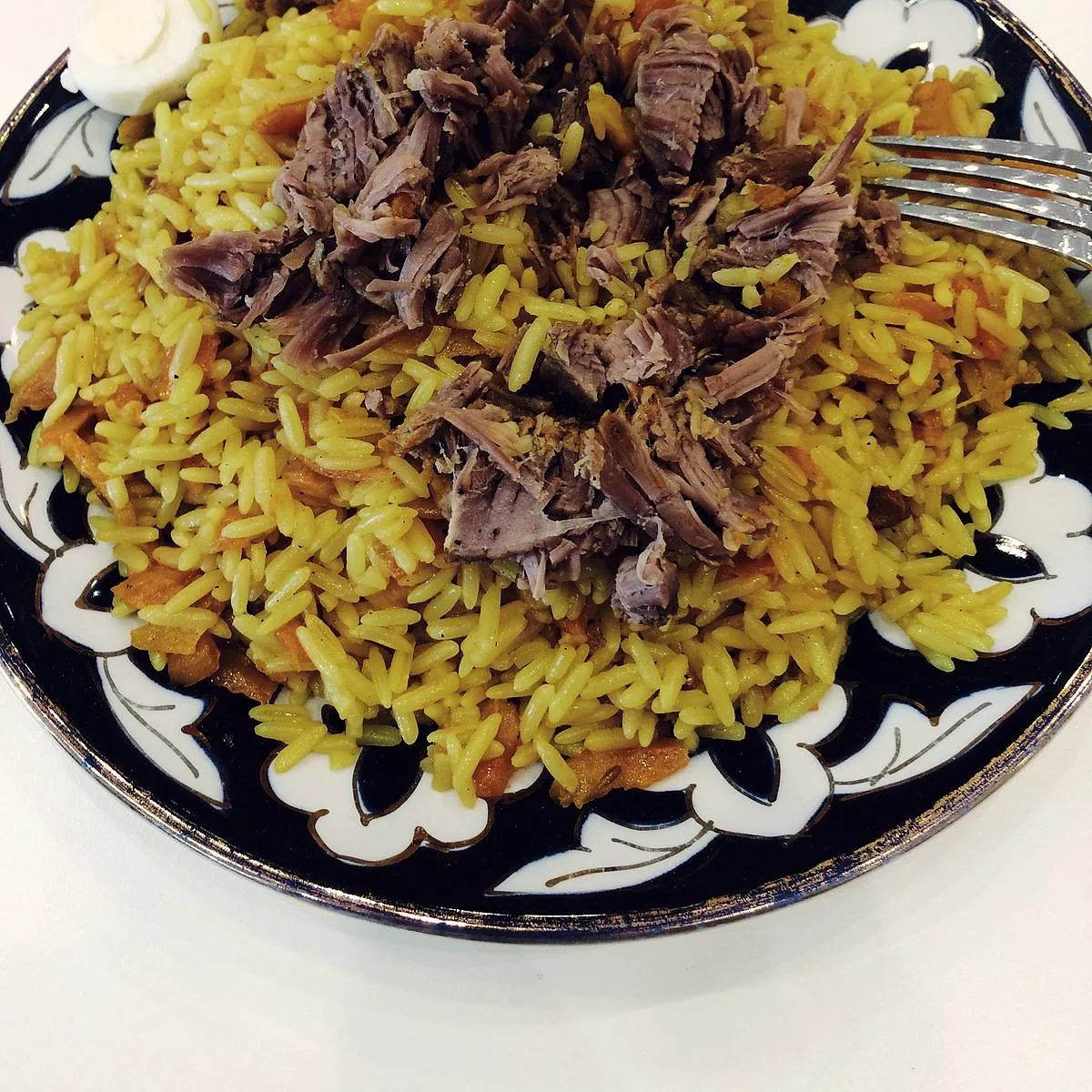

CC BY-SA 4.0. Cropped and colour-adjusted for this site.
The same dish, adapted. Every quantity, time and figure below changes with the version.
Method
Heat the 45 g peanut oil in a heavy pot until shimmering and brown the 450 g lamb leg on all sides over a high heat. This takes 10m.
Add the 200 g yellow onion and cook, stirring often, for 15m, until it has turned a deep golden-brown.
Add the 500 g carrot and cook briefly without much stirring, so it keeps some structure. Nestle in the 12 garlic cloves (60 g) heads, then add the 6 g whole cumin, 2 dried chillies (4 g), the 12 g fine sea salt and the 500 ml water. Bring to a simmer, cover, and cook gently for 45m, until the lamb is tender and the stock is richly flavoured. Lift out the garlic heads and set them aside.
The zirvak (meat, onion, carrot and stock cooked down together before the rice ever goes in) is what carries flavour through the whole pot. Rice added straight to plain water and meat, without this stage, tastes only of itself.
Rinse the 400 g basmati rice until the water runs clear and spread it evenly over the zirvak without stirring it in. Add just enough hot water to cover the rice by a fingertip's depth, and boil, uncovered, for 10m, until the water has dropped level with the rice.
Poke several holes down through the rice to the base of the pot, tuck the garlic heads back in, cover tightly, and cook over the lowest heat for 25m, undisturbed, until the rice is tender and every drop of stock is gone.
Common pitfallStirring the rice once it is steaming breaks the grains and clouds the pot with released starch. It is left alone from the moment the holes are poked until the lid comes off.
Let the pot rest off the heat, still covered, before folding the rice and zirvak gently together. Spread onto a platter and set the whole garlic heads on top for guests to split apart at the table. This takes 10m.
Method
Heat the 45 g peanut oil in a heavy pot until shimmering and brown the 450 g lamb leg on all sides over a high heat. This takes 10m.
Add the 200 g yellow onion and cook, stirring often, for 15m, until it has turned a deep golden-brown.
Add the 500 g carrot and cook briefly without much stirring, so it keeps some structure. Nestle in the 12 garlic cloves (60 g) heads, then add the soaked 80 g dried chickpeas, the 5 g whole cumin, the 12 g fine sea salt and the 550 ml water. Bring to a simmer, cover, and cook gently for 55m, until the lamb and chickpeas are both tender and the stock is richly flavoured. Lift out the garlic heads and set them aside.
Common pitfallUnsoaked chickpeas will not soften fully in the time the zirvak takes to cook. An overnight soak is what lets them turn tender in the same simmer as the lamb rather than staying chalky at the centre.
Rinse the 400 g basmati rice until the water runs clear and spread it evenly over the zirvak without stirring it in. Add just enough hot water to cover the rice by a fingertip's depth, and boil, uncovered, for 10m, until the water has dropped level with the rice.
Scatter the 40 g raisins over the rice, poke several holes down through to the base of the pot, tuck the garlic heads back in, cover tightly, and cook over the lowest heat for 25m, undisturbed, until the rice is tender and every drop of stock is gone.
Let the pot rest off the heat, still covered, then plate in distinct layers rather than mixing the pot together: rice first, spread wide over the platter, then the carrot, chickpeas and raisins over that, and the lamb and whole garlic heads set on top. This takes 10m.
Plov's own past is told mostly through legend, and both sources here are explicit that none of the usual stories is documented fact. One account credits Alexander the Great, who is said to have ordered his cooks to devise a filling, easy-to-prepare dish for his soldiers after he took Marakanda, the city that became Samarkand [1]. Another names the tenth-century physician and scholar Ibn Sina, sometimes called the "father of plov," for having written down a recipe for what he called palov osh [1]. A third points to Tamerlane, the Central Asian conqueror who ruled the region in the thirteen-hundreds, serving the dish to his armies. None of the three is treated as more than legend by either source, and the honest position is that the dish's ancestry is contested rather than resolved [2].
What written record exists points further back and more vaguely: the earliest documented reference to a dish resembling plov (meat, rice and spices cooked together) appears in the tenth-century Islamic cookbook Kitab al-Tabikh, taken as a possible ancestor of the modern dish rather than plov itself under another name [2]. The word plov is itself borrowed, tracing to the Persian polow for rice cooked with meat or fish and spices, and the same root produces pilaf internationally and osh or ash across Central Asia and the Caucasus [2].
Far better documented is how differently the dish is made across Uzbekistan itself. Around Samarkand it is cooked much as elsewhere but kept in distinct layers at the point of serving (rice, then carrot, then meat) rather than folded together; Tashkent mixes everything through instead; and the Fergana Valley's version is known specifically for being made very spicy [1]. Plov was added to UNESCO's Intangible Cultural Heritage list in 2016 on Uzbekistan's submission, a recognition that a number of its neighbours, who also claim versions of the dish as their own, did not uniformly welcome [1].
Sources
- A Brief History of Uzbekistan's Plov, Smithsonian MagazineCalls the dish's history "slightly murky," lays out the Alexander the Great, Ibn Sina and Tamerlane legends without endorsing any one of them, and describes the Samarkand layered style, the Fergana Valley's very spicy style and Tashkent's mixed style specifically.
- What Is Plov? Meet the Rice Dish at the Heart of Nowruz Celebrations, National GeographicIndependently calls the dish's ancestry contested, cites the tenth-century Kitab al-Tabikh as the earliest documented reference to a similar meat-rice-spice dish, and confirms Alexander's campaign as one competing account rather than a settled one.