Russian · Main Course
Pelmeni
A small, thin-skinned Siberian dumpling of beef and pork, boiled and served with soured cream or melted butter.
Not the same asPierogi (A Polish dumpling with a much larger, thicker-doughed wrapper, most often filled with potato and cheese rather than meat, and typically pan-fried after boiling.)Mantı (A Turkish dumpling folded smaller still, filled with lamb rather than beef and pork, and served under garlic yoghurt and paprika butter rather than soured cream.)
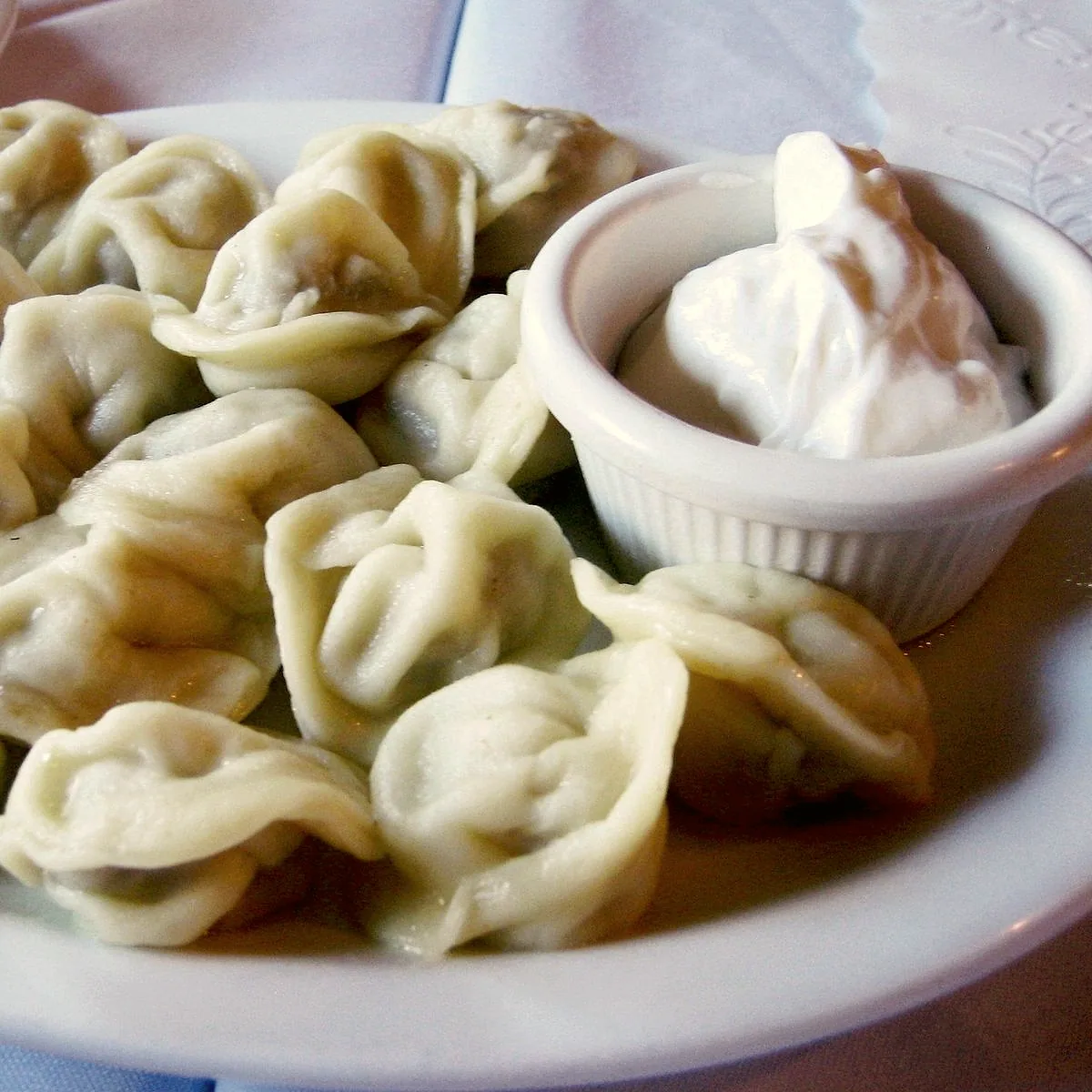

CC BY 2.0. Cropped and colour-adjusted for this site.
Method
Combine the 280 g plain flour, 1 egg (50 g), 90 ml water and 3 g fine sea salt in a bowl and bring together into a firm dough, then turn it out and knead for 10m until smooth and no longer tacky.
Cover the dough and rest it for 30m at room temperature, until it has relaxed and no longer springs back when pressed.
Meanwhile, combine the 150 g beef mince, 150 g pork mince, 100 g yellow onion, 2 g ground black pepper and 4 g fine sea salt in a bowl and mix by hand until evenly combined.
Roll the rested dough out on a surface dusted with the 20 g plain flour and cut into small rounds about 5 cm across. Spoon a little filling into the centre of each round, fold in half and pinch the curved edge fully shut into a half-moon, then bring the two pointed corners around and pinch them together to close the ring into the classic ear shape.
Common pitfallA ring pinched shut only at the two corners and not along the folded seam behind them comes apart in the pot; every part of the join needs sealing, not just the tips.
Drop the pelmeni into a large pot of well-salted, boiling water, stirring once so they do not settle on the base, and cook for 7m, until they float and the dough is cooked through.
Lift the pelmeni out with a slotted spoon and serve with the 60 g cultured soured cream and the 20 g unsalted butter spooned over.
Pelmeni takes its name from pel'nyan', "ear bread," in the Komi and Udmurt languages of the Finno-Ugric peoples of the Ural Mountains, and the dish is rooted in Komi, Udmurt and Permian cooking before it was ever treated as Russian at all [1]. From the Urals it is generally held to have spread east into Siberia, where hunters carried sacks of the raw dumplings frozen solid as winter provisions, boiling them straight from the cold as needed [1].
Pelmeni's own ancestry is argued to reach further than the Urals. One theory holds the dish descended from Chinese jiaozi, pointing to the black pepper and other spices in a traditional filling that are not native to Russia as a trace of that route [1]. A single Ural-Siberian origin is itself disputed: some historians propose that comparable dumplings reached the region by several separate paths (through Crimean Tatar, Central Asian and Dagestani cooking) and were only folded together under the one name by the middle of the nineteenth century [2].
What the record agrees on is that pelmeni is a late arrival to Russian cookbooks. No printed Russian recipe for it is known before the 1820s and 1830s; an 1817 account described dumplings of this kind as "like Chinese pastries," and in 1837 the writer Yekaterina Avdeyeva still filed pelmeni under Siberian provincial vocabulary rather than treating it as a national dish [2]. Its present status as an everyday, all-Russian staple is a comparatively modern development set against a much older regional history.
Sources
- Pelmeni, WikipediaSets out the Komi/Udmurt "ear bread" etymology, the Chinese-jiaozi theory, and the tradition of freezing pelmeni outdoors as winter provisions.
- The Paradox of Pelmeni, The Moscow TimesDates the dish's first appearance in Russian cookbooks to the 1820s–1830s and sets out the case against a single Ural-Siberian origin.