American · Soup
New England Clam Chowder
Clams and potato in a milk-and-cream broth, thickened lightly with a butter roux and salted with rendered bacon.
Not the same asManhattan clam chowder (A tomato-based, cream-free version from further down the coast: no milk or cream at all, and closer to a light vegetable soup studded with clams.)
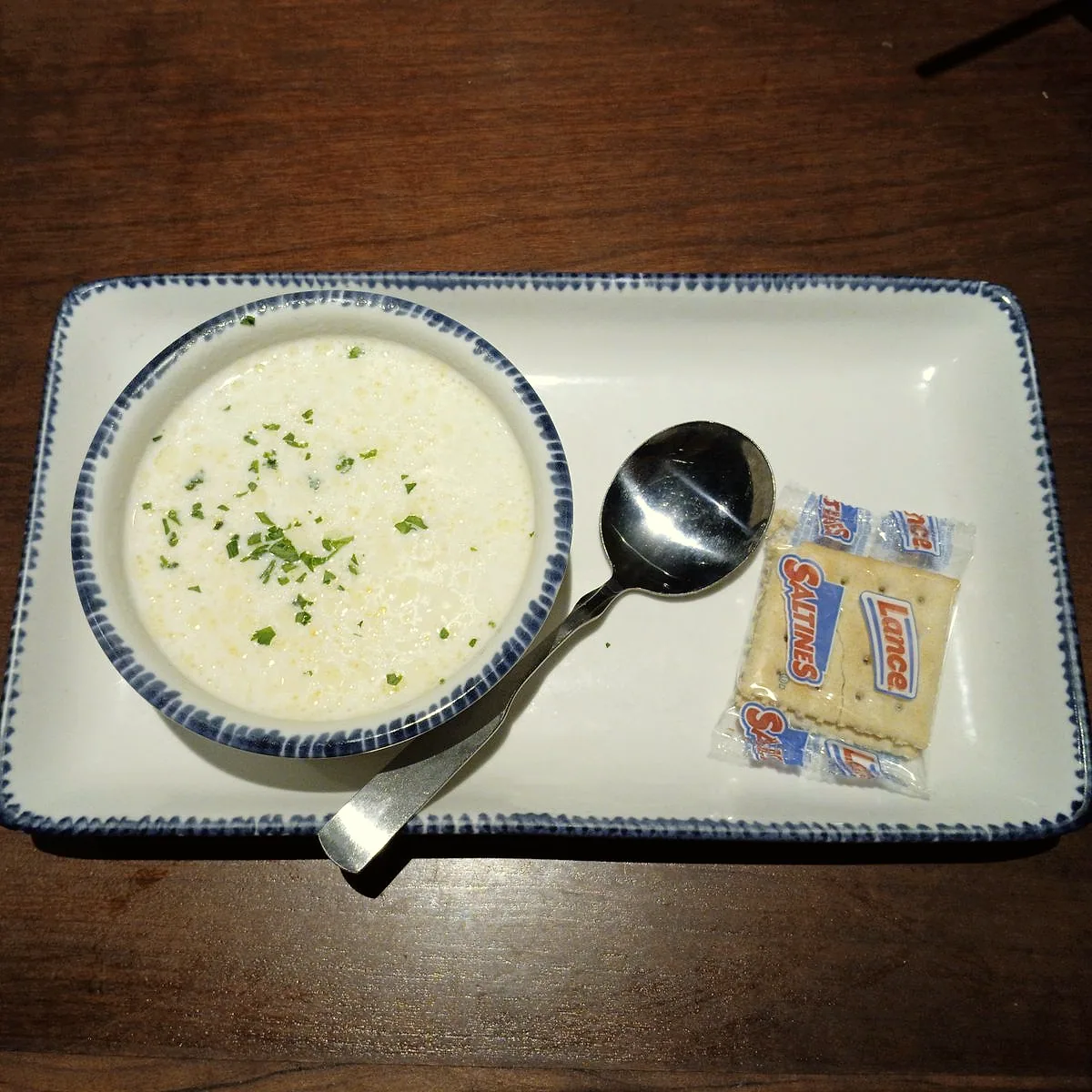

CC BY-SA 4.0. Cropped and colour-adjusted for this site.
Method
Render the 100 g bacon in a heavy pot over a medium heat for 8m, until crisp. Lift out with a slotted spoon, leaving the fat behind.
Add the 150 g yellow onion and 100 g celery to the fat and cook for 6m, until softened.
Stir in the 30 g unsalted butter and, once melted, the 30 g plain flour, cooking for 3m to remove the raw taste.
Whisk in the 700 ml water until smooth, add the 400 g potato and the 1 bay leaf (0.2 g), and simmer for 15m, until the potato is tender.
Stir in the 500 g clams, the 500 ml milk and the 150 ml double cream, and warm through gently for 8m without letting it boil. Season with the 2 g ground black pepper and the 3 g fine sea salt, and finish with the reserved bacon scattered over each bowl.
The clams and dairy go in only at the end, over gentle heat. Clams simmered from the start turn rubbery long before the potatoes are tender, and milk added too early or boiled too hard can split.
Common pitfallLetting the chowder reach a full boil after the milk and cream go in risks curdling it. It only needs to come back up to a gentle heat, not a simmer.
Long before European settlers arrived, coastal Algonquian-speaking peoples of the region were harvesting quahog clams and cooking them into shellfish stews, a practice that runs back centuries and that the standard telling of chowder's history routinely omits in favour of a purely European story [1]. The dish usually credited as chowder's direct ancestor (French, Breton or English fish-and-biscuit stews carried over by settlers) most plausibly absorbed and built on food and technique already established on the coast rather than introducing the idea of a clam stew from nothing [1].
The milk-based version now called New England chowder took its familiar shape by the eighteenth century, thickened with crushed crackers or bread before the now-standard combination of potato and dairy settled in [2]. Its most famous rivalry is regional rather than international: Manhattan clam chowder, built on tomatoes with no dairy anywhere near it, is treated in New England as close to a heresy. Maine state representative Cleveland Sleeper made a running joke of introducing bills to ban tomatoes from chowder outright, and in 1939 the Maine Hotel Association settled the argument with a cook-off rather than a law: a panel that included the state's governor and Ruth Wakefield, inventor of the chocolate chip cookie, tasted both versions and voted unanimously for the New England recipe [3].
The version here keeps to the New England line (potato, milk and cream, no tomato) and follows the one technical rule most chowder disagreements do agree on: the clams and the dairy go in last, so that neither toughens nor splits over heat meant for the vegetables underneath them.
Sources
- They Stole Our Soup! The Native Origins of 'New England' Clam Chowder, Indian Country Today (ICT News)On Indigenous shellfish stews that predate European settlement in the region and their erasure from the standard chowder origin story.
- Clam chowder, WikipediaOn the European settler adaptations of the dish and the regional rivalry with tomato-based Manhattan chowder.
- Maine's Great Clam Chowder War of 1939, New England Historical SocietyOn Maine Rep. Cleveland Sleeper's repeated, half-joking bills to ban tomatoes from chowder, and the 1939 cook-off that settled the argument in New England's favour.