Brazilian · Main Course
Moqueca
White fish simmered with onion, tomato and pepper in a rich sauce of dendê oil and coconut milk. This is the Bahian version, the one most associated with the name outside Brazil.
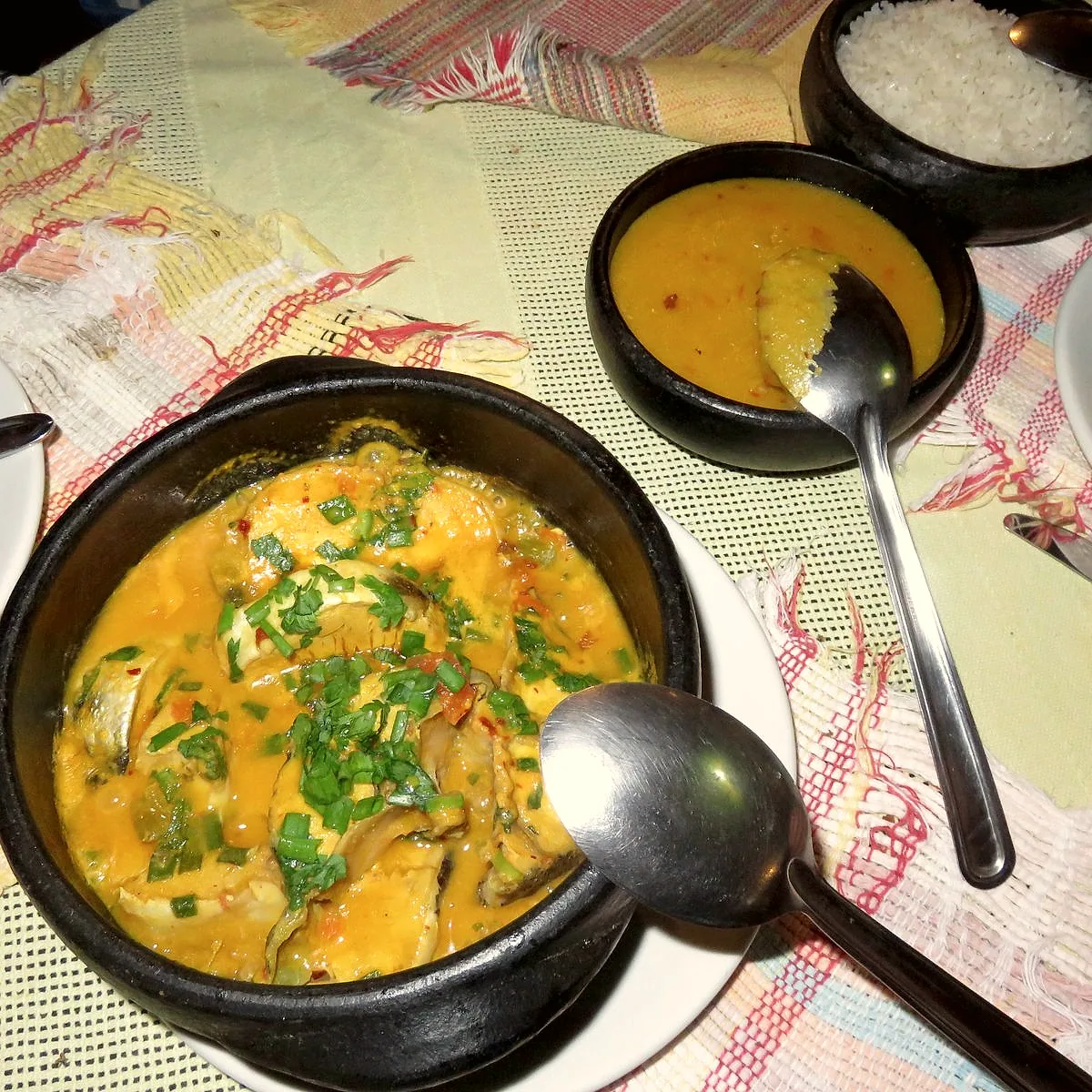
_(20326498234).jpg)
CC BY 2.0. Cropped and colour-adjusted for this site.
The same dish, adapted. Every quantity, time and figure below changes with the version.
Method
Toss the 700 g corvina with the 30 ml fresh lime juice, 5 g fine sea salt and 2 garlic cloves (10 g).
A short cure in lime juice and salt firms the fish's surface before it hits the sauce, which is what keeps the pieces intact through simmering rather than flaking apart into the liquid.
Set the fish aside to cure for 15m.
While the fish rests, layer the 150 g red onion, 200 g ripe tomatoes, 100 g red pepper and 2 malagueta chillies (4 g) in a wide, shallow pan and pour over the 30 ml palm oil. Cook over a medium heat for 10m, until the vegetables have softened at the edges.
Lay the marinated fish over the vegetables, pour in the 300 ml coconut milk and season with the 3 g fine sea salt. Simmer gently, without stirring, for 15m, until the fish is just cooked through and the sauce has taken on the oil's deep colour.
Common pitfallStirring the fish once it is in the sauce breaks the pieces apart. The pan is shaken gently by the handle to move things around instead, and the fish is otherwise left alone until it is done.
Scatter over the 15 g fresh coriander and serve at once.
Method
Toss the 700 g corvina with the 30 ml fresh lime juice, 5 g fine sea salt and 2 garlic cloves (10 g).
Set the fish aside to cure for 15m.
While the fish rests, warm the 30 ml extra-virgin olive oil in a clay pot or wide shallow pan and stir in the 4 g achiote until it colours the oil deep red. Add the 150 g red onion and 220 g ripe tomatoes and cook for 10m, until softened.
Common pitfallReaching for dendê oil or coconut milk here folds the Bahian version into this one. The capixaba sauce gets its colour from annatto and its richness from olive oil alone, which is exactly what keeps the fish flavour in front rather than behind a heavier sauce.
Lay the marinated fish over the vegetables, pour in the 150 ml water and season with the 3 g fine sea salt. Simmer gently, without stirring, for 15m, until the fish is just cooked through.
Scatter over the 15 g fresh coriander and serve at once, in the pot it cooked in.
Moqueca's name is generally traced to pokeka, a Tupi word the folklorist Luís da Câmara Cascudo recorded for fish the Indigenous peoples of coastal Brazil wrapped in leaves and cooked over hot coals or embers: a cooking method rather than a fixed recipe, and regional newspaper coverage of the dish's modern rivalry traces the same divergence to how differently that method met local ingredients as it spread along the coast [1][2]. What reached the stewpot form eaten today is a layering of three culinary traditions: Indigenous technique, a Portuguese habit of building stews around fish and aromatics, and ingredients (dendê palm oil and coconut milk chief among them) generally attributed to the transatlantic slave trade and credited with giving Bahia's version its stronger Afro-Brazilian imprint [1][2].
Those African ingredients are also exactly what split the dish into two rival versions, one from Bahia and one from Espírito Santo, and neither state concedes the other's claim to be the original. Moqueca baiana keeps the dendê oil, coconut milk and bell pepper that carry the strongest African imprint, producing a richer, more intensely coloured stew. Moqueca capixaba leaves all three out, colouring its sauce with annatto instead of palm oil and building its richness from olive oil alone, and is generally read as sitting closer to the dish's Indigenous and Portuguese roots [2]. The capixaba version is also inseparable from its cookware: it is traditionally finished and served in a clay pot hand-made by artisans in Goiabeiras, a Vitória neighbourhood whose potters were formally registered in 2002 as bearers of Brazilian intangible cultural heritage, with their pans named specifically for their use in moqueca capixaba [1][3].
Neither regional claim is likely to be settled, and the dispute is treated in Brazil less as a historical question than as a live rivalry, the kind of argument that gets rehearsed at every table where both versions might be on offer [2]. The fairer reading of the record is that moqueca was never one dish to begin with: it is a cooking method that met different ingredients in different places and produced two legitimate, independently evolved results.
Sources
- Moqueca, WikipediaCites the folklorist Luís da Câmara Cascudo's account of the Tupi word "pokeka" and describes the Indigenous, Portuguese and African threads behind the baiana and capixaba styles.
- A moqueca é capixaba ou baiana? Entenda a disputa e veja as receitas, Estado de MinasBrazilian regional newspaper account of the ongoing rivalry, setting out the ingredient and technique differences point by point and attributing the baiana style's dendê and coconut milk to its stronger Afro-Brazilian imprint.
- Ofício das paneleiras de Goiabeiras, IPHAN (Instituto do Patrimônio Histórico e Artístico Nacional)Official Brazilian federal heritage register entry, confirming the Goiabeiras potters' 2002 registration as intangible cultural heritage and their clay pots' specific use for moqueca capixaba.