Burmese · Salad
Lahpet Thoke
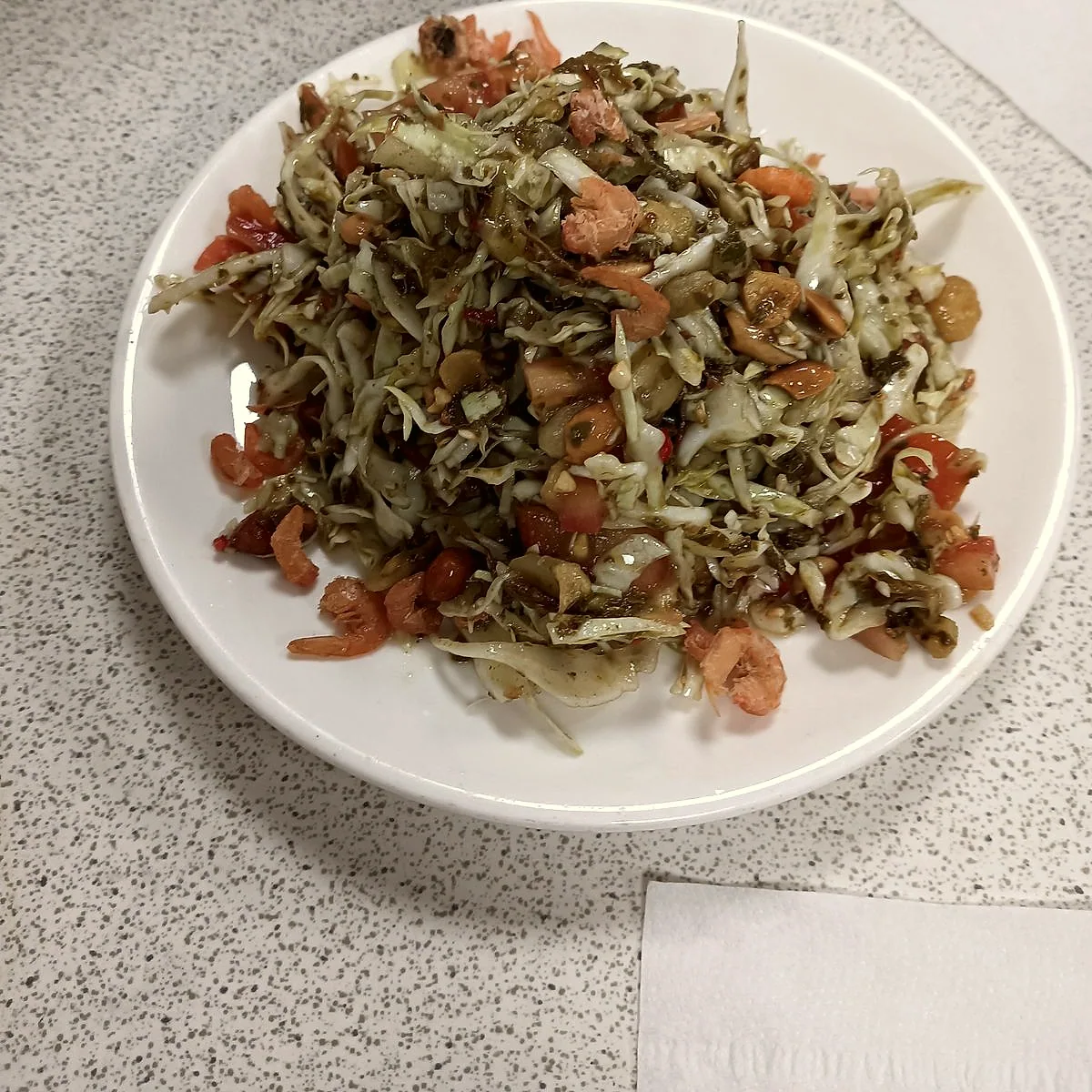
Fermented tea leaves tossed with crisp-fried beans, peanuts and garlic, sharpened with lime, fish sauce and fresh chilli.
Also known asLaphet thoke · Myanmar
.jpg)
CC BY-SA 4.0. Cropped and colour-adjusted for this site.
Method
Heat the 40 g peanut oil in a small pan and fry the 5 garlic cloves (25 g) over a medium heat for 6m, until golden and crisp. Lift out with a slotted spoon, reserving the oil.
In the same oil, fry the 40 g dried broad beans for 6m, until crisp and golden, then lift out and drain alongside the garlic.
Shred the 80 g romaine, cut the 100 g ripe tomatoes into wedges, and slice the 1 ½ serrano chillies (10 g). This takes 8m.
In a large bowl, combine the drained 150 g fermented tea leaves, fried garlic, fried beans, 40 g roasted peanuts, 15 g dried shrimp and 10 g sesame seeds with the shredded lettuce, tomato and chilli. Add the 20 ml fresh lime juice, 12 ml fish sauce, the reserved garlic oil and the 2 g fine sea salt, and toss everything together for 6m just before serving.
The salad is tossed and eaten immediately rather than left to sit, because the crisp-fried garlic and beans are the point of contrast against the soft, sour tea leaves; given time, they soften and the dish loses its texture.
Fermenting tea leaves to eat rather than to drink is, on the documentary record, a practice of Myanmar origin rather than one derived from another culture's tea tradition [2]. The leaves are steamed, packed airtight and left to sour slowly, for months rather than days, into a food in its own right rather than a byproduct of drinking tea.
Lahpet's oldest documented social role was not as an everyday dish at all. It served as a formal peace offering between warring Burmese kingdoms, exchanged and eaten once a dispute had been settled as a way of sealing the agreement [1][2].
That symbolism of settlement and welcome is broadly the role lahpet still holds today: the tray is offered to houseguests as a mark of hospitality and remains an essential dish at traditional ceremonies, weddings and novitiation rites among them [1][2], eaten as ahlu-lahpet, the communal, build-your-own version of the tray, rather than a plated salad served to one person.
Sources
- Lahpet, WikipediaCovers the folk account of King Alaungsithu and tea in the Pagan era, the peace-offering tradition, and lahpet's place in ceremonies including weddings and novitiations.
- The Legend of Laphet: A Myanmar Fermented Tea Leaf, Journal of Ethnic Foods (Han, T. & Aye, K. N., 2015), 2015Published abstract, consulted via Mendeley after the ScienceDirect original blocked automated access, stating that laphet is of Myanmar origin and not derived from other cultures, that it was historically used as a peace offering between warring kingdoms, and that the laphet tray remains a core expression of hospitality and of traditional ceremonies.