Japanese · Main Course
Gyoza
A thin-wrapped, garlic-heavy pork and cabbage dumpling, pan-fried in a row until the bases crisp into one sheet, and served with a soy and vinegar dip.
Not the same asJiaozi (The Chinese dumpling gyoza was adapted from, with a thicker hand-rolled wrapper, less garlic, a fully sealed all-round pleat, and a boiled or steamed version as common as the fried one.)Guotie (A related northern Chinese pan-fried dumpling, larger and pleated along a flat, unsealed base rather than gyoza's thinner, front-pleated half-moon.)
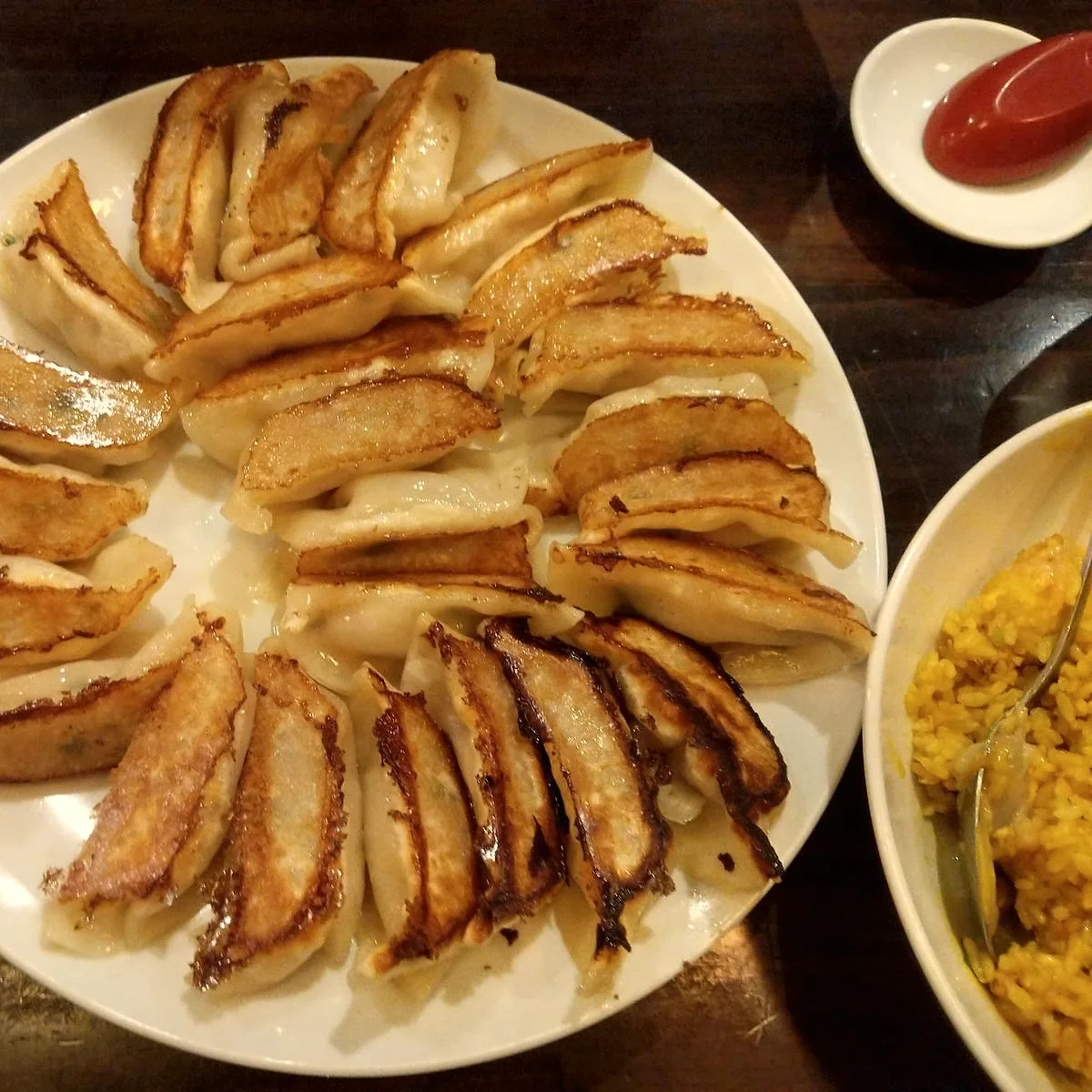

CC BY-SA 4.0. Cropped and colour-adjusted for this site.
Method
Combine the 280 g plain flour, 150 ml water and 2 g fine sea salt in a bowl and bring together into a shaggy dough, then turn it out and knead for 8m until smooth and firm.
Cover the dough and rest it for 30m at room temperature, until it has relaxed and no longer springs back when pressed.
Meanwhile, combine the 250 g pork mince, 200 g napa cabbage, 30 g garlic chives, 1 ½ garlic cloves (8 g), 6 g fresh ginger, 8 ml toasted sesame oil, 1 g ground white pepper, 12 ml light soy sauce and 4 g fine sea salt in a bowl and stir hard in one direction until the mixture stiffens and holds together.
Stir the 20 ml light soy sauce and 15 ml rice vinegar together in a small dish.
Roll the rested dough into a log and pinch off small, even pieces, keeping the rest covered. Roll each piece with the 20 g plain flour underneath into a thin round about 7 cm across, thinner than a jiaozi wrapper. Spoon filling into the centre, fold in half and pleat the front edge only, leaving the back seam flat, so each dumpling sits low with a straight base.
Pleating only the front edge and leaving the back seam flat is what lets gyoza sit low and even in the pan, so the whole row crisps at the same rate instead of the plumper, upright shape jiaozi is folded into.
Heat the 15 ml peanut oil in a wide, lidded pan over a high heat. Stand the dumplings in base down in a tight row, and sear for 3m until the bases are golden.
Pour in the 50 ml water, cover at once and let the dumplings steam-fry for 5m, until the water has all but disappeared and the wrappers have turned glossy.
Uncover and cook for a further 2m, letting the last of the water evaporate and the bases fuse into one crisp sheet. Loosen with a wide spatula and turn out in one piece, base up. Serve with the dipping sauce.
Gyoza is a recent arrival in Japanese food by the standards of most of the dishes it now sits beside. Its usual route into the country runs through Manchukuo, the Japanese-controlled state in northeast China, and through the Japanese settlers who returned from it after the end of the Second World War carrying jiaozi recipes with them [1]. Many of those returnees had cooked and eaten the dish for years in Manchuria and opened noodle stalls back in Japan once they were home; jiaozi, refashioned as gyoza, was often what they sold alongside the ramen [1]. The word itself is thought to come not from Mandarin but from Manchu, borrowed as giyose by Japanese settlers before it settled into its current pronunciation [1].
The dish changed once it took root. Japanese gyoza carry noticeably more garlic than the Chinese original, to the point that the smell of a gyoza restaurant is part of how the dish is recognised [1]. Commercial gyoza wrappers in Japan are also thinner than a typical Chinese jiaozi skin, a difference traced partly to machine-rolling becoming the norm in Japanese production in a way it did not for home-made jiaozi [1]. And where jiaozi is boiled as often as it is fried, gyoza in Japan is overwhelmingly a pan-fried dish, cooked in rows in a flat pan until the bases fuse into a single crisp sheet, the form most people outside Japan now picture first when they hear the word "dumpling" at all.
The repatriation account is not carried by one source alone: the dish's rise to everyday food is dated to the same postwar return of Japanese who had grown used to eating jiaozi on the mainland [2]. Its densest concentration is in Utsunomiya, north of Tokyo, which has topped the national household survey of gyōza spending repeatedly since 1987 and has built a good deal of civic identity on it [2].
Sources
- Gyoza, WikipediaCovers the postwar repatriation route from Manchukuo, the likely Manchu origin of the word gyōza, and the divergence in wrapper thickness and garlic.
- Food for the soul: Utsunomiya builds a brand around gyōza, The Japan TimesAlex K.T. Martin's feature on Utsunomiya, corroborating the postwar repatriation boom and setting out the city's long run at the top of the household gyōza spending survey.