Chinese · Main Course
Guotie
Pork, cabbage and garlic chives folded into a flat-bottomed dumpling, seared, steamed and crisped as one joined sheet in the pan.
Also known asPotstickers · North America
Not the same asJiaozi (pan-fried) (Boiled jiaozi finished in a pan, standing upright and sealed all round like the boiled version. Guotie is pleated along one seam only, sits flat rather than upright, and is fried in a joined block rather than as separate dumplings.)Gyoza (The Japanese descendant of this dish, with a thinner machine-rolled wrapper, a finer mince and more garlic.)
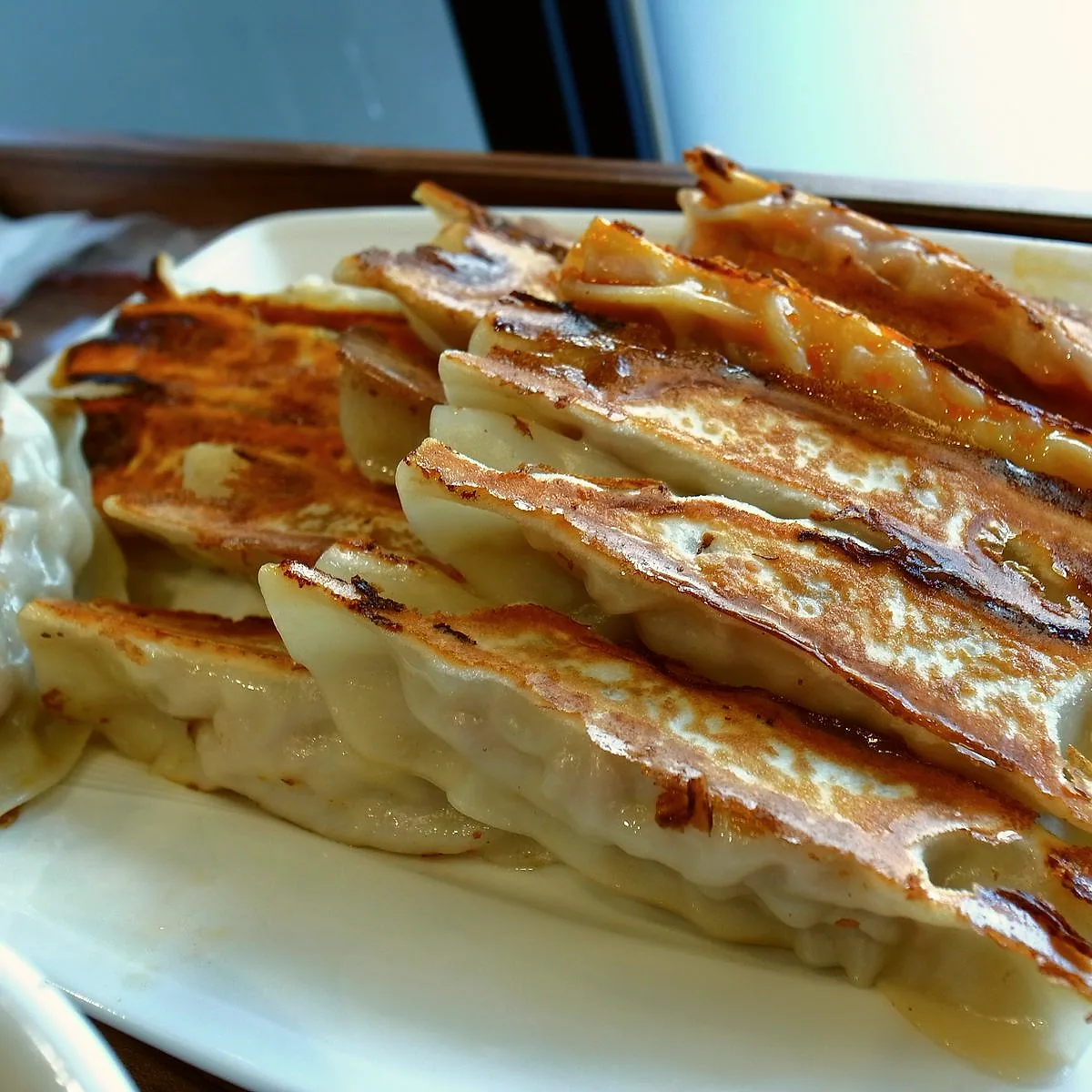

CC BY-SA 2.0. Cropped and colour-adjusted for this site.
Method
Combine the 300 g plain flour, 160 ml water and 3 g fine sea salt in a bowl and bring together into a shaggy dough, then turn it out and knead for 10m until smooth and firm.
Cover the dough and rest it for 30m at room temperature, until it has relaxed and no longer springs back when pressed.
Meanwhile, combine the 300 g pork mince, 250 g napa cabbage, 40 g garlic chives, 8 g fresh ginger, 2 garlic cloves (10 g), 15 ml light soy sauce, 10 ml toasted sesame oil, 1 g ground white pepper and 4 g fine sea salt in a bowl and stir hard in one direction until the mixture stiffens and holds together.
Roll the rested dough into a log and pinch off small, even pieces, keeping the rest covered. Roll each piece with the 20 g plain flour underneath into a thin oval about 9 cm long. Spoon filling along the centre, fold in half lengthways and pleat along the top seam only, pinching the two ends shut and leaving the base flat and unpleated.
Heat the 20 ml peanut oil in a wide, lidded pan over a high heat. Stand the dumplings in base down, packed edge to edge so they touch, and sear for 4m until the bases are golden.
Packing the dumplings edge to edge rather than leaving gaps is deliberate; the starch that leaks from the seams fuses the bases into one lacy sheet as they fry, which is the point of cooking them this way rather than as separate pieces.
Pour in the 60 ml water, cover at once and let the dumplings steam-fry for 7m, until the water has all but disappeared and the wrappers have turned glossy.
Uncover and cook for a further 3m, letting the last of the water evaporate and the joined base recrisp. Loosen the whole sheet with a wide spatula and turn it out in one piece, base up.
Common pitfallTrying to free single dumplings from the pan tears the joined base apart. Loosen the whole sheet at once with a wide spatula and turn it out in one piece.
The best-known story behind guotie is a kitchen accident. As it is usually told, a cook in the Song dynasty (960–1279) let the water boil away from a pan of ordinary boiled jiaozi, and rather than start again he added more water and let the dumplings finish with their bottoms already caramelised to the pan. The dish that resulted (a crisp, glassy-based dumpling with a soft, sealed top) kept the name of the accident: guōtiē is usually glossed as "stuck to the pot" [1]. Nobody claims a documentary source for the story, and it belongs with the wider family of Chinese food legends that explain a dish by the mishap that supposedly produced it rather than by any recorded kitchen.
What is better established is guotie's relationship to jiaozi, and it is not quite the simple one the accident story implies. In northern China, guotie is usually treated as a distinct dumpling from jiaozi (smaller, pleated along one seam rather than sealed all around, and shaped to sit flat rather than stand upright), while in the south the same word is often used simply to mean "pan-fried jiaozi," with no distinction intended at all [2]. Both usages are current; neither is a mistake. The English name most cooks outside China now reach for, "potsticker," has its own recorded starting point: the writer Buwei Yang Chao introduced it in her 1949 cookbook How to Cook and Eat in Chinese, and it stuck for the same reason the Chinese name did [2].
Sources
- Wok Stickers: Original Pot Sticker Experiment, Viet World KitchenSets out the Song-dynasty kitchen-accident legend explicitly as legend, and its relationship to boiled jiaozi.
- Jiaozi, WikipediaDescribes the North/South split in whether guotie counts as its own dish, and the 1949 English-language coining of "potsticker."