American · Chinese · Main Course
General Tso's Chicken
Cornflour-dredged, deep-fried chicken thigh tossed in a sweet, sharp, glossy soy and vinegar glaze.
Not the same asHunanese cooking (The dish is named for a nineteenth-century Hunanese general but bears little resemblance to the sour, hot, salty cooking of his home province; it was invented later, in Taiwan, and sweetened further for American diners.)
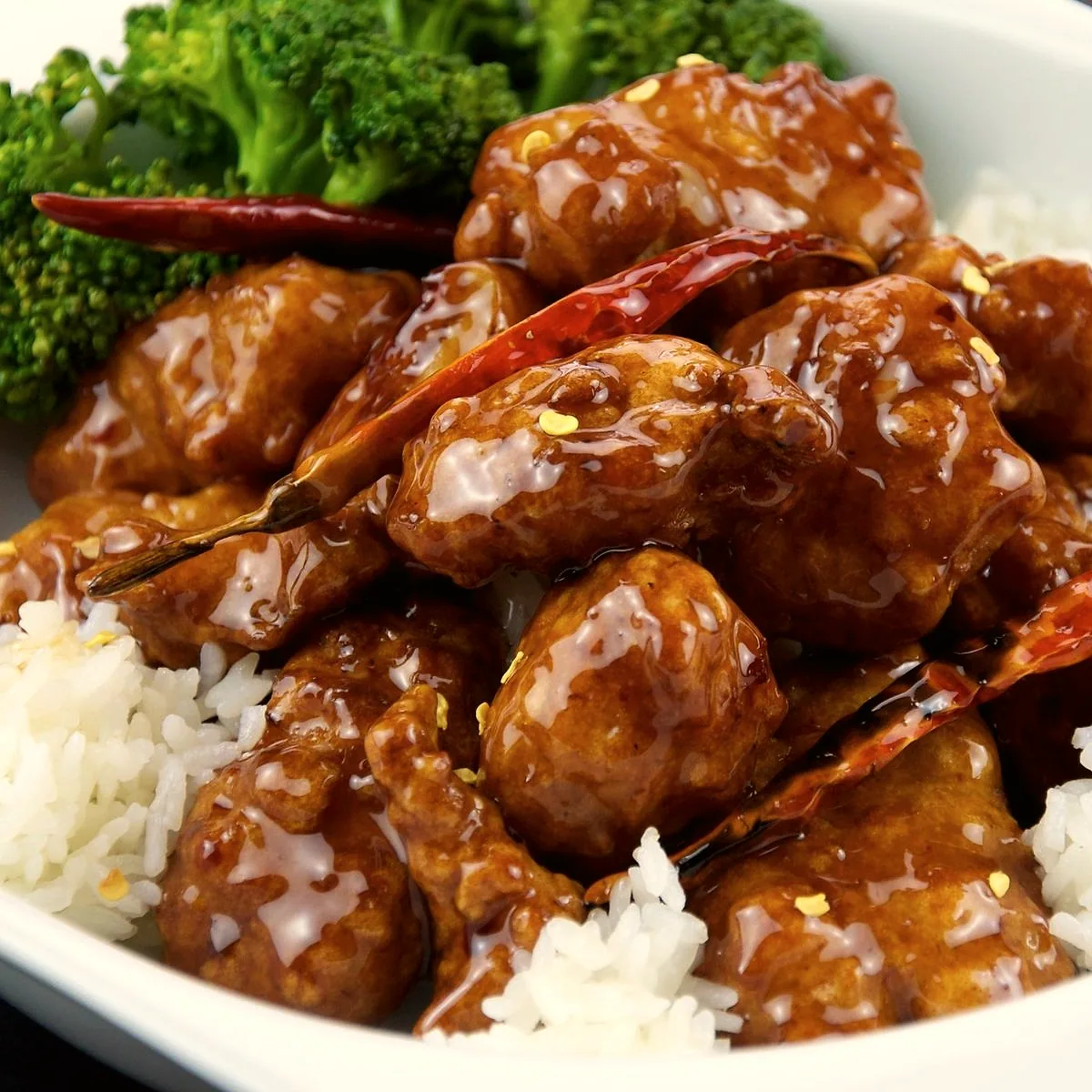
.jpg)
CC BY 2.0. Cropped and colour-adjusted for this site.
Method
Combine the 45 ml light soy sauce, 30 ml rice vinegar, 30 g caster sugar and 60 ml water with the 15 g cornflour, stirring until the cornflour is fully dissolved.
Toss the 450 g chicken thigh in the 1 egg (50 g), then coat each piece evenly in the 35 g cornflour, shaking off the excess.
Heat the 800 ml vegetable oil until shimmering and fry the chicken in batches for 10m, until deeply golden and cooked through. Drain on a rack.
A cornflour coating rather than a batter is what gives the chicken its dry, craggy crust. It is the same starch that lets the sauce cling to it afterwards instead of sliding off.
Pour off all but a thin film of the frying oil and stir-fry the 2 garlic cloves (10 g), 10 g fresh ginger and 2 dried chillies (4 g) briefly until fragrant. Pour in the sauce mixture and cook for 5m, stirring, until thickened and glossy. Return the fried chicken to the pan and toss to coat, then finish with the 5 ml toasted sesame oil and the 1 ½ spring onions (20 g).
Common pitfallTossing the chicken in the sauce too far ahead of serving softens the crust within minutes. It goes in only at the very end, for just long enough to coat.
The dish is named after Zuo Zongtang, a nineteenth-century Qing-dynasty general from Hunan province, but the connection is a borrowed name rather than a family recipe; he has no documented link to it at all [2]. It was created in the twentieth century by Peng Chang-kuei, a chef trained in Hunanese cooking who fled to Taiwan after the Chinese Civil War. Peng is credited with inventing the dish in Taipei in the 1950s for a banquet, in a form far closer to Hunan's sour, hot, salty cooking than the version now familiar in the United States [1].
Peng later brought the dish to New York, and it was there, adapting it for American customers, that it changed into something closer to what it is now: sweeter, less aggressively spiced, and built around a glossy, sugared glaze rather than Hunan's sourer, hotter profile [1]. Peng reportedly disapproved of what other restaurants did with his recipe once it spread beyond his own kitchens, finding the sweetened American version far removed from what he had intended [2].
It belongs, as a result, to American-Chinese cooking rather than to Hunan or to China more broadly; it is a dish invented once, in exile, and then reinvented a second time by the country that adopted it.
Sources
- A Brief History of General Tso's Chicken, Smithsonian MagazineOn Peng Chang-kuei's creation of the dish in Taiwan and its later transformation for American diners.
- Who is General Tso — and why does he have his own chicken dish?, National GeographicOn the real Qing-dynasty general Zuo Zongtang and the dish's lack of connection to Hunanese cuisine.