Central American · Breakfast · Side
Gallo Pinto
Rice and black beans fried together in one pan with onion, pepper and a dark, tangy sauce until every grain is speckled brown. It is Costa Rica's everyday breakfast.
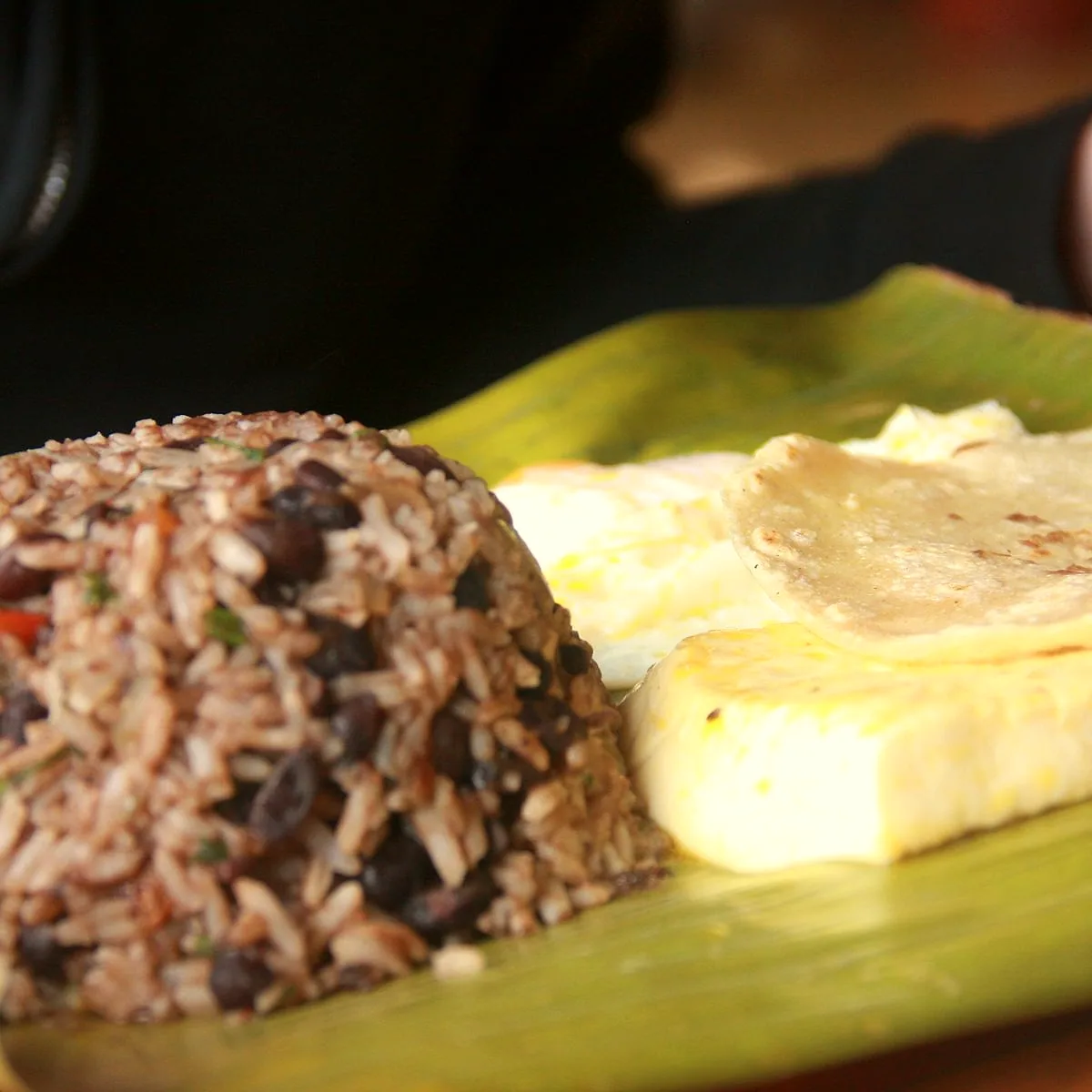

CC BY 3.0. Cropped and colour-adjusted for this site.
Method
Soak the 150 g dried black beans in plenty of cold water for 8h, then drain.
Simmer the soaked beans in the 600 ml water for 50m, until tender. Drain, reserving some of the cooking liquid.
Meanwhile, cook the 300 g basmati rice according to the packet instructions, then set aside. This takes about 20m.
Heat the 20 ml vegetable oil in a large pan over a medium heat and cook the 60 g white onion, 50 g red pepper and 1 ½ garlic cloves (8 g) for 5m, until softened.
Add the cooked rice, the drained beans and the 15 ml Worcestershire sauce to the pan and fry over a fairly high heat, stirring and turning often, for 10m, until the grains are speckled brown and lightly crisp in places, adding a splash of the reserved bean liquid if the pan looks dry.
Frying already-cooked rice and beans together in a hot pan, rather than combining them straight after cooking, is what gives gallo pinto its speckled, slightly crisp grains; the dish's name, "spotted rooster," describes exactly this effect.
Stir in the 10 g fresh coriander and 4 g fine sea salt and serve at once. This takes about 3m.
Both Costa Rica and Nicaragua call gallo pinto their own, and neither claim is baseless, which is exactly why the dispute has never been settled. Scholars broadly agree that the dish's roots are Afro-Caribbean, tracing to enslaved Africans who worked the banana plantations along Central America's Caribbean coast [1] [2]. From there, it spread inland with migrant labourers who came to work the railroads and plantations of Costa Rica's Limón province, carrying the dish with them into the country's interior.
The clearest documentary trace of the dish's early spread comes not from a cookbook but a novel. Carlos Luis Fallas's Mamita Yunai describes Costa Rican and Nicaraguan banana workers eating gallo pinto together on the Caribbean coast, a reference anthropologist Theresa Preston-Werner reads as evidence the dish was already an everyday food by the early twentieth century [1] [2].
Costa Rica's own foundation story, by contrast, is a twentieth-century legend rather than a documented event: a version involving a speckled hen in a San José neighbourhood, dated to around 1930, decades after Preston-Werner's evidence suggests the dish was already established on the Caribbean coast [1] [2]. The two countries' versions still differ today in one clear, checkable way: Costa Rica's is made with black beans, Nicaragua's with red.
Sources
- Gallo pinto, WikipediaStates the scholarly consensus on Afro-Caribbean origins, cites anthropologist Theresa Preston-Werner on the dish's documented ubiquity by the early twentieth century via the novel Mamita Yunai, and describes the competing Costa Rican and Nicaraguan claims along with the black-bean/red-bean regional split.
- Gallo Pinto: Tradition, Memory, and Identity in Costa Rican Foodways, Journal of American Folklore, vol. 122, no. 483 (University of Illinois Press)Anthropologist Theresa Preston-Werner's peer-reviewed article traces gallo pinto to enslaved Africans on the Caribbean-coast banana plantations of Costa Rica and Nicaragua, reads Carlos Luis Fallas's novel "Mamita Yunai" as evidence the dish was already an everyday food by the early twentieth century, and situates Costa Rica's speckled-hen naming legend as cultural memory rather than documented history.