Caribbean · Snack
Doubles
Curried chickpeas sandwiched between two pieces of soft, turmeric-fried bara bread. It is Trinidad's street-food breakfast, eaten standing up with a spoon of chutney.
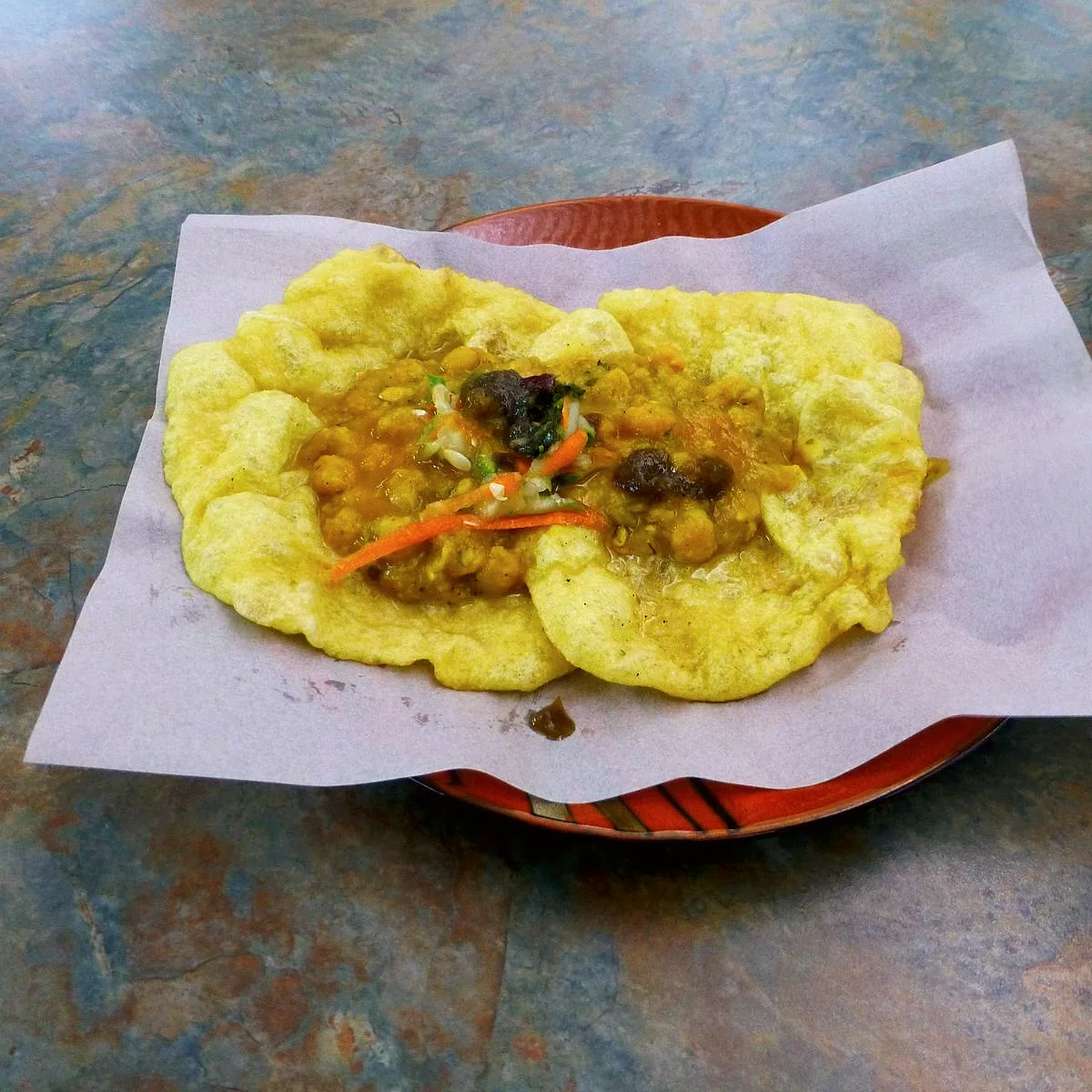

CC BY-SA 4.0. Cropped and colour-adjusted for this site.
Method
Soak the 250 g dried chickpeas in plenty of cold water for 8h, then drain.
Simmer the soaked chickpeas with the 3 g ground turmeric, 4 g ground cumin, 60 g white onion, 2 garlic cloves (10 g), 5 g scotch bonnet, 20 ml vegetable oil and 3 g fine sea salt in enough water to cover, for 40m, until the chickpeas are soft and the liquid has reduced to a thick curry. Remove the scotch bonnet before serving.
Whisk the 300 g plain flour, 4 g dried yeast, 3 g ground turmeric and 3 g fine sea salt together, then work in the 200 ml water to make a soft, wet, elastic batter-like dough. This takes about 8m.
Cover the dough and leave it in a warm place for 45m, until visibly puffed.
Common pitfallAn underproved dough fries flat and tough rather than light and puffed, so the batter needs the full rise before it goes anywhere near the oil.
With wet hands, pull off pieces of dough and pat each into a thin, round disc directly against the palm. Lay the discs out on a floured tray as they are shaped, ready to fry; this takes about 12m.
Heat the 1 L vegetable oil in a deep pan and fry the discs a few at a time for about a minute a side, until puffed, golden and cooked through. Drain on paper towels. Frying the whole batch takes about 15m.
A soft, wet dough fried quickly in oil hot enough to make it puff produces the light, slightly chewy bara doubles need; a stiffer dough or cooler oil fries dense and heavy instead.
Spoon the curried channa onto one piece of bara and top with a second piece to close the sandwich, in the manner that gives doubles its name. Assembling the full batch takes about 8m.
Doubles has a founding story unusually specific for a street food: it names the couple who made it, and the year. Emamool "Mamoodeen" Deen and his wife Raheeman Rasulan Deen were selling from near to nothing in the southern Trinidad town of Princes Town in 1936, having just sold the only goat they owned [1] [2]. With the little the sale brought in, Rasulan bought chickpeas, fried them, and served them over a piece of fried flatbread called bara [2].
What she sold that first night was closer to a snack of fried chickpeas than the dish doubles later became. Over time she braised the chickpeas down into a curry seasoned with cumin, turmeric and the Trinidadian blend of fresh herbs known as green seasoning, and switched the bara itself from a more traditional mung-bean-flour dough to a cheaper one made with wheat flour [2]. Emamool carried it through town by bicycle, selling it from paper cones.
The name is the part of the story every account of the dish repeats. Deen first sold the curried chickpeas over a single piece of bara; when customers began asking him to double the bara in their order, the request is said to have given the dish its name; it is a detail that travels with the founding story above even where it is not independently documented. Some writers have also pointed to a resemblance between doubles and chole bhature, the chickpea-curry-and-fried-bread dish of northern India, offered as a plausible influence rather than a competing account of the dish's Trinidadian invention.
Doubles is now sold from roadside stands across Trinidad and Tobago at all hours, eaten by hand with a spoon of tamarind or pepper chutney, and is widely regarded as the country's national snack.
Sources
- Doubles (food), WikipediaStates the 1936 invention by Emamool "Mamoodeen" Deen and Raheeman Rasulan Deen in Princes Town, and the customer-request origin of the "doubles" name.
- How Deen's Doubles Fed Trinidad, The JuggernautRecounts the couple's poverty, the sale of their only goat, Rasulan's initial fried chickpeas served over bara, and her later refinement of the channa with cumin, turmeric and green seasoning.