Balkan · Main Course
Burek
Minced beef and onion rolled in filo into a tight coil and baked until the spiral shatters. In Bosnian usage this is the only filling allowed to keep the name "burek", while the cheese and spinach versions of the same pastry are called sirnica and zeljanica.
Also known asBosanski burek · Bosnia and Herzegovina
Not the same asSirnica (The same coiled filo pastry filled with cheese instead of meat. In Bosnian usage it is never called burek; only the meat filling carries that name.)Zeljanica (The same pastry filled with spinach and cheese instead of meat. Like sirnica, it has its own name in Bosnian usage and is not called burek.)
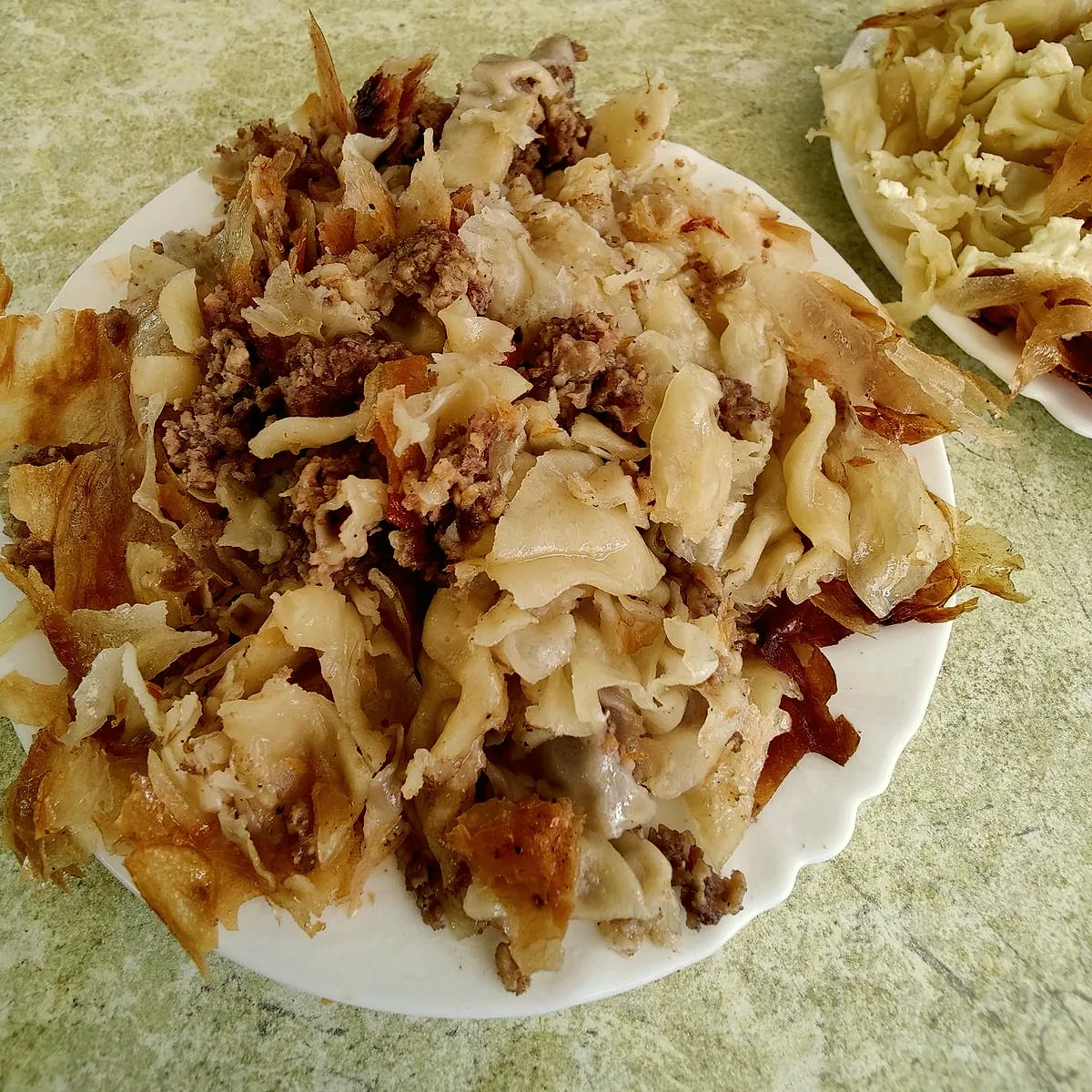

CC BY-SA 4.0. Cropped and colour-adjusted for this site.
The same dish, adapted. Every quantity, time and figure below changes with the version.
Method
Combine the 500 g beef mince, 200 g yellow onion, 7 g fine sea salt and 2 g ground black pepper in a bowl and mix until evenly distributed. Do not overwork it: the filling should stay loose rather than pack down like a sausage mix.
Lay out a sheet of 400 g filo pastry and brush it lightly with the 70 g unsalted butter. Spoon a strip of the filling along one long edge and roll the sheet up around it into a loose log, leaving the ends open. Coil the log into a spiral in a round, buttered baking tin, joining the next log to the end of the last so the spiral grows outward, until the tin is filled and all the filling is used.
The filling is rolled inside the filo into a long log before it is coiled, rather than spread sheet by sheet, so that every slice cut from the finished spiral carries the same ratio of pastry to meat.
Brush the top of the coil with the remaining butter and bake for 45m, until the filo is deeply golden and crisp and the meat inside is cooked through. Rest briefly before cutting into wedges.
Common pitfallFilo left uncovered while the filling is prepared dries out and cracks instead of coiling. Keep the stack under a damp cloth and work through it quickly, sheet by sheet.
Method
Combine the 400 g feta, 3 eggs (150 g) and 100 g yoghurt in a bowl and mash together into a thick, spreadable curd.
Lay out a sheet of 400 g filo pastry and brush it lightly with the 70 g unsalted butter. Spread a strip of the cheese filling along one long edge and roll the sheet up around it into a loose log, leaving the ends open. Coil the log into a spiral in a round, buttered baking tin, joining the next log to the end of the last so the spiral grows outward, until the tin is filled and all the filling is used.
Brush the top of the coil with the remaining butter and bake for 40m, until the filo is deeply golden and crisp and the filling has set. Rest briefly before cutting into wedges.
Common pitfallFeta already carries a heavy salt load, so seasoning the filling again before tasting it oversalts the whole pastry; the cheese needs only the egg and yoghurt to bind it.
Method
Wilt the 500 g spinach with the 100 g yellow onion in a dry pan over a medium heat for 8m, until collapsed and no longer releasing liquid. Tip into a sieve and press out as much water as possible, then chop roughly once cool enough to handle.
Common pitfallSpinach wilted and used without draining floods the filling with water, which soaks straight through the filo. Press it firmly in a sieve until it stops releasing liquid before it goes anywhere near the cheese.
Combine the wilted spinach and onion with the 250 g feta, 2 eggs (100 g), 2 g fine sea salt and 1 g ground black pepper in a bowl and mix until evenly combined.
Lay out a sheet of 400 g filo pastry and brush it lightly with the 70 g unsalted butter. Spread a strip of the filling along one long edge and roll the sheet up around it into a loose log, leaving the ends open. Coil the log into a spiral in a round, buttered baking tin, joining the next log to the end of the last so the spiral grows outward, until the tin is filled and all the filling is used.
Brush the top of the coil with the remaining butter and bake for 40m, until the filo is deeply golden and crisp and the filling has set. Rest briefly before cutting into wedges.
The word börek traces to a Turkish verb, bürmek, meaning to twist or roll, and the earliest documented uses of the name are Anatolian: a thirteenth-century mention by the poet Mevlana, and a Kipchak-Turkic dictionary from the early fourteenth century that defines börek as dough stuffed with meat [1]. Where the pastry itself came from before that name is disputed. One account traces it to en tyritas plakountas, a layered Byzantine cheese dish descended from Greek and Roman baking; another credits the Turkic tradition of yufka, a thin flatbread layered with butter and filling, carried west by nomadic groups out of Central Asia [1]. Both theories agree that a recognisable form of the pastry was already established by the time the Ottoman Empire began its Balkan expansion.
Burek reached Bosnia with that expansion in the mid-fifteenth century, and Bosnian cooks did more than adopt it: the dough was worked thinner, the shape was tightened into the spiral coil the pastry is now most associated with there, and meat became its defining filling [2]. That last point hardened into a naming rule that still holds locally. In Bosnia, the coiled filo pastry is called burek only when it is filled with meat; the same pastry filled with cheese is sirnica, and with spinach is zeljanica, both classed more generally as pita rather than burek [1]. The distinction is not observed uniformly across the region (in Croatia and Serbia, "burek" is commonly used for any filling, cheese and even fruit included [2]), but within Bosnia itself, asking for burek and receiving anything other than meat is treated as a genuine mix-up rather than a regional variant.
Sources
- Burek, WikipediaOn the etymology of börek, the disputed Byzantine-versus-Turkic theories of its origin, and Bosnia's meat-only naming convention.
- Burek: A Slice of History of Croatia's Adopted National Street Food, Croatia WeekOn the Ottoman spread of börek across the Balkans and the regional difference between Bosnia's meat-only "burek" and the looser use of the word elsewhere in the former Yugoslavia.