Chinese · Main Course
Beef Chow Fun
Wide rice noodles tossed hard and fast over the highest possible heat with marinated beef, bean sprouts and spring onion, in dark soy alone rather than a wet sauce.
Also known asBeef ho funGon chow ngau ho
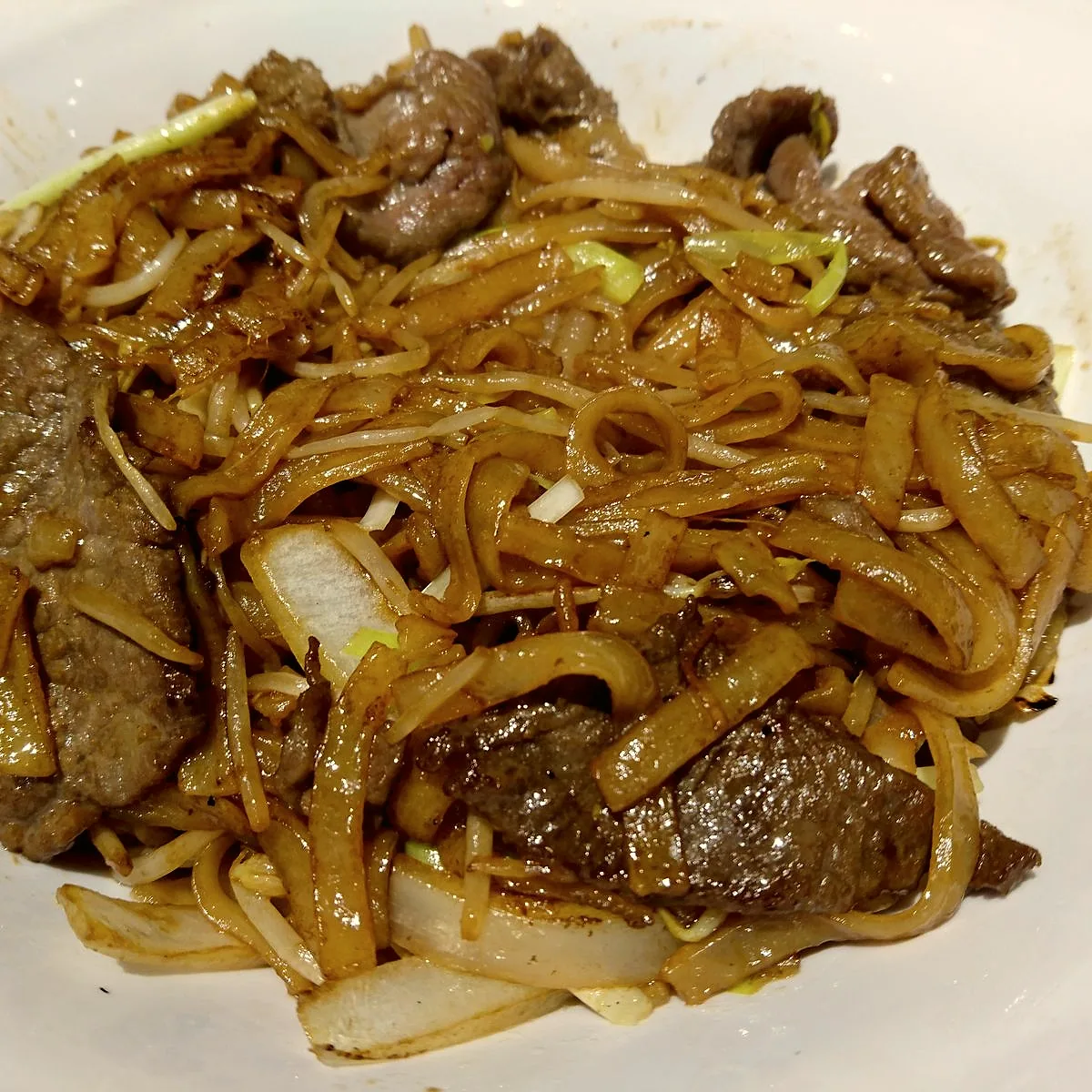

CC BY-SA 4.0. Cropped and colour-adjusted for this site.
Method
Combine the 15 ml light soy sauce, 10 ml Shaoxing wine, 8 g cornflour and 10 ml vegetable oil in a bowl and turn the 300 g flank steak through it.
Leave the beef to marinate for 15m.
Heat a wok over the highest possible heat until smoking. Add a little of the 40 ml vegetable oil and sear the beef for 3m, until just coloured but not fully cooked through, then lift out and set aside.
Add the remaining 40 ml vegetable oil to the wok along with the 1 ½ garlic cloves (8 g), then add the 500 g fresh rice noodles, loosening the strands gently by hand as they go in. Toss over the highest heat for 5m, letting the noodles catch and char lightly in places, and add the 20 ml dark soy sauce and 15 ml light soy sauce partway through so the colour works evenly through the strands.
The wok needs to be smoking hot before the noodles go in, since chow fun's char comes from direct contact with a very hot surface in a short time; a cooler pan steams the noodles soft instead of catching the edges.
Common pitfallFresh rice noodles tear if handled roughly while cold and stiff. Loosening them gently by hand before they hit the wok, and tossing rather than stirring once they are in, keeps the strands whole.
Return the beef to the wok with the 150 g bean sprouts, 2 ½ spring onions (40 g) and 5 g caster sugar. Toss over high heat for 3m, until the beef is cooked through and everything is evenly combined.
The dish is built on shahe fen, the wide, flat rice noodle of Cantonese cooking. Beef chow fun is the noodle stir-fried dry, in soy alone, rather than served wet in a gravy. That is a distinction the dish's Cantonese name insists on, since gon chow ngau ho means specifically "dry-fried beef ho fun."
How that dry style came about is told through one particular story rather than a documented record. In the version usually repeated, a cook named Mr Hui, forced back to Canton from Hunan during the Japanese occupation of the Second World War, ran out of the starch needed to thicken chow fun's usual wet sauce one night while a demanding customer waited under curfew. Rather than risk the man's anger with no dish at all, Hui stir-fried the noodles dry instead, and the style is said to have stuck. It is a story told and retold as folklore, with no documentary trail back to a real Mr Hui [1] [2]. The dish may equally have developed gradually across the dai pai dong street stalls that fed postwar Hong Kong, rather than at any single traceable moment.
Those street stalls, known as dai pai dong, were themselves a product of the same postwar period: the Hong Kong government began issuing large, photograph-bearing licenses to displaced families needing a fast way to earn a living, and the resulting stalls became the setting most associated with dishes like this one, cooked to order over intense heat from a portable stove [2]. Whatever its precise origin, the dish's identity now rests entirely on that heat: a wok hot enough to char the noodles' edges before their moisture has time to steam them soft is what beef chow fun is judged on, far more than any particular story behind it.
Sources
- Beef chow fun, WikipediaPresents the Mr Hui wartime origin story explicitly as legend rather than documented history, and describes the dry-frying method.
- A Crash Course in Dai Pai Dong History, Chatteris Community KitchenOn the licensed street-food stalls of postwar Hong Kong, the setting the dish's origin story is placed in.