Austrian · Dessert
Apfelstrudel
A hand-stretched dough, pulled paper-thin, rolled around spiced apples, raisins and buttered breadcrumbs.
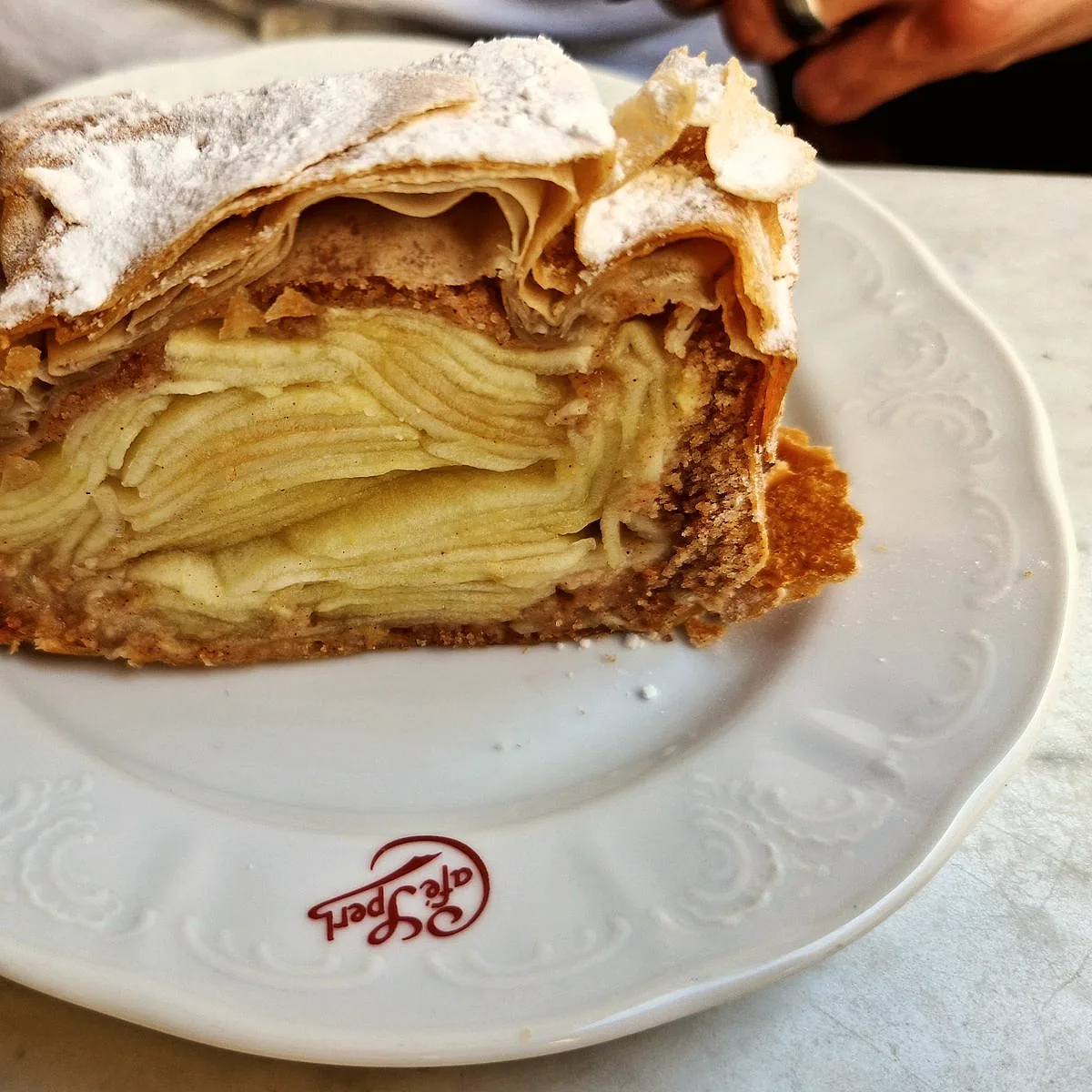

CC BY-SA 4.0. Cropped and colour-adjusted for this site.
Method
Combine the 250 g plain flour and the 2 g fine sea salt, then work in the 25 g vegetable oil, the 1 egg (50 g), the 100 g water and the 5 g cider vinegar and knead until smooth, soft and elastic.
Shape into a ball, brush with a little oil, cover and rest at room temperature for 30m.
Toss the 900 g apple with the 80 g caster sugar, the 3 g ground cinnamon, the 60 g raisins and the 15 g freshly squeezed lemon juice. Fry the 40 g dried breadcrumbs in the 25 g unsalted butter until golden and set aside.
Common pitfallButtered, toasted breadcrumbs scattered under the apples are what keep the pastry from turning soggy where it meets the fruit's juice; skipping them leaves a wet, collapsed layer at the base of the roll.
On a large floured cloth, stretch the dough from the centre outward with the backs of the hands until it is paper-thin and almost translucent, trimming away the thicker edge.
The dough is pulled, not rolled, from the centre outward until it is thin enough to read newsprint through; a strudel dough is elastic enough to stretch to almost nothing without tearing, which a rolling pin alone cannot achieve.
Scatter the buttered breadcrumbs over two-thirds of the dough, top with the apple mixture, and use the cloth to roll the strudel up over the filling into a tight log. Transfer to a lined tray, seam side down, and brush all over with the 45 g unsalted butter.
Bake at 190 °C for 35m, until deep golden and crisp. Dust with the 10 g icing sugar once cooled slightly.
Apfelstrudel's defining technique (a single sheet of dough pulled thin enough to read through, rather than dozens of individually layered leaves) is a Viennese refinement of a pastry that began further east. Strudel's ancestor is generally traced to Hungarian rétes, itself understood to have developed from Ottoman baklava during the period of Turkish rule in Hungary, as the technique of building a pastry from very thin dough moved west with Ottoman expansion into Europe in the fifteenth and sixteenth centuries [1][2].
The earliest strudel recipe anyone has produced in writing is Austrian and specific: a handwritten cookbook held at the Wienbibliothek im Rathaus, the Vienna city library, dated to 1696, contains a recipe for Millirahmstrudel (a milk-cream strudel) alongside a savoury turnip version, making no mention yet of apples [1][2]. The rolled form that now defines the pastry, one continuous stretched sheet wrapped around its filling rather than the many separate leaves of baklava or rétes, is understood to have taken shape in the Austrian court kitchens around the turn of the eighteenth century [1][2]. From there, strudel's popularity spread widely through the Habsburg and later Austro-Hungarian territories, with regional versions multiplying through the nineteenth century and into the Austro-Hungarian Empire period as pastry chefs across Austria and Hungary adapted the technique to different fillings [2].
Apple, now the strudel most people picture, is one variation among many that grew out of that single technique; its distinction was never the filling but the dough, stretched by hand until a Habsburg-era baker's palm could show through it, which is still the part no shortcut fully replaces.
Sources
- Strudel, WikipediaOn the 1696 Viennese manuscript recipe for Millirahmstrudel, strudel's descent from Hungarian rétes and Ottoman baklava, and the Habsburg-era shift to a single rolled dough.
- Strudel & Baklava: Uncovering the Rich Layers of History, Grapes & GrainsOn baklava's spread into Central Europe during Ottoman expansion and strudel's later proliferation under the Austro-Hungarian Empire.