Filipino · Main Course
Adobo
Chicken simmered in vinegar, soy sauce, garlic and bay, the vinegar left unstirred to mellow before the pot is uncovered to reduce.
Also known asAdobong manok
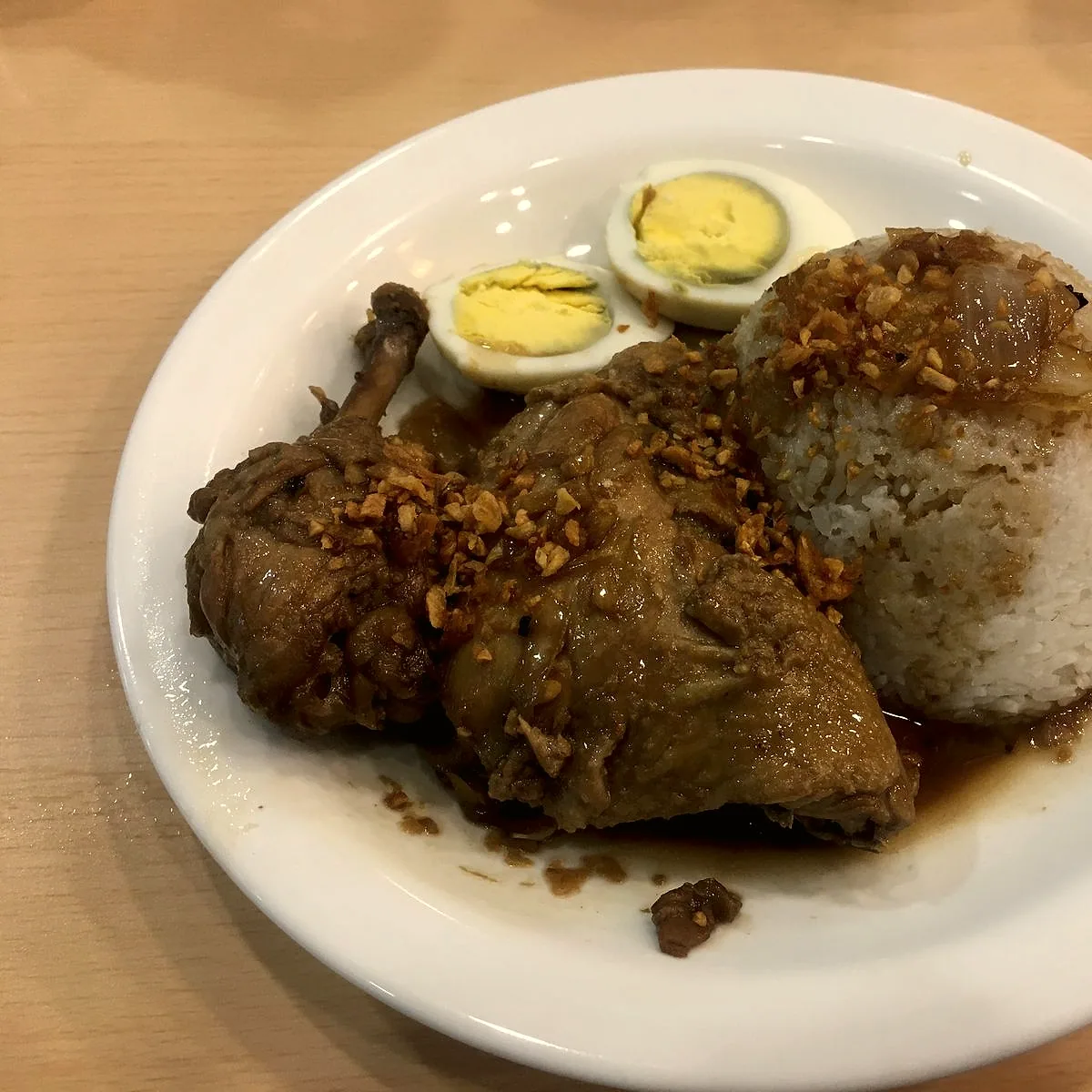

CC BY-SA 4.0. Cropped and colour-adjusted for this site.
The same dish, adapted. Every quantity, time and figure below changes with the version.
Method
Heat the 15 ml vegetable oil in a wide, heavy pot over a medium-high heat and brown the 1 kg bone-in, skin-on chicken on all sides, in batches if needed, for 8m. Lift out and set aside.
Add the 4 garlic cloves (20 g) and 100 g yellow onion to the same pot and cook for 3m, stirring, until softened and just turning gold.
Return the chicken to the pot and pour in the 90 ml light soy sauce, 90 ml cane vinegar, 150 ml water, 2 bay leaves (0.4 g) and 2 g ground black pepper. Do not stir; let the pot come up to a simmer undisturbed for 2m.
The vinegar goes in and is left alone, unstirred, for the first part of the simmer. Stirring raw vinegar straight into hot fat and soy sauce sharpens the smell and the taste; left to come to a simmer undisturbed, its edge softens before it mixes into the sauce.
Cover and simmer for 25m, until the chicken is cooked through and tender.
Common pitfallLifting the lid to stir in the first few minutes drives off the vinegar's aroma along with its harshness. Leave the pot covered and undisturbed until the liquid is already simmering.
Uncover and simmer for a further 12m, turning the chicken occasionally, until the sauce has reduced and thickened enough to coat the pieces.
Method
Heat the 10 ml vegetable oil in a wide, heavy pot over a medium-high heat and brown the 900 g pork belly on all sides, in batches if needed, for 8m. Lift out and set aside.
Add the 4 garlic cloves (20 g) and 100 g yellow onion to the same pot and cook for 3m, stirring, until softened and just turning gold.
Return the pork to the pot and pour in the 90 ml light soy sauce, 90 ml cane vinegar, 200 ml water, 2 bay leaves (0.4 g) and 2 g ground black pepper. Do not stir; let the pot come up to a simmer undisturbed for 2m.
Cover and simmer for 45m, until the pork is fork-tender.
Common pitfallPork belly needs longer than the covered simmer a leaner cut would take before the fat and connective tissue soften; testing a piece rather than watching the clock is the reliable way to know it is ready.
Uncover and simmer for a further 15m, turning the pork occasionally, until the sauce has reduced and thickened enough to coat the pieces and the fat has begun to render into it.
Long before the dish had the name it carries now, cooks across the archipelago were simmering meat and fish in vinegar, salt and garlic, an acid-and-salt preservation method suited to a hot, humid climate with no refrigeration [2]. What survives of that method is essentially adobo's spine: vinegar, garlic, pepper and a slow simmer, with everything else treated as a later addition.
The name itself is borrowed. Spanish colonisers, noticing that the technique resembled their own adobar (to marinate or pickle) began calling it adobo de los naturales, "adobo of the natives." The label is first recorded in Pedro de San Buenaventura's 1613 Vocabulario de la lengua tagala, a Tagalog dictionary compiled by a Franciscan missionary [1] [3]. What the dish was actually called before that borrowing is not settled: no native name for it survives [3].
Soy sauce, the ingredient most people now associate with adobo's dark colour and savoury depth, is a later layer again, introduced through Chinese trade and settlement rather than present from the start [1] [3]. Its arrival split the dish in two. Adobong itim ("black adobo"), coloured and salted with soy sauce, is now the version most widely cooked and exported. Adobong puti ("white adobo") omits the soy sauce entirely, seasoning with salt instead, and is generally held to sit closer to the dish's pre-Hispanic form [1] [2]. Neither is more "correct" than the other in contemporary cooking, but only one of them, whichever a household grew up with, usually gets called adobo without qualification.
What both versions agree on is that vinegar, not soy sauce, is the non-negotiable ingredient: a version without it reads as a different dish, however dark and salty the sauce [2].
Sources
- Philippine adobo, WikipediaCovers the 1613 dictionary reference, the debate over the name's origin, and the soy versus salt split.
- My Adobo Is Better Than Yours, MICHELIN GuideDiscusses the pre-colonial vinegar-preservation methods and the primacy of vinegar over soy sauce in what counts as adobo.
- History of Filipino Adobo, BusinessMirrorCorroborates the 1613 Vocabulario de la lengua tagala reference and the toyo-versus-puti distinction.