The Wartime Innovation Period (1939-1945)
Polyethylene Terephthalate (PET)
The Bottle Revolution
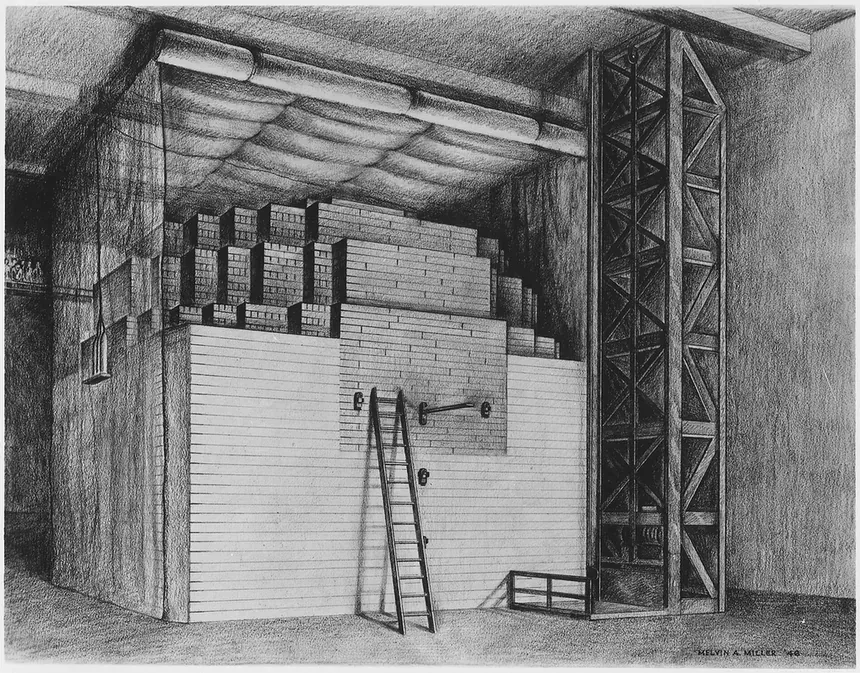
The biggest secret of 1942 was being built under a squash court at the University of Chicago, where a team led by Enrico Fermi stacked graphite blocks and uranium into a crude pile that, on 2 December, sustained the first controlled nuclear chain reaction in history. Almost nothing about it could be photographed, published, or even discussed outside a small circle with clearance; the whole apparatus existed, for the public record, nowhere at all.
Plate I

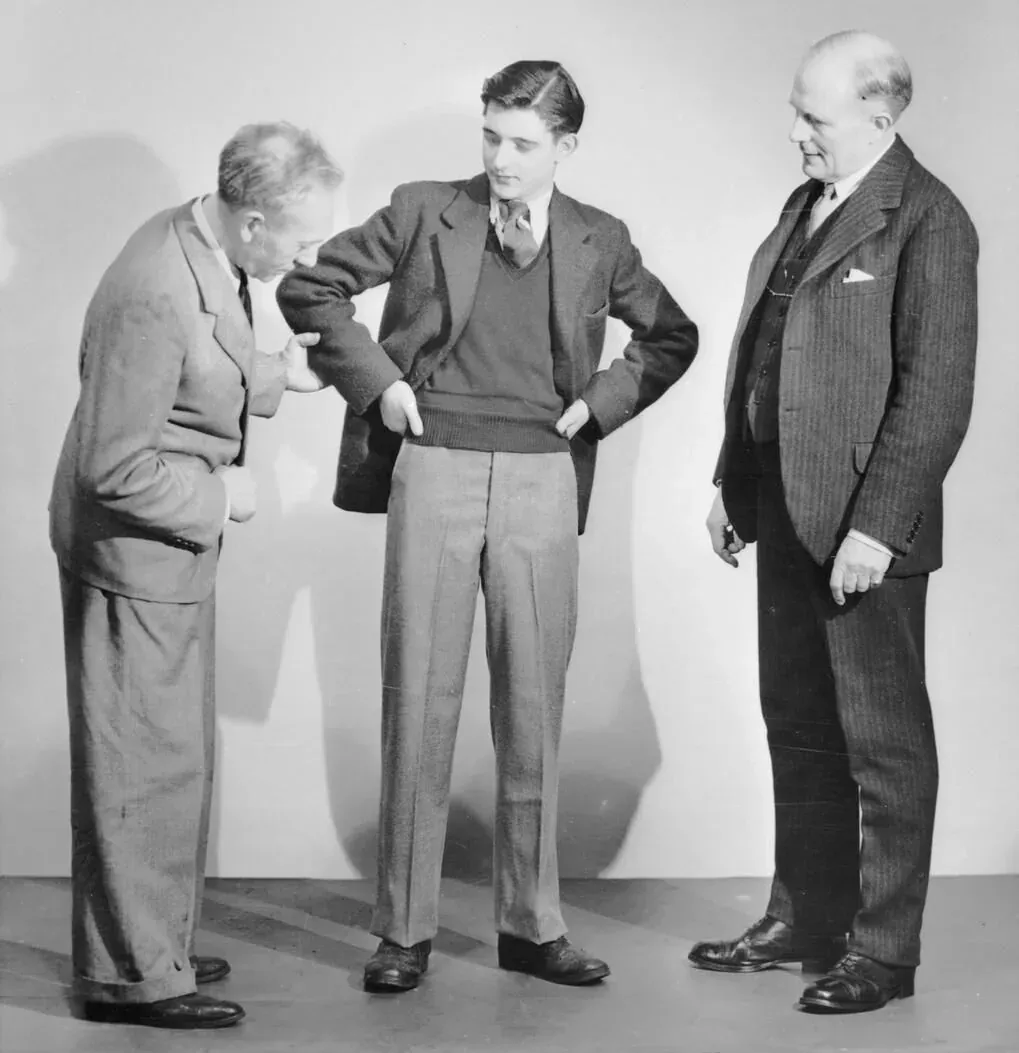
Britain was keeping a much smaller secret of its own, for a much more modest reason. Wool and cotton were both rationed by 1942; every adult’s clothing allowance ran on a coupon book, and the Board of Trade’s “Make Do and Mend” campaign was teaching housewives to unpick old sweaters rather than buy new ones. The previous year, two research chemists at the Calico Printers’ Association in Manchester, John Rex Whinfield and James Tennant Dickson, had condensed ethylene glycol with terephthalic acid and pulled from the reaction flask a polymer that could be drawn into a strong, resilient fiber: everything wool and cotton were, without a sheep or a cotton field anywhere near it. Wartime secrecy rules closed over the discovery almost as fast as they closed over Fermi’s pile: the patent was filed in July 1941, but the government sat on its publication until 1946, and Whinfield himself was seconded to the Ministry of Supply before the year was out, leaving Dickson to carry the work forward at Calico Printers.
Plate II

Whinfield had gone looking for exactly this. A decade earlier, Wallace Carothers at DuPont had shown that condensing an acid with an alcohol built a fiber-forming polyester, but Carothers had used aliphatic diacids, and the polymer that came out melted too low and hydrolyzed too easily to compete with the nylon that grew out of the same research. Whinfield and Dickson’s insight was to reach for a rigid, ring-shaped acid instead: terephthalic acid gave the chain a stiff, flat unit at every other link, which raised the melting point far enough, and lowered the water-sensitivity far enough, to make a genuinely useful textile fiber. They called the polymer nothing in particular at first; it would later become Terylene in Britain, Dacron in America, and, stretched into film instead of fiber, Mylar.
The Molecular Marvel
PET’s success lies in its molecular structure. Picture a chain built from two alternating pieces: a short, flexible hinge contributed by ethylene glycol, and a flat, rigid brace contributed by terephthalic acid’s benzene ring. The flexible sections let the chain fold and pack; the rigid sections resist that folding just enough to let regions of the chain line up into crystals when the material is cooled or stretched under tension. That balance (flexible enough to process, rigid enough to crystallize on demand) is the entire reason PET can be blown into a bottle, drawn into a fiber, and cast into a film, each one relying on a different degree of that same crystallization.
Properties that Changed the World
PET sits right at the density of a material that just barely sinks in water, and which of its two forms you are holding matters: quenched quickly, it stays glassy and clear, close to as transparent as the glass it was designed to replace; cooled slowly or oriented under stretching, it crystallizes into an opaque, much stiffer material used for fiber and engineering parts. Either way, its glass transition sits comfortably above room temperature, so a PET bottle or a polyester shirt keeps its shape in ordinary use, and its melting point is high enough that boiling water alone will not touch it. It is also a notably tough plastic for something so rigid, absorbing an impact without the dramatic embrittlement of a poured resin, and hard enough on the surface to resist scuffing.
What made PET a packaging material rather than only a textile one is how little passes through it. Its film is a remarkably tight barrier to oxygen and water vapor, tight enough that a carbonated drink stays carbonated for months in a PET bottle, a property no earlier lightweight plastic offered. It resists dilute acids, greases and everyday hydrocarbon solvents comfortably, absorbs almost no moisture on its own, and holds up as an electrical insulator good enough for film capacitors. Its one real chemical weakness is alkali (strong bases attack the ester linkages directly, hydrolyzing the backbone), which is why PET bottles and fiber are dried thoroughly before melt processing and why the material has no place in contact with strong cleaning alkalis over the long term.
From Molecule to Material
PET is produced through a two-stage process: first, the esterification of terephthalic acid with ethylene glycol, creating bis(hydroxyethyl) terephthalate; this intermediate then undergoes polycondensation under vacuum at a higher temperature, where the molecular chains grow longer as ethylene glycol is driven off. The process requires precise control of temperature, pressure, and catalysts (typically antimony or titanium compounds) to reach the molecular weight each end use needs, since fiber, film and bottle-grade resin are not the same product off the same line.
A Material That Changed Everything
For three decades after Whinfield and Dickson’s discovery, PET was a fiber and, cast as thin film, an electrical and photographic material; DuPont’s Mylar dates to the early 1950s. Its move into rigid packaging came from a single DuPont engineer, Nathaniel Wyeth, who spent much of the late 1960s solving the problem of how to blow-mould a PET bottle strong enough to hold a carbonated drink without bursting; the patent for a biaxially oriented PET bottle was granted in 1973. That patent is the reason a plastic soda bottle exists at all, and it opened PET’s largest market by volume.
Plate III
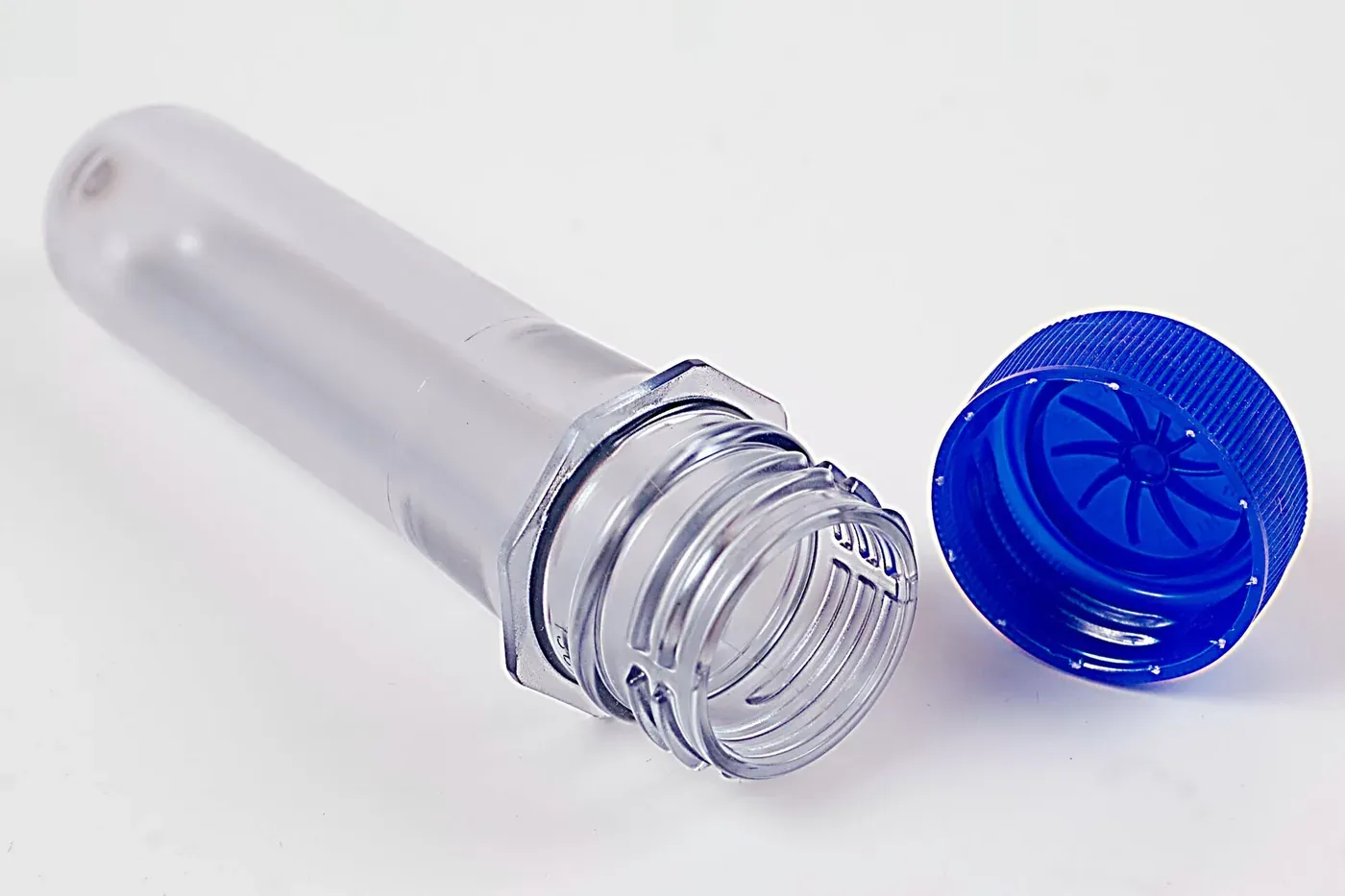

Today PET’s range spans from carbonated beverage and water bottles to polyester apparel, thermal wear and automotive upholstery, from aluminized film for food packaging to glass-fiber-reinforced grades used in electrical components. It is, by weight, one of the most manufactured polymers on Earth.
The Recycling Question
PET carries resin identification code 1, and of the common plastics it is the one curbside recycling has actually managed to handle well: infrared sorting picks PET containers out of the mixed stream, and the flakes that result are clean enough to spin into new fiber or, after further processing, back into food-contact bottles. Mechanical recycling, melting and reforming the flakes, is the workhorse route; a newer chemical route, enzymatic or catalytic depolymerization back to the original monomers, is being run at industrial scale by companies including Carbios, and promises virgin-quality output regardless of how mixed or coloured the input stream is.
Plate IV
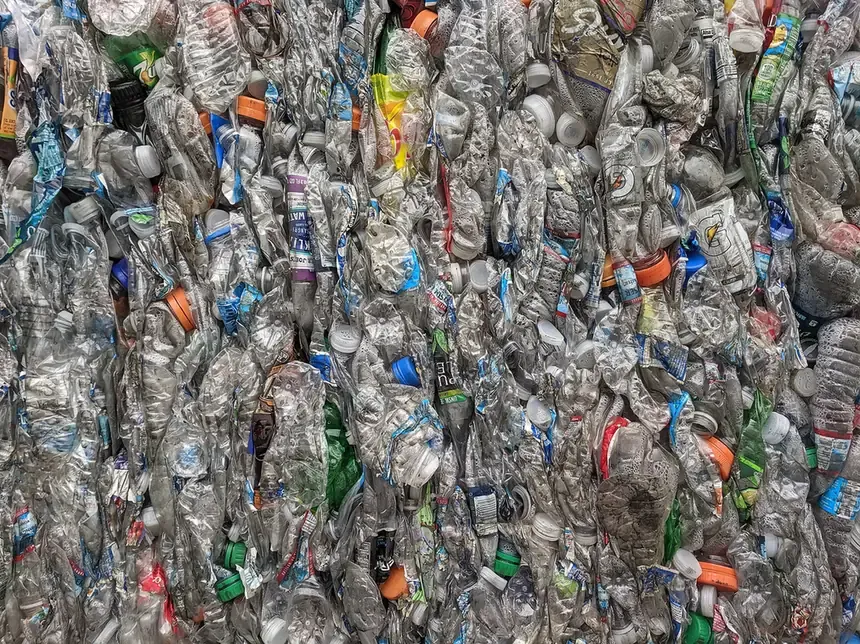

None of that erases the scale of the problem: most PET still goes to landfill or the environment after a single use, and the material that survived a dive to the floor of the Mariana Trench survives just as well in a hedgerow. But among plastics it is the one the recycling system was actually built to work with, which is more than can be said for most of what shares a supermarket shelf with it.
From Fiber to Fashion
In textiles, PET is simply polyester, melted and extruded through fine holes, then stretched to align the molecules along the fiber axis, which is what gives polyester its wrinkle resistance and durability. It has gone from a wartime wool substitute to the material behind moisture-wicking sportswear and, increasingly, fabric spun from recycled bottles rather than virgin resin. This is a fiber that has come, eight decades on, roughly back to where its own raw material began.
values with [n] cite the numbered references·estimates are flagged·“not yet available” and “N/A” are honest states, not gaps
fetching the model…
Polyethylene Terephthalate repeat unit
- Abbreviation
- PET
- Type
- polymer family (hub)
- CAS number
- 25038-59-9
- Resin ID code
- 1
- Formula
- (C10H8O4)n[-O-CH2-CH2-O-CO-C6H4-CO-]n
- Repeat unit (BigSMILES)
{[][>]OCCOC(=O)c1ccc(cc1)C(=O)[<][]}- IUPAC name
- Poly(ethylene terephthalate)
- Synonyms
- PETE; Terylene; Dacron; Mylar
- Also known as
- PETETeryleneDacronMylar
- Chemical family
- polyester
- Backbone class
- heterochain
- Polymerization mechanism
- step-growth-condensation
- Constitutional monomer
- Ethylene glycolTerephthalic acid
- Polymer class
- thermoplastic
- Year of origin
- 1942
- Era
- The Wartime Innovation Period (1939-1945)
- Key figures
- John Rex Whinfield · James Tennant Dickson · Nathaniel Wyeth
- Events referenced
- First controlled nuclear chain reaction, Chicago Pile-1 (2 December 1942) · Wartime clothes rationing and the 'Make Do and Mend' campaign in Britain (1941-1942)
- Polymerization type
- step-growth condensation
- Common monomers (feedstocks)
- ethylene glycol, terephthalic acid, dimethyl terephthalate
- Catalysts
- not yet available
Patented in 1941 by John Rex Whinfield and James Tennant Dickson (Calico Printers' Association); DuPont commercialized Dacron fiber in 1950 and Mylar film in 1951. Two main industrial routes: the DMT process (transesterification of dimethyl terephthalate with ethylene glycol) and the PTA process (direct esterification of terephthalic acid with ethylene glycol). ~31 million tonnes produced globally as of 2025.
- Tacticity
- not yet available
- Crystal structure
- Triclinic unit cell, 1 chain per cell (a≈0.448–0.456 nm, b≈0.58–0.594 nm, c≈1.071–1.086 nm; α≈98–107°, β≈118–119°, γ≈111–112°); nearly planar chain conformation.
- Typical crystallinity
- 35 (20–50) %[3]Semi-crystalline; degree of crystallinity is strongly processing-dependent (amorphous/clear in quenched bottle-grade PET vs. more crystalline/opaque in fiber or engineering grades). Oriented fiber ≈52.5–54.6%, oriented film up to 85%.
Molecular weight
- Number average (Mn)
- not yet available
- Mass average (Mw)
- 42500 (19000–66000) g/mol[3]Virgin resin; recycled PET reported lower, 29,800–45,800 g/mol.
- Dispersity (Mw/Mn)
- not yet available
| Solvent | T | M range | K | a |
|---|---|---|---|---|
| o-chlorophenol[4] | 303 K | — | 0.0372 mL/g | 0.73 |
- Density
- 1.35 (1.3–1.4) g/cm³[3]At 20°C; amorphous PET ≈1.333 g/cm³, crystalline PET ≈1.455 g/cm³.
- Melt flow index
- 7 g/10min[3]230°C/3.8 kg
- Refractive index
- 1.575[3]20°C, exp.
- Transmittance
- not yet available
- Haze
- 0.6 %[3]
- Gloss
- not yet available
- Water absorption
- 0.09 (0.04–0.14) %[3]24 h immersion at 23°C; equilibrium (saturation) value 0.6%; equilibrium at 23°C/50% RH 0.35%.
- Dielectric constant
- 3.25 (3.2–3.3)[3]1 MHz
- Dielectric strength
- 24 (22–26) kV/mm[3]Film, d = 0.6–0.8 mm
- Electrical conductivity
- 1 × 10⁻¹³ S/m[3]Reciprocal of reported volume resistivity (1×10¹³ Ω·m).
- Tensile modulus
- 2300 (2000–2700) MPa[3]Tensile (Young's) modulus range 2,000–2,700 MPa; reported tensile modulus 2,300 MPa.
- Yield strength
- 49.6 (36.5–62.7) MPa[3]Tensile stress at yield.
- Tensile strength at break
- 32.7 (24–41.4) MPa[3]Unqualified 'tensile strength' row, distinct from reported yield stress.
- Elongation at break
- 175 (100–250) %[3]
- Impact strength (Izod)
- 640 J/m[3]23°C, notched
- Impact strength (Charpy)
- not yet available
- Hardness
- 110 Rockwell R[3]
- Flexural modulus
- 2105 (1560–2650) MPa[3]
- Poisson's ratio
- 0.426 (0.421–0.43)[3]
- Coefficient of friction
- 0.45[3]Film-to-film contact.
- Solvent: dilute acids
- good[3]
- Solvent: concentrated acids
- fair[3]
- Solvent: alcohols
- good to fair[3]
- Solvent: alkalis
- poor[3]
- Solvent: aliphatic hydrocarbons
- good[3]
- Solvent: aromatic hydrocarbons
- good[3]
- Solvent: esters
- fair to poor[3]
- Solvent: greases & oils
- good[3]
- Solvent: halogenated hydrocarbons
- poor[3]
- Solvent: ketones
- fair[3]
- Weathering / UV
- not yet available
- Hydrolysis resistance
- Susceptible to hydrolysis; abiotic (ester-bond) hydrolysis is the principal degradation pathway under heat and moisture, hence the pre-drying requirement before melt processing.[3]
- Flammability (UL94)
- not yet availableOnly glass-fiber-reinforced grades given a UL94 rating in the source (HB / V-0 with flame retardant); no rating stated for the unfilled resin.
- Limiting oxygen index
- 21.5 (20–23) %[3]
- Solubility parameter (δ)
- 18.95 (17.1–20.8) MPa^0.5[3]exp.
Gas permeability
- O₂
- 4 × 10⁻¹⁵ cm³(STP)·cm/(cm²·s·Pa)[3]25°C; converted from reported 0.4 × 10⁻¹⁸ m³·m·m⁻²·s⁻¹·Pa⁻¹.
- water vapor
- 1.13 × 10⁻¹¹ cm³(STP)·cm/(cm²·s·Pa)[3]25°C
Polymer-solvent interaction parameter (χ)
not yet available
- Rigid packagingcarbonated beverage and water bottles
- Flexible packagingaluminized BOPET food-packaging film
- Textilespolyester apparel · thermal wear · automotive upholstery
- Engineeringglass-fiber-reinforced electrical components
- Recyclable
- Yes
- Biodegradable
- No
- Degradation pathway
- not yet available
Resin identification code 1 (PET/PETE); one of the most widely and successfully curbside-recycled plastics.
- [1]Polyethylene terephthalateWikipediaAccessed 2026-07-14https://en.wikipedia.org/wiki/Polyethylene_terephthalate[wiki-pet]
- [2]Resin Identification Codes (RICs), as Specified by ASTM D7611The ANSI BlogAccessed 2026-07-14; confirms PVC = RIC 3https://blog.ansi.org/ansi/resin-identification-codes-rics-astm-d7611/[ansi-resin-codes]
- [3]Handbook of PolymersChemTec Publishinghttps://www.worldcat.org/isbn/9781895198928[handbook-wypych-2016]
- [4]Polymer Data HandbookOxford University Presshttps://search.worldcat.org/search?q=Polymer+Data+Handbook+Mark+1999[handbook-mark-1999]
Illustrations
- Plate IChicago Pile-1, drawn from memory years later since no photograph of the actual 1942 apparatus was permitted, one of the year's genuine secrets, kept the way governments keep them.Wikimedia Commons
- Plate IIMen modelling Britain's wartime utility clothing scheme, cut to strict cloth rations, the same shortage of wool and cotton that sent Whinfield and Dickson looking for a fiber that owed nothing to a farm.Wikimedia Commons
- Plate IIIA PET preform, injection-moulded thick and then reheated and blown into its final bottle shape, the process Nathaniel Wyeth's 1973 patent made possible.Wikimedia Commons
- Plate IVBaled PET bottles awaiting reprocessing. PET is recycled more successfully than almost any other plastic, though by most estimates still less than a third of it is captured worldwide.Wikimedia Commons