The Post-War Boom (1946-1960)
Polyacetal (POM)
Revolutionizing Precision
At four o’clock on the afternoon of 25 September 1956, the Postmaster General in London lifted a telephone in Lancaster House and spoke to the chairman of AT&T in New York. The words travelled through TAT-1, the first telephone cable ever laid across the Atlantic seabed, and the connection held. The cable itself was unremarkable copper and gutta-percha-descended insulation, but the achievement that mattered was buried three miles down in its 102 signal repeaters: valves engineered so precisely, and so far beyond any hope of repair once submerged, that they were built to run without failure for twenty years. They ran for twenty-two, and never once failed.
Plate I
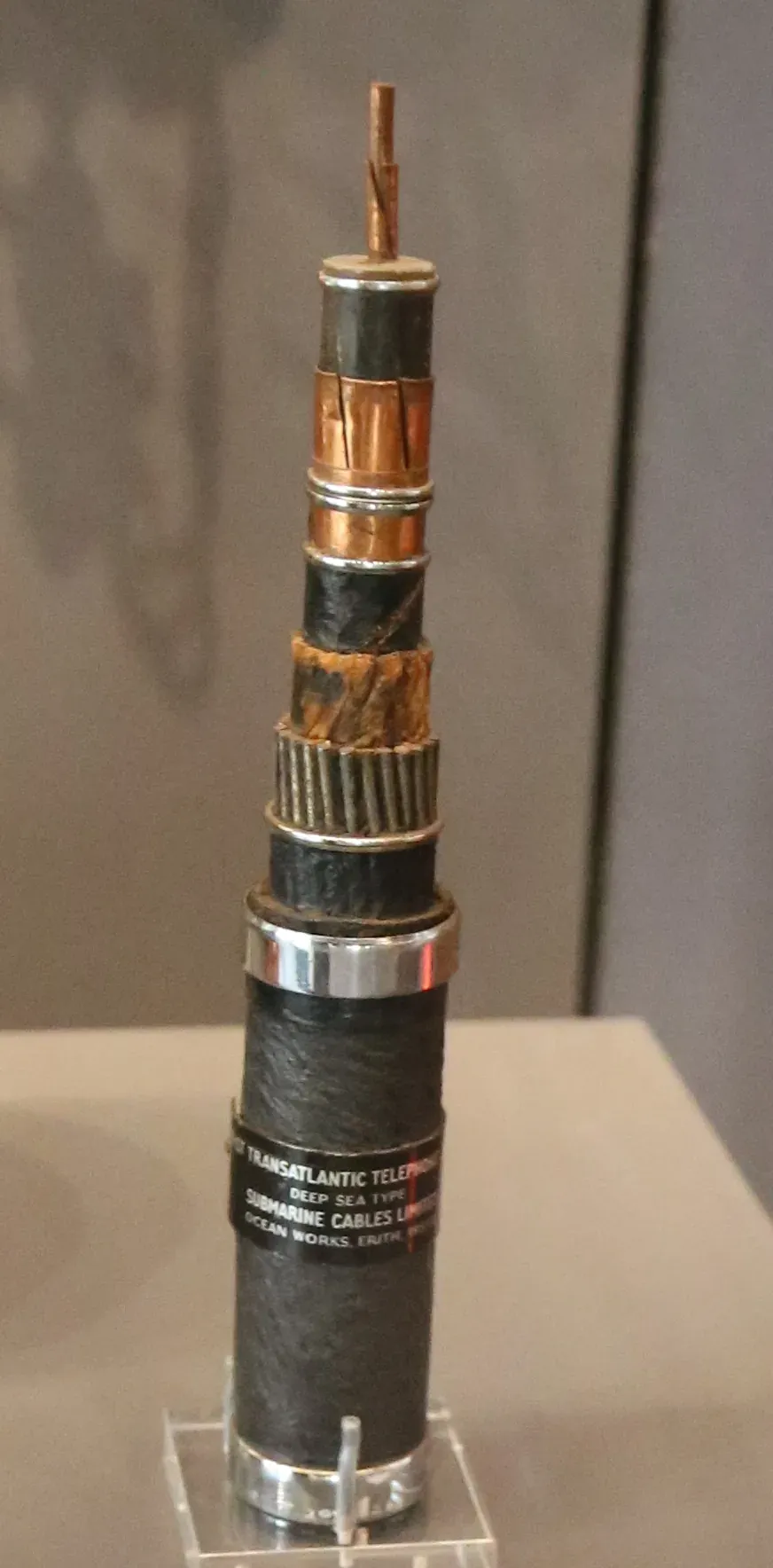

Plate II


Five weeks later, on 30 October 1956, a DuPont chemist named Robert N. MacDonald filed a patent of his own. It had nothing to do with telephones. MacDonald had spent several years building high-molecular-weight polyoxymethylene (a plastic made by stringing together the simplest possible building block, formaldehyde, into long, tightly ordered chains) and had found that it could be moulded into parts stiff and precise enough to challenge metal in exactly the applications where a machinist’s tolerance mattered most: gears, bearings, clips, valve components. Nobody was going to bury POM under the ocean, but 1956 was unmistakably a year in which engineering across the board (telecommunications, automotive, consumer goods) was asking the same question TAT-1 had just answered for undersea cable: could something be built precise and stable enough to be trusted without a repair crew standing by?
A Discovery That Nearly Fell Apart
MacDonald’s early polymer had a serious flaw. Formaldehyde chains have a habit of “unzipping” from whichever end is left exposed, falling back apart into monomer at the first sign of heat, which made his first high-molecular-weight POM commercially useless: it degraded before it could be moulded into anything. The fix came from a second DuPont chemist, Stephen Dal Nogare, who found that capping both ends of the chain with acetate groups (reacting the reactive hemiacetal ends with acetic anhydride) sealed the zipper shut and gave the polymer the thermal stability it needed to survive processing. That combination, MacDonald’s original synthesis and Dal Nogare’s stabilisation, is what let DuPont open a dedicated plant in Parkersburg, West Virginia, in January 1960 and sell the result under a name still on toolboxes and hardware catalogues today: Delrin.
An Orderly Molecule
POM’s chain is about as simple as a heterochain polymer gets: a carbon, an oxygen, a carbon, an oxygen, on and on. That simplicity is the whole point. With no bulky side groups and no irregular sequence to get in the way, the chains pack together into a highly crystalline solid far more readily than most plastics manage, and it is that crystallinity, not any particular chemical trick, that gives POM its combination of stiffness, low friction and dimensional stability. A moulded POM part holds a tolerance the way a well-machined metal part does, which is precisely why it has spent seventy years quietly replacing small metal components inside machines nobody thinks to open.
What the Material Actually Does
POM sits close to the middle of the engineering-plastic pack in weight (heavier than water, lighter than the aluminium and brass parts it typically displaces), and it is stiff and hard enough to hold a moulded gear tooth or a snap-fit clip without rounding off in use, though it will crack rather than bend if pushed past its limit. It keeps that stiffness well above the temperature of boiling water before it begins to soften, and resists most solvents, fuels, and dilute chemicals convincingly, though strong acids attack it and, like nylon, its performance in sunlight needs help from a stabiliser to hold up over years outdoors. Its most distinctive trait is how little resistance it offers to sliding contact: an unlubricated POM part slides against another almost as readily as one coated in a dry lubricant, which is exactly why it turns up in zippers, gears, and moving mechanisms that are expected to run for years without a drop of oil.
Two Roads to the Same Chain
Industrial POM is made by two different routes. The older one, cationic polymerisation of formaldehyde gas itself, runs at temperatures well below freezing, using a Lewis acid such as boron trifluoride to kick off the chain; it demands that cold because formaldehyde is otherwise eager to do almost anything except line up in an orderly chain. The newer route sidesteps that problem by polymerising trioxane, a cyclic trimer of formaldehyde that is far more manageable, opening the ring under a similar acid catalyst at temperatures closer to 100°C. Both routes still have to solve MacDonald’s original problem, and modern plants solve it the way Dal Nogare did (end-capping) or, in copolymer grades, by copolymerising in a small fraction of a second monomer whose bulkier unit simply blocks the unzipping reaction before it can run very far.
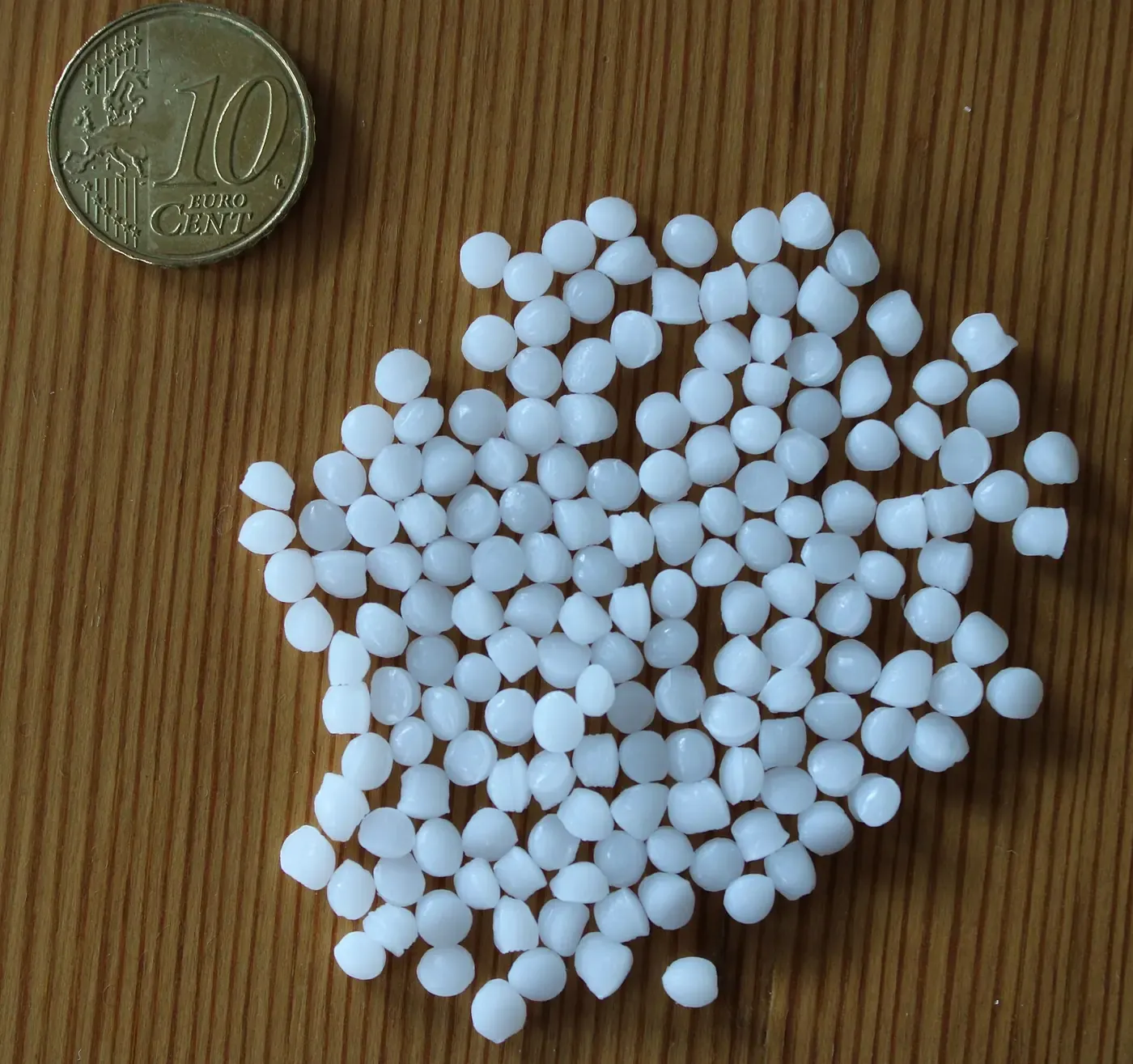
Plate III

A Material Found in the Small Things
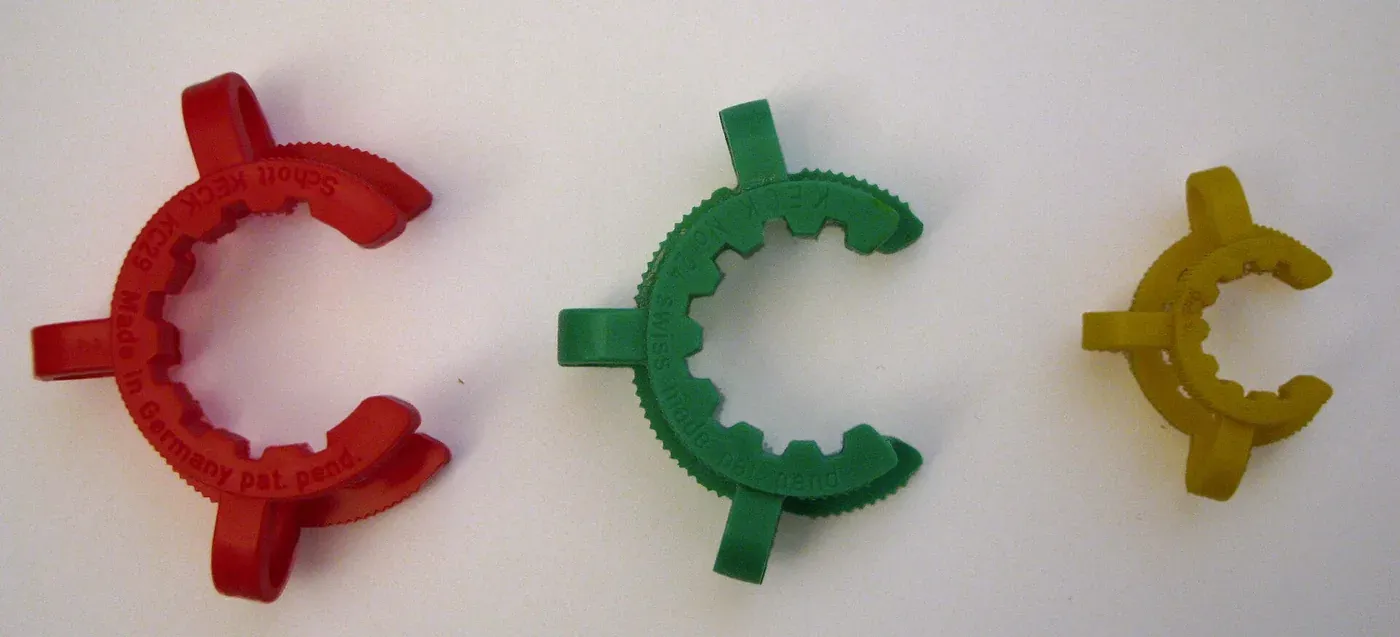
POM’s working life is a list of parts too small to notice until one fails: seatbelt buckle mechanisms, door handle linkages and window-lift gears in cars, the internal gearing of a fuel pump, insulin-pen components, zipper teeth and slider bodies, ski-binding release mechanisms, and the snap-fit clips holding together a hundred kinds of consumer electronics. Laboratories know it in an even smaller form: the coloured Keck clips that hold a ground-glass joint together on a distillation rig are almost always moulded from acetal resin, chosen for the same reasons an automotive engineer chooses it: it holds its shape, resists the solvents running through the glassware next to it, and does not seize or gall against the glass the way a bare metal clip would.
Plate IV

Still Precise, Seventy Years On
POM has never needed to reinvent itself the way some of its contemporaries have. Composite grades reinforced with glass fibre, carbon fibre or PTFE now extend its range further into low-friction bearings and higher-load gearing, and manufacturers continue to refine copolymer grades for better long-term stability, but the material’s job has stayed remarkably constant since MacDonald’s 1956 patent: wherever an engineer needs a moulded part to behave with the predictability of a machined metal one, POM is still very often the answer.
values with [n] cite the numbered references·estimates are flagged·“not yet available” and “N/A” are honest states, not gaps
fetching the model…
Polyacetal repeat unit
- Abbreviation
- POM
- Type
- polymer family (hub)
- CAS number
- 9002-81-7
- Resin ID code
- none assigned
- Formula
- (CH2O)n[-CH2-O-]nHomopolymer POM is shown. Copolymer grades insert a small fraction of ethylene oxide units into the chain, which is what stops the backbone unzipping from its ends.
- Repeat unit (BigSMILES)
{[][>]OC[<][]}- IUPAC name
- Polyoxymethylene
- Synonyms
- acetal; polyformaldehyde; Delrin
- Also known as
- acetalDelrinPOM
- Chemical family
- polyketone
- Backbone class
- heterochain
- Polymerization mechanism
- ring-opening-polymerizationstep-growth-condensation
- Constitutional monomer
- Formaldehyde
- Polymer class
- thermoplastic
- Year of origin
- 1956
- Era
- The Post-War Boom (1946-1960)
- Key figures
- R. N. MacDonald · Stephen Dal Nogare
- Events referenced
- Opening of TAT-1, the first transatlantic telephone cable (25 September 1956)
- Polymerization type
- ring-opening or step-growth condensation (formaldehyde polymerization)
- Common monomers (feedstocks)
- formaldehyde
- Catalysts
- not yet available
DuPont synthesized POM around 1952 and filed for homopolymer patent protection in 1956, commercializing it as Delrin at a Parkersburg, WV facility in 1960.
- Tacticity
- not yet available
- Crystal structure
- not yet available
- Typical crystallinity
- 48–85 %[2]homopolymer, unoriented; up to 72–92% in highly-oriented fiber. Copolymer grades run lower, ~56–59% (handbook-mark-1999).
Molecular weight
- Number average (Mn)
- 20000–110000 g/mol[3]
- Mass average (Mw)
- 21000–1000000 g/mol[3]
- Dispersity (Mw/Mn)
- 1.84–14.7[3]
| Solvent | T | M range | K | a |
|---|---|---|---|---|
| p-chlorophenol[3] | 403 K | — | 0.0543 mL/g | 0.66 |
| p-chlorophenol, 2% α-pinene[3] | 333 K | 62–129 kg/mol | 0.0413 mL/g | 0.724 |
| phenol[3] | 363 K | — | 0.0113 mL/g | 0.76 |
| dimethylformamide[3] | 423 K | 89–285 kg/mol | 0.044 mL/g | 0.66 |
| dimethylformamide[3] | 403 K | 1.5–15 kg/mol | 0.0224 mL/g | 0.71 |
High chain regularity and crystallinity give POM its combination of stiffness, low friction, and dimensional stability, ideal for precision parts.
- Density
- 1.42 g/cm³[3]ASTM D792Homopolymer, amorphous density; copolymer grades ~1.41 g/cm³. Crystalline-phase density is higher, 1.49–1.53 g/cm³.
- Melt flow index
- 1.9–52 g/10min[2]190 °C/3.8 kg, range across commercial grades
- Refractive index
- 1.545–1.553[2]20 °C; a separate value of 1.47 is also reported in the same source without further qualification
- Transmittance
- not yet available
- Haze
- not yet available
- Gloss
- not yet available
- Water absorption
- 0.8–1.65 %[2]equilibrium, immersion in water at 23 °C; equilibrium moisture uptake at 23 °C/50% RH is 0.2–0.4%
- Dielectric constant
- 3.7[3]ASTM D15010²-10⁶ Hz; homopolymer and copolymer both reported at 3.7
- Dielectric strength
- 21–40 kV/mm[2]specimen thickness 0.6–0.8 mm
- Electrical conductivity
- 1 × 10⁻¹³–1 × 10⁻¹² S/m[2]reciprocal of reported volume resistivity, 1×10¹²-1×10¹³ Ω·m
- Glass transition (Tg)
- -75.15 °C[3]198 K; a separate experimental range of -90 to -60 °C across grades is also reported (handbook-wypych-2016)
- Melting temperature (Tm)
- 174.85 °C[3]ASTM D2133Homopolymer (Delrin 500), 448 K; copolymer (Celcon M90) melts at 164.85 °C (438 K)
- Crystallization (Tc)
- not yet available
- Heat deflection (HDT)
- 135.85 °C[3]ASTM D648, 1.82 MPaHomopolymer (Delrin 500), 409 K; copolymer (Celcon M90) is 109.85 °C. At 0.45 MPa, Delrin 500 is 171.85 °C.
- Decomposition onset
- 230–250 °C[2]in air; in nitrogen, 277–326 °C
- Thermal conductivity
- 0.303 (0.294–0.312) W/(m·K)[2]solid state; melt state is lower, 0.13–0.15 W/(m·K)
- Tensile modulus
- 3100 MPa[3]ASTM D638Homopolymer, 296 K; copolymer grades ~2825 MPa
- Yield strength
- 43–74 MPa[2]tensile stress at yield, range across POM grades
- Tensile strength at break
- 68.9 MPa[3]ASTM D638Homopolymer, 296 K; copolymer grades ~60.6 MPa
- Elongation at break
- 23–75 %[3]ASTM D638Homopolymer, 296 K, maximum extensibility; copolymer grades 40–75%
- Impact strength (Izod)
- 69–122 J/m[3]ASTM D256, notchedHomopolymer, 296 K, 3.175 mm; copolymer grades 53–80 J/m. At 233 K, homopolymer is 53–95 J/m.
- Impact strength (Charpy)
- 5.3–8 kJ/m²[2]notched, 23 °C
- Hardness
- 94 Rockwell M[3]ASTM D785Homopolymer; copolymer grades are Rockwell M80
- Flexural modulus
- 2830 MPa[3]ASTM D790Homopolymer, 296 K; copolymer grades ~2584 MPa
- Poisson's ratio
- 0.27[2]
- Coefficient of friction
- 0.18–0.41[2]against steel; against itself 0.10–0.38, dynamic 0.11
- Solvent: dilute acids
- good[2]
- Solvent: concentrated acids
- poor[2]
- Solvent: alcohols
- good[2]
- Solvent: alkalis
- good to poor[2]
- Solvent: aliphatic hydrocarbons
- very good[2]
- Solvent: aromatic hydrocarbons
- good[2]
- Solvent: esters
- good[2]
- Solvent: greases & oils
- good[2]
- Solvent: halogenated hydrocarbons
- good[2]
- Solvent: ketones
- good[2]
- Weathering / UV
- ~50% tensile strength retention after 1000 h UV exposure (SAE J-1885); UV-stabilized grades retain ~98%[2]
- Hydrolysis resistance
- not yet available
- Flammability (UL94)
- HB[2]1.6/0.8 mm thickness
- Limiting oxygen index
- 15.5 (15–16) %[2]unfilled grade
- Solubility parameter (δ)
- not yet available
Gas permeability
not yet available
Polymer-solvent interaction parameter (χ)
not yet available
- Precision mechanicalgears · fasteners · lock systems · zippers · ski bindingsCoefficient of friction against steel 0.31–0.37. Low friction plus high stiffness makes POM a common metal-replacement engineering plastic.
- Automotive & electronicsautomotive components · consumer electronics parts
- Recyclable
- Yes
- Biodegradable
- No
- Degradation pathway
- Not biodegradable; thermal/chemical degradation releases formaldehyde, which itself acts as a biocide against further microbial attack.
- [1]PolyoxymethyleneWikipediaAccessed 2026-07-14https://en.wikipedia.org/wiki/Polyoxymethylene[wiki-pom]
- [2]Handbook of PolymersChemTec Publishinghttps://www.worldcat.org/isbn/9781895198928[handbook-wypych-2016]
- [3]Polymer Data HandbookOxford University Presshttps://search.worldcat.org/search?q=Polymer+Data+Handbook+Mark+1999[handbook-mark-1999]
Illustrations
- Plate IA section of TAT-1 cable, its layers stripped back to show the engineering underneath: the same autumn a DuPont chemist was patenting a plastic built for exactly this kind of unforgiving precision, if at a much smaller scale.Wikimedia Commons
- Plate IIThe IEEE marker at Kerrera, Scotland, the cable's eastern landing point. It was installed to mark an engineering achievement whose whole point was that nobody would ever need to visit the actual hardware again.Wikimedia Commons
- Plate IIIPolyoxymethylene as it leaves the reactor: white pellets ready for moulding, the raw form of a plastic sold on hundredths-of-a-millimetre tolerance rather than colour or clarity.Wikimedia Commons
- Plate IVKeck clips for laboratory glassware, a small everyday object almost always moulded from acetal resin, chosen for the same dimensional stability and chemical resistance that put POM into automotive and industrial gears.Wikimedia Commons