The Birth of Synthetic Polymers (1907-1938): The Bakelite Revolution
Polytetrafluoroethylene (PTFE)
A Slippery Discovery
By 1938 the American kitchen was being rewired. Mechanical refrigeration, a luxury a decade earlier, was going into ordinary homes by the millions, and the entire industry ran on a family of gases called chlorofluorocarbons that a General Motors team had introduced under the name Freon in 1930. DuPont had a stake in that business through a joint venture with GM, and it wanted refrigerants of its own that did not infringe anyone else’s patents. That commercial pressure is the reason a twenty-seven-year-old chemist named Roy J. Plunkett was at DuPont’s Jackson Laboratory in New Jersey that spring, manufacturing a hundred pounds of a candidate gas called tetrafluoroethylene and storing it in small cylinders on dry ice.
Plate I
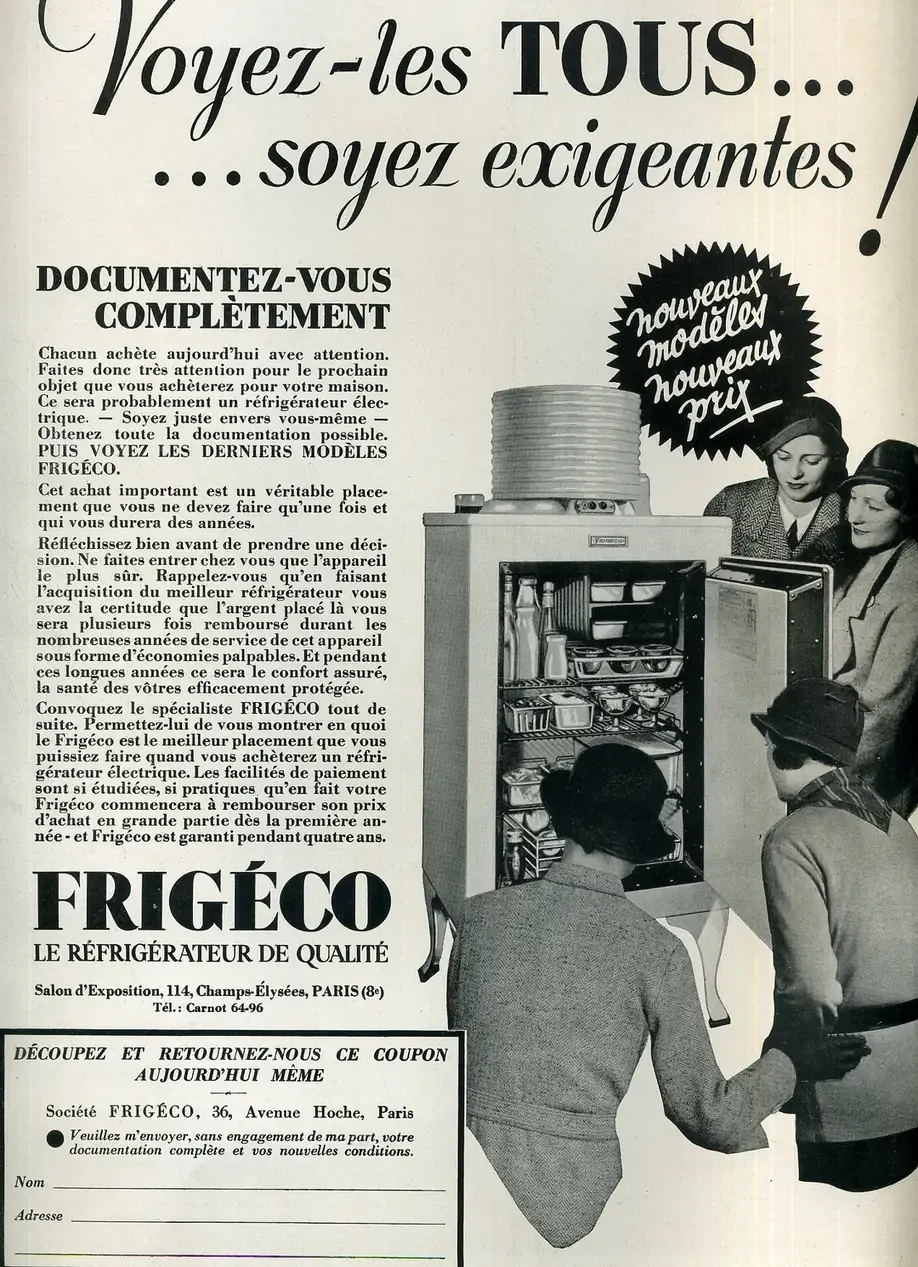

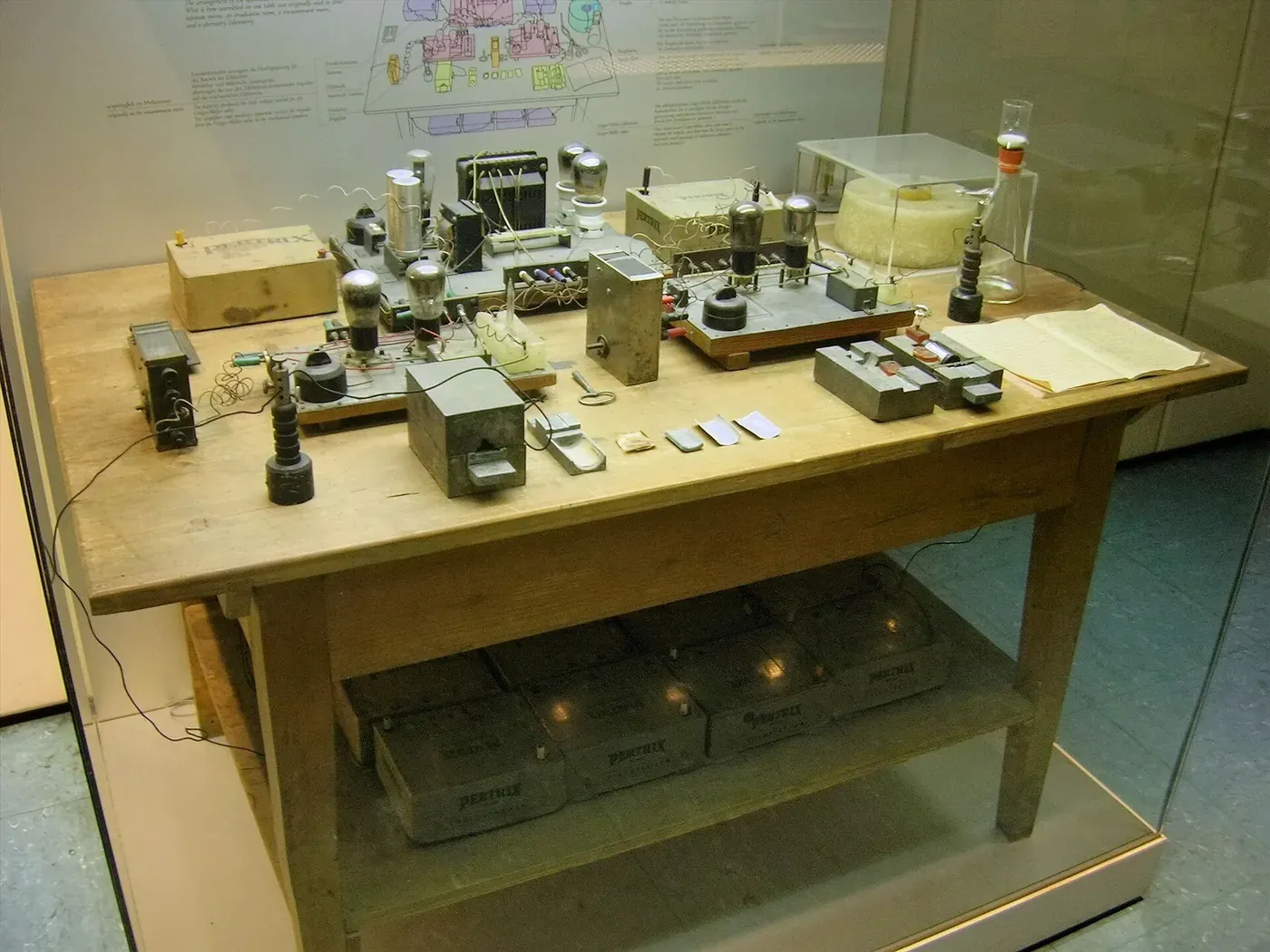
Some four hundred miles away in Berlin that same year, Otto Hahn and Fritz Strassmann were bombarding uranium with neutrons and finding, to their own disbelief, that the atom itself would come apart. Nuclear fission would not be explained in print until January 1939, but 1938 was already the year physics discovered that matter could be split open. It is a strange coincidence that the same twelve months produced, in a New Jersey laboratory, a molecule that nothing on earth could split open at all.
Plate II

An Empty Cylinder That Was Not Empty
On the morning of 6 April 1938, Plunkett and his laboratory assistant, Jack Rebok, went to draw off gas from one of the stored cylinders and got nothing. The valve was open, the line was clear, and yet the cylinder had not lost any weight. Rather than write it off, Plunkett cut the cylinder open. Inside was a smooth, waxy white powder. The tetrafluoroethylene gas had polymerised on its own, catalysed by the iron of the cylinder’s own interior wall. That was something no theory of the day predicted a fluorocarbon would do. Instead of discarding a ruined experiment, Plunkett set the refrigerant work aside and spent the following weeks characterising the powder itself: testing its response to heat, solvents, acids and electrical fields. What he had was polytetrafluoroethylene, and almost every test came back the same way: nothing touched it.
A Backbone Nothing Can Reach
PTFE’s chain is carbon, two fluorines to a link, running on indefinitely. What makes the material remarkable is not the carbon backbone, which is common to half the plastics in this Atlas, but the sheath the fluorine builds around it. Fluorine is the most electronegative element there is, and the carbon-fluorine bond it forms is among the strongest single bonds in organic chemistry. Packed one after another down the chain, the fluorine atoms crowd out any possible approach to the carbon underneath, so that the backbone sits inside what is effectively a fully-fluorinated tube. Nothing gets past it to react.
A Material of Extremes
PTFE occupies a strange position among plastics: it is one of the densest of them, distinctly heavier than water though still far lighter than the metals whose jobs it eventually took, and it keeps its working properties across an enormous temperature span, from deep-freeze cold to well past the boiling point of water. It is soft and readily deforms under sustained load rather than snapping, which is part of why it can be skived into thin tape or machined into gaskets. Its most famous number is not really a number the reader needs; what matters is that it has the lowest coefficient of friction of any solid material known, low enough that almost nothing will adhere to a clean PTFE surface at all. That same fluorinated sheath makes it close to chemically inert: strong acids, strong bases, solvents and oils all pass over it without effect, and only a handful of the most aggressive reagents on earth (molten alkali metals, elemental fluorine gas) can touch it. It does not truly melt in the way most thermoplastics do, either; its molten state is so viscous that it cannot be pumped or injection moulded, and virtually all PTFE parts are formed by pressing the powder into shape and sintering it, the same principle a potter uses to fire clay.
From Powder to Product
Commercial production begins with tetrafluoroethylene made from chloroform and hydrogen fluoride, which is then polymerised in water using persulfate initiators under carefully controlled pressure and moderate heat; TFE is unstable enough in bulk that the reaction has to be respected rather than rushed. The resulting resin cannot be melt-processed, so parts are compression-moulded or ram-extruded as a powder compact and then sintered in an oven at several hundred degrees, after which the solid block or rod is skived, machined, or drawn into finished shapes. DuPont registered the Teflon trademark in 1945 and had commercial production running at industrial scale within a few years.
Plate III

Non-stick cookware, the application most people know PTFE by, did not come from DuPont at all. In 1954, a French engineer named Marc Grégoire (who had already been coating fishing tackle in Teflon to help his line run more freely off the rod) coated a frying pan for his wife Colette at her suggestion. Two years later the couple founded Tefal to sell the pans commercially, and non-stick cookware has carried some version of that chemistry ever since.
The War’s Quiet Passenger
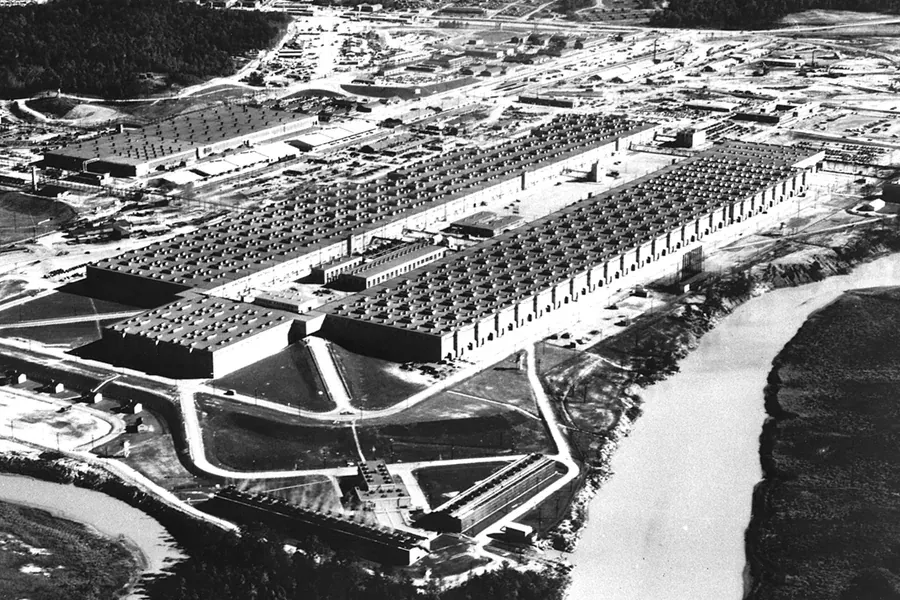
PTFE’s first major industrial role, though, was one nobody could talk about for years. The Manhattan Project’s uranium enrichment plant at Oak Ridge, Tennessee, separated uranium isotopes by forcing uranium hexafluoride gas (ferociously corrosive, and reactive with almost every metal, rubber and plastic then in use) through miles of piping, valves and gaskets. PTFE was one of vanishingly few materials that simply did not react with it, and it went into seals and gasket linings throughout the plant. The work stayed classified long after the war ended, and PTFE’s reputation as an industrial material was already well established elsewhere before the public learned what it had quietly been holding together at Oak Ridge.
Plate IV

From there PTFE’s uses only widened: wire and cable insulation for aircraft and electronics, artificial blood vessels and joint liners in medicine, tank and pipe linings wherever a chemical plant needed to hold something nothing else could hold, and, laminated into a breathable membrane, the Gore-Tex fabric that keeps rain out while letting water vapour escape.
The Cost of Never Reacting
The same inertness that makes PTFE useful is what makes it a long-term environmental problem. The industry has taken to calling it, and the wider fluoropolymer family, “forever chemicals,” because the carbon-fluorine bonds that resist every solvent and acid also resist the microbes and sunlight that break down ordinary plastic waste. Manufacture of its precursor gas has historically involved potent greenhouse-gas byproducts, and processing aids once used in PTFE production (chiefly PFOA) have left a legacy of persistent environmental contamination that the industry has spent the past two decades phasing out. PTFE itself, once formed, is chemically stable and non-toxic in ordinary use; the environmental and health concerns attached to the “forever chemical” label mostly belong to the smaller, more mobile fluorinated molecules used in its manufacture or produced when it burns, not to the finished polymer sitting in a frying pan.
That distinction matters for cooks, too. PTFE cookware only begins to break down at temperatures well above anything a recipe calls for; ordinary frying, even on high heat, does not approach it. An empty pan left over a hot burner is the real risk, since with nothing in it to absorb the heat it can climb into the range where the coating starts to give off fumes and, at the higher end, can briefly cause a flu-like reaction in humans known as polymer fume fever. Used as directed (with food in the pan, and without scrubbing the coating away with metal tools), PTFE cookware is about as unremarkable, chemically, as kitchenware gets.
values with [n] cite the numbered references·estimates are flagged·“not yet available” and “N/A” are honest states, not gaps
fetching the model…
Polytetrafluoroethylene repeat unit
- Abbreviation
- PTFE
- Type
- polymer family (hub)
- CAS number
- 9002-84-0
- Resin ID code
- none assigned
- Formula
- (C2F4)n[-CF2-CF2-]n
- Repeat unit (BigSMILES)
{[][$]C(F)(F)C(F)(F)[$][]}- IUPAC name
- Poly(1,1,2,2-tetrafluoroethylene)
- Synonyms
- Teflon
- Also known as
- Teflon
- Chemical family
- fluoropolymer
- Backbone class
- carbon-chain
- Polymerization mechanism
- free-radical
- Constitutional monomer
- Tetrafluoroethylene
- Polymer class
- thermoplastic
- Year of origin
- 1938
- Era
- The Birth of Synthetic Polymers (1907-1938): The Bakelite Revolution
- Key figures
- Roy Plunkett
- Events referenced
- Freon and the 1930s home-refrigeration boom · Discovery of nuclear fission (Otto Hahn and Fritz Strassmann, 1938) · The Manhattan Project's Oak Ridge gaseous diffusion plant
- Polymerization type
- free-radical chain-growth
- Common monomers (feedstocks)
- tetrafluoroethylene
- Catalysts
- persulfate initiators
Roy J. Plunkett discovered PTFE accidentally in 1938 at DuPont's New Jersey facility while attempting to synthesize a refrigerant. The 'Teflon' trademark was registered in 1945; commercial production reached over 910,000 kg/year by 1948. Produced via free-radical suspension or emulsion polymerization of tetrafluoroethylene, with persulfate initiators generating the propagating radicals.
- Tacticity
- Not applicable: the CF2-CF2 repeat unit has no stereocenter.
- Crystal structure
- Polymorphic helical chain packing: Form II below 19 °C (triclinic/pseudohexagonal, a=b≈0.559 nm, c≈1.688 nm, β≈119.3°, 13/6 helix); Form IV 19–30 °C and Form I above 30 °C (trigonal, a=b≈0.566–0.567 nm, c>1.95 nm, 15/7 helix); Form III at high pressure (orthorhombic, 2/1 helix).
- Typical crystallinity
- 78 (58–98) %[2]
Molecular weight
- Number average (Mn)
- 400000–10000000 g/mol[2]
- Mass average (Mw)
- not yet available
- Dispersity (Mw/Mn)
- not yet available
Mark-Houwink constants
not yet available
The fully fluorinated backbone gives PTFE its extremely low surface energy and low coefficient of friction.
PTFE has several sub-Tg crystalline transitions in addition to its amorphous glass transition, most notably the ~19–30 °C crystal-disordering transitions (β 292 K, β″ 303 K) that cause a characteristic small volume change near room temperature.
- Density
- 2.18 (2.16–2.2) g/cm³[2]20 °C; amorphous 2.077, crystalline 2.187, triclinic 2.344 g/cm³
- Melt flow index
- Not applicablePTFE has essentially no melt flow even above Tm due to extremely high melt viscosity; processed via sintering, not conventional melt extrusion.
- Refractive index
- 1.36 (1.35–1.37)[2]20 °C
- Transmittance
- not yet available
- Haze
- not yet available
- Gloss
- not yet available
- Water absorption
- 0 %[2]equilibrium, 23 °C water immersion
- Dielectric constant
- 2.1[2]100 Hz to 1 MHz
- Dielectric strength
- 39.85 (19.7–60) kV/mm[2]specimen thickness 0.6–0.8 mm
- Electrical conductivity
- 1 × 10⁻¹⁶ S/m[2]reciprocal of reported volume resistivity, 1×10¹⁶ Ω·m
- Glass transition (Tg)
- 125.85 °C[3]α (glass I) transition, 399 K; PTFE also shows sub-Tg crystalline transitions (β 292 K, β″ 303 K, γ/glass II 193 K)
- Melting temperature (Tm)
- 317–345 °C[2]DSC, first (irreversible) melt; reversible/second melt ~327 °C, extended-chain form ~385 °C
- Crystallization (Tc)
- not yet available
- Heat deflection (HDT)
- 52.5 (45–60) °C[2]1.8 MPa
- Decomposition onset
- 508 °C[2]decomposition onset; 350 °C reported for 0.001% weight loss
- Thermal conductivity
- 0.25 W/(m·K)[3]298 K
- Tensile modulus
- 475 (400–550) MPa[2]
- Yield strength
- 10 MPa[3]296 K, ASTM D638
- Tensile strength at break
- 27.5 (20–35) MPa[2]
- Elongation at break
- 425 (300–550) %[2]
- Impact strength (Izod)
- 188 J/m[2]notched, 23 °C
- Impact strength (Charpy)
- not yet available
- Hardness
- not yet available
- Flexural modulus
- 480 (340–620) MPa[2]
- Poisson's ratio
- 0.48 (0.46–0.5)[2]
- Coefficient of friction
- 0.08 (0.06–0.08)[2]static 0.08, dynamic 0.06; against polished steel 0.05–0.08 per Mark 1999
- Solvent: most_chemicals
- Exceptional resistance; used as a liner for corrosive-material containment[1]
- Solvent: acids
- resistant[2]dilute and concentrated, including fuming nitric acid and aqua regia
- Solvent: alcohols
- resistant[2]
- Solvent: alkalis
- resistant[2]attacked by molten alkali metals
- Solvent: aliphatic hydrocarbons
- resistant[2]
- Solvent: aromatic hydrocarbons
- resistant[2]
- Solvent: esters
- resistant[2]
- Solvent: greases & oils
- resistant[2]
- Solvent: halogenated hydrocarbons
- resistant[2]
- Solvent: ketones
- resistant[2]
- Weathering / UV
- not yet available
- Hydrolysis resistance
- Not applicable
- Flammability (UL94)
- V-0[2]
- Limiting oxygen index
- [2]>99.5% O2 (effectively non-flammable in air); Mark 1999 reports >95%
- Solubility parameter (δ)
- 14.7 (12.7–16.7) MPa^0.5[2]12.7 is the calculated value; an experimental figure of 16.7 is also reported
Gas permeability
not yet available
Polymer-solvent interaction parameter (χ)
not yet available
- Electronics & aerospacewire insulation~50% of production.
- Cookwarenon-stick coatings
- Industriallow-friction seals and bearings · chemical-resistant tank/pipe liners
- Architecturetensioned membrane structures
- Recyclable
- No
- Biodegradable
- No
- Degradation pathway
- not yet available
PTFE manufacture has historically been associated with PFOA/PFAS-family processing aids, a significant environmental and regulatory concern for the fluoropolymer industry broadly (specific to PTFE's own persistence: not independently verified).
- [1]PolytetrafluoroethyleneWikipediaAccessed 2026-07-14https://en.wikipedia.org/wiki/Polytetrafluoroethylene[wiki-ptfe]
- [2]Handbook of PolymersChemTec Publishinghttps://www.worldcat.org/isbn/9781895198928[handbook-wypych-2016]
- [3]Polymer Data HandbookOxford University Presshttps://search.worldcat.org/search?q=Polymer+Data+Handbook+Mark+1999[handbook-mark-1999]
Illustrations
- Plate IThe mechanical refrigerator was becoming a mass consumer object across the industrialised world in the 1930s, and its growth is what put a cylinder of experimental refrigerant gas on Plunkett's bench.Wikimedia Commons
- Plate IIThe apparatus with which Otto Hahn and Fritz Strassmann split the uranium atom in Berlin in 1938, now in the Deutsches Museum. The same year, a DuPont chemist in New Jersey found a molecule that resisted being taken apart by anything at all.Wikimedia Commons
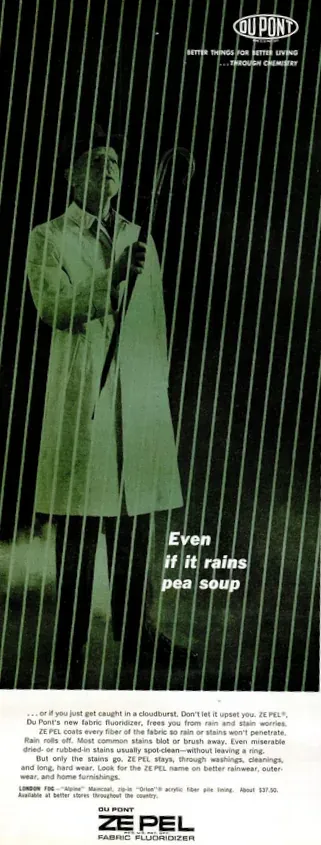
- Plate IIIDuPont spent the 1950s and 60s finding fluorochemistry a life beyond the laboratory bench; Zepel, a fabric treatment built on the same chemistry as Teflon, is one of many trade names PTFE and its relatives wore into the consumer market.Wikimedia Commons
- Plate IVThe K-25 gaseous diffusion plant at Oak Ridge, where PTFE gaskets and seals held back uranium hexafluoride gas that would have destroyed almost any other material. The use stayed classified for years after the war.Wikimedia Commons