
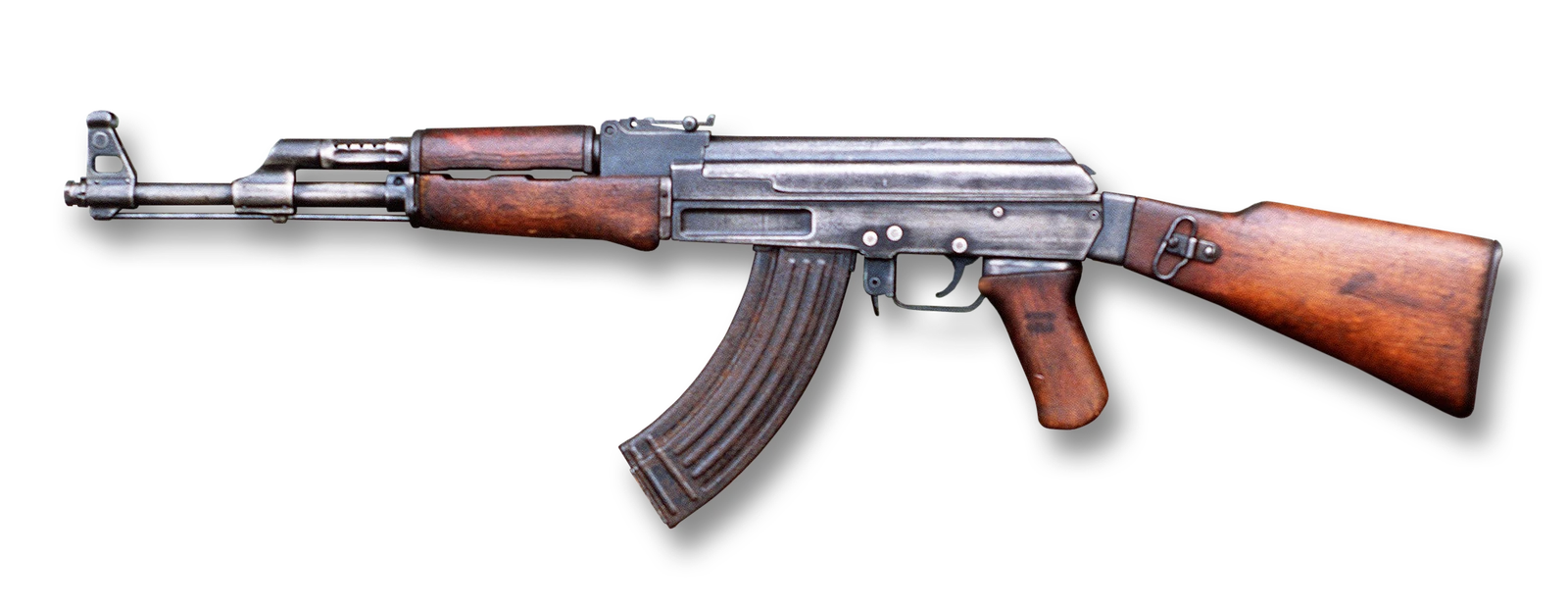
Image credit
- Title
- AK-47 type II noBG
- Author
- User:Nemo5576(attribution required)
- Licence
- CC BY-SA 4.0
- Source
- https://commons.wikimedia.org/wiki/File:AK-47_type_II_noBG.png

How Muzzle energy is calculated
E = ½ · m · v²
Inputs
- m8 g123.5 grverifiedsourceBallistics table of the cited article.
- v738 m/s2,421 fpsverifiedMeasured with a 520 mm barrel, not this arm's 415 mm. Velocity outside the sourced range is not projected.
1 of 2 inputs link to their source.
How Muzzle velocity is calculated
nearest sourced barrel length, no extrapolation
Inputs
- v at 520 mm738 m/s2,421 fpsverifiedsourceBallistics table of the cited article.
Assumptions
- This figure belongs to a 520 mm barrel. It is shown because it is the closest measurement that exists, not because it applies here.
1 of 1 inputs link to their source.
How Loaded mass is calculated
m_loaded = m_empty + m_magazine + n · m_cartridge
Not calculated: m_cartridge has no sourced figure yet. Nothing is substituted for a missing input.
Assumptions
- One magazine, filled to the stated capacity. Spare magazines, optics, slings and lights are the owner’s, not the arm’s.
3 of 4 inputs link to their source.
How Free recoil is calculated
E_recoil = ½ · m_firearm · v_recoil²
Inputs
- m_firearm3.47 kg7.650 lbverifiedsourceWithout magazine, Type 3 receiver.
- v_recoil1.701 m/s5.582 fpsestimated
Assumptions
- Propellant gas momentum is excluded: ARMAG does not record charge weights. This is therefore a lower bound on the real free recoil, consistent between entries but smaller than a figure that includes the gas term.
- Free recoil: the arm is unrestrained. Stock design, muzzle devices, stance and shooter mass are not modelled, because none of them is a property of the arm.
1 of 2 inputs link to their source.
How Capacity is calculated
as published for the primary chambering
Inputs
- capacity30verifiedsource30-round box. 20 and 50-round boxes and 40 and 75-round drums are also listed.
1 of 1 inputs link to their source.
Derived figures
Computed from the sourced values above. Open ƒ on any figure for the formula, its inputs, and the assumptions it makes.
How Momentum is calculated
p = m · v
Inputs
- m8 g123.5 grverifiedsourceBallistics table of the cited article.
- v738 m/s2,421 fpsverifiedMeasured with a 520 mm barrel, not this arm's 415 mm. Velocity outside the sourced range is not projected.
1 of 2 inputs link to their source.
How Sectional density is calculated
SD = mass(gr) / (7000 · diameter(in)²)
Inputs
- mass8 g123.5 grverifiedsourceBallistics table of the cited article.
- diameter7.92 mm0.3118 inverifiedsourceCartridge maximum, dimension G1.
Assumptions
- Reported in the conventional lb/in² so it is directly comparable with published figures.
2 of 2 inputs link to their source.
How Power factor is calculated
PF = mass(gr) · velocity(fps) / 1000
Inputs
- mass8 g123.5 grverifiedsourceBallistics table of the cited article.
- velocity738 m/s2,421 fpsverifiedMeasured with a 520 mm barrel, not this arm's 415 mm. Velocity outside the sourced range is not projected.
Assumptions
- A competition classification defined by the IPSC and USPSA rulebooks, stated in their units. It describes a scoring category, not an effect.
1 of 2 inputs link to their source.
How Magazine dump is calculated
t = (n − 1) / (rpm / 60)
Inputs
- n30verifiedsource30-round box. 20 and 50-round boxes and 40 and 75-round drums are also listed.
- rpm600 rpmverifiedsource
Assumptions
- Cyclic rate held for the whole magazine, no stoppages, trigger held down. A theoretical figure for comparing mechanisms, not a measured one.
2 of 2 inputs link to their source.
How Sight error at 1 mm is calculated
θ = atan(misalignment / sight radius)
Inputs
- sight radius378 mm14.88 inverifiedsource
- misalignment1 mm0.03937 inverified
Assumptions
- Shows what a stated aiming error costs. The misalignment is the reader’s figure; the site does not claim how well anyone aims.
1 of 2 inputs link to their source.
Variants
Type 1
1948–1951
The original stamped receiver, abandoned because Soviet industry could not hold the tolerances at volume.
Type 2
1951–1954
Milled receiver, heavier than the stamping it replaced.
Type 3
1955–1959
Lightened milled receiver. The figures on this page belong to this variant.
AKS
Underfolding stamped stock for airborne and vehicle crews.
| Variant | Years | Changes |
|---|---|---|
| Type 1 | 1948–1951 | no spec change |
| Type 2 | 1951–1954 | no spec change |
| Type 3 | 1955–1959 | no spec change |
| AKS | — | no spec change |
Specifications
Every row here is generated from the schema, so a figure recorded on this entry cannot be missing from the table, and the same rows, read the same way, are what the comparison shows.
Identity
- Type
- Rifle
- Action
- Self-loading
- Fire modes
- Semi-automatic
- Fully automatic
- Operating system
- Gas, long-stroke piston
- Designed in
- Soviet Union
- Produced in
- Introduced
- 1949
- Production
- 1948–present
Dimensions and mass
- Mass, empty
- 3.47 kg7.650 lbsource
Without magazine, Type 3 receiver.
- Magazine, empty
- 0.43 kg0.9480 lbsource
Early-issue magazine, empty.
- Length
- 880 mm34.65 insource
With the fixed wooden stock.
- Length, folded
- not recorded
- Width
- not recorded
- Height
- not recorded
- Barrel length
- 415 mm16.34 insource
Overall barrel length. The rifled bore is 369 mm of it.
Sights and rifling
Operation
Chamberings
- 7.62x39mmprimary30 rounds
Scale
A to-scale outline against family siblings. The dimensions are sourced; the shape is a representative outline for the type, and says so.
- AK-47880 mm34.65 inheight not recorded
Representative outline: the dimensions are sourced, the shape is not. Overall length, and barrel length where recorded, are drawn from this entry's own figures; the profile is a generic one for the firearm type and says nothing about this arm's actual contours. AK-47 records no height, so its outline is drawn at the type's proportion. That height is part of the shape, not a measurement.
Lineage
Gallery
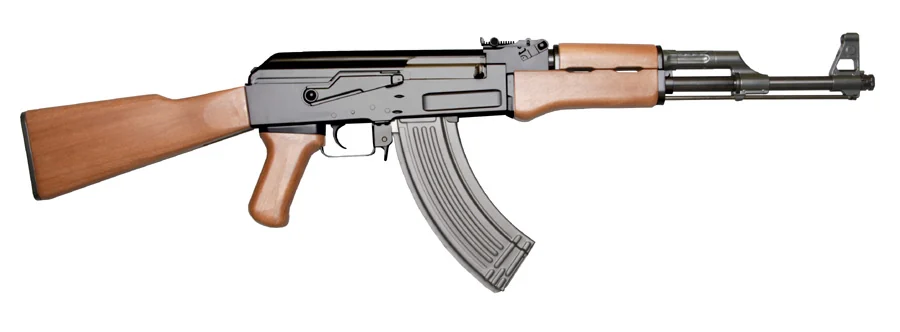
Image credit
- Title
- AK-47 assault rifle
- Author
- Ickybicky at en.wikipedia
- Licence
- Public domain
- Source
- https://commons.wikimedia.org/wiki/File:AK-47_assault_rifle.jpg

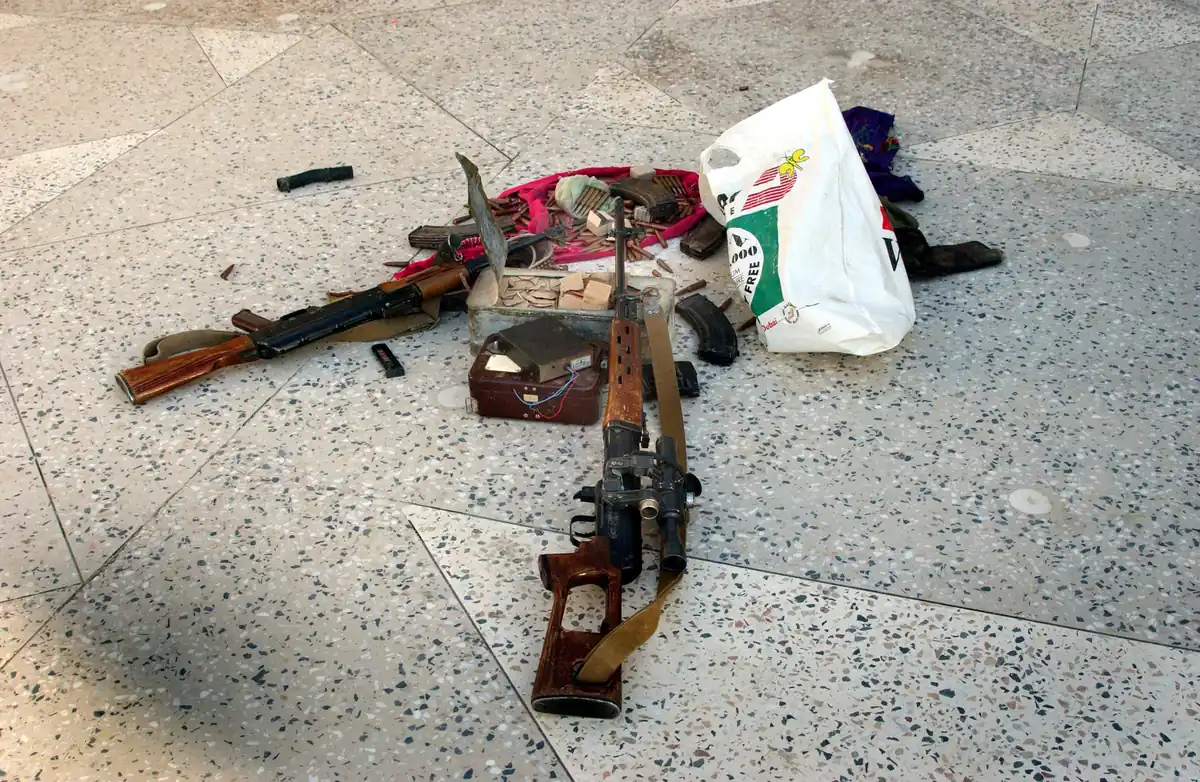
Image credit
- Title
- Captured AK-47, Dragunov and ammunition in Khowst, Afghanistan, during Exercise Alamo Sweep
- Author
- SPC Eric E. Hughes, US Army
- Licence
- Public domain
- Source
- https://commons.wikimedia.org/wiki/File:Captured_AK-47,_Dragunov_and_ammunition_in_Khowst,_Afghanistan,_during_Exercise_Alamo_Sweep.jpg

Detail
Mikhail Kalashnikov’s rifle was not the first Soviet arm for the 1943 intermediate cartridge and it was not obviously the best entry in the trial that selected it. What it had was tolerance: a long-stroke gas piston permanently attached to the bolt carrier, a rotating bolt with two enormous lugs, and clearances generous enough that dirt, ice and poor ammunition rarely stopped the cycle. Those clearances are also why it has never been an accurate rifle by target standards, and both halves of that trade were deliberate.
The receiver went through three shapes in seven years. The stamped Type 1 was abandoned because the factories could not hold it, replaced by a milled billet that was stronger, slower to make and heavier; the stamping only returned, successfully, with the AKM in 1959. A rifle sold today as an AK-47 is almost always an AKM pattern or a descendant of one.
Its production total is an estimate and is labelled as one: no manufacturer has ever published a figure, and the widely repeated seventy-five million is a survey estimate rather than a count.
References
This entry's own bibliography. Every citation key on this page resolves into this list.
- AK-47 · 1371468711 · read 2026-08-27 · CC BY-SA 4.0
Last verified 2026-08-27 · review status: spot-checked