
Arisaka
有坂銃
Koishikawa Arsenal1897–1945Smokeless revolution
Also known as Arisaka-jū, Type 38 rifle
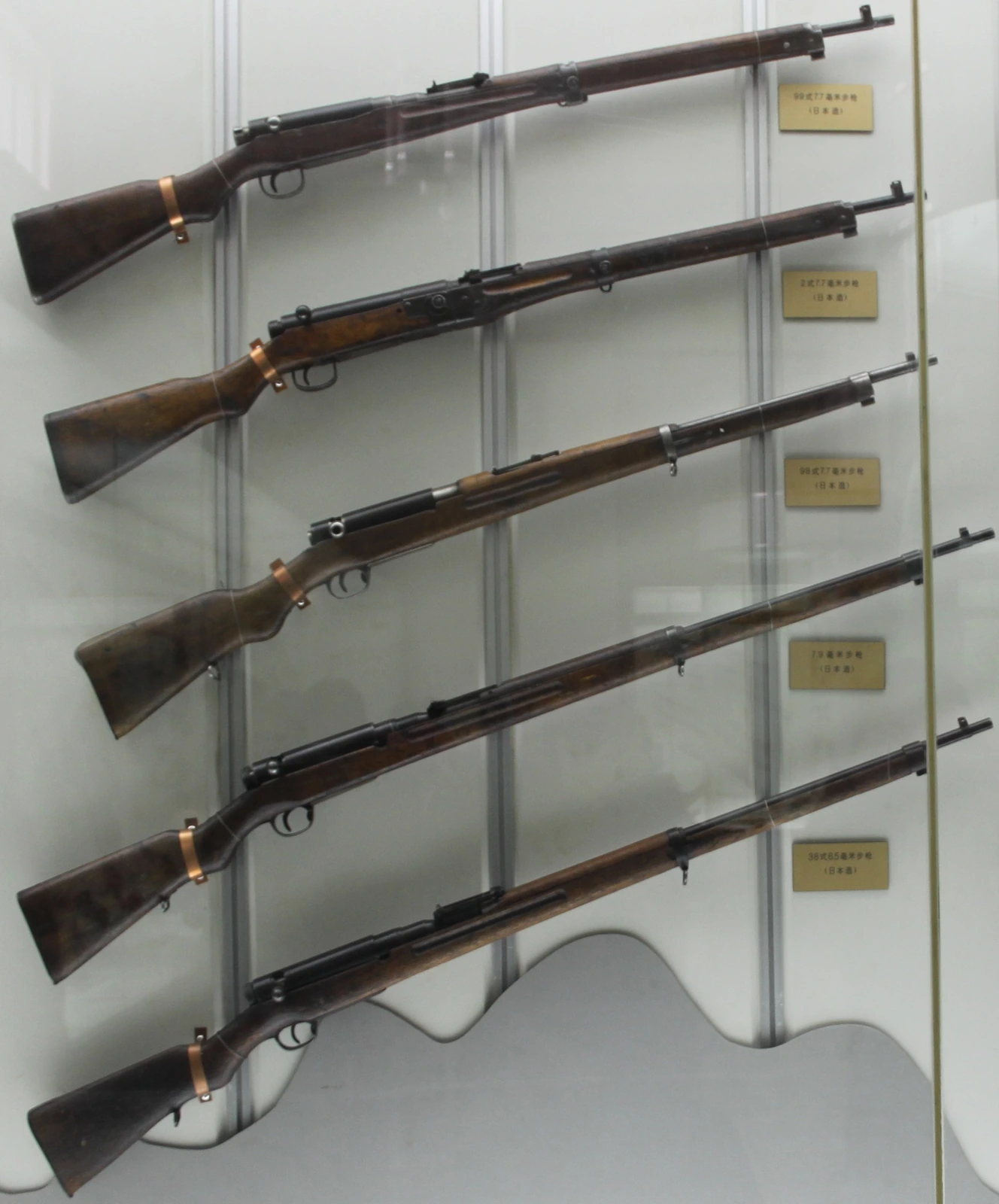
Image credit
- Title
- File:ArisakaDisplay.jpg
- Author
- Gary Todd
- Licence
- CC0, public domain dedication
- Source
- https://commons.wikimedia.org/wiki/File:ArisakaDisplay.jpg

How Muzzle energy is calculated
E = ½ · m · v²
Inputs
- m9.001 g138.9 grverifiedsource138.9 gr as published in the article's ballistics table, converted to grams; the article's running text gives the same bullet as 9.0 g.
- v770 m/s2,526 fpsverifiedMeasured with a 800 mm barrel, not this arm's 797 mm. Velocity outside the sourced range is not projected.
1 of 2 inputs link to their source.
How Muzzle velocity is calculated
nearest sourced barrel length, no extrapolation
Inputs
- v at 800 mm770 m/s2,526 fpsverifiedsource770 m/s as published, in an infobox that declares SI ballistics.
Assumptions
- This figure belongs to a 800 mm barrel. It is shown because it is the closest measurement that exists, not because it applies here.
1 of 1 inputs link to their source.
How Loaded mass is calculated
m_loaded = m_empty + m_magazine + n · m_cartridge
Not calculated: m_magazine has no sourced figure yet. Nothing is substituted for a missing input.
Assumptions
- One magazine, filled to the stated capacity. Spare magazines, optics, slings and lights are the owner’s, not the arm’s.
1 of 4 inputs link to their source.
How Free recoil is calculated
E_recoil = ½ · m_firearm · v_recoil²
Inputs
- m_firearm4.19 kg9.237 lbestimatedFrom the Wikipedia infobox for the Type 38 rifle, uncited there. No arm-mass source states whether a magazine is included.
- v_recoil1.654 m/s5.427 fpsestimated
Assumptions
- Propellant gas momentum is excluded: ARMAG does not record charge weights. This is therefore a lower bound on the real free recoil, consistent between entries but smaller than a figure that includes the gas term.
- Free recoil: the arm is unrestrained. Stock design, muzzle devices, stance and shooter mass are not modelled, because none of them is a property of the arm.
No input on this calculation carries a clickable source yet.
How Capacity is calculated
as published for the primary chambering
Inputs
- capacity5verifiedsourceStated for the Type 38 rifle: a non-detachable staggered-row box magazine loaded from a five-round stripper clip.
1 of 1 inputs link to their source.
Derived figures
Computed from the sourced values above. Open ƒ on any figure for the formula, its inputs, and the assumptions it makes.
How Momentum is calculated
p = m · v
Inputs
- m9.001 g138.9 grverifiedsource138.9 gr as published in the article's ballistics table, converted to grams; the article's running text gives the same bullet as 9.0 g.
- v770 m/s2,526 fpsverifiedMeasured with a 800 mm barrel, not this arm's 797 mm. Velocity outside the sourced range is not projected.
1 of 2 inputs link to their source.
How Sectional density is calculated
SD = mass(gr) / (7000 · diameter(in)²)
Inputs
- mass9.001 g138.9 grverifiedsource138.9 gr as published in the article's ballistics table, converted to grams; the article's running text gives the same bullet as 9.0 g.
- diameter6.63 mm0.2610 inverifiedsourceCartridge maximum, dimension G1, and the same figure the encyclopedia infobox gives. The lead sentence of that article instead states 6.705 mm, which the datasheet contradicts.
Assumptions
- Reported in the conventional lb/in² so it is directly comparable with published figures.
2 of 2 inputs link to their source.
How Power factor is calculated
PF = mass(gr) · velocity(fps) / 1000
Inputs
- mass9.001 g138.9 grverifiedsource138.9 gr as published in the article's ballistics table, converted to grams; the article's running text gives the same bullet as 9.0 g.
- velocity770 m/s2,526 fpsverifiedMeasured with a 800 mm barrel, not this arm's 797 mm. Velocity outside the sourced range is not projected.
Assumptions
- A competition classification defined by the IPSC and USPSA rulebooks, stated in their units. It describes a scoring category, not an effect.
1 of 2 inputs link to their source.
How Magazine dump is calculated
t = (n − 1) / (rpm / 60)
Not calculated: rpm has no sourced figure yet. Nothing is substituted for a missing input.
Assumptions
- Cyclic rate held for the whole magazine, no stoppages, trigger held down. A theoretical figure for comparing mechanisms, not a measured one.
1 of 2 inputs link to their source.
How Sight error at 1 mm is calculated
θ = atan(misalignment / sight radius)
Not calculated: sight radius has no sourced figure yet. Nothing is substituted for a missing input.
Assumptions
- Shows what a stated aiming error costs. The misalignment is the reader’s figure; the site does not claim how well anyone aims.
No input on this calculation carries a clickable source yet.
Specifications
Every row here is generated from the schema, so a figure recorded on this entry cannot be missing from the table, and the same rows, read the same way, are what the comparison shows.
Identity
- Type
- Rifle
- Action
- Bolt action
- Fire modes
- not recorded
- Operating system
- Manually operated
- Roles
- Designed in
- Japan
- Produced in
- Introduced
- 1897
- Production
- 1897–1945
Dimensions and mass
- Mass, empty
- 4.19 kg9.237 lbestimated
From the Wikipedia infobox for the Type 38 rifle, uncited there. No arm-mass source states whether a magazine is included.
- Magazine, empty
- not recorded
- Length
- 1,275 mm50.20 inestimated
From the Wikipedia infobox for the Type 38 rifle, uncited there. Full-length rifle configuration; the Type 38 carbine measured 966 mm.
- Length, folded
- not recorded
- Width
- not recorded
- Height
- not recorded
- Barrel length
- 797 mm31.38 inestimated
From the Wikipedia infobox for the Type 38 rifle, uncited there. Full-length rifle configuration; the Type 38 carbine measured 487 mm.
Sights and rifling
- Sight radius
- not recorded
- Sight height over bore
- not recorded
- Rifling twist
- not recorded
- Twist direction
- not recorded
- Grooves
- not recorded
- Sight graduation
- not recorded
Operation
- Cyclic rate
- not recorded
- Trigger pull
- not recorded
- Effective range
- not recorded
- Units produced
- not recorded
- Launch price
- not recorded
Chamberings
- 6.5x50mmSR Arisakaprimary5 rounds
Scale
A to-scale outline against family siblings. The dimensions are sourced; the shape is a representative outline for the type, and says so.
- Arisaka1,275 mm50.20 inheight not recorded
Representative outline: the dimensions are sourced, the shape is not. Overall length, and barrel length where recorded, are drawn from this entry's own figures; the profile is a generic one for the firearm type and says nothing about this arm's actual contours. Arisaka records no height, so its outline is drawn at the type's proportion. That height is part of the shape, not a measurement.
Gallery
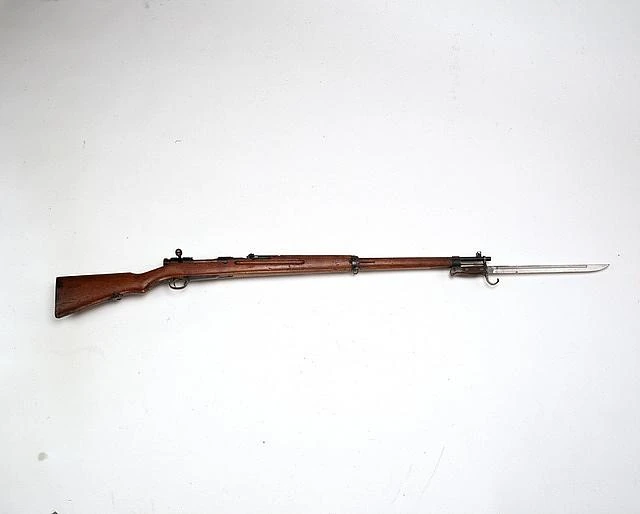
Image credit
- Title
- Japanese Arisaka Rifle with Bayonet
- Author
- NMAH
- Licence
- CC0, public domain dedication
- Source
- https://n2t.net/ark:/65665/ng49ca746a2-1bc5-704b-e053-15f76fa0b4fa
- Note
- Smithsonian Open Access, released CC0 by the NMAH. Museum identifier: AF.59478M; 59478M; 214893.
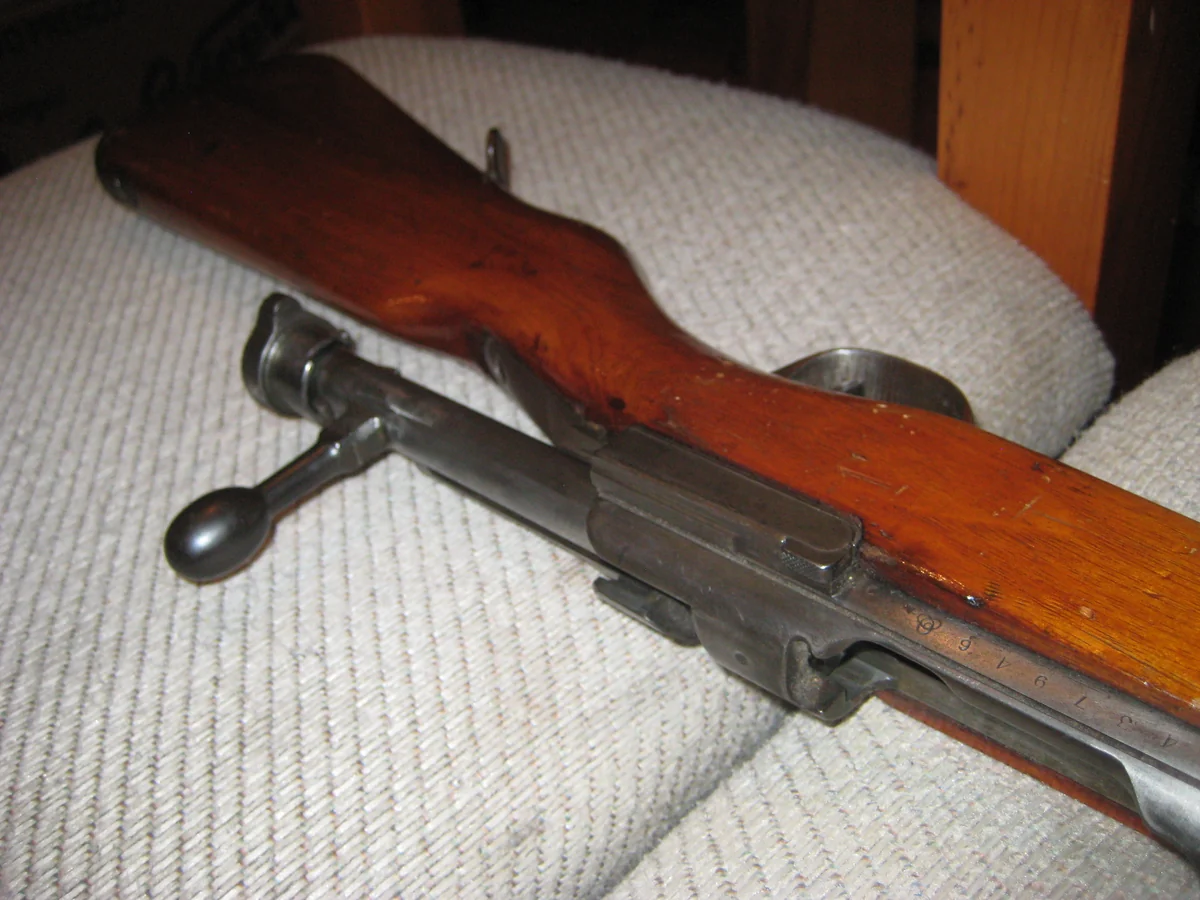
Image credit
- Title
- File:Arisaka Type 38 rifle action.JPG
- Author
- Ca.garcia.s(attribution required)
- Licence
- CC BY-SA 3.0
- Source
- https://commons.wikimedia.org/wiki/File:Arisaka_Type_38_rifle_action.JPG

Detail
The Arisaka is the bolt-action rifle that armed the Imperial Japanese Army and Navy from 1897, when it replaced the Murata rifle, into the Second World War. It takes its name from Colonel Arisaka Nariakira, who headed the commission that designed it; the action resembled, and may have drawn on, the German Rifle Testing Commission’s 1888 bolt-action design, itself built on earlier Mauser work. This entry covers the line’s most widely produced form, the Type 38, designed by Major Kijirō Nambu and adopted in 1905 for the 6.5×50mmSR Type 38 cartridge, the chambering the Arisaka name is most closely associated with, and the one carried by the largest number of rifles the design ever produced.
The Type 38 fed from a five-round non-detachable box magazine loaded from a stripper clip pressed in from the top, a magazine and loading arrangement it shared with most of the family that came before and after it. Its receiver and bolt were carbon steel, and post-war destructive testing found the action stronger than the contemporary M1903 Springfield, Lee–Enfield and Mauser designs. Rifles issued to imperial forces carried a sixteen-petal chrysanthemum stamped into the top of the receiver as a mark of imperial ownership; occupation-era policy required the mark’s removal before a rifle left Japanese state service, which is why it is ground, filed or stamped over on most examples that survive outside Japan today.
Beyond Japan, the Type 38 saw service with the Imperial Russian Army, in Finland and Albania, and with the Czechoslovak Legions during the Russian Civil War; Britain’s Royal Navy bought a quantity during the First World War to free up Lee–Enfield rifles for its own land forces, and small numbers were exported to Mexico. Production of the rifle and its ammunition stopped abruptly at Japan’s 1945 surrender, and large numbers were brought home as war trophies by American servicemen, which is why the type remains common in North American collections.
The Arisaka name also covers a later generation, the Type 99 of 1939, which the army developed from the Type 38 to fire the more powerful 7.7×58mm cartridge already used in its machine guns. Because it changed the primary cartridge, it is a separate entry rather than a variant of the rifle described here.
Most Type 38s, an estimated two million, were built at the Koishikawa Arsenal in Tokyo between 1906 and 1932, with the rest from the Kokura, Nagoya, Jinsen and Mukden arsenals.
No source consulted states whether the Type 38’s mass figure includes its magazine, and no free dimensional standard exists for the 6.5×50mmSR Type 38 cartridge to check the rifle’s chamber dimensions against. No twist rate for the Type 38’s barrel is published by any source found.
References
This entry's own bibliography. Every citation key on this page resolves into this list.
- Arisaka · Wikipedia · 1369456234 · read 2026-09-24 · CC BY-SA 4.0
- Type 38 rifle · Wikipedia · 1376325323 · read 2026-09-24 · CC BY-SA 4.0
- Japanese Arisaka Rifle with Bayonet · Smithsonian National Museum of American History · read 2026-09-24 · CC0
Last verified 2026-09-24 · review status: agent-populated