American · Dessert
Red Velvet Cake
A cocoa sponge coloured deep red and soured with buttermilk, layered with cream cheese frosting. One serving is one slice from a two-layer cake.
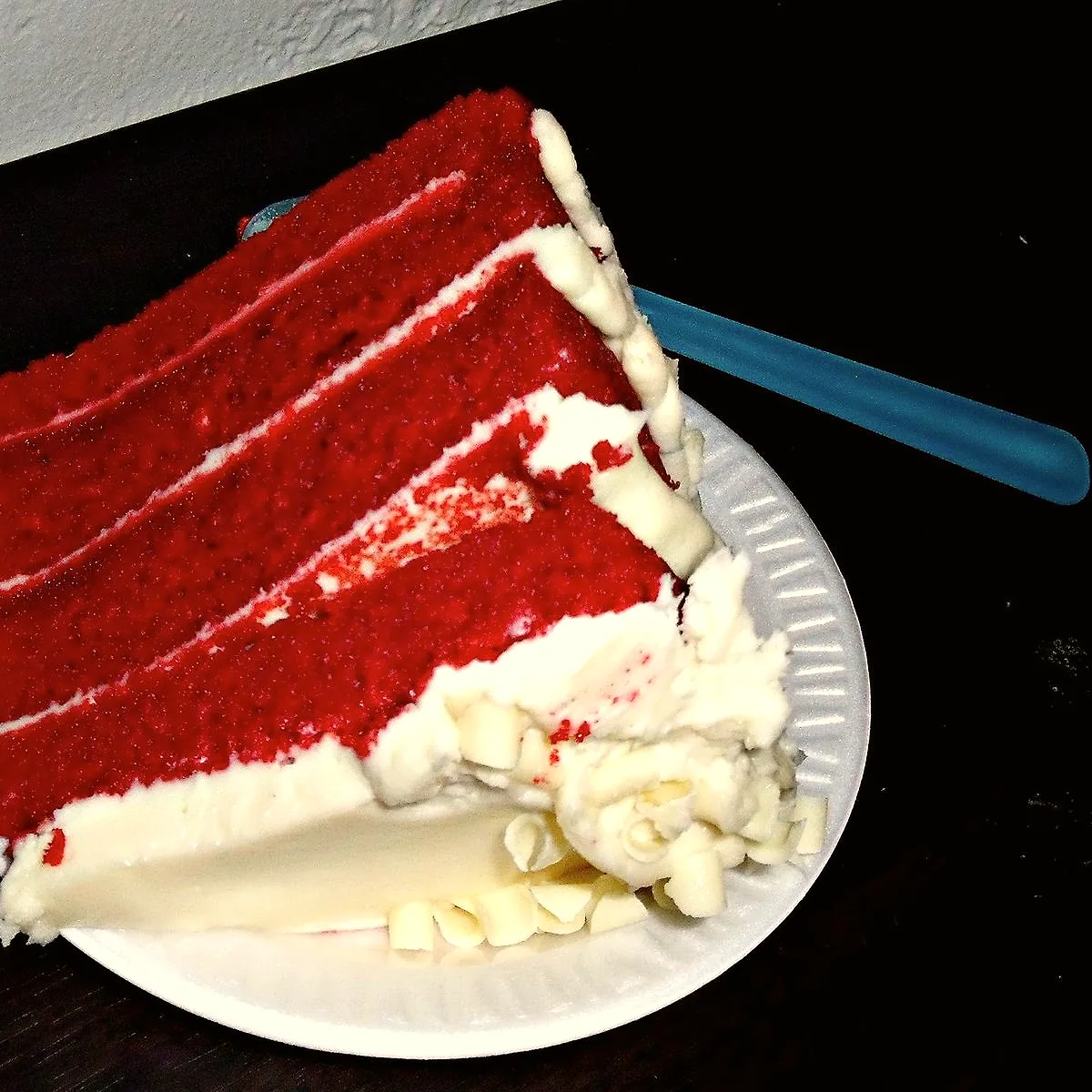

CC BY 2.0. Cropped and colour-adjusted for this site.
Method
Heat the oven to 175 °C and butter and line two cake tins, allowing 12m for the oven to come to temperature.
Whisk the 300 g plain flour, 15 g cocoa powder, 5 g bicarbonate of soda and 4 g fine sea salt together in a bowl.
Whisk the 300 g caster sugar with the 180 ml vegetable oil and the 3 eggs (150 g) until smooth. Whisk in the 250 ml cultured buttermilk, the 8 ml vanilla extract, the 10 ml cider vinegar and the 10 ml red food colouring, then fold in the dry ingredients over 6m, mixing only until smooth. Divide the batter between the prepared tins straight away.
The vinegar and buttermilk react with the bicarbonate of soda as soon as they meet it, so the batter goes into the oven promptly once combined, while that reaction is still lifting it.
Bake at 175 °C for 28m, until a skewer pushed into the centre of each sponge comes out clean.
Common pitfallOpening the oven door before the sponge has set lets the layers sink in the centre, since the structure is still held up mainly by trapped gas rather than set crumb at that stage.
Cool the sponges in their tins briefly, then turn them out onto a rack and leave to cool completely, for 1h.
While the sponges cool, beat the 250 g cream cheese with the 100 g unsalted butter, the 300 g icing sugar and the 5 ml vanilla extract until smooth and holding soft peaks, over 6m.
Spread a layer of frosting over the top of one cooled sponge, set the second sponge on top, and cover the top and sides with the remaining frosting, spending 10m to leave an even coat.
"Velvet" cakes (named for a fine, soft crumb rather than any particular colour) were a Victorian-era category on both sides of the Atlantic, made with cocoa powder to give a tender texture unlike a plain yellow or white cake [1]. The reddish tinge now considered essential to red velvet began as a genuine, if unreliable, side effect of baking: natural, non-Dutched cocoa powder can react with an acid such as buttermilk or vinegar in a way that shifts its colour slightly toward red, and early twentieth-century bakers noticed and leaned into it. By around 1911 a "velvet cocoa cake" using this reaction was already circulating [1].
The cake's best-known origin story credits the Waldorf-Astoria Hotel in New York with inventing it in the 1920s, a claim the hotel's own cookbook repeats. The claim does not hold up: the earliest documented cake using a large, deliberate dose of red food colouring (as opposed to the faint, natural reddish-brown of the cocoa reaction) is a "Waldorf red cake" recipe that only appears in 1959, by which point the Waldorf-Astoria had never actually served anything resembling today's red velvet cake [2]. What the hotel is more plausibly connected to is a later urban legend in which a customer was charged for the recipe and retaliated by mailing it to everyone she knew. It is a story with no documented source, told about more than one Waldorf dish, and not confirmed by either source consulted here.
The modern cake (deep red from added colouring rather than from chemistry alone, and typically finished with cream cheese frosting) is a mid-twentieth century American product built on top of a much older, much paler cocoa cake tradition [1].
Sources
- The evolution of red velvet cake, an iconic American dessert, The Splendid Table (American Public Media)On the Victorian "velvet cake" tradition and the cocoa-buttermilk-vinegar reaction behind the early cake's colour.
- Red Velvet Cake Was Originally Born at the Waldorf-Astoria Hotel, Untapped New YorkExamines and questions the Waldorf-Astoria origin claim.