Colombian · Side
Patacones
Green plantain fried once to soften, flattened into wide discs, then fried again until crisp, and finished with hogao, Colombia's tomato-and-onion sauce.
Not the same asTostones (The same twice-fried green plantain technique under its Caribbean name. Puerto Rico, Cuba and the Dominican Republic use tostones, dipped in salted water between fryings rather than finished with hogao.)
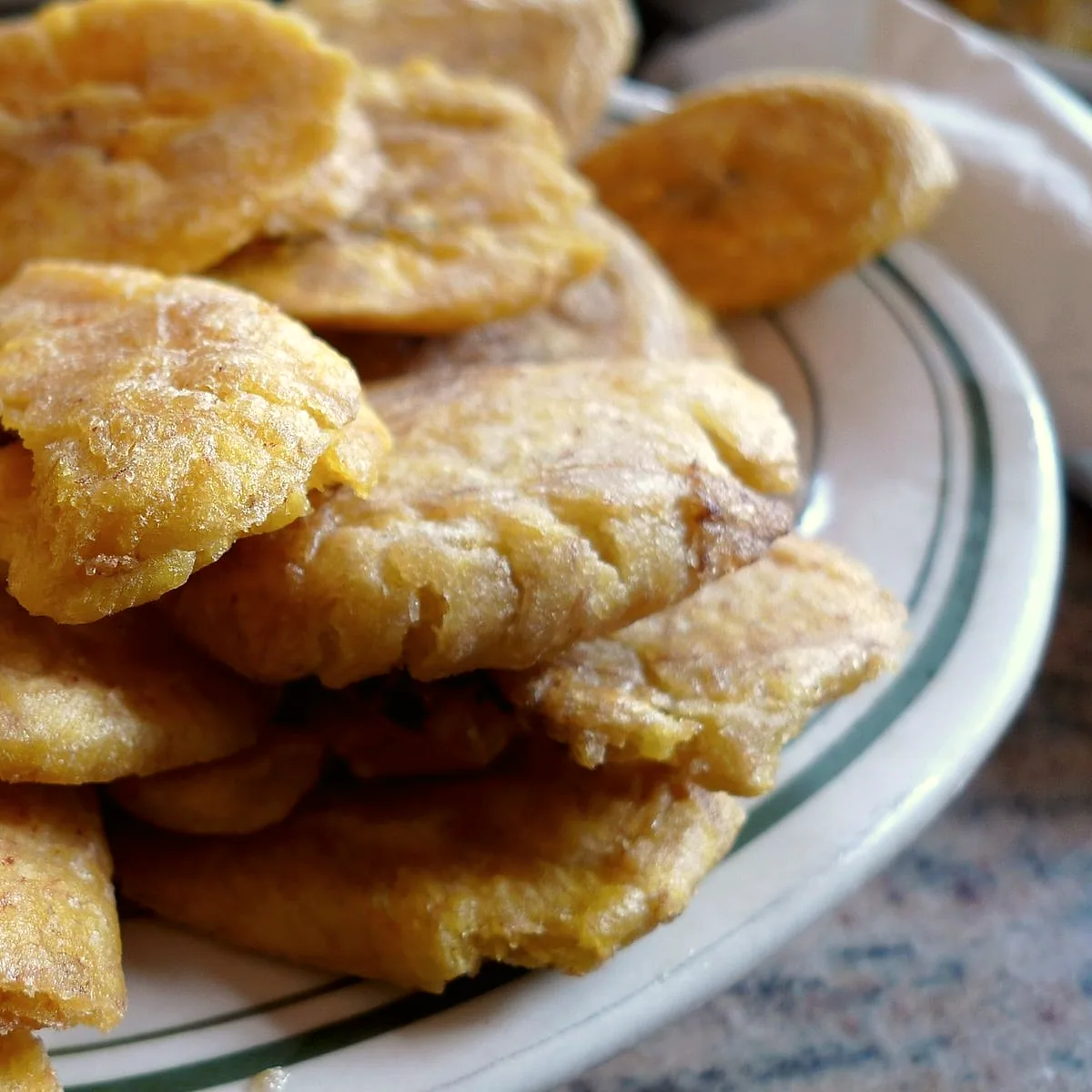

CC BY 2.0. Cropped and colour-adjusted for this site.
Method
Heat the 15 ml extra-virgin olive oil in a small pan over a low heat and cook the 80 g white onion and 1 ½ garlic cloves (8 g) until soft, then add the 150 g ripe tomatoes, 1 g ground cumin and 2 g fine sea salt and cook gently for 15m, until the tomato has completely broken down into a thick sauce.
Cooking the tomato and onion down slowly until they collapse into a thick, jammy sauce, rather than leaving them fresh and chunky, is what gives hogao the concentrated sweetness that plain fried plantain needs alongside it.
Meanwhile, heat the 700 ml vegetable oil in a deep, heavy pan and fry the 500 g green plantain for 8m, until pale gold and just tender but not browned. Lift out and drain, leaving the oil in the pan.
Press each piece flat with a tostonera, the base of a glass, or the flat side of a knife, into a wide disc. This takes about 5m.
Common pitfallPlantain flattened straight from the hot oil tears easily; letting it cool for a few seconds first, or pressing gently rather than all at once, keeps the disc in one piece.
Return the plantain to the hot oil and fry for 6m, until deeply golden and crisp at the edges. Drain, season with the 5 g fine sea salt, and serve with the hogao spooned over or alongside.
The technique behind patacones (frying green plantain, flattening it, and frying it again until crisp) is not itself Colombian in origin. African agricultural and culinary traditions shaped how plantain was grown and prepared once it reached the Americas, brought by enslaved Africans for whom the fruit became an affordable, filling food [2] [1]. What is more locally specific is the Colombian name for the result, which follows a different history from the Caribbean's more common name for the same food.
Where "tostón" comes straightforwardly from tostar, the Spanish verb for toasting, "patacón" is argued to travel a considerably longer route: from the Arabic batakká, later associated in Italy with the word patácca, and into colonial Spanish American use as a name for a silver coin; a 1627 document from Santa Fe, present-day Bogotá, already records "patacón" used with that meaning [1]. On this account, the fried plantain disc took its name not from how it was cooked but from what it looked like once flattened: round and flat, echoing that colonial coin closely enough for the name to stick.
The same food travels under different names today: tostones in much of the Caribbean, patacones in Colombia and, further south, in Peru [2], a naming split that maps political and linguistic history onto a dish whose underlying technique never actually changed.
Sources
- El patacón: un paso del oro al servicio de los paladares, Noticias la Voz RealitiesTraces "patacón" to the Arabic batakká, a word later associated in Italy with patácca, and cites historian Fabio Gómez Arrubla's finding of a 1627 Santa Fe (Bogotá) document recording "patacón" as meaning a silver coin; also describes enslaved Africans adapting plantain into a staple food.
- Behind the Recipes: Tostones, America's Test KitchenStates that African agricultural and culinary traditions shaped plantain cultivation and preparation in the Americas, and that the same twice-fried plantain is called patacones in Peru.