Thai · Snack
Moo Ping
Thin-sliced pork shoulder marinated in coconut milk, fish sauce and palm sugar, grilled over charcoal until sticky and lightly charred. It is a street snack, not a plated main.
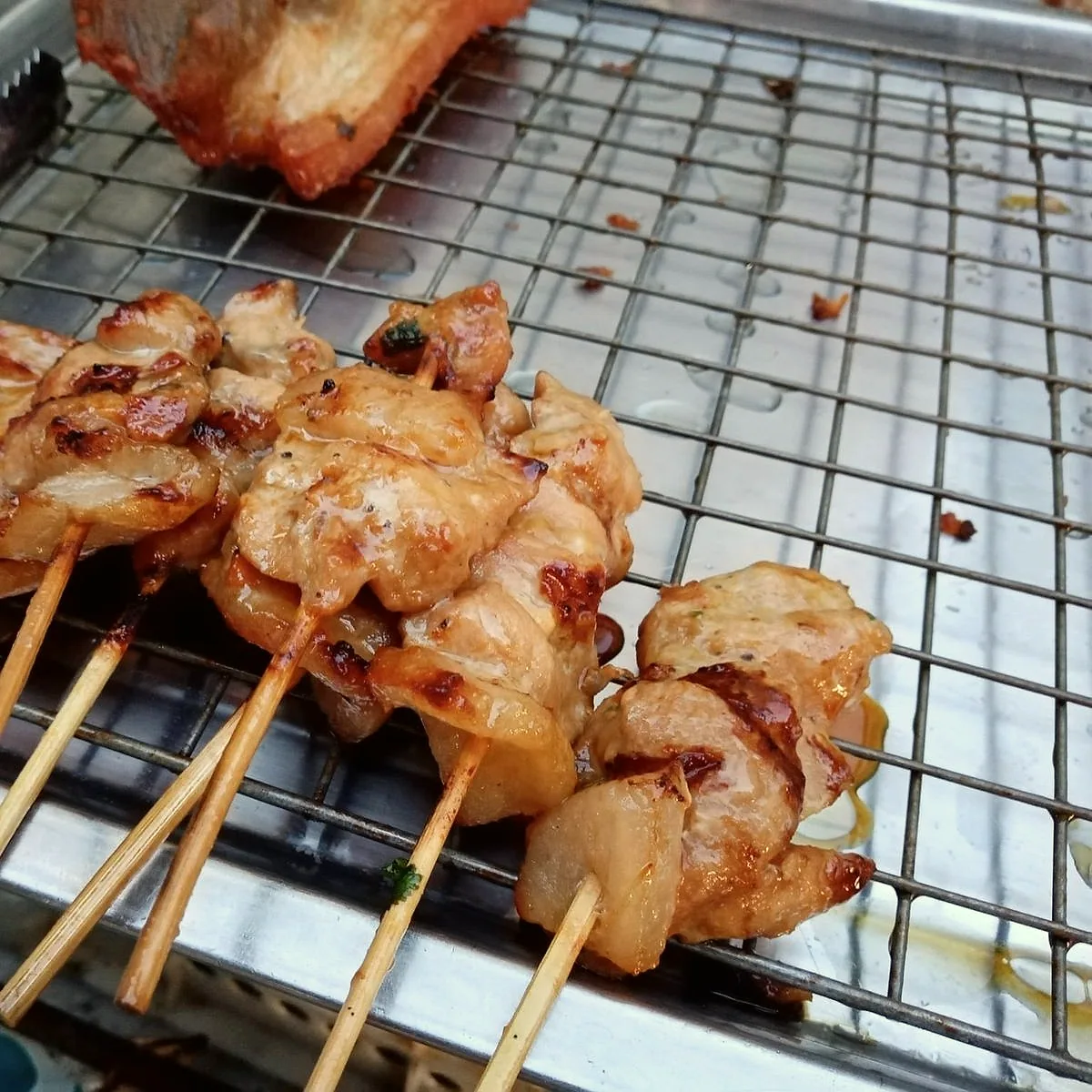

CC BY-SA 4.0. Cropped and colour-adjusted for this site.
Method
Stir the 60 ml coconut milk, 20 ml fish sauce, 30 g palm sugar, 2 garlic cloves (10 g), 10 g fresh coriander and 1 g ground white pepper together in a bowl until the sugar has mostly dissolved.
Add the 400 g pork shoulder to the marinade, turning to coat every slice, and leave it to marinate, covered and refrigerated, for 3h.
Thread the marinated slices onto skewers, weaving each slice back and forth so it sits in a compact ripple rather than a flat sheet.
Grill the skewers over hot charcoal for 8m, turning often, until the edges are lightly charred and sticky and the pork is cooked through.
Common pitfallSlices this thin cook through in minutes, and the sugar in the marinade catches easily. Direct heat close to the coals gives the char before the meat dries out; leaving the skewers too long turns the sugar bitter.
Moo ping's rise as a Thai street food is tied to a specific piece of urban infrastructure rather than a kitchen. Sources place it in the early 1950s, when carts used to transport food were redesigned into mobile vendor stalls, making it easy for sellers to carry a charcoal grill through the city and serve pork skewers where people already were [1][2]. That shift, rather than any single recipe, is what turned grilled pork into an everyday breakfast and snack sold on Bangkok's streets from early morning.
The marinade itself now exists in two recognised styles. Mu ping boran, the older style, is built on a soy-based marinade; mu ping nom sod, literally "fresh milk", replaces it with milk to tenderise the meat and is now the more commonly sold version [1]. Which milk is meant is not fixed: dairy milk is the version the name literally describes, but coconut milk is a documented variation used for the same tenderising, creamier effect, and it is coconut milk rather than dairy that most versions cooked outside Thailand are built around [1]. Both styles share the same base of coriander root, garlic and black pepper worked into the marinade before the pork goes in.
Sources
- Mu ping, WikipediaNames the two marinade styles, mu ping boran and mu ping nom sod, and the 1952 street-cart redesign.
- How to Make Moo Ping | Thai Grilled Pork, Thai-FoodieCorroborates the 1950s date for the cart redesign that spread moo ping as street food, without pinning it to a single year.