Georgian · Main Course
Khinkali
A thick-doughed Georgian dumpling gathered into a twisted topknot, boiled so the beef and pork filling forms its own broth inside.
Not the same asXiao long bao (A steamed Chinese dumpling whose broth comes from a jellied aspic that melts as it steams, in a thin, delicate wrapper eaten in one bite with a spoon. Khinkali is boiled rather than steamed, its broth comes from water worked directly into the raw filling rather than a set aspic, and its thick topknot is deliberately left uneaten.)
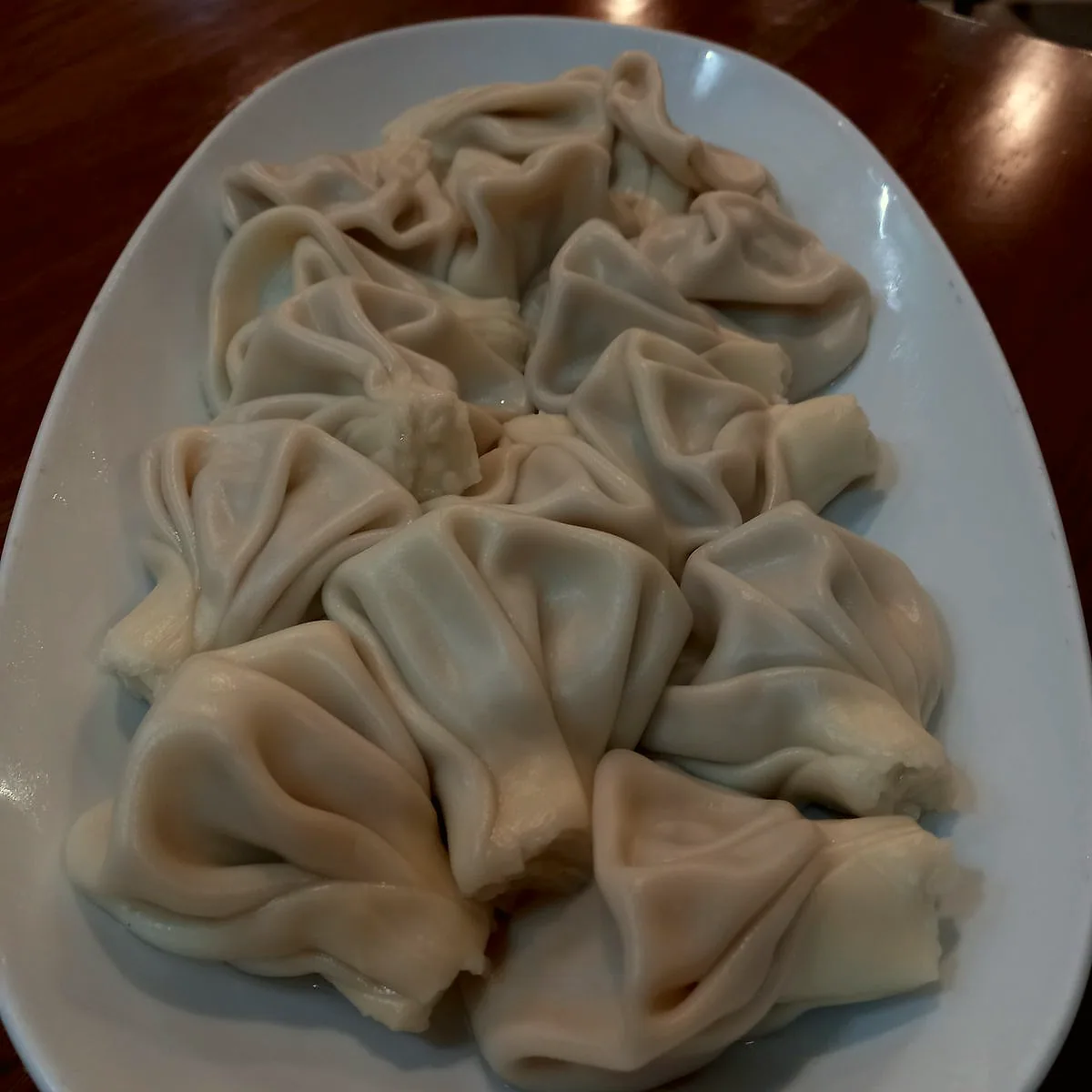

CC BY-SA 4.0. Cropped and colour-adjusted for this site.
Method
Combine the 320 g plain flour, 150 ml water and 4 g fine sea salt in a bowl and bring together into a firm dough, then turn it out and knead for 10m until smooth and no longer tacky.
Cover the dough and rest it for 30m at room temperature, until it has relaxed and no longer springs back when pressed.
Meanwhile, combine the 180 g beef mince, 180 g pork mince, 120 g yellow onion, 2 ½ garlic cloves (12 g), 12 g fresh coriander, 4 g ground black pepper and 5 g fine sea salt in a bowl. Work in the 100 ml water a little at a time, mixing until the filling turns loose and wet rather than staying stiff.
Working water into the raw mince rather than adding a stock later is what fills the sealed dumpling with broth as it boils; a drier filling gives a dumpling with no soup inside.
Roll the rested dough out on a surface dusted with the 20 g plain flour and cut into rounds about 10 cm across. Spoon filling into the centre of each round, then gather the edge up around it in narrow pleats, twisting the pleats together at the top into a knotted handle and pinching the join fully shut. Set the shaped khinkali on a floured tray, knot up, as you go.
Common pitfallA twisted seam that is not pinched fully shut lets the broth leak out into the pot rather than staying inside the wrapper.
Drop the khinkali into a large pot of well-salted, gently boiling water, stirring once so they do not settle on the base, and cook for 12m, until they float and the dough is cooked through. Lift out with a slotted spoon and serve at once, holding each by its knotted top to eat and setting the knot itself aside uneaten.
Khinkali is credited to Georgia's northeastern mountain provinces (Pshavi, Khevsureti, Tusheti, Mtiuleti and Khevi) where it is remembered as food made for shepherds and farmers working long hours in a cold climate, portable and filling enough to sustain a day of labour [1]. Local tradition inside Georgia credits particular mountain villages, Pasanauri among them, with originating the dish [2].
How the dish arrived in those mountains at all is not settled. One account holds that it travelled with Mongol steppe armies passing along the Silk Road around the thirteenth century, who carried meat wrapped in dough as trail food, and that it entered Georgian cooking from that contact [1]. The theory is disputed rather than accepted: at least one Georgian chef has rejected it outright as invention purely local to the Caucasus, while other food writers argue the steppe connection plausible without treating it as proven [2]. No single source settles which account is right.
The dish's two main styles mark out where it comes from. The mountain version, khevsuruli or mtiuluri, is seasoned sparely (minced lamb, beef or pork with onion, salt, chilli and cumin, and no fresh herbs at all), while the urban kalakuri style that spread to Tbilisi and beyond works parsley and coriander into the filling [1][2]. The herbs are the dividing line between the two, not the meat.
One piece of etiquette survives from the mountains into the modern restaurant: the twisted knob of dough at the top, formed where the pleats are gathered and sealed, is tough enough that it is traditionally left on the plate rather than eaten, and diners are said to count the discarded knobs to tally how many they have had [1].
Sources
- Khinkali, WikipediaSets out the mountain-province origin, the shepherd purpose, the khevsuruli/kalakuri filling distinction, and the tradition of discarding the topknot.
- From Mountain Staple to National Icon: Georgia's Khinkali, Feast JournalA Georgian chef's rejection of the steppe-influence theory set against the case for it, and the mtiuluri/kalakuri seasoning contrast.