Chinese · Main Course
Jiaozi
Pork and napa cabbage folded into a thin unleavened wheat wrapper. It is the everyday Chinese dumpling, boiled, steamed or pan-fried depending on the meal.
Also known asChinese dumplings
Not the same asGuotie (A related but distinct dumpling in northern Chinese usage: smaller, pleated only along the top, and pan-fried in a single open-ended shape rather than boiled or folded into a sealed half-moon.)Gyoza (The Japanese descendant, developed from jiaozi recipes after the Second World War, with a thinner machine-rolled wrapper, a finer mince and more garlic.)
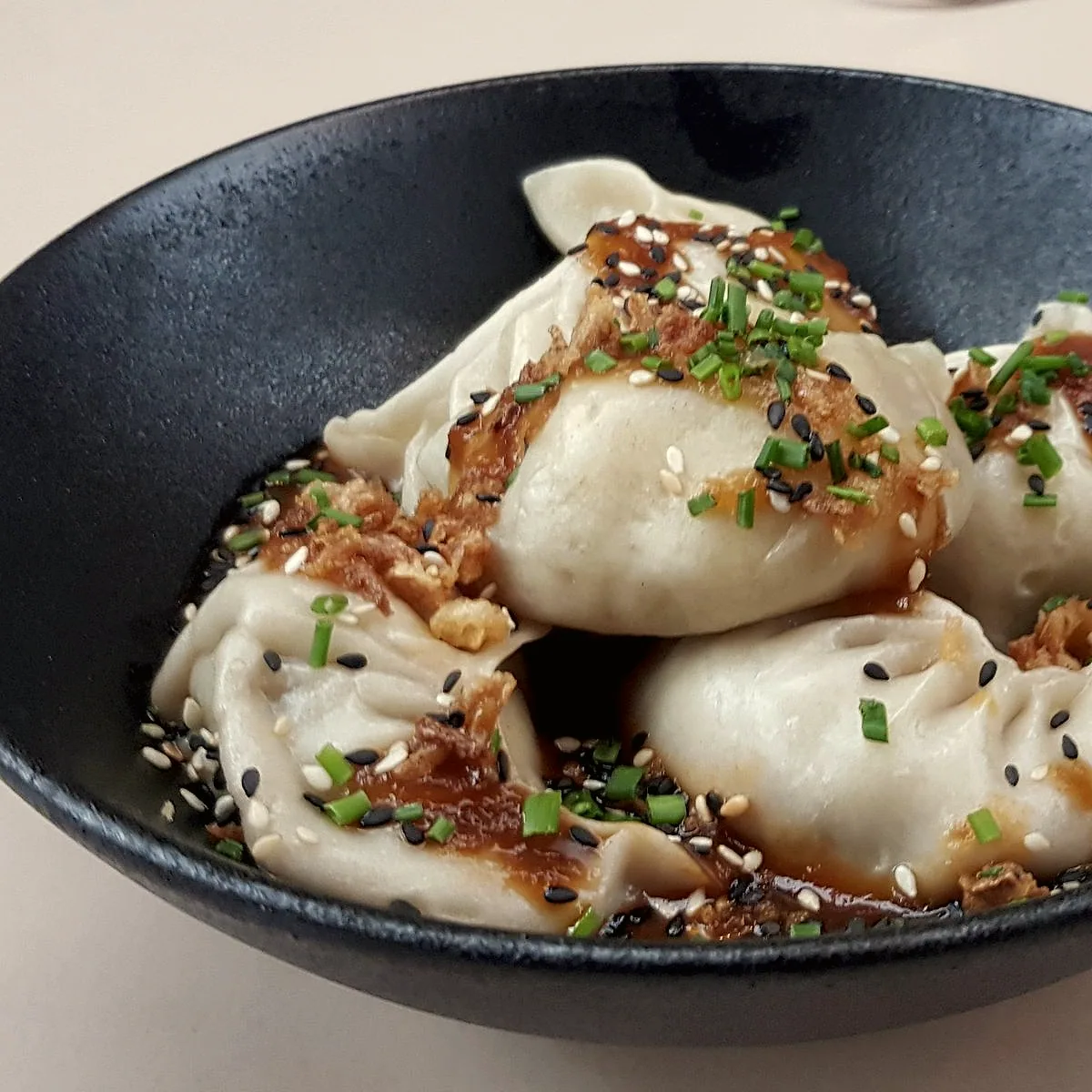
_by_ArmAg.jpg)
CC BY-SA 4.0. Cropped and colour-adjusted for this site.
The same dish, adapted. Every quantity, time and figure below changes with the version.
Method
Combine the 300 g plain flour, 160 ml water and 3 g fine sea salt in a bowl and bring together into a shaggy dough, then turn it out and knead for 10m until smooth and firm.
Cover the dough and rest it for 30m at room temperature, until it has relaxed and no longer springs back when pressed.
Meanwhile, combine the 300 g pork mince, 300 g napa cabbage, 10 g fresh ginger, 2 spring onions (30 g), 15 ml light soy sauce, 10 ml toasted sesame oil, 1 g ground white pepper and 4 g fine sea salt in a bowl and stir hard in one direction until the mixture stiffens and holds together.
Roll the rested dough into a log and pinch off small, even pieces, keeping the rest covered. Roll each piece with the 20 g plain flour underneath into a thin round about 8 cm across, thicker at the centre than at the rim. Spoon filling into the middle of each round and pleat the edge closed into a sealed half-moon, standing it upright on its base.
Common pitfallA wrapper rolled thicker at the centre than the edge is the standard fix for a filling that tears through; the seam is already doubled by the pleat, so the centre does not need the extra thickness.
Drop the dumplings into a large pot of rapidly boiling water, working in batches so the pot is not crowded. Once the water returns to the boil, add a splash of cold water to check it, and repeat as the water threatens to boil over. Cook for 8m in total, until the dumplings float and the wrappers look taut and slightly translucent.
Adding cold water partway through keeps the pot at a rolling simmer rather than a hard boil, which cooks the thick folded seam through without splitting the thinner wrapper around it.
Method
Combine the 300 g plain flour, 160 ml water and 3 g fine sea salt in a bowl and bring together into a shaggy dough, then turn it out and knead for 10m until smooth and firm.
Cover the dough and rest it for 30m at room temperature, until it has relaxed and no longer springs back when pressed.
Meanwhile, combine the 300 g pork mince, 300 g napa cabbage, 10 g fresh ginger, 2 spring onions (30 g), 15 ml light soy sauce, 10 ml toasted sesame oil, 1 g ground white pepper and 4 g fine sea salt in a bowl and stir hard in one direction until the mixture stiffens and holds together.
Roll the rested dough into a log and pinch off small, even pieces, keeping the rest covered. Roll each piece with the 20 g plain flour underneath into a thin round about 8 cm across, thicker at the centre than at the rim. Spoon filling into the middle of each round and pleat the edge closed into a sealed half-moon, standing it upright on its base.
Heat the 15 ml peanut oil in a wide, lidded pan over a high heat. Stand the dumplings in, base down, packed close together, and sear for 3m until the bottoms are golden.
Common pitfallA cold pan or a low flame lets the wrappers sit in oil instead of searing, so the base turns pale and greasy rather than crisp. The pan needs to be properly hot before the dumplings go in.
Pour in the 60 ml water, cover at once and let the dumplings steam-fry for 6m, until the water has all but disappeared and the wrappers have turned from opaque to glossy.
Uncover and cook for a further 2m, letting the last of the water evaporate and the base recrisp. Loosen with a spatula and turn out base-up.
Method
Combine the 300 g plain flour, 160 ml water and 3 g fine sea salt in a bowl and bring together into a shaggy dough, then turn it out and knead for 10m until smooth and firm.
Cover the dough and rest it for 30m at room temperature, until it has relaxed and no longer springs back when pressed.
Meanwhile, combine the 300 g pork mince, 300 g napa cabbage, 10 g fresh ginger, 2 spring onions (30 g), 15 ml light soy sauce, 10 ml toasted sesame oil, 1 g ground white pepper and 4 g fine sea salt in a bowl and stir hard in one direction until the mixture stiffens and holds together.
Roll the rested dough into a log and pinch off small, even pieces, keeping the rest covered. Roll each piece with the 20 g plain flour underneath into a thin round about 8 cm across, thicker at the centre than at the rim. Spoon filling into the middle of each round and pleat the edge closed into a sealed half-moon, standing it upright on its base.
Line a steamer basket so the dumplings cannot touch the metal or bamboo directly, and set them in with space between each. Steam over rapidly boiling water for 12m, until the wrappers turn glossy and slightly translucent and the filling is cooked through.
Common pitfallDumplings set straight on the metal or bamboo of a steamer stick fast and tear when lifted. A base of cabbage leaf, baking paper or an oiled plate keeps them free.
Jiaozi are old enough that their history is written in fragments rather than in one continuous record. The character jiaozi appears in the Guangya, a dictionary compiled during the Three Kingdoms period, and a century later the scholar Yan Zhitui described a dumpling "shaped like a crescent moon" as already common food across the land [1]. The archaeological record agrees with the texts: dumplings recovered from a Tang dynasty tomb near Turpan, over a thousand years old, are close enough to today's jiaozi to be identified on sight [1]. The Astana cemetery there has yielded dumplings spanning the Six Dynasties period as well as the Tang, preserved by the dry climate of the Turpan basin and described by archaeologists as crescent-shaped parcels of meat in a wheat-flour wrapper that look much like what is eaten in China now [2].
The dish's popular origin story is a different kind of claim. It credits the Eastern Han physician Zhang Zhongjing with inventing jiaozi as medicine, stewing lamb, black pepper and warming herbs, wrapping the mixture in dough shaped like an ear, and distributing it to treat the frostbitten poor one winter. The shape is said to be why jiaozi are still eaten at the new year for luck, and why the fold is meant to resemble an ear as much as it resembles the crescent moon of the earlier written record. It is a well-loved story and an unverified one: it rests on tradition rather than on any documentary or archaeological source, and it sits alongside a written record for the dumpling itself that predates the Han physician's lifetime by less than the legend implies [1].
What the sources do establish without dispute is jiaozi's role as a food that travelled. Its most direct descendants carry that history in their names: Japanese gyoza, adapted from jiaozi recipes brought home after the Second Sino-Japanese War, and Cantonese guotie, whose pan-fried bottom and steamed top are treated in the north as a dumpling in their own right and in the south as simply how jiaozi are cooked when boiling is not the plan. The wrapper, the fold and the ratio of meat to cabbage travelled outward from the same long-attested dish; the cooking method did not have to.
Sources
- Jiaozi, WikipediaCollates the textual references across dynasties, the Turpan tomb find, and the Zhang Zhongjing legend's status as folklore rather than documented history.
- A Lucky Food for Lunar New Year, Archaeology NowBecky Lao on the Astana cemetery finds: the range of dates represented, the dry-climate preservation, and how closely the excavated dumplings resemble modern ones.