Chinese · Main Course
Red Braised Pork Belly
Pork belly seared, then braised low and slow in soy sauce, rice wine, star anise and rock sugar until the fat turns glossy and almost translucent.
Also known asHong shao rouMao's red-braised pork · Hunan
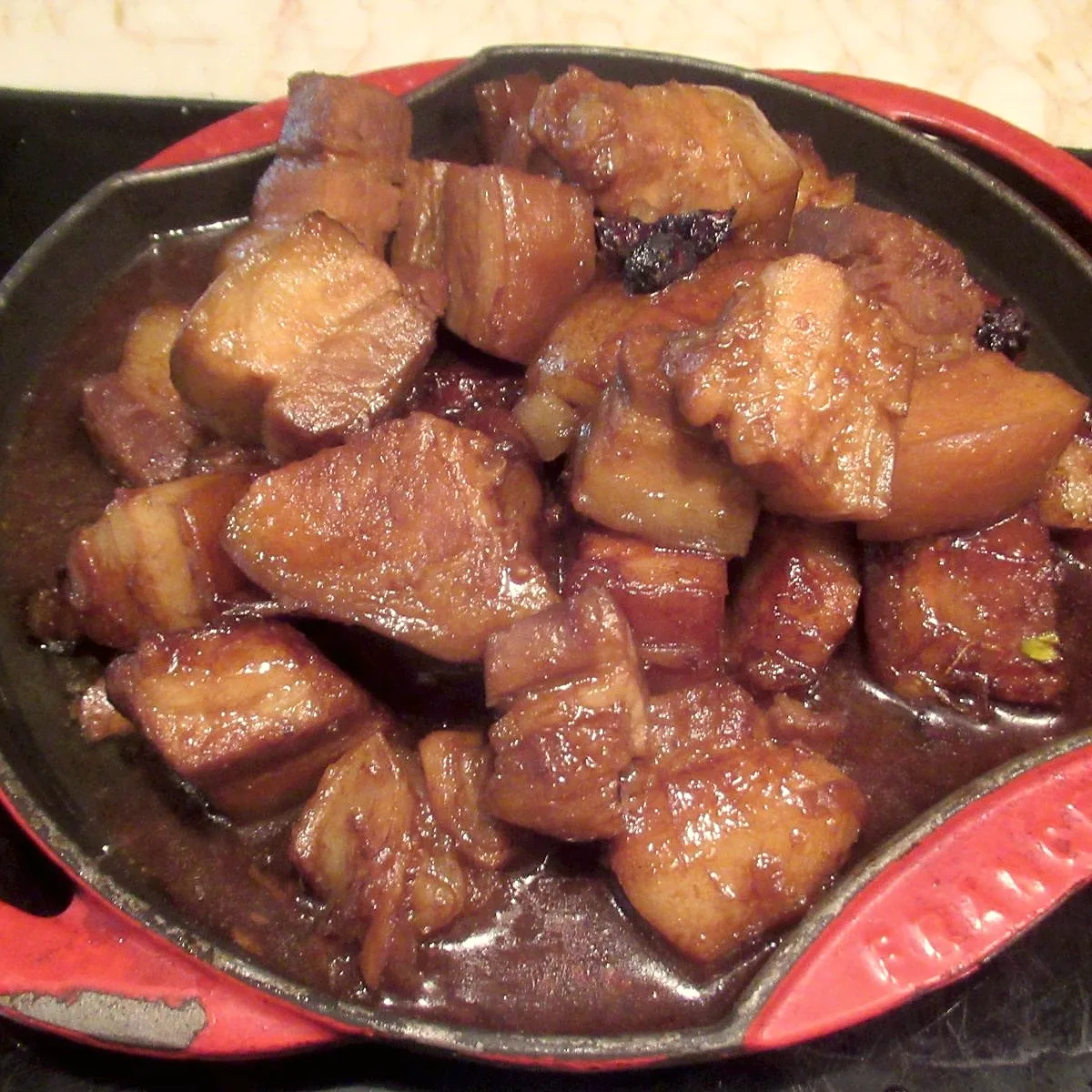

CC BY-SA 4.0. Cropped and colour-adjusted for this site.
Method
Blanch the 800 g pork belly in a pot of boiling water for 5m, then drain and rinse.
Heat the 15 ml vegetable oil in a heavy pot over a low heat and add the 40 g rock sugar. Cook gently, swirling, for 5m, until melted and a deep amber colour.
Melting the rock sugar to a deep amber before the pork goes in, rather than adding it as a sweetener later, is what gives the dish its glossy mahogany colour, the same colour a plain soy braise cannot fully reach on its own.
Add the blanched pork to the pot and turn it through the caramel until every side is coated and lightly coloured, about 8m. Add the 20 g fresh ginger and 2 spring onions (30 g) and stir briefly.
Pour in the 60 ml Shaoxing wine, 30 ml light soy sauce, 20 ml dark soy sauce and 500 ml water, and add the 4 g whole star anise and 1 cinnamon stick (3 g). Bring to a bare simmer, cover with the lid slightly ajar, and braise for 1h 15m, until the pork is completely tender.
Common pitfallA hard simmer breaks the pork cubes apart before the fat has had time to turn tender and translucent. The braise wants the gentlest possible bubble, with the lid slightly ajar, for the full length of cooking.
Uncover fully and raise the heat, reducing the sauce for 10m, until thick and glossy enough to coat the pork. Discard the spices and finish with a little extra sliced spring onion.
Red-braised pork (meat coloured a deep reddish-brown by caramelised sugar and soy sauce rather than by any chilli) is cooked all over China under different regional names and small variations in technique. The Hunanese version is the one most widely known today, largely because of a single, well-attested association: Mao Zedong, a Hunan native, is said to have loved it enough to request it regularly from his personal chefs once he was living in Beijing [1] [2].
Around that documented fondness sits a softer kind of local legend: villagers in Shaoshan, Mao's birthplace, are said to have credited the dish with keeping the mind sharp as well as the body fed, a claim that belongs to folklore rather than to any medical record and is best read as regional pride rather than fact [2].
The technique itself needs no origin story to justify it. Sugar melted to a dark caramel before the meat goes in, rather than added later as sweetening, is what gives the pork its lacquered colour, and a long, barely-simmering braise is what turns belly fat, which would otherwise render out chewy and tough, into something soft enough to yield under a chopstick.
Sources
- Red braised pork belly, WikipediaOn the Hunanese version's association with Mao Zedong.
- Chairman Mao's Red-Cooked Pork Belly Recipe (Hong Shao Rou), Andrea Nguyen, Asian Dumpling TipsCookbook author Andrea Nguyen on Mao's documented preference for the dish, sourced to Fuchsia Dunlop's Hunanese cooking research, and on the separate, more folkloric health claims made for it in his home village.