Egyptian · Breakfast
Ful Medames
Fava beans simmered until very tender, mashed with garlic and cumin, and dressed with lemon juice and olive oil.
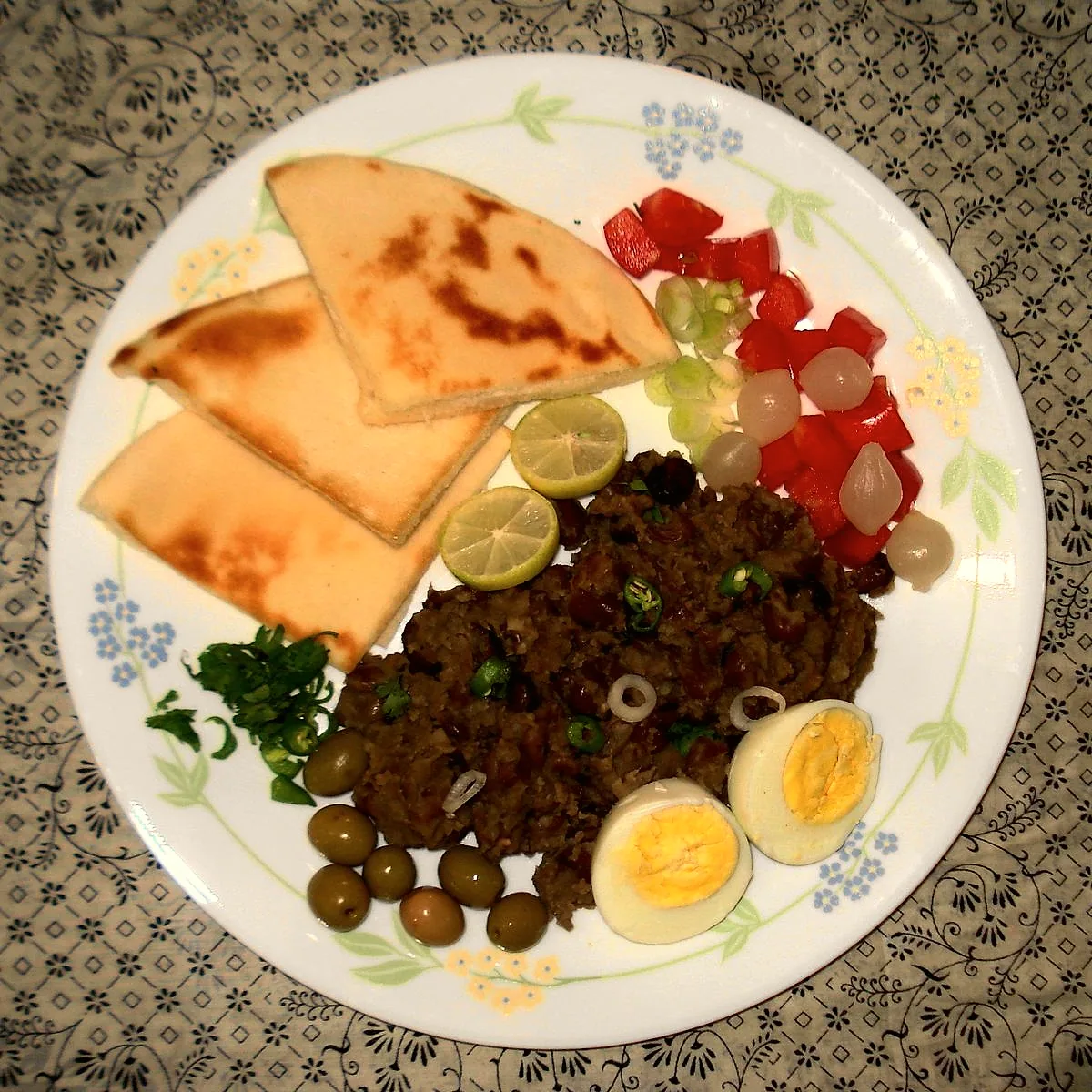

CC0. Cropped and colour-adjusted for this site.
Method
Drain the soaked 250 g dried broad beans, cover with the 1 L water and simmer for 1h 30m, until completely tender and starting to break down.
Common pitfallFava beans that have not been simmered long enough stay grainy no matter how hard they are mashed afterward. They need to collapse on their own before mashing, not be forced there by force.
Meanwhile, boil the 2 ½ eggs (120 g) for 10m, then cool, peel and quarter.
Drain most of the cooking liquid, reserving a little, and mash the beans with the 3 garlic cloves (15 g), 3 g ground cumin and 4 g fine sea salt for 5m, loosening with the reserved liquid to a thick, coarse texture.
Stir in the 30 ml freshly squeezed lemon juice and 15 ml extra-virgin olive oil. Spoon into bowls and top with the 100 g ripe tomatoes, 10 g flat-leaf parsley, quartered egg and the 15 ml extra-virgin olive oil, working for 5m.
The name is a description of a cooking method rather than an ingredient list. Ful is simply Arabic for beans; medames comes from Coptic and means "buried," recording how the dish was once cooked: a pot of fava beans sunk into hot ash or embers and left to simmer for hours, sealed rather than watched [1] [2].
That method had a specific home in medieval and early-modern Cairo: for generations, the trade in cooked ful was centred on the Princess Baths, a public bathhouse near the old Bab Zuweila gate, where enormous amphora-shaped pots of bathwater, called qidras, were kept boiling over fires stoked all day. When the baths closed for the night, rather than let the embers go to waste, more qidras were filled with beans and buried in the coals to cook slowly until morning, supplying cookshops across the city with wholesale ful for breakfast [2]. The nineteenth-century orientalist Edward William Lane described the same practice directly in 1860: earthenware pots "buried, all but the neck," in the hot ash of an oven or bathhouse, their contents eaten with oil and lime juice [1] [2].
Whether the dish itself reaches back to ancient Egypt, as is often claimed, is considerably less certain than the bathhouse history. The claim rests on fava beans found at a late-Neolithic site and on the Coptic root of medames, circumstantial evidence at best, which is why Wikipedia qualifies the pharaonic-era origin as something "some writers have suggested" rather than established, and Roads & Kingdoms allows only that the popular legend "jibes, somewhat" with the documented facts [1] [2]. The claim is best treated as a popular attribution rather than an established fact. What is not in doubt is the dish's staying power: cooked slowly, dressed simply, and eaten daily, ful medames remains Egypt's most common breakfast and is widely regarded as its national dish.
Sources
- Ful medames, WikipediaCovers the disputed ancient-Egyptian claim, the Coptic "buried" etymology, Edward William Lane's 1860 account of the cooking method, and the medieval Cairo bathhouse trade.
- Everything You Ever Needed to Know About Mashed Fava Beans, Roads & KingdomsBy Tom Verde; covers the Princess Baths qidra pots and the trade in wholesale ful supplied from a bathhouse's overnight embers, with a named present-day ful vendor.