Mexican · American · Salad · Starter
Caesar Salad
Whole romaine leaves in a thick dressing of pounded anchovy, garlic and raw yolk, with croutons fried in olive oil.
Also known asEnsalada César · Mexico
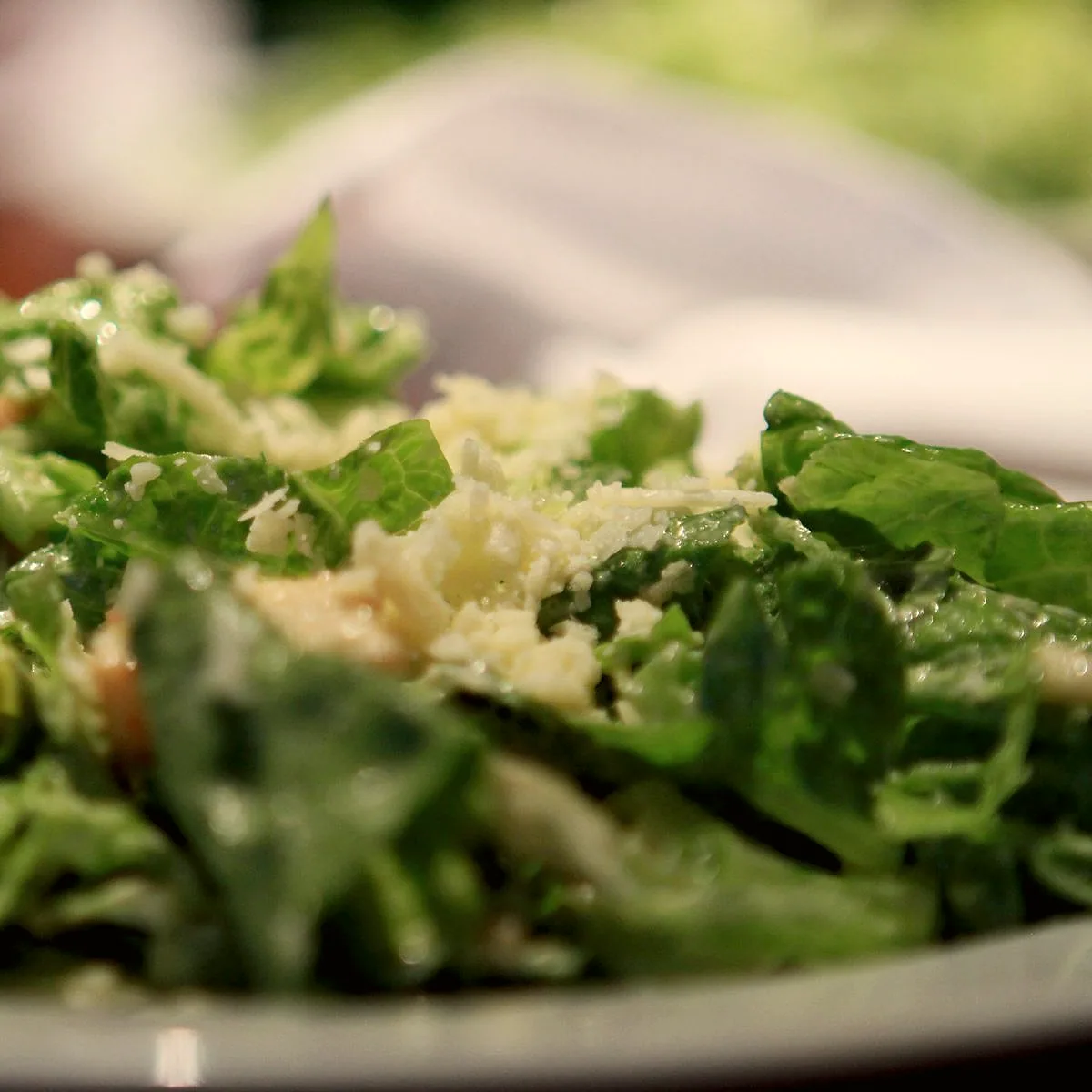

CC BY-SA 4.0. Cropped and colour-adjusted for this site.
Method
Warm the 45 ml extra-virgin olive oil in a wide pan over a medium heat. Put in the 120 g sourdough with the 2 g fine sea salt and turn the pieces until they have taken up the oil evenly. Fry for 12m, moving them often, until they are deep gold and dry through to the middle rather than only at the edges. Tip them out onto paper and leave them to crisp as they cool.
While the croutons colour, pound the 4 anchovy fillets (16 g) and the 2 garlic cloves (10 g) to a smooth paste in a mortar, or chop them together and work them under the flat of a knife. Scrape the paste into a wide bowl and whisk in the 2 egg yolks (34 g), the 30 ml freshly squeezed lemon juice and the 8 ml Worcestershire sauce. Add the 60 ml extra-virgin olive oil a few drops at a time to begin with, whisking constantly, then in a thin steady stream once the mixture has thickened and taken on a pale gloss. Whisk in the 40 g Parmigiano-Reggiano and the 2 g ground black pepper. It takes 8m in all, and the dressing should end up thick enough to hold a line drawn through it.
The oil goes in slowly because a yolk can only take up so much of it at a time. Poured in at once it will not emulsify, and the dressing stays thin and slides off the leaves instead of clinging to them.
Put the 600 g romaine into the widest bowl available and spoon the dressing over it. Turn the leaves through it with both hands for 3m, until every surface is coated and nothing has pooled at the bottom. Add the croutons, turn them through once, and scatter over the 20 g Parmigiano-Reggiano. Serve straight away.
Common pitfallThe croutons go in after the leaves are coated, not alongside them. Added at the same time they take up the dressing meant for the romaine and are soft before the bowl reaches the table.
The Caesar salad is neither Italian nor American. It was made in Tijuana, at a restaurant opened by the Italian immigrant Caesar Cardini to feed visitors from across the border, and the border is the whole of the explanation: Prohibition had made a Mexican dining room the nearest place an American could order a drink with dinner [1].
The story attached to it is precise in the way that ought to invite suspicion. On the fourth of July 1924, during an unexpected rush, the kitchen ran short and Cardini improvised from what was left (whole romaine leaves, garlic oil, Worcestershire sauce, egg, Parmesan), dressing them at the table [3]. His daughter Rosa is the source of that date [2]. She is not the only claimant: Cardini's brother Alex, a First World War pilot, is credited by some accounts with a version served to airmen, and a cook named Livio Santini maintained the recipe had been his mother's [3]. The more interesting response to the argument is that having it at all misses the point: the dish crossed into American restaurant culture so completely that its Mexican birth dropped out of the telling [1].
Two corrections travel with the story. The first concerns anchovy, which is now taken to define the dressing: Cardini is said to have kept whole fillets out on the grounds that the Worcestershire already carried enough of them [3], and the fillets are usually credited to his brother's version [2]. The second is quieter. The original called for limón, which in Mexico means lime, and which crossed the border as lemon [2].
The salad travelled regardless of who made it first. By 1953 the International Society of Epicures in Paris was calling it the finest recipe to have come out of the Americas in fifty years [2].
Sources
- The Myth of the Caesar Salad: A Case Study in Mexican Tourism, HistoricalMXBrianna Sheen's argument that the competing invention stories obscure the more consequential history, that of a Mexican dish absorbed into American restaurant culture through Prohibition-era border tourism.
- The story behind Caesar salad, National Geographic Traveller (UK), 2025Daniela Toporek's account, carrying the rival claims, the original dressing, and the limón mistranslation.
- Inside the history of Caesar salad — the world-famous salad that just turned 100, Salon, 2024Joy Saha's centenary retrospective, including Rosa Cardini's account of why her father kept anchovy fillets out.