American · Main Course
Barbecue Ribs
Pork ribs rubbed with spice and smoked low over wood (dry and unsauced in Memphis, thick and sweet in Kansas City, or tangy over the trimmed St. Louis cut).
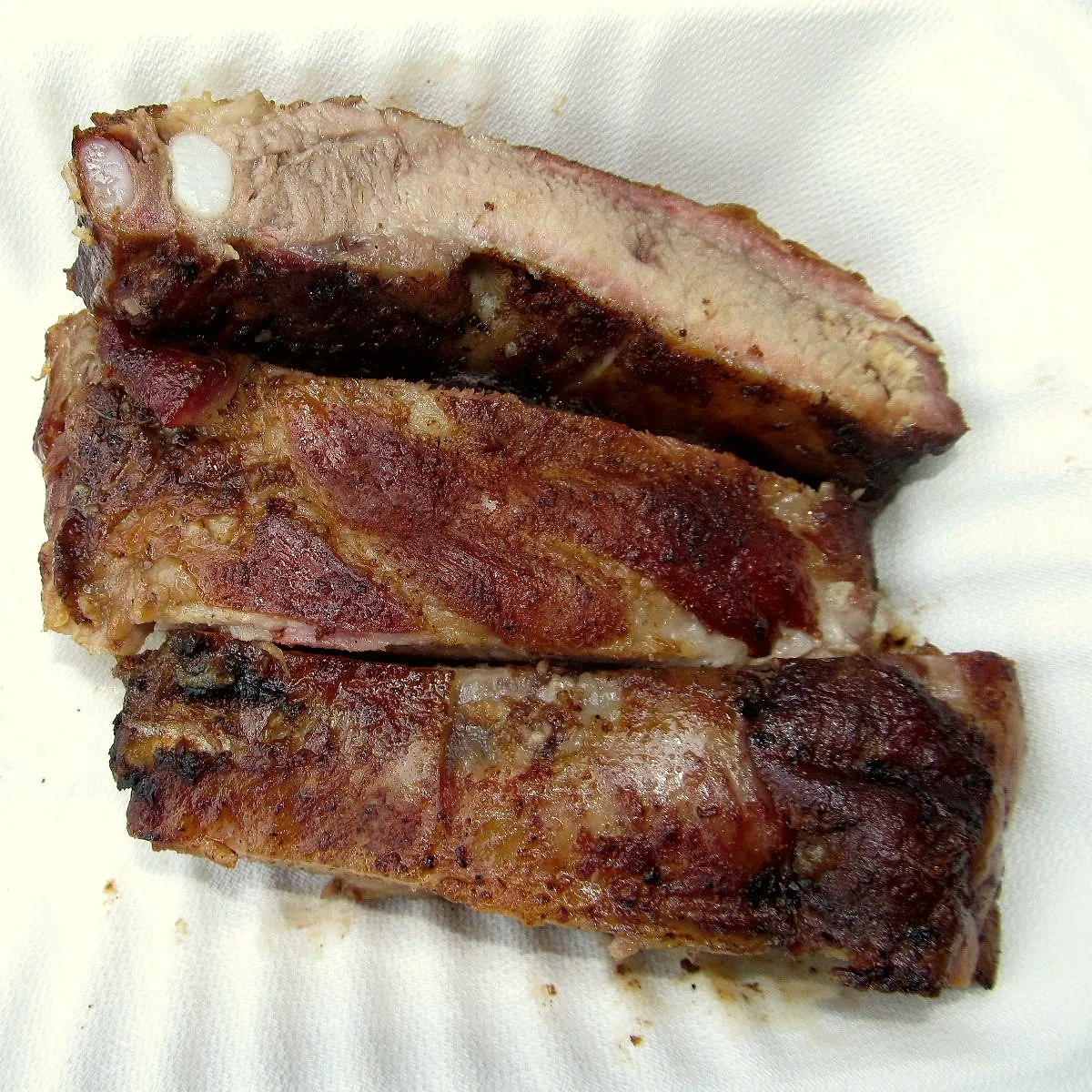
.jpg)
CC BY-SA 2.0. Cropped and colour-adjusted for this site.
The same dish, adapted. Every quantity, time and figure below changes with the version.
Method
Peel the thin membrane from the underside of the 2 kg pork baby back ribs and pat the racks dry. Combine the 20 g fine sea salt, 16 g ground black pepper, 30 g light brown sugar, 30 g sweet paprika, 8 g mustard powder and 8 g celery salt, then coat both racks evenly on all sides.
Smoke the racks bone side down at a steady 110 °C for 4h, without opening the smoker more than occasionally, until the meat has pulled back from the ends of the bones and a rack lifted at one end bends and just begins to crack across the surface.
Common pitfallWrapping or brushing sauce onto the racks partway through, the way spare ribs are often treated, washes out the whole point of a dry rub. They stay uncovered and unsauced for the entire smoke.
Brush the racks all over with the 60 ml cider vinegar and dust them with a last light scattering of any rub left on the board, then set them aside off the heat.
The vinegar wash cuts through the richness of the pork and helps a final scattering of rub cling to the surface, without turning the ribs into a sauced style.
Rest the ribs, loosely tented, for 10m before cutting.
Cut the racks into individual ribs and serve them dry, with no sauce added at the table.
Method
Peel the thin membrane from the underside of the 2.6 kg pork spare ribs and pat the racks dry. Combine the 25 g fine sea salt, 20 g ground black pepper, the 40 g light brown sugar, the 40 g smoked paprika and the 10 g mustard powder, then coat both racks evenly on all sides.
While the ribs smoke, combine the 150 g tomato ketchup, 30 g molasses, 30 ml cider vinegar, the 30 g light brown sugar, the 10 g smoked paprika and the 5 g mustard powder in a small pan and simmer gently, stirring, until it has thickened enough to coat the back of a spoon.
Smoke the racks bone side down at a steady 110 °C for 5h, until the meat has pulled back from the ends of the bones and is tender enough that a rack lifted at one end bends deeply.
Brush the racks all over with the sauce and return them to the smoker or a hot grill for 15m, just long enough for the glaze to turn tacky and set rather than run.
Common pitfallBrushing on sugary sauce too early scorches it long before the ribs are done. It goes on only once the meat is already tender, for a short spell of heat that sets the glaze rather than a cook that finishes the meat.
Rest the glazed ribs, loosely tented, for 10m before cutting.
Cut the racks into individual ribs and serve with any remaining sauce on the side.
Method
Peel the thin membrane from the underside of the 2.4 kg pork spare ribs and pat the racks dry. Combine the 24 g fine sea salt, 19 g ground black pepper, the 30 g light brown sugar, the 35 g smoked paprika and the 10 g mustard powder, then coat both racks evenly on all sides.
While the ribs smoke, combine the 60 g tomato purée, 60 ml cider vinegar, the 10 g light brown sugar, the 10 g smoked paprika, the 4 g mustard powder and the 3 g chilli flakes with a splash of water in a small pan and simmer gently, stirring, until it has thinned to a pourable, tangy glaze rather than a thick paste.
Smoke the racks bone side down at a steady 110 °C for 5h, until the meat has pulled back from the ends of the bones and is tender enough that a rack lifted at one end bends deeply.
Brush the racks all over with the sauce and return them to the smoker or a hot grill for 15m, just long enough for the glaze to set into a thin, sticky coat rather than a heavy one.
Common pitfallBrushing on sugary sauce too early scorches it long before the ribs are done. It goes on only once the meat is already tender, for a short spell of heat that sets the glaze rather than a cook that finishes the meat.
Rest the glazed ribs, loosely tented, for 10m before cutting.
Cut the racks into individual ribs and serve with any remaining sauce on the side.
Memphis's dry rib is tied to one restaurant. Charlie Vergos opened the Rendezvous in a Memphis basement in 1948, serving sandwiches until he converted an old coal chute into a charcoal pit in the mid-1950s and turned his attention to pork ribs, a cut most of the city's barbecue restaurants had been ignoring [1]. His method (a spice rub built on his family's Greek cooking, a vinegar spritz, and no sauce at the table) is still credited as the origin of the Memphis dry rib, and the restaurant is still run by his descendants [1].
Kansas City's sauce has a longer chain of hands and a less settled one. Henry Perry, a pitmaster from Shelby County, Tennessee (practically Memphis's back yard), brought his smoking to Kansas City in 1908, selling meat wrapped in newspaper from an alley stand before settling into an old trolley barn, dressed in a sauce remembered as harsh and peppery rather than sweet [2]. After Perry's death in 1940 the business passed to his employee Charlie Bryant, who later sold it to his brother Arthur, and it was Arthur who reworked the sauce recipe at the restaurant that still carries the Bryant name [2]. Accounts disagree on exactly when the sauce became the thick, tomato-and-molasses style now associated with the city: some credit Arthur Bryant himself with the sweetening, while others place the decisive change decades later, with Rich Davis, whose KC Masterpiece sauce (first sold to grocers in 1977) pushed Kansas City barbecue further toward the sweet, thick style most Americans now picture when they hear the word "barbecue" [3].
The two styles are usually presented as opposites (dry against sauced, Tennessee against Missouri), but the line runs directly through Perry, a Tennessean who founded the Kansas City tradition, which makes the rivalry more a matter of what happened to the sauce after it left Memphis than of two unconnected cuisines. The St. Louis cut sits alongside both: it names a trim of the spare rib rack, tips and cartilage removed to a neat rectangle, rather than a flavour of its own, and it is finished either way (dry, wet, or somewhere between the two) depending on whose smoker it is in.
Sources
- Charlie Vergos's Rendezvous, Southern Foodways AllianceOral history interview covering the opening of the Rendezvous and its move into ribs.
- Henry Perry, The Pendergast Years (Kansas City Public Library / UMKC Center for Midwestern Studies)Covers Perry's 1908 stand in the Garment District, his trolley-barn location, his harsh peppery sauce, his 1940 death, and the business passing from Charlie Bryant to Arthur Bryant.
- Rich Davis, Creator Of Kansas City Masterpiece Barbecue Sauce, Dies, KCUROn Rich Davis launching KC Masterpiece to grocers in 1977 and its thicker, molasses-forward sauce becoming the template for later Kansas City sauces.