The Engineering Polymers Era (1961-1979)
Styrene-Ethylene-Butylene-Styrene (SEBS)
The Molecular Bridge Builder
On 20 July 1969, Neil Armstrong climbed down the ladder of the lunar module Eagle and put a boot on the Moon, the end point of a decade of engineering that had to reconcile two flatly opposed demands: a machine rigid enough to survive a rocket launch, and soft and forgiving enough to land gently on an unknown surface four days later. That same tension (how do you get one material to be both hard and soft, without cheating and using two) was quietly being solved on Earth as well, in a chemistry lab that had nothing to do with rockets.
Plate I


Four and a half months earlier, on 4 March 1969, the US Patent Office granted Robert C. Jones of the Shell Oil Company a patent (filed back in January 1964) for “Hydrogenated Block Copolymers of Butadiene and a Monovinyl Aryl Hydrocarbon.” Stripped of the legal language, it described a chain built in three sections: a soft, rubbery middle flanked by two rigid ends, with almost all of the middle section’s chemical double bonds removed afterward by hydrogenation. Shell had been selling an unhydrogenated version of this same architecture since the mid-1960s under the name Kraton, mostly for shoe soles and adhesives, but that rubbery midblock still carried its original unsaturation, the same kind of chemical vulnerability that ages natural rubber, made brittle by sunlight and slowly eaten away by ordinary atmospheric oxygen. Jones’s patent solved that specific problem, and once Shell had the hydrogenation process running at commercial scale later that year, the resulting polymer took the name it still carries: Styrene-Ethylene-Butylene-Styrene, SEBS for short.
A Chain With Two Jobs
SEBS is not one uniform material but two, chemically welded into a single molecule. Each chain is built A-B-A: a rigid block of polystyrene, a long flexible mid-section built from what hydrogenated butadiene becomes, and a second rigid polystyrene block at the far end. Cool the finished polymer to room temperature and the rigid styrene ends do not mix with the rubbery middle at all; they cluster together with the matching ends of neighbouring chains, forming small, hard domains scattered through a continuous rubbery matrix, the way raisins might cluster inside a very stretchy dough. Those styrene domains act as physical anchor points, holding the whole rubbery network together without a single covalent crosslink. Heat the material past the styrene domains’ own softening point, though, and the anchors let go: the whole thing flows like an ordinary thermoplastic and can be melted, molded, and cooled to set again; that is something a truly vulcanized rubber can never do.
Plate II
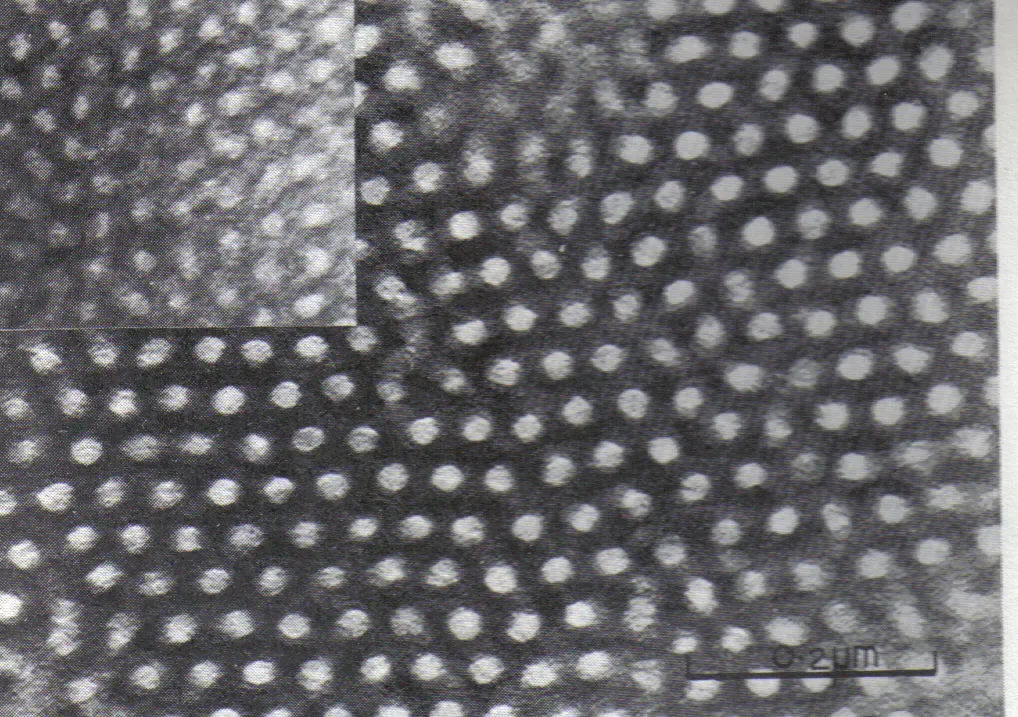

What Hydrogenation Buys
Removing the double bonds from the rubbery midblock does not change how the material behaves mechanically (SEBS stretches and recovers essentially the way its SBS parent does), but it changes how the material ages. An unsaturated rubber like SBS has a backbone that ozone and atmospheric oxygen can attack directly, breaking chains and stiffening or cracking the surface over months of outdoor exposure. With most of those double bonds hydrogenated away, SEBS has far less of that chemistry left to attack, and it holds up to sunlight, ozone, and repeated heat cycling for years where SBS would visibly degrade. It survives a service range that runs from well below freezing to comfortably past the temperature of boiling water without embrittling at one end or melting at the other, which is exactly why it took over the applications (medical tubing, weather seals, anything meant to last outdoors or through repeated sterilization) that SBS itself was never quite suited for.
From Living Chain to Finished Compound
The route to SEBS starts with anionic polymerization, a technique that builds each block in sequence (styrene first, then butadiene, then a second styrene block) onto a single growing chain with essentially no unwanted side reactions, which is exactly the precision needed to get three cleanly separated segments rather than a disordered mixture. The resulting SBS is then hydrogenated: run over a metal catalyst under hydrogen, saturating the butadiene mid-block’s double bonds while leaving the aromatic rings in the styrene end-blocks untouched. From there it processes like any other thermoplastic (injection molding, extrusion, and overmolding a soft grip directly onto a rigid part are all routine), provided the melt is not sheared and heated so hard that the styrene domains themselves are disrupted before the part has set.
What the Numbers Mean
SEBS is distinctly lighter than the rigid styrenics that share its family tree, floating close to the density of water rather than sinking well past it. It is also, by design, extremely soft to begin with: an unfilled compound offers almost no resistance to an initial stretch, then goes on stretching remarkably far before it finally lets go, springing back to very nearly its original shape and size afterward, the signature trick of a good rubber, achieved here without a trace of sulfur or a vulcanization step. Compounders can dial that starting softness across an enormous range, from something as yielding as a rubber band to something as firm as a hard caster wheel, simply by changing the ratio of hard to soft block or blending in oil and filler. Chemically, it shrugs off dilute acids, alcohols, and ordinary greases and oils without much trouble, but the same hydrocarbon solvents that dissolve grease will swell or soften it, a limitation it shares with nearly everything else in the styrenic family.
Where It Ended Up
Because a soft-touch surface can be permanently bonded to a rigid one in a single molding step, SEBS became the material behind the rubbery overmolded grip on tools, toothbrushes, and razor handles: two plastics injected into one cavity, one hard and one soft, fusing at the interface rather than merely sitting next to each other.
Plate III
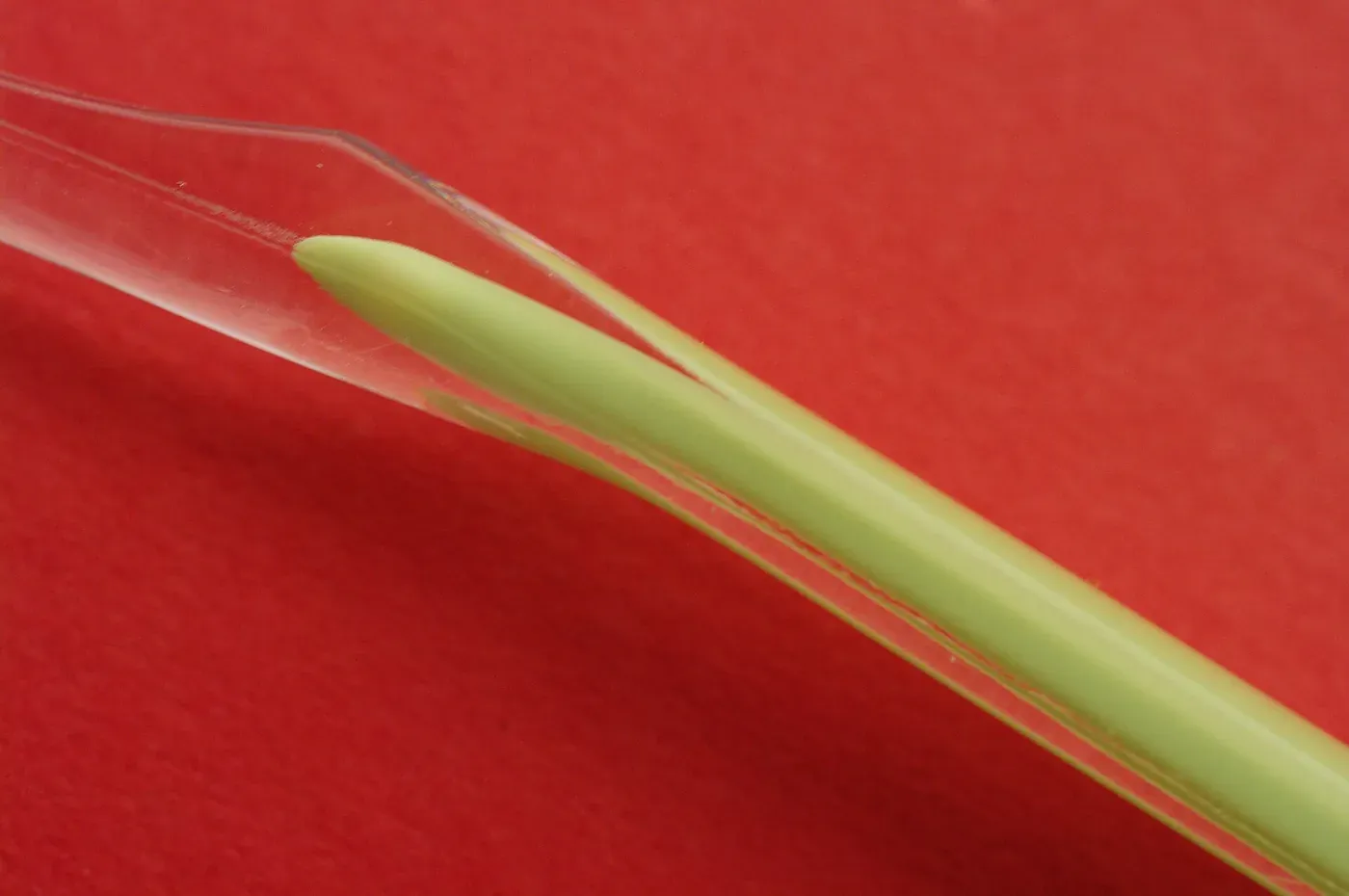

Away from consumer products, the same rubbery toughness goes to work underfoot: SEBS and its relatives are blended into paving-grade bitumen to make asphalt that resists rutting in summer heat and cracking in winter cold, a use that has nothing to do with grip or gloss and everything to do with a rubbery network quietly doing its job inside a material nobody thinks to associate with plastics at all.
Plate IV


A Quiet Kind of Bridge
SEBS never had a moment like Armstrong’s step off the ladder; nobody watched it happen live, and the patent office does not hold a press conference. But the two achievements of 1969 rhyme in a way that is easy to miss: one reconciled rigid and flexible engineering long enough to put a person on another world and bring them home; the other reconciled rigid and flexible chemistry long enough to make a single plastic behave like both, on command, for as long as it is asked to.
values with [n] cite the numbered references·estimates are flagged·“not yet available” and “N/A” are honest states, not gaps
fetching the model…
Styrene-Ethylene-Butylene-Styrene repeat unit
- Abbreviation
- SEBS
- Type
- polymer family (hub)
- CAS number
- None (heterogeneous class or not assigned)
- Resin ID code
- none assigned
- Formula
- (C8H8)x·(C4H8)y[-CH2-CH(C6H5)-]x[-CH2-CH2-CH2-CH2-]ySEBS is a segmented A-B-A triblock, not a random or alternating copolymer: the two brackets above show the two segment compositions and their approximate ratio, but the real chain is one long hydrogenated-polybutadiene midblock (segment y) flanked by a polystyrene block (segment x) at each end. That block sequence, not the monomer ratio, is why SEBS behaves as a rubber at room temperature yet melts and flows like a thermoplastic. The midblock also contains butylene branches from 1,2-addition alongside the tetramethylene run shown.
- Repeat unit (BigSMILES)
{[][$]CC(c1ccccc1)[$],[$]CCCC[$][]}- IUPAC name
- —
- Synonyms
- —
- Also known as
- —
- Chemical family
- styrenicthermoplastic-elastomer
- Backbone class
- carbon-chain
- Polymerization mechanism
- anionic
- Constitutional monomer
- Styrene1,3-Butadiene (hydrogenated to ethylene/butylene mid-block)
- Polymer class
- elastomer
- Year of origin
- 1969
- Era
- The Engineering Polymers Era (1961-1979)
- Key figures
- Robert C. Jones
- Events referenced
- Apollo 11 lands on the Moon (1969)
- Polymerization type
- living anionic polymerization (SBS precursor), then catalytic hydrogenation
- Common monomers (feedstocks)
- styrene, 1,3-butadiene
- Catalysts
- not yet available
Made by hydrogenating SBS (styrene-butadiene-styrene) triblock copolymer: the ethylene/butylene mid-block forms by eliminating the C=C double bonds in the butadiene segment. Hydrogenation (>95% degree critical for maximum thermal stability) removes most of the double bonds, sharply reducing degradation by oxygen, ozone, and UV relative to unhydrogenated SBS.
- Tacticity
- not yet available
- Crystal structure
- not yet available
- Typical crystallinity
- not yet available
Molecular weight
- Number average (Mn)
- 50000–154000 g/mol[2]
- Mass average (Mw)
- 57000–183000 g/mol[2]
- Dispersity (Mw/Mn)
- 1.05[2]
Mark-Houwink constants
not yet available
Microphase-separated triblock structure: glassy polystyrene end-blocks act as physical crosslinks, while the rubbery ethylene/butylene mid-block provides elasticity, giving SEBS its thermoplastic-elastomer behavior (rubber-like at use temperature, moldable when hot).
- Density
- 0.915 (0.88–0.95) g/cm³[2]20 °C.
- Melt flow index
- 11.5 (1–22) g/10min[2]230 °C/5 kg.
- Refractive index
- not yet available
- Transmittance
- not yet available
- Haze
- not yet available
- Gloss
- not yet available
- Water absorption
- not yet available
- Dielectric constant
- not yet available
- Dielectric strength
- not yet available
- Electrical conductivity
- not yet available
- Glass transition (Tg)
- -56.5 (-60–-53) °C[2]Two-phase block copolymer; also reported separately: ethylene/butylene midblock -36 °C, polystyrene endblock 100 °C.
- Melting temperature (Tm)
- Not applicableAmorphous/microphase-separated block copolymer; no conventional single melting point.
- Crystallization (Tc)
- Not applicable
- Heat deflection (HDT)
- 37.5 (-50–125) °C[2]Not a standard HDT (ASTM D648) figure: source instead reports a continuous-use (long-term service temperature) range of -50 °C to +125 °C; brittleness point (ASTM D746) is -60 to -21 °C.
- Decomposition onset
- 400 (380–420) °C[1]5% weight-loss temperature (TGA, nitrogen atmosphere).
- Thermal conductivity
- not yet available
- Tensile modulus
- 2.8 (0.2–5.4) MPa[2]
- Yield strength
- 5.6 MPa[2]SEBS shows a measurable tensile yield point under this test, distinct from its ultimate tensile strength at break.
- Tensile strength at break
- 21.5 (3–40) MPa[2]Wide range reflects grade/hardness variation across SEBS compounds.
- Elongation at break
- 675 (470–880) %[2]
- Impact strength (Izod)
- [2]no break
- Impact strength (Charpy)
- Not applicable
- Hardness
- 62.5 (30–95) Shore A[2]
- Flexural modulus
- 400 (100–700) MPa[2]
- Poisson's ratio
- not yet available
- Coefficient of friction
- not yet available
- Solvent: acids
- good[2]
- Solvent: alcohols
- good[2]
- Solvent: aliphatic hydrocarbons
- poor[2]
- Solvent: aromatic hydrocarbons
- poor[2]
- Solvent: greases & oils
- good[2]
- Solvent: halogenated hydrocarbons
- poor[2]
- Weathering / UV
- Significantly improved oxidation/ozone/UV resistance vs. unhydrogenated SBS[1]
- Hydrolysis resistance
- Not applicable
- Flammability (UL94)
- not yet available
- Limiting oxygen index
- not yet available
- Solubility parameter (δ)
- not yet available
Gas permeability
not yet available
Polymer-solvent interaction parameter (χ)
not yet available
- Consumer & industrialsoft-touch grips · adhesives
- Constructionbitumen/asphalt modification
- Recyclable
- Yes
- Biodegradable
- No
- Degradation pathway
- not yet available
- LD50 (oral, rat)
- 2000 mg/kg[2]Reported as >2,000 mg/kg (practically nontoxic).
- NFPA health
- 0[2]
- NFPA flammability
- 1[2]
- NFPA reactivity
- 0[2]
- Carcinogenic classification
- not listed by ACGIH, NIOSH, NTP[2]
Skin (rabbit) LD50: >2,000 mg/kg. Aquatic toxicity (48 h LC50): Daphnia magna >1,000 mg/L, bluegill sunfish >1,000 mg/L.
- [1]Styrene-Ethylene-Butylene-Styrene (SEBS) properties and productionWeb search summary (material-properties.org, Kuraray, LCY)Accessed 2026-07-14https://material-properties.org/styrene-ethylene-butylene-styrene-sebs/[search-sebs]
- [2]Handbook of PolymersChemTec Publishinghttps://www.worldcat.org/isbn/9781895198928[handbook-wypych-2016]
Illustrations
- Plate INeil Armstrong at the Apollo 11 lunar module, 20 July 1969: the only photograph taken of him on the Moon's surface, since he was holding the camera in most of the others.Wikimedia Commons
- Plate IIAn electron micrograph of Kraton, SEBS's unhydrogenated sister SBS, taken the year after Jones's patent: the pale dots are the polystyrene domains, each only a few tens of nanometres across, suspended in the surrounding rubber matrix.Wikimedia Commons
- Plate IIITwo plastics, one mold: a soft SEBS-style insert fused into a rigid handle by co-injection, the everyday form this chemistry is most often felt rather than seen.Wikimedia Commons
- Plate IVAsphalt paving: an unglamorous application, and one where a rubbery styrenic additive like SEBS improves resistance to rutting and cracking without anyone noticing it is there.Wikimedia Commons