The Engineering Polymers Era (1961-1979)
Polybutylene (PB-1)
The Rise and Fall of a Promising Polymer
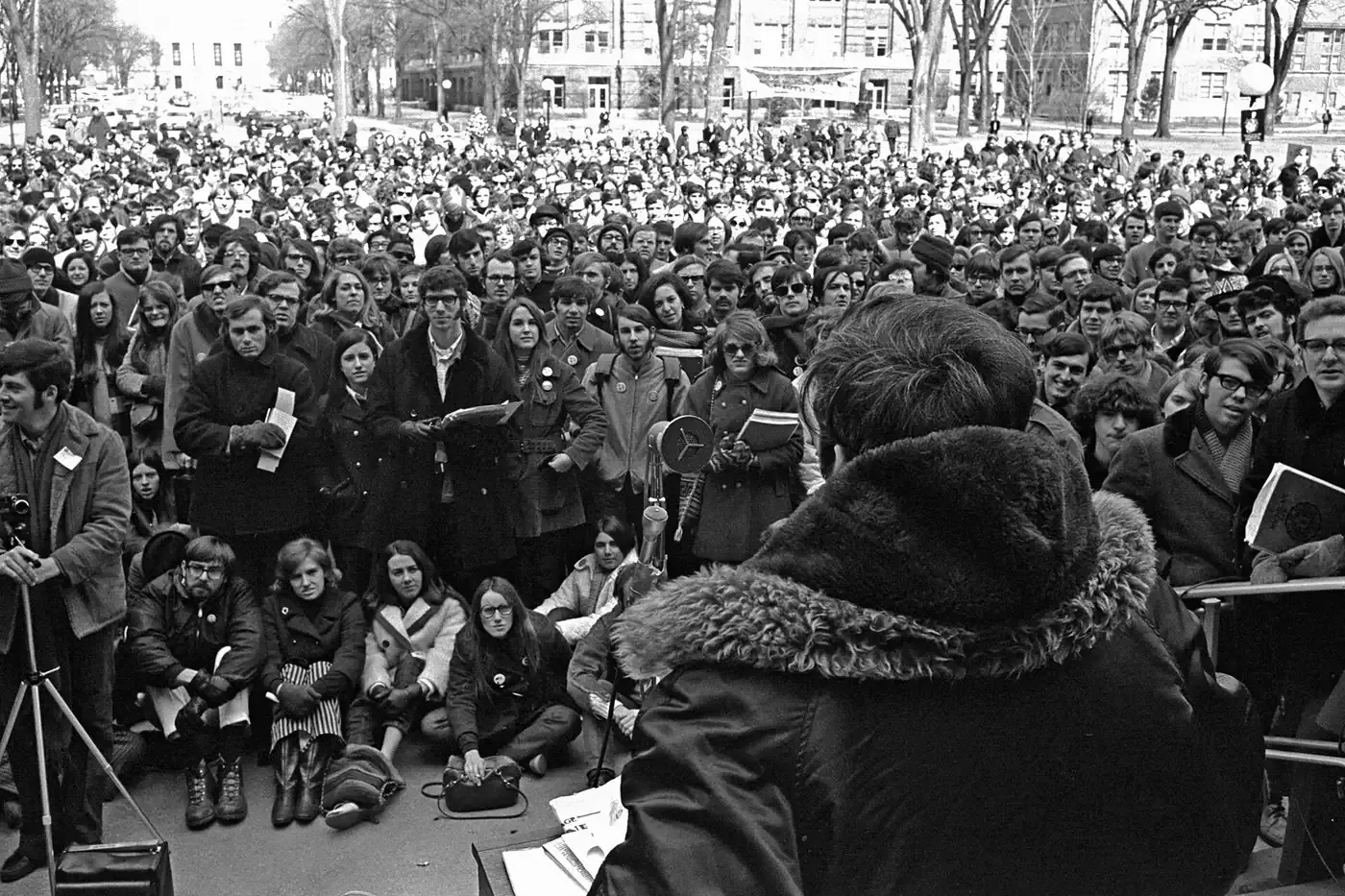
In March 1970, students at the University of Michigan held a three-day “teach-in” on the environment that helped set the pattern for the first Earth Day a month later, one of the opening acts of the modern American environmental movement. It is an odd year, on the face of it, for a new petroleum-derived plastic to be finding its footing. But that is exactly what was happening to polybutylene, a polyolefin whose entire pitch to the construction industry was environmental in the practical, unglamorous sense: pipe that did not need mining, smelting or a plumber’s torch to install, and that promised to outlast the copper it replaced.
Plate I

A Late Arrival to the Olefin Family
Isotactic poly(1-butene) had been made in the laboratory as early as 1954, in the same wave of Ziegler-Natta catalyst research that had just produced high-density polyethylene and isotactic polypropylene, but turning it into an industrial material took much longer. Chemische Werke Hüls in Germany ran the first industrial production, under the name Vestolen BT, starting in 1964. In the United States, Mobil Oil built its own small plant at Taft, Louisiana in 1968 to develop the polymer independently; as the 1970s opened, that plant passed to the Witco Chemical Corporation, which began marketing its own grade, Whitron, into industrial and specialty markets. Shell Chemical Company was running a parallel research program through this same period, and it was Shell’s version of the resin, reaching full commercial production later in the decade, that eventually carried polybutylene into millions of American homes as pressurized water pipe.
Plate II

A Backbone With an Ethyl Group
Poly(1-butene)‘s chain is built the same way polypropylene’s is, just one carbon longer at the side branch: instead of a methyl group hanging off every other backbone carbon, PB-1 carries a full ethyl group. Made isotactic by a Ziegler-Natta catalyst, those ethyl groups line up in a regular spiral that lets the chains pack into a genuinely crystalline solid, giving PB-1 a useful combination of flexibility and long-term strength under sustained pressure and heat, precisely the profile a pressurized hot-water pipe needs. What makes the material unusual, and eventually made it notorious, is that the chain does not settle into its final packing right away. Fresh from the mould, PB-1 first solidifies into a looser, metastable crystal arrangement; only over the following week or two, at ordinary room temperature, does it reorganize itself into the denser, more stable structure the material is actually specified to have. Warm the polymer back up past the point where that stable structure holds, and the whole slow rearrangement can run in reverse. No other common commercial polymer performs quite this trick, and manufacturers had to design around it: a PB-1 pipe fitting is not really finished the moment it leaves the mould.
Where the Pipe Went
That combination of pressure resistance, flexibility and heat tolerance made PB-1 look ideal for exactly the application it is now most associated with: hot and cold water plumbing, particularly the pressurized supply lines and underfloor heating loops that copper handled less gracefully. It also found real, if quieter, roles as a peel-seal layer in food packaging film and as a processing modifier blended into other polyolefins.
The Reckoning
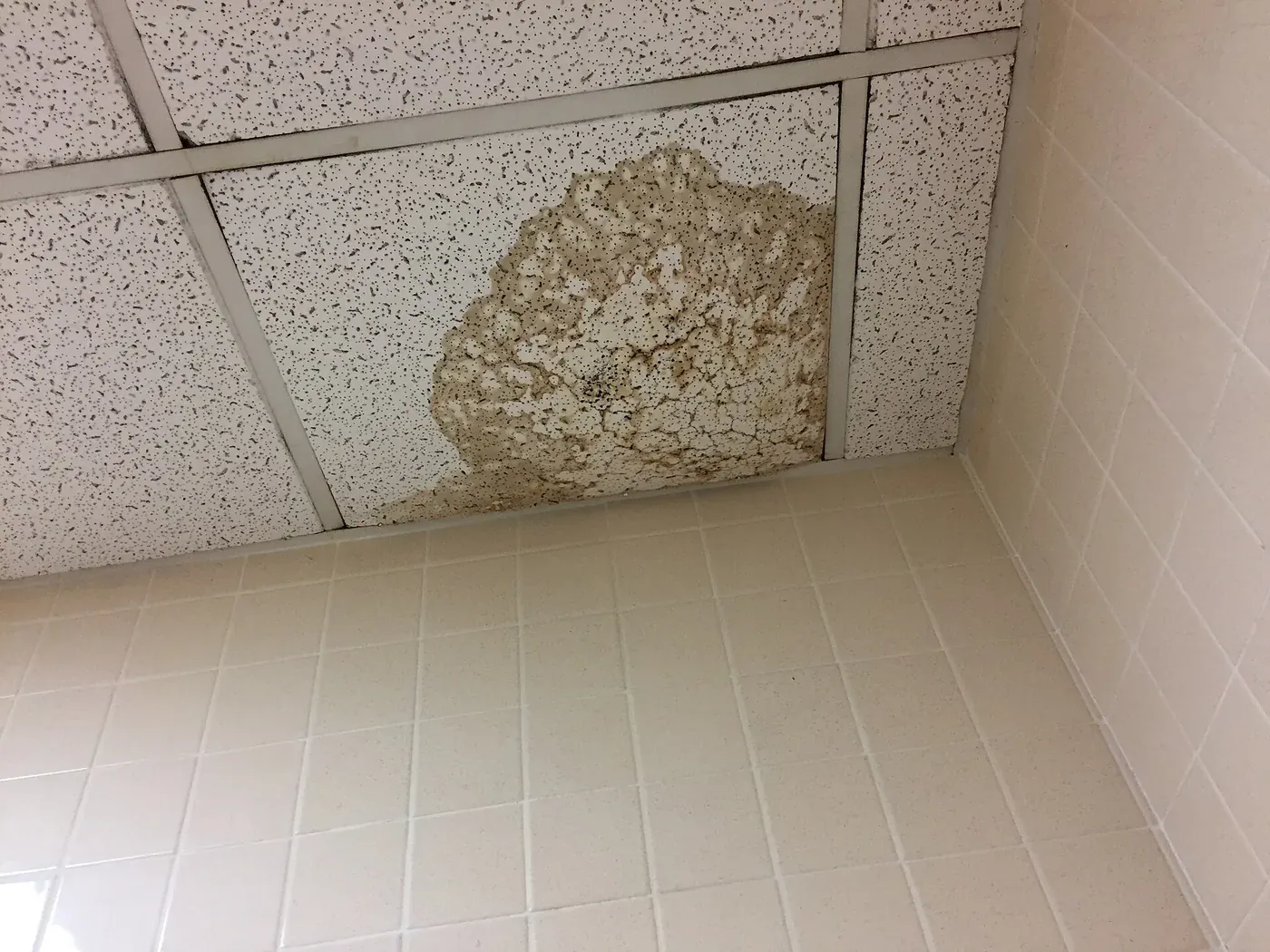
The pipe’s American career did not end well, and it is worth being precise about why, because the actual cause is less romantic than the polymer’s own crystal chemistry. Municipal water suppliers in North America almost universally disinfect the supply with chlorine or chloramine, and both are aggressive oxidizers. Sitting inside a polybutylene pipe for years on end, that treated water slowly attacked the polymer chain itself, embrittling it from the inside; the plastic fittings used to join the pipe, rather than the pipe alone, often failed first. The damage was invisible until it wasn’t: pipes installed through the late 1970s, 1980s and into the mid-1990s began splitting and leaking inside walls and slab foundations, sometimes years after installation. The resulting litigation, above all the nationwide class action Cox v. Shell Oil Co., became one of the largest product-liability settlements in the history of American home construction, and polybutylene plumbing effectively disappeared from new construction in North America by the late 1990s.
Plate III

What Survived
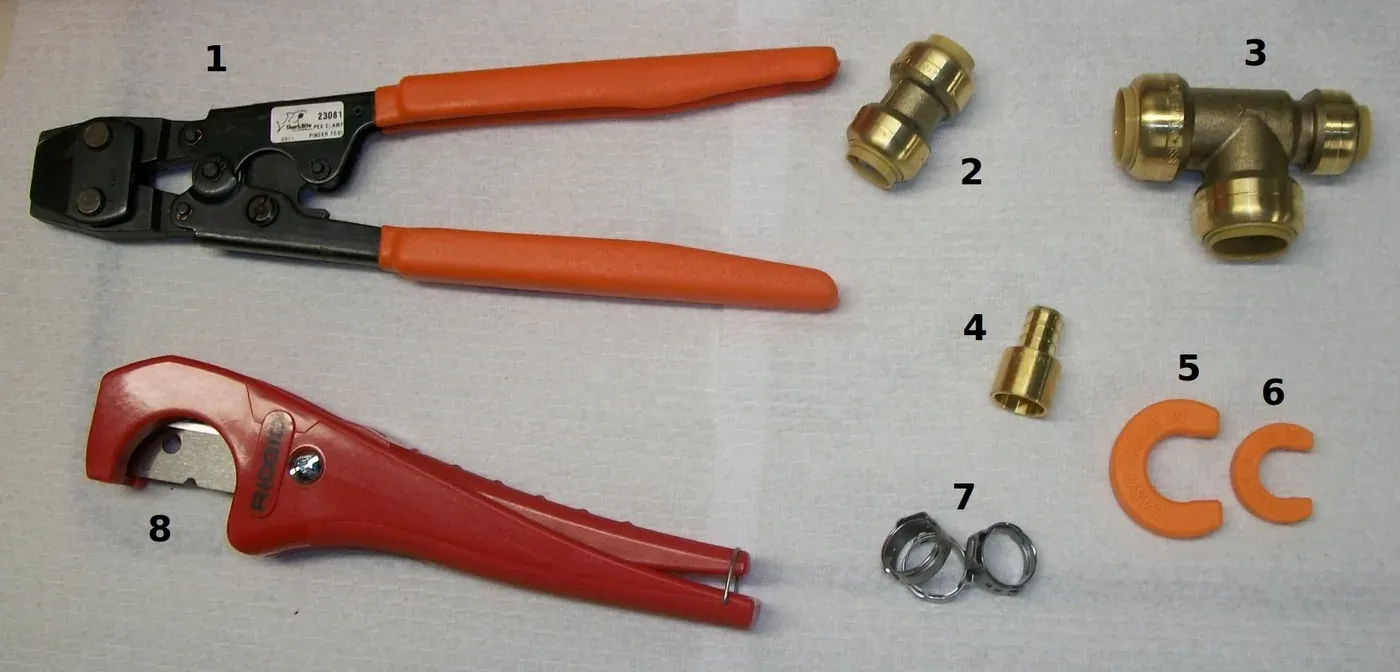
Polybutylene did not vanish from the world, even if it left American plumbing supply houses. In much of Europe, where water disinfection practices and installation standards differ, PB-1 pipe remains in routine use for hot-water and underfloor-heating systems, valued for the same creep resistance and flexibility that made it attractive in the first place. Cross-linked polyethylene, PEX, became the material North American plumbers reached for instead, cheaper to install than copper, without the specific failure mode that ended polybutylene’s American story.
Plate IV

A Fair Hearing, Decades Later
Polybutylene’s American reputation was made almost entirely by its worst chapter, which is not quite fair to the chemistry. The polymer did what it was designed to do; the water running through it, and the fittings it was joined with, did not cooperate over the multi-decade timescale the pipe itself could easily survive. Its story is a genuinely useful caution for materials science more broadly: a polymer can pass every test that matters in a laboratory and still meet a failure mode nobody thought to test for, because nobody expected chlorinated tap water to be the thing attacking it.
values with [n] cite the numbered references·estimates are flagged·“not yet available” and “N/A” are honest states, not gaps
fetching the model…
Polybutylene repeat unit
- Abbreviation
- PB-1
- Type
- polymer family (hub)
- CAS number
- 9003-28-5
- Resin ID code
- none assigned
- Formula
- (C4H8)n[-CH2-CH(C2H5)-]nThe bracketed unit is the chain's repeat unit and does not indicate which polymorphic crystal form is present. Isotactic poly(1-butene) is polymorphic, with at least four crystal forms, so a single crystal structure or density value does not represent the material across its post-molding aging timeline (form II converts to form I over ~2–14 days).
- Repeat unit (BigSMILES)
{[][$]CC(CC)[$][]}- IUPAC name
- Poly(1-butene)
- Synonyms
- polybutene-1; poly(1-butene); PB-1
- Also known as
- polybutene-1poly(1-butene)
- Chemical family
- polyolefin
- Backbone class
- carbon-chain
- Polymerization mechanism
- coordination
- Constitutional monomer
- 1-Butene
- Polymer class
- thermoplastic
- Year of origin
- 1970
- Era
- The Engineering Polymers Era (1961-1979)
- Key figures
- Shell Chemical Company · Chemische Werke Hüls
- Events referenced
- University of Michigan environmental teach-in, a precursor to the first Earth Day (March 1970)
- Polymerization type
- coordination chain-growth
- Common monomers (feedstocks)
- 1-butene
- Catalysts
- Ziegler-Natta type catalysts
Produced by catalytic (Ziegler-Natta) polymerization of 1-butene monomer to give isotactic, semi-crystalline PB-1.
- Tacticity
- Isotactic.
- Crystal structure
- Polymorphic with at least four crystal forms. Melt-solidified PB-1 first forms a metastable tetragonal phase (Form II), which irreversibly transforms to a thermodynamically stable hexagonal phase (Form I) over roughly 2–14 days at room temperature. This is a slow solid-state transition that is the defining quirk of this material.
- Typical crystallinity
- 38–58 %[2]Wypych: 45–55% conventional (47–58% form I, 38% form II); Mark: 48–55% (form I, after extrusion)
Molecular weight
- Number average (Mn)
- 20000–300000 g/mol[2]Wypych; Mark's typical commercial range is narrower at ~70,000–75,000 g/mol
- Mass average (Mw)
- 85000–2200000 g/mol[2]Wypych; Mark's typical commercial range is narrower at ~725,000–750,000 g/mol
- Dispersity (Mw/Mn)
- 4–12[2]Wypych (Ziegler-Natta); Mark reports 10–11 for Ziegler-Natta, 1.02 for anionic polymerization
| Solvent | T | M range | K | a |
|---|---|---|---|---|
| 1,2,4-trichlorobenzene[3] | 408 K | not given (GPC) | 0.0118 mL/g | 0.729 |
| decalin[3] | 388 K | ~900,000 g/mol (single-point LS measurement) | 0.00949 mL/g | 0.73 |
Tg ~-21°C.
- Density
- 0.87–0.95 g/cm³[2]20°C, general 0.87–0.92 g/cm³ (0.95 g/cm³ crystalline); Mark reports crystalline density by polymorph: Form I (hexagonal, stable) 0.951, Form II (tetragonal, metastable) 0.902, Form III (orthorhombic) 0.905 g/cm³, consistent with the Form II -> Form I density increase on aging
- Melt flow index
- 1–30 g/10min[2]190°C/10 kg; Mark separately reports 0.4 g/10min under ASTM D1238 condition E (190°C/2.16 kg): different load, not directly comparable
- Refractive index
- 1.5125–1.5246[2]exp., 20°C; Mark's isotactic value (1.5125) matches the lower bound
- Transmittance
- not yet available
- Haze
- not yet available
- Gloss
- not yet available
- Water absorption
- [2]<0.03%, 24h water immersion, 23°C (ASTM D570; Wypych and Mark agree)
- Dielectric constant
- 2.53[2]100 Hz-1 MHz; Mark corroborates at 10³-10⁶ Hz
- Dielectric strength
- not yet available
- Electrical conductivity
- not yet available
- Glass transition (Tg)
- -21 (-45–-17) °C[2]exp.; form I -20.5°C, form II -26.9°C; Mark's DMA measurement gives -25.2 to -17.2°C (248–256 K), consistent
- Melting temperature (Tm)
- 97–142 °C[2]DSC, isotactic (Wypych 97–142°C general; by form: I 120–135°C, I' 90–100°C, II 110–120°C, III 90–100°C). Mark gives higher form-specific values: I 138–142°C, II 120–130°C, III 101–110°C; syndiotactic ~50°C (both agree)
- Crystallization (Tc)
- 72 °C[2]reported as "rapid crystallization temperature"
- Heat deflection (HDT)
- 54–60 °C[3]1.82 MPa, ASTM D648
- Decomposition onset
- 300–440 °C[2]form I
- Thermal conductivity
- 0.22 W/(m·K)[3]ASTM C177; Wypych separately reports 0.1344–0.22 W/(m·K) for the melt
- Tensile modulus
- 150–295 MPa[2]Wypych 150–295 MPa; Mark's ASTM D638 measurement gives 290–295 MPa (matches Wypych's upper bound and its separately reported "elastic modulus" of 290–295 MPa)
- Yield strength
- 12–18 MPa[2]Wypych 12–15 MPa; Mark's ASTM D638 measurement gives 16–18 MPa
- Tensile strength at break
- 27–45 MPa[2]Wypych 27–45 MPa; Mark's ASTM D638 measurement gives 32–35 MPa
- Elongation at break
- 200–400 %[2]Wypych 200–400%; Mark's ASTM D638 measurement gives 275–320%
- Impact strength (Izod)
- 640–800 J/m[3]notched, ASTM D256; not given in the Wypych entry
- Impact strength (Charpy)
- not yet available
- Hardness
- 55–65 Shore D[3]ASTM D2240
- Flexural modulus
- 250–450 MPa[2]Wypych 250–450 MPa; Mark's ASTM D790 measurement gives 375–380 MPa
- Poisson's ratio
- 0.47[2]exp., 25°C (Wypych and Mark agree); calc.=0.393
- Coefficient of friction
- not yet available
- Solvent: acids
- good[2]dilute and concentrated
- Solvent: alcohols
- good[2]
- Solvent: alkalis
- good[2]
- Solvent: aliphatic hydrocarbons
- good[2]
- Solvent: aromatic hydrocarbons
- poor[2]
- Solvent: esters
- poor[2]
- Solvent: greases & oils
- poor[2]
- Solvent: halogenated hydrocarbons
- good[2]
- Solvent: ketones
- poor[2]
- Weathering / UV
- not yet available
- Hydrolysis resistance
- Not applicable
- Flammability (UL94)
- not yet available
- Limiting oxygen index
- not yet available
- Solubility parameter (δ)
- not yet available
Gas permeability
not yet available
Polymer-solvent interaction parameter (χ)
- Processing methods
- injection moldingextrusion (pipe/fittings)
- Drying required
- not yet determined
- Processing temperature
- not yet available
- Shrinkage rate
- 2.5–5 %[2]
- Pipingpressurized hot and cold water piping systemsOutstanding creep, cracking, and impact resistance make PB-1 a technically preferred (if commercially niche) material for pressure piping.
- Medical & aerospacemedical/pharmaceutical equipment · food packaging · aviation and aerospace components
- Recyclable
- Yes
- Biodegradable
- No
- Degradation pathway
- not yet available
- [1]Polybutene-1 (PB-1) properties and applicationsWeb search summary (PBPSA, LyondellBasell, ScienceDirect)Accessed 2026-07-14https://www.pbpsa.com/pb1-material/what-is-polybutene-1[search-pb1]
- [2]Handbook of PolymersChemTec Publishinghttps://www.worldcat.org/isbn/9781895198928[handbook-wypych-2016]
- [3]Polymer Data HandbookOxford University Presshttps://search.worldcat.org/search?q=Polymer+Data+Handbook+Mark+1999[handbook-mark-1999]
Illustrations
- Plate IA 1970 environmental teach-in at the University of Michigan, part of the wave of activism that led to the first Earth Day that April, the same year a new plastic pipe was being pitched as the practical alternative to mined and smelted copper.Wikimedia Commons
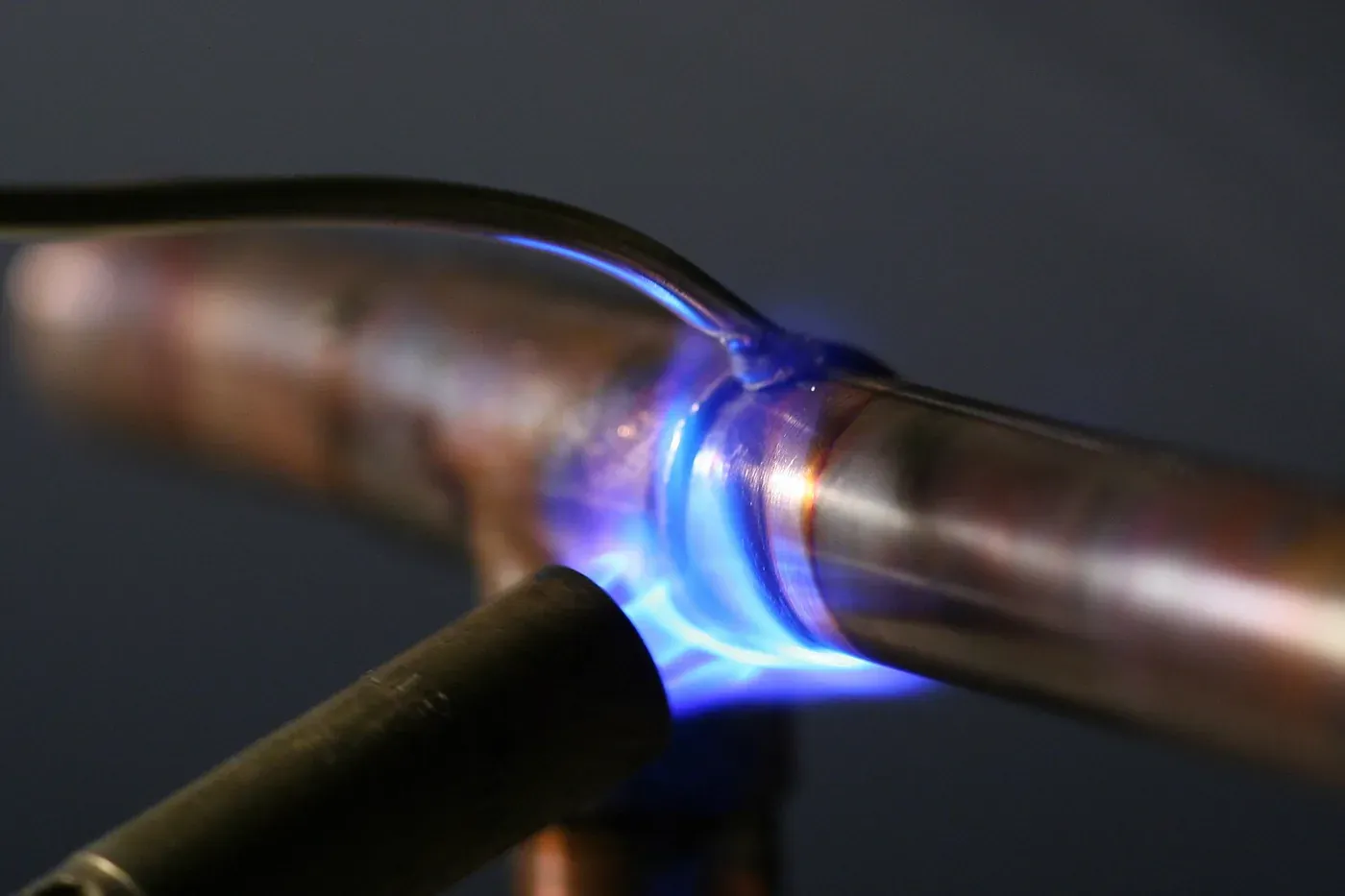
- Plate IISweating a copper joint, the skilled, torch-and-solder trade that PB-1 pipe, joined instead with plastic fittings, was sold as a faster and cheaper alternative to.Wikimedia Commons
- Plate IIIThe kind of damage, from a slow leak hidden behind a wall or ceiling, that fuelled the class-action litigation which ended polybutylene's career in American plumbing.Wikimedia Commons
- Plate IVThe tools of PEX plumbing, the cross-linked polyethylene tubing that took over the market polybutylene lost.Wikimedia Commons