The Engineering Polymers Era (1961-1979)
The UCST/LCST Concept
When Polymers Choose to Mix or Part
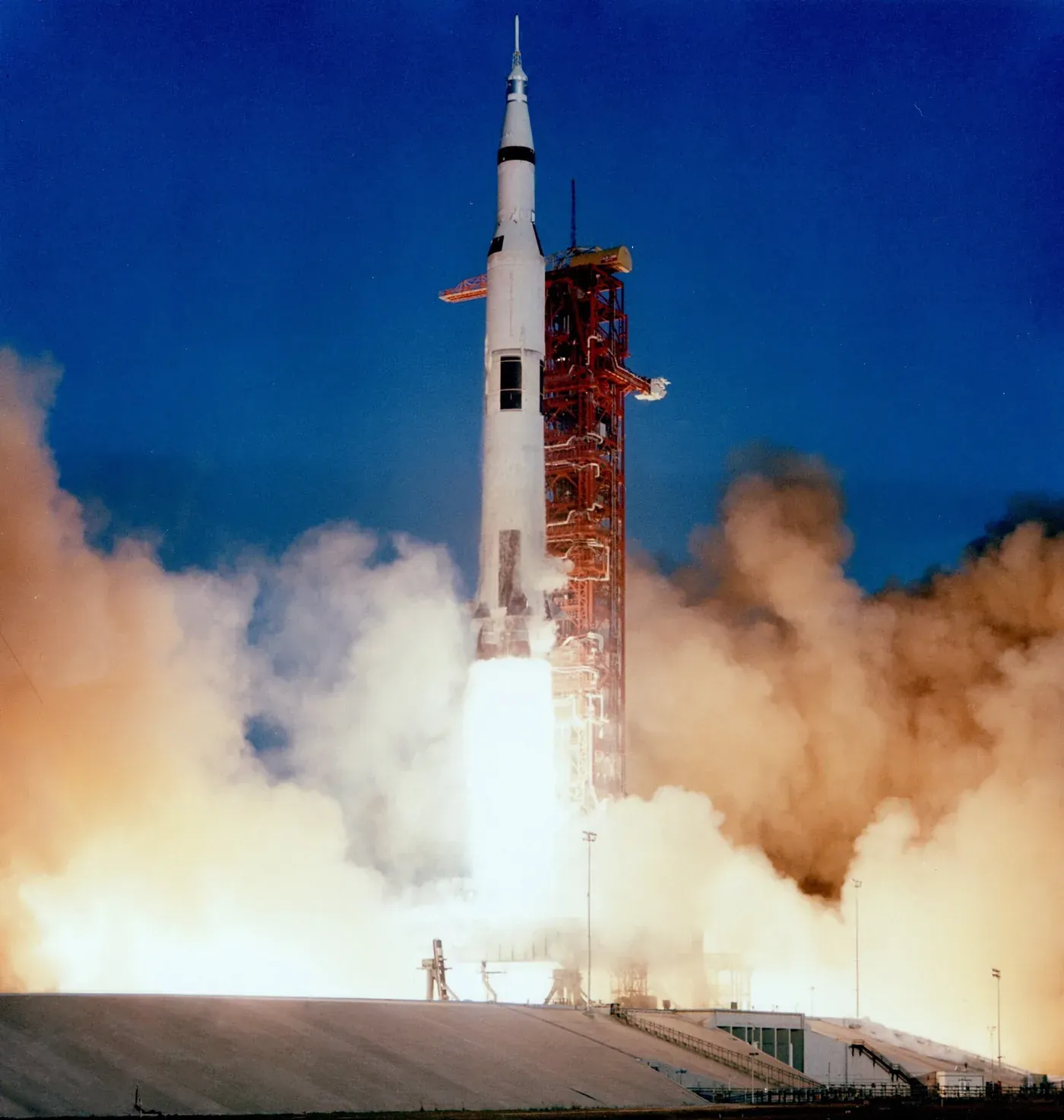
On the 21st of December, 1968, three men left the Earth’s gravity entirely for the first time in human history. Apollo 8 had no lunar module and was never meant to land; its only job was to prove that a crew could leave, circle the Moon ten times, and come home. Three days later, on Christmas Eve, astronaut Bill Anders looked up from a window as the spacecraft rolled and saw the Earth clear the lunar horizon: a blue and white disk hanging alone over grey rock. He had about ten seconds to get the shot before it was gone.
Plate I

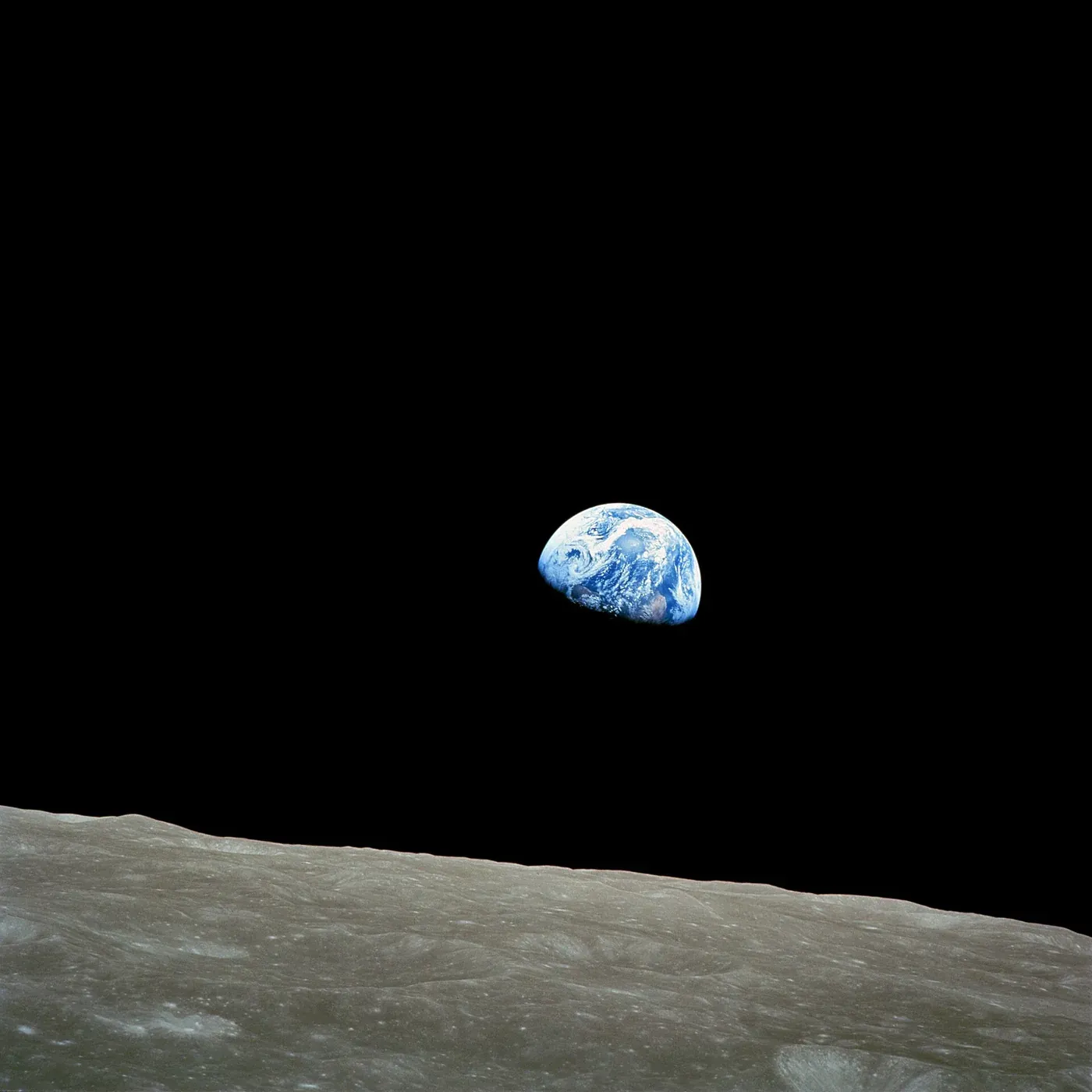
Earthrise is remembered as the picture that let a species see the edge of its own world: the line where “everything” stopped being an abstraction and became a boundary you could point a camera at. Every one of the Apollo 8 crew has said since that the Moon, the thing they had travelled to see, ended up mattering far less than turning around.
Plate II

Polymer chemistry has its own boundaries, far smaller and far less photogenic, but they work on the same principle: cross a line and a system that looked whole a moment ago turns out to be two things. In 1968, at the University of Toronto, a graduate student named M. Heskins and his supervisor, James Guillet, published a paper charting exactly such a line for a polymer called poly(N-isopropylacrylamide), PNIPAM. Dissolved in water, PNIPAM is perfectly clear and stays that way as you warm it, right up until it crosses a specific temperature. Then, within moments, the solution turns milky white. Heskins and Guillet were not the first chemists to notice that a solution could do this (the underlying thermodynamics had been worked out decades earlier), but they were the first to map the phenomenon carefully in a synthetic polymer and give the field a name for it: critical solution temperature. It is a small, precise idea that turned out to organize an enormous amount of what polymers in solution actually do.
A Line That Can Run Either Way
A polymer dissolved in a solvent is not automatically stable at every temperature. At some point, the balance between how much the chains want to mingle with the solvent and how much entropy is gained or lost by doing so can flip, and the single clear solution splits into a polymer-rich phase and a solvent-rich phase, cloudy, then visibly separated if left alone. The temperature at which this happens is the critical solution temperature, and it comes in two opposite forms.
Plate III


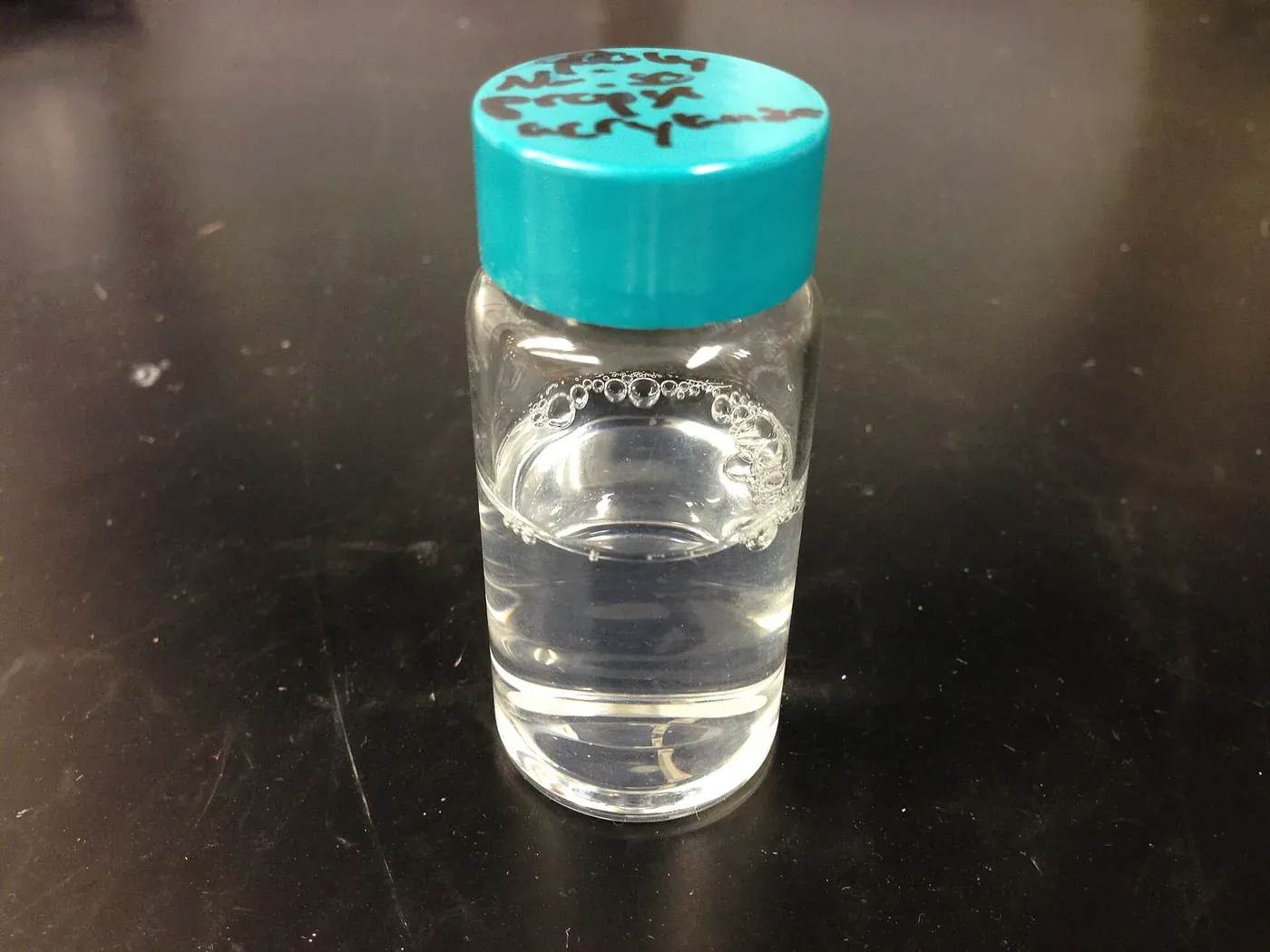
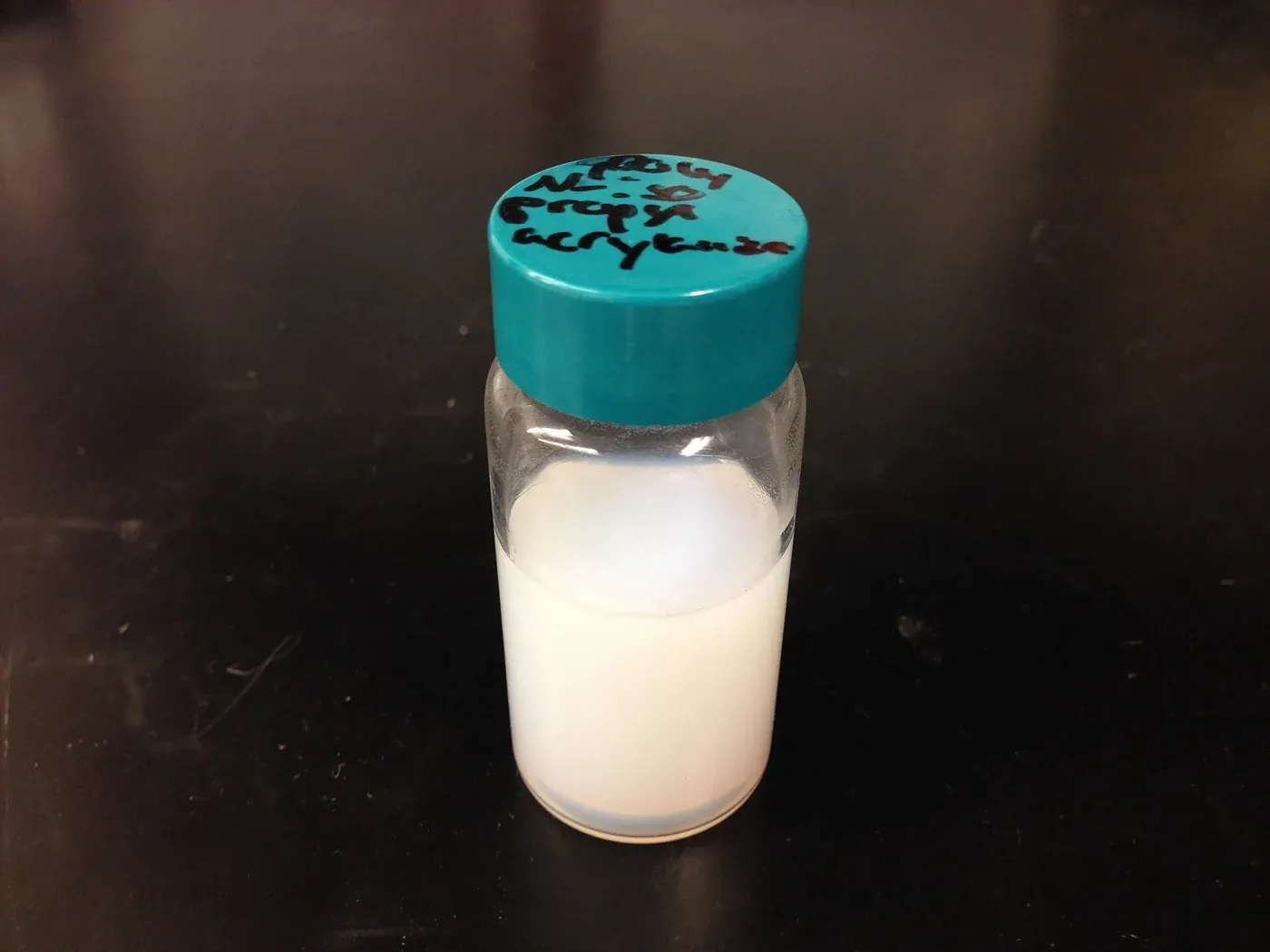
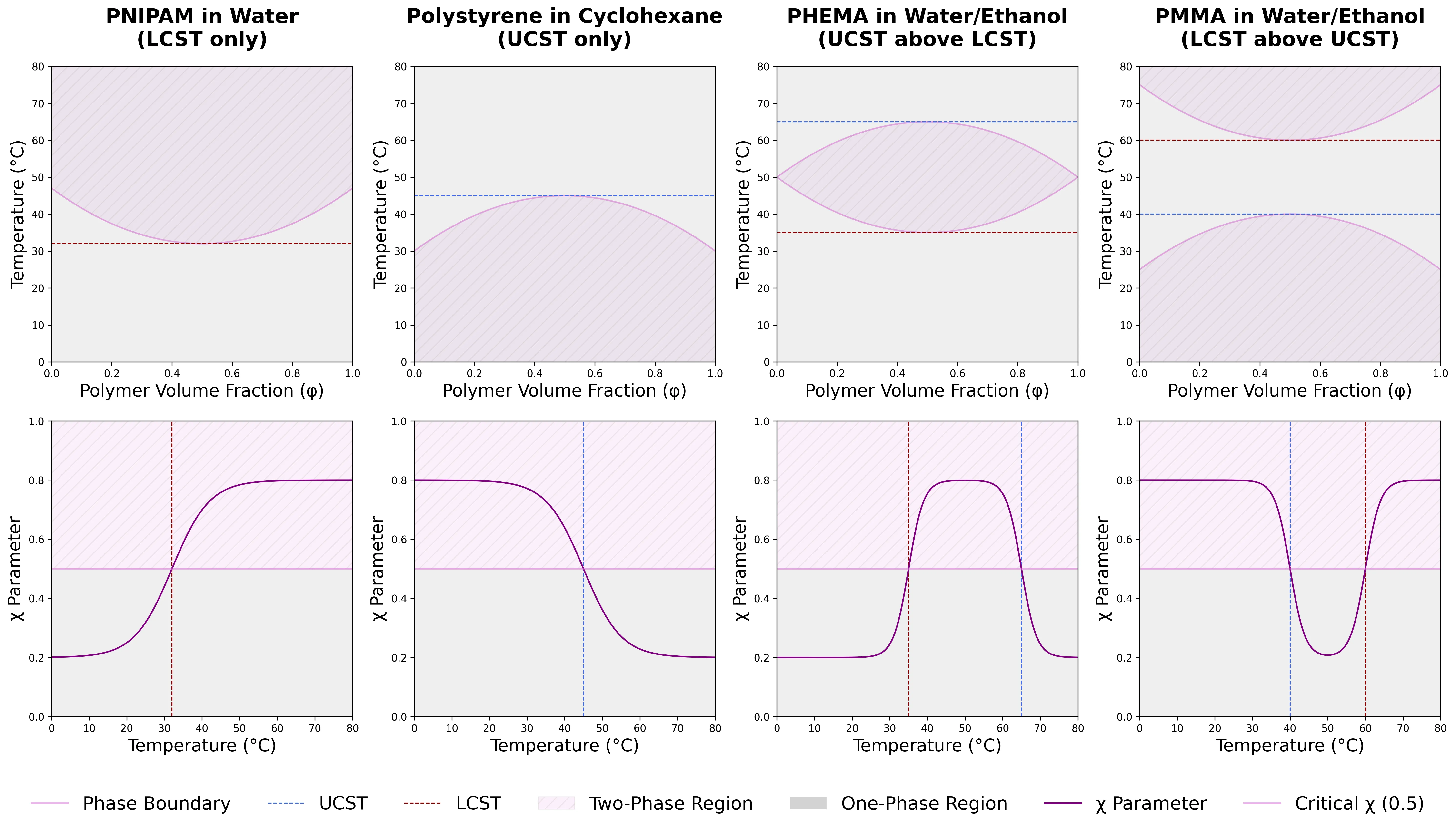
In a Lower Critical Solution Temperature (LCST) system, the polymer is soluble when cold and separates when heated; this is the counterintuitive direction, since warming usually helps things dissolve. PNIPAM is the standard example: below its LCST, around 32°C, its chains stay extended and hydrogen-bonded to the surrounding water; cross the line and they collapse into dense, water-shedding globules almost at once. The photographs below show the same vial of PNIPAM solution on either side of that line: clear one moment, opaque the next, with nothing added or removed.
Plates IV & V


An Upper Critical Solution Temperature (UCST) system runs the other way: the polymer becomes more soluble as the temperature climbs. The classic case is polystyrene in cyclohexane, which separates into two phases below roughly 35°C (the chains draw together and push the solvent out, the way strangers at a cold bus stop end up standing closer together than they would on a warm day) and mixes freely again once warmed past that point.
When a Solution Changes Its Mind Twice
Some systems are not satisfied with a single threshold. Poly(2-hydroxyethyl methacrylate), PHEMA, dissolved in certain water-alcohol mixtures, and poly(methyl methacrylate) in some alcohol-water blends, can show both an LCST and a UCST at once, with a window of full miscibility sitting between, or, in other compositions, a window of separation sandwiched between two miscible ranges. Which pattern appears, and exactly where the boundaries fall, depends closely on solvent composition, so the useful statement is qualitative rather than a fixed pair of numbers: these are systems where “does it dissolve” is not a single yes-or-no answer but a question with more than one answer depending on where on the temperature scale you ask it.
Why the Line Moves: Entropy, Enthalpy, and Flory-Huggins
The theory that explains where these boundaries sit was not built for this purpose at all. Paul Flory and Maurice Huggins independently worked out a lattice model for polymer solutions in the early 1940s, decades before anyone was looking for a switchable polymer. They wanted a working thermodynamics for ordinary polymer-solvent mixtures, and what they produced turned out to also predict when a solution splits in two.
At the centre of that theory sits a single number, the Flory-Huggins interaction parameter, χ, which measures how much the polymer and solvent “prefer” their own company over each other’s. For any polymer of a given chain length there is a critical value of χ above which the two-phase state becomes favourable; for a very long chain that critical value approaches one half. A solution phase-separates once its χ crosses that line, and the two curves that describe the boundary (the binodal, marking where two phases can coexist at all, and the spinodal, marking where a single phase becomes mechanically unstable and separates on its own) meet at exactly one point: the critical point, the unique temperature and concentration where the distinction between “mixed” and “separated” stops being meaningful.
What makes LCST and UCST behaviour different is simply which way χ moves with temperature. In an LCST system, χ rises as the solution warms, driven mainly by the entropy cost of ordering water molecules around the polymer’s hydrophobic parts; this is the reason PNIPAM in water separates on heating rather than cooling. In a UCST system the more familiar case holds: χ falls as temperature rises, weakening the polymer’s own network of favourable enthalpic interactions until the solvent can compete. In the dual-transition systems, χ does both in sequence as temperature climbs, which is what produces two boundaries instead of one.
Chain Architecture Changes What the Line Does
A linear chain that crosses its LCST separates from its solvent outright, the two phases eventually settling into distinct layers if left alone. A chain that has been cross-linked into a network cannot do that (it cannot leave the solvent, because it is one continuous molecule threaded through it), so instead it undergoes a volume phase transition, expelling water and shrinking sharply while holding its shape. This is the mechanism behind PNIPAM hydrogels used as temperature-controlled valves and actuators: the network does not dissolve or fall apart at the LCST, it just gets dramatically smaller.
From Laboratory Curiosity to Design Tool
Heskins and Guillet’s 1968 paper gave chemists a name and a framework for something they could then engineer deliberately. By copolymerizing PNIPAM with more hydrophilic or hydrophobic comonomers, or by grafting temperature-responsive chains onto other backbones, researchers can push a transition temperature up or down until it lands exactly where an application needs it, often close to body temperature, which is why PNIPAM-based materials are so common in drug delivery and tissue engineering. A hydrogel that releases its cargo only once warmed past a set point, a chromatography surface that releases cultured cells intact when cooled below one, a membrane that opens or closes its pores in response to a temperature swing: all of them are applications of the same boundary Heskins and Guillet first drew a line under in 1968. What began as a description of why one vial of polymer solution turns cloudy became one of the standard tools for building materials that respond to their environment on command.
A polymer solution that is a single, clear phase at one temperature can separate into two phases when heated or cooled past a critical solution temperature. In Lower Critical Solution Temperature (LCST) systems the polymer is soluble when cold but separates on heating (e.g. PNIPAM, LCST ~32C); in Upper Critical Solution Temperature (UCST) systems the polymer becomes more soluble as temperature rises (e.g. polystyrene in cyclohexane, UCST ~35C). Some systems (e.g. PHEMA or PMMA in water/alcohol mixtures) show both an LCST and a UCST, giving three distinct temperature-dependent phases. The phase behavior is governed by the Flory-Huggins interaction parameter (chi): in LCST systems chi increases with temperature, in UCST systems it decreases, and phase separation occurs once chi crosses the critical value set by the polymer's degree of polymerization. Heskins and Guillet first characterized this critical-solution-temperature behavior in PNIPAM in 1968, turning it from a laboratory curiosity into a foundational design principle for stimuli-responsive/smart materials (drug delivery, smart windows, switchable membranes).
- Gibbs free energy of mixing
- Polymer volume fraction
- Flory-Huggins polymer-solvent interaction parameter
- Critical value of chi at which phase separation begins
- Degree of polymerization
- Year of origin
- 1968
- Era
- The Engineering Polymers Era (1961-1979)
- Key figures
- Paul Flory · Maurice Huggins · M. Heskins · J. E. Guillet
- Events referenced
- Apollo 8 (first crewed lunar orbit, December 1968) · Earthrise photograph (24 December 1968)
- [1]Paul FloryWikipediaAccessed 2026-07-14https://en.wikipedia.org/wiki/Paul_Flory[wiki-paul-flory]
Illustrations
- Plate IApollo 8 leaves the pad on 21 December 1968, three days before its crew photographed Earth whole for the first time.Wikimedia Commons
- Plate IIEarthrise, photographed by Bill Anders on 24 December 1968 (the boundary of the whole Earth, seen for the first time from outside it).Wikimedia Commons
- Plate IIIThe University of Toronto chemistry precinct today. Heskins and Guillet's laboratory stood in this building when they mapped PNIPAM's phase diagram in 1968.Wikimedia Commons
- Plate IVA PNIPAM solution below its LCST: the chains are extended and hydrated, and the liquid is optically clear.Wikimedia Commons
- Plate VThe same solution warmed past its LCST: the chains have collapsed into globules that scatter light, turning the liquid white within moments.Wikimedia Commons