The Birth of Synthetic Polymers (1907-1938): The Bakelite Revolution
Polyvinyl Acetate (PVAc)
Adhesive That Bound the Modern World
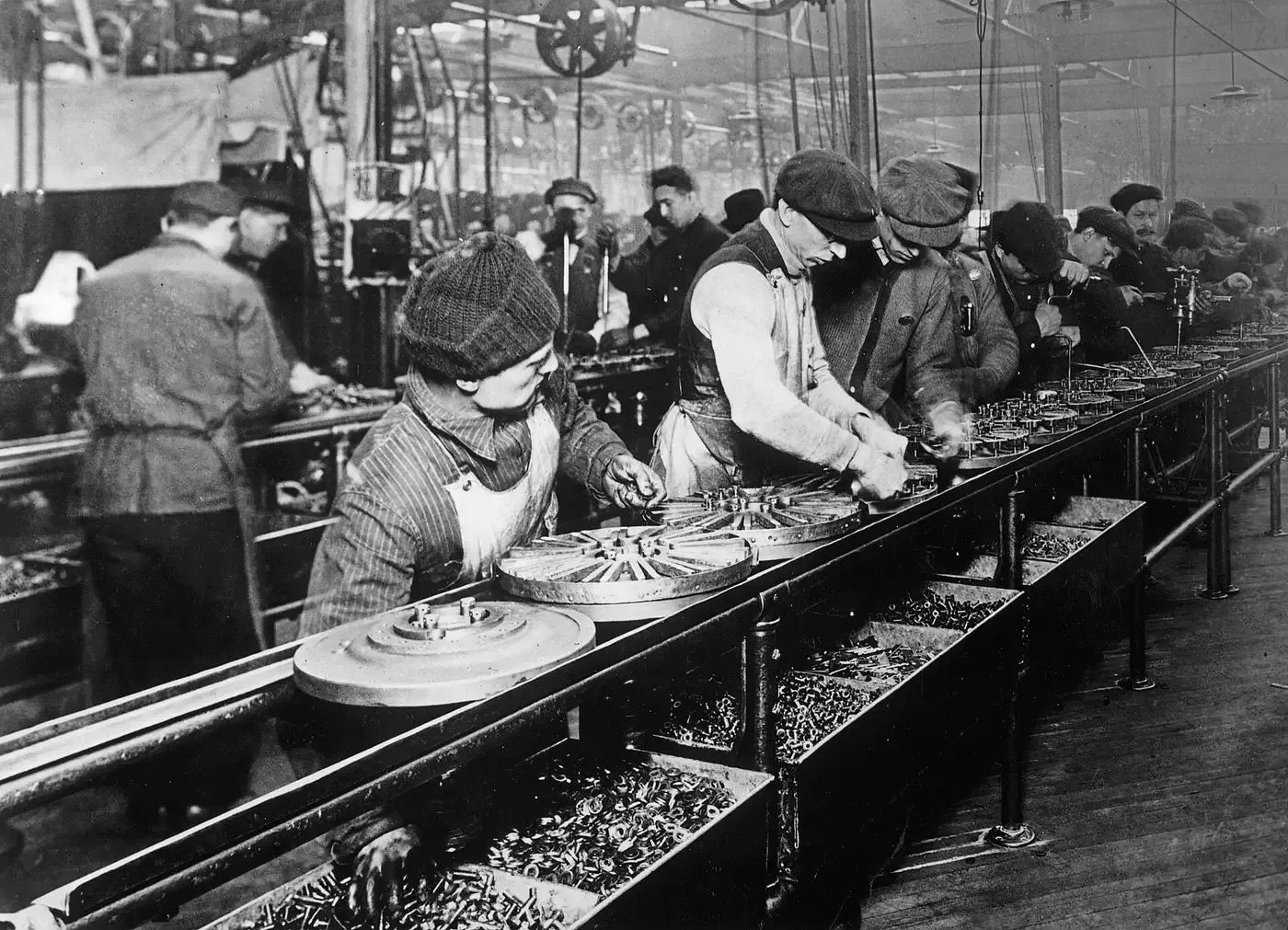
In 1913 the modern factory was inventing itself. That October, at Ford’s new plant in Highland Park, Michigan, a chassis under construction began moving past its workers instead of the other way around, and the twelve hours it had taken to build a car collapsed to about ninety minutes. Word of what a moving line could do to the cost of a finished good spread through every industry that made anything at all.
Plate I
.jpg)
That appetite was, for the moment, being fed by materials that had not industrialized at all: hide glue rendered from boiled animal connective tissue, and shellac still scraped by hand from the branches of trees. Both were about to have a synthetic competitor, and it appeared, almost as a side note, in a German patent filed the same year.
A Patent Filed, Then Nearly Forgotten
At Chemische Fabrik Griesheim-Elektron, a chemist named Fritz Klatte had been working with acetylene, the same gas used in miners’ lamps and welding torches, made cheaply by German industry from calcium carbide. Reacting it with acetic acid gave him vinyl acetate, a liquid that turned out to polymerize with almost no encouragement at all; left in a sealed vessel in sunlight, it could set solid on its own, sometimes violently enough to burst the container. Klatte patented the process on 4 July 1913: German patent DRP 281687, covering the acetylene route to vinyl acetate and its polymerization into what he called a substitute for horn, celluloid and lacquer.
It was not, in 1913, a discovery anyone could sell. The same uncontrolled, “explosive” polymerization that made vinyl acetate easy to form made it nearly impossible to manufacture on purpose, and Griesheim-Elektron let the idea sit for over a decade. It took another German chemist, W. O. Herrmann, working at the Consortium für elektrochemische Industrie in Munich, to tame the reaction well enough to build a factory around it. A plant at Burghausen in Bavaria turned out the first commercial polyvinyl acetate resin, sold under the name Vinnapas, in 1930, seventeen years after Klatte’s patent, and a reminder that a molecule can exist for a generation before anyone finds a way to make it behave.
An Ordinary Chain With One Useful Habit
Strip away the chemistry and PVAc is a plain carbon backbone with an acetate group hanging off every other carbon. Nothing about that structure looks special until you notice what it does at everyday temperatures: the polymer sits right at the edge of softening, so a touch of warmth and the mechanical work of spreading it are enough to make it flow and wet a surface, and a return to room temperature is enough to lock it rigid again. That narrow, forgiving window between soft and set is the entire reason PVAc became an adhesive rather than a curiosity: it does not need a chemical cure, only a change in temperature, to go from liquid to bond.
Plate II
_(14802851343).jpg)
From Raw Materials to Ready-to-Use
Modern PVAc still starts from vinyl acetate monomer, now made by reacting ethylene and acetic acid over a palladium catalyst rather than Klatte’s acetylene route, and still relies on free-radical polymerization to string the monomer into a chain. The difference is entirely in the control: manufacturers run the reaction as an emulsion in water, holding temperature, pH and initiator concentration inside narrow bands so the vigorous exothermic reaction that once burst Klatte’s vessels instead produces a stable milky-white dispersion, ready to be thickened, tinted or blended into the adhesives, paints and coatings that use it.
Properties That Set It Apart
PVAc is only a little denser than water, and its glass transition sits just above ordinary room temperature, close enough that a warm hand or a hair dryer can soften a set joint, which is exactly the behavior a woodworking or bookbinding glue needs. Structurally it never crystallizes at all; the chains are too irregular to pack into an ordered lattice, so there is no true melting point to speak of, only a gradual softening as heat is added and, eventually, decomposition rather than a clean melt. Mechanically it is a modest performer by plastics standards (it takes only a light load before yielding and stretches only a little before it lets go), which is unimportant for a material whose job is to hold a joint rather than bear a structural load on its own. It resists alkalis reasonably well, which is precisely why alkaline hydrolysis is the standard route from PVAc to polyvinyl alcohol, but it is readily attacked by acids, alcohols, aromatic solvents, ketones and esters, and by sustained sunlight, which breaks its chains and releases a faint trace of acetic acid as the material ages. It takes up a modest amount of moisture from humid air and stays clear and glossy in thin films, the optical quality that makes it useful in coatings as well as adhesives.
A World Held Together by PVAc
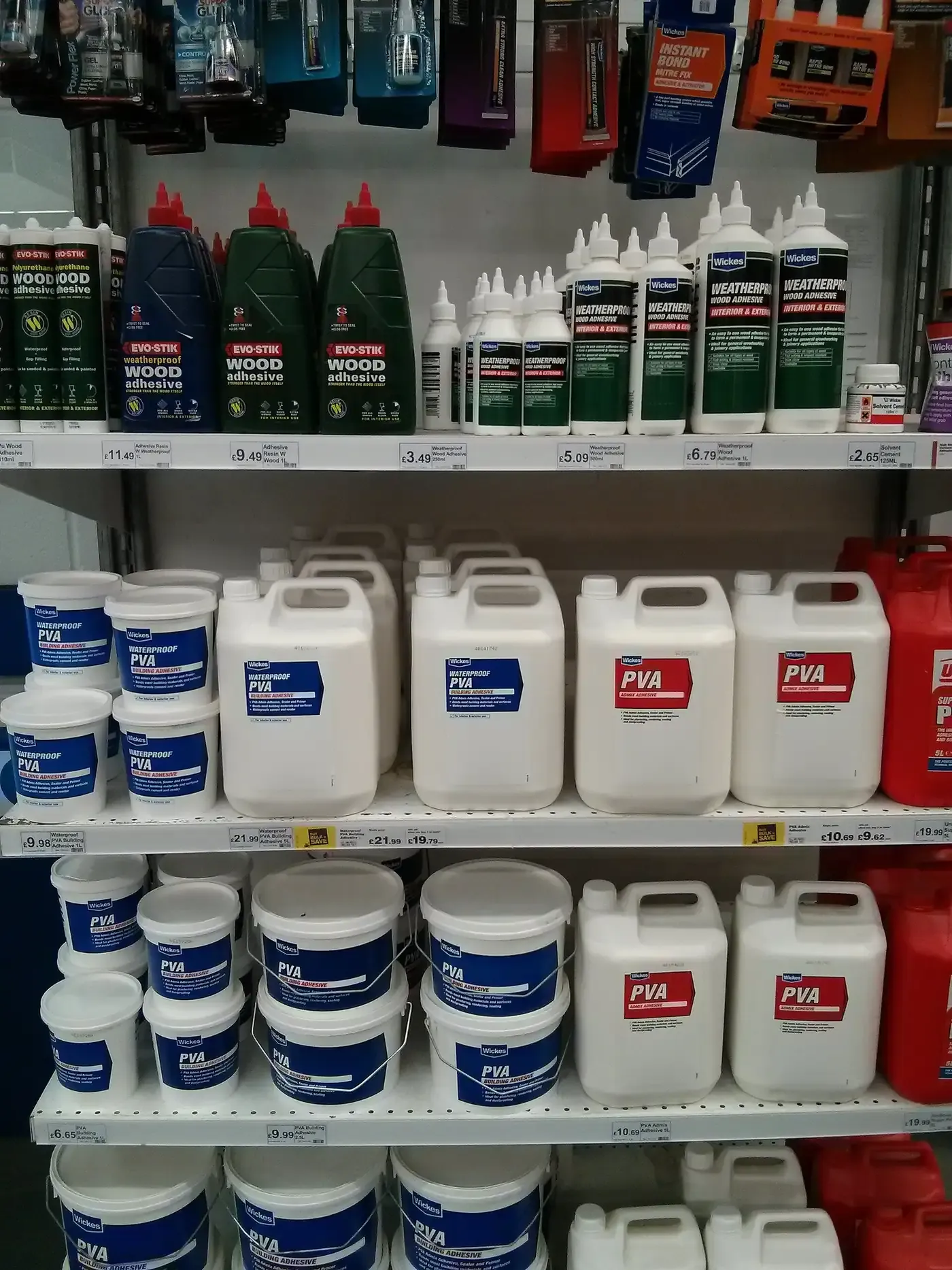
Today PVAc is everywhere the previous generation used hide glue or shellac and did not know it. It is the wood glue and the carpenter’s glue on the workbench, the primer and sealer beneath paint, the sizing that stiffens paper and nonwoven fabric, and, reformulated as a food-grade grade, the base ingredient in chewing gum, chosen because it holds its shape and its flexibility through an hour of chewing without dissolving in saliva.
Plate III

Preserving History: PVAc in Art Conservation
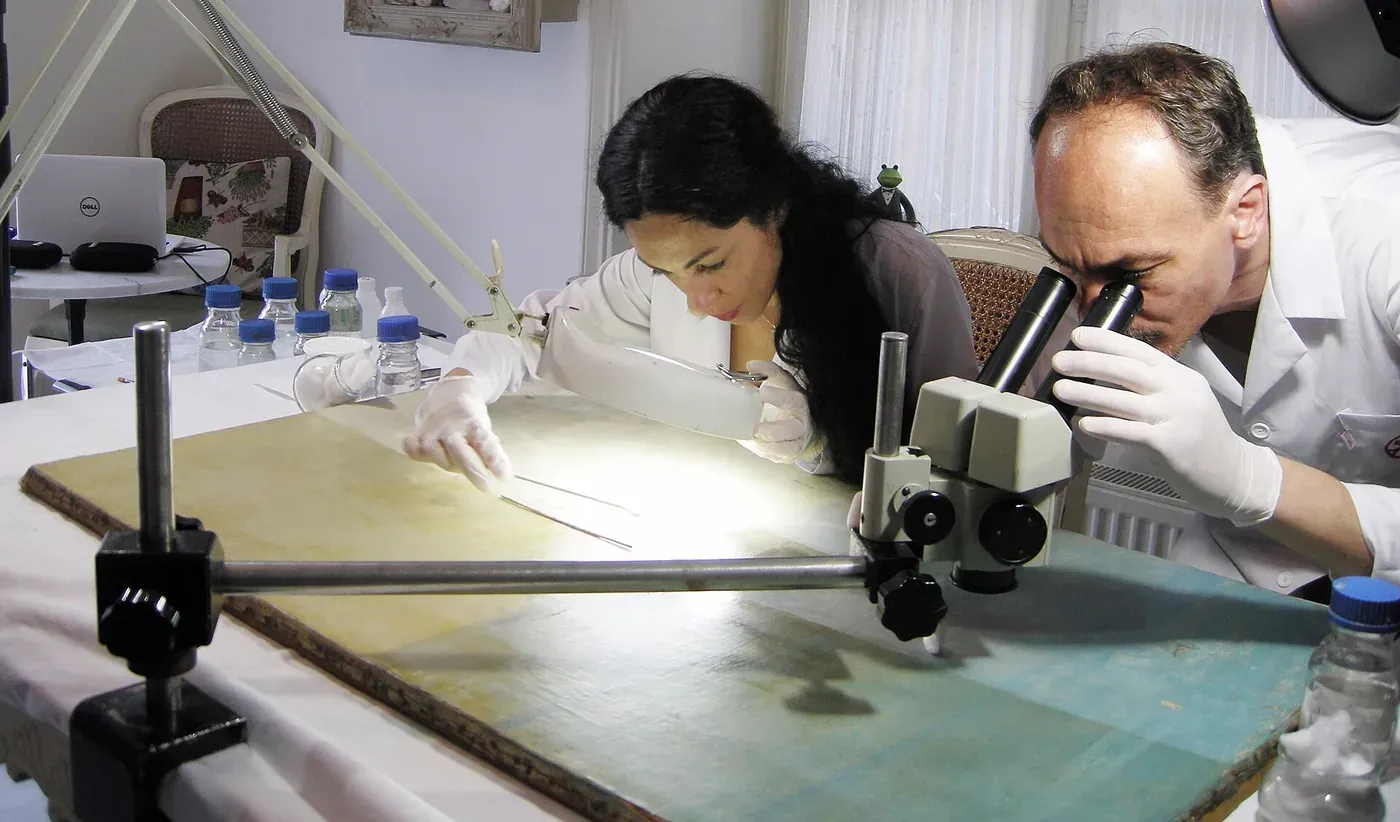
Museums found a use for PVAc that has nothing to do with commerce. Since the 1930s, conservators have used it to consolidate flaking paint and stabilize deteriorating canvas and wood, prizing it for a combination that is hard to find elsewhere: it can be dissolved back out with common solvents if a later conservator needs to undo the work, and it does not visibly discolor as it ages. A material invented to bind things permanently turned out, in dilute solution, to be exactly reversible enough for a discipline built around never doing anything to an artwork that cannot later be taken back.
Plate IV

Sustainable Innovations: PVAc’s Green Revolution
Polymer scientists are now working on making PVAc itself less dependent on petrochemical feedstocks, exploring agricultural waste and bio-based ethanol as sources for the acetic acid and ethylene that go into vinyl acetate monomer, alongside water-based formulations that cut down on the solvents used in some coating applications. None of it changes the underlying chemistry Klatte patented in 1913; it changes only where the starting molecules come from.
The Future Sticks with PVAc
More than a century after a German chemist filed a patent nobody quite knew what to do with, PVAc remains one of the least noticed materials in ordinary life: present in the spine of a book, the underside of a floor, the primer beneath a coat of paint, and the gum in a child’s mouth, doing its job precisely by not calling attention to itself.
values with [n] cite the numbered references·estimates are flagged·“not yet available” and “N/A” are honest states, not gaps
fetching the model…
Polyvinyl Acetate repeat unit
- Abbreviation
- PVAc
- Type
- polymer family (hub)
- CAS number
- 9003-20-7
- Resin ID code
- none assigned
- Formula
- (C4H6O2)n[-CH2-CH(OCOCH3)-]n
- Repeat unit (BigSMILES)
{[][$]CC(OC(C)=O)[$][]}- IUPAC name
- Poly[1-(acetyloxy)ethylene]
- Synonyms
- wood glue resin; white glue polymer
- Also known as
- PVA glue
- Chemical family
- vinyl-polymer
- Backbone class
- carbon-chain
- Polymerization mechanism
- free-radical
- Constitutional monomer
- Vinyl acetate
- Polymer class
- thermoplastic
- Year of origin
- 1913
- Era
- The Birth of Synthetic Polymers (1907-1938): The Bakelite Revolution
- Key figures
- Fritz Klatte
- Events referenced
- Ford's moving assembly line begins operation, Highland Park, Michigan (October 1913)
- Polymerization type
- free-radical chain-growth
- Common monomers (feedstocks)
- vinyl acetate
- Catalysts
- not yet available
Vinyl acetate monomer (itself produced industrially via palladium-catalyzed oxidative addition of acetic acid to ethylene) undergoes free-radical vinyl polymerization to yield PVAc, typically with degree of polymerization 100–5000. Discovered by Fritz Klatte in Germany, 1912–1913 (patented 1913–1914).
- Tacticity
- Predominantly atactic (commercial, free-radical polymerized).
- Crystal structure
- not yet available
- Typical crystallinity
- 0 %[2]Amorphous (atactic, commercial grade).
Molecular weight
- Number average (Mn)
- not yet available
- Mass average (Mw)
- 13000–500000 g/mol[2]Range across commercial grades
- Dispersity (Mw/Mn)
- 2[2]
| Solvent | T | M range | K | a |
|---|---|---|---|---|
| acetone[3] | 298 K | — | 0.0146 mL/g | 0.72 |
| acetonitrile[3] | 298 K | — | 0.0162 mL/g | 0.71 |
| benzene[3] | 303 K | — | 0.0563 mL/g | 0.62 |
| butanone (MEK)[3] | 298 K | — | 0.0134 mL/g | 0.71 |
| chlorobenzene[3] | 298 K | — | 0.11 mL/g | 0.5 |
| chloroform[3] | 298 K | — | 0.0203 mL/g | 0.72 |
| 1,4-dioxane[3] | 298 K | — | 0.0114 mL/g | 0.74 |
| ethanol[3] | 330 K | theta condition | 0.09 mL/g | 0.5 |
| methanol[3] | 298 K | — | 0.038 mL/g | 0.59 |
| tetrahydrofuran[3] | 298 K | — | 0.016 mL/g | 0.7 |
| toluene[3] | 298 K | — | 0.108 mL/g | 0.53 |
Tg (30–45°C) depends on molecular weight; near room temperature, giving PVAc its characteristic tacky/film-forming behavior used in adhesives.
- Density
- 1.19 (1.18–1.2) g/cm³[2]20 °C
- Melt flow index
- not yet available
- Refractive index
- 1.468 (1.467–1.469)[2]20 °C
- Transmittance
- not yet available
- Haze
- not yet available
- Gloss
- not yet available
- Water absorption
- 4.5 (3–6) %[2]Equilibrium, 23 °C
- Dielectric constant
- 3.5[2]1 MHz (100 Hz value not reported)
- Dielectric strength
- 39.4 (30.7–39.4) kV/mm[3]30–60 °C (decreases with temperature)
- Electrical conductivity
- not yet available
- Glass transition (Tg)
- 34 (28–40) °C[2]Commercial grade; atactic 24–31 °C, isotactic 26 °C.
- Melting temperature (Tm)
- Not applicablePredominantly atactic/amorphous; no sharp crystalline melting point.
- Crystallization (Tc)
- Not applicable
- Heat deflection (HDT)
- 50 °C[3]
- Decomposition onset
- 150 °C[3]
- Thermal conductivity
- 0.159 W/(m·K)[3]
- Tensile modulus
- 1765.5 (1275–2256) MPa[3]
- Yield strength
- not yet available
- Tensile strength at break
- 9.1 (6.2–12) MPa[2]
- Elongation at break
- 15 (10–20) %[3]20 °C
- Impact strength (Izod)
- 102.4 J/m[3]Notched
- Impact strength (Charpy)
- not yet available
- Hardness
- not yet available
- Flexural modulus
- not yet available
- Poisson's ratio
- not yet available
- Coefficient of friction
- not yet available
- Solvent: acids
- poor[2]
- Solvent: alcohols
- poor[2]
- Solvent: alkalis
- good[2]
- Solvent: aliphatic hydrocarbons
- fair[2]
- Solvent: aromatic hydrocarbons
- poor[2]
- Solvent: esters
- poor[2]
- Solvent: halogenated hydrocarbons
- poor[2]
- Solvent: ketones
- poor[2]
- Weathering / UV
- Photodegrades via chain scission, releasing acetic acid[2]Spectral sensitivity ~313 nm
- Hydrolysis resistance
- Susceptible to hydrolysis (basis of the polyvinyl alcohol production route); also enzymatically hydrolyzed by lipase.[2]
- Flammability (UL94)
- not yet available
- Limiting oxygen index
- not yet available
- Solubility parameter (δ)
- 21.07 MPa^0.5[3]25 °C (Handbook of Polymers reports an experimental range of 18.0–25.7 MPa^0.5)
Gas permeability
- O₂
- 3.67 × 10⁻¹⁴ cm³(STP)·cm/(cm²·s·Pa)[2]25 °C
Polymer-solvent interaction parameter (χ)
- acetone
- 0.35 (0.31–0.39)[3]30–50 °C
- benzene
- 0.42[3]20 °C
- n-butane
- 1.97[3]100 °C
- butanone
- 0.44[3]25 °C
- chloroform
- -0.13 (-0.17–-0.09)[3]80–135 °C
- cyclohexane
- 1.18[3]100 °C
- ethanol
- 0.8[3]100 °C
- n-hexane
- 1.71–2.06[3]100–120 °C
- n-octane
- 1.94–2.3[3]90–120 °C
- 1-propanol
- 1–1.3[3]30–50 °C
- vinyl acetate
- 0.22–0.41[3]30 °C
- water
- 2.5[3]40 °C
- Processing methods
- emulsion polymerization (as adhesive/paint dispersion)solution/hot-melt application
- Drying required
- not yet determined
- Processing temperature
- Not applicable
- Shrinkage rate
- Not applicable
- Adhesiveswood/paper/cloth glue ('white glue', 'carpenter's glue') · bookbinding adhesive
- Coatingspaints · industrial coatings
- Textilessizing · nonwoven fiber binding
- Consumerchewing gum base
- Recyclable
- No
- Biodegradable
- No
- Degradation pathway
- Plasticizers in PVAc formulations are attacked by fungi; the polymer itself is susceptible to hydrolysis by lipase enzymes.
- [1]Polyvinyl acetateWikipediaAccessed 2026-07-14https://en.wikipedia.org/wiki/Polyvinyl_acetate[wiki-polyvinyl-acetate]
- [2]Handbook of PolymersChemTec Publishinghttps://www.worldcat.org/isbn/9781895198928[handbook-wypych-2016]
- [3]Polymer Data HandbookOxford University Presshttps://search.worldcat.org/search?q=Polymer+Data+Handbook+Mark+1999[handbook-mark-1999]
Illustrations
- Plate IFord's moving line at Highland Park, 1913. Mass production of standardized goods created its own appetite: an equally standardized, equally cheap way to bind, seal and package them.Wikimedia Commons
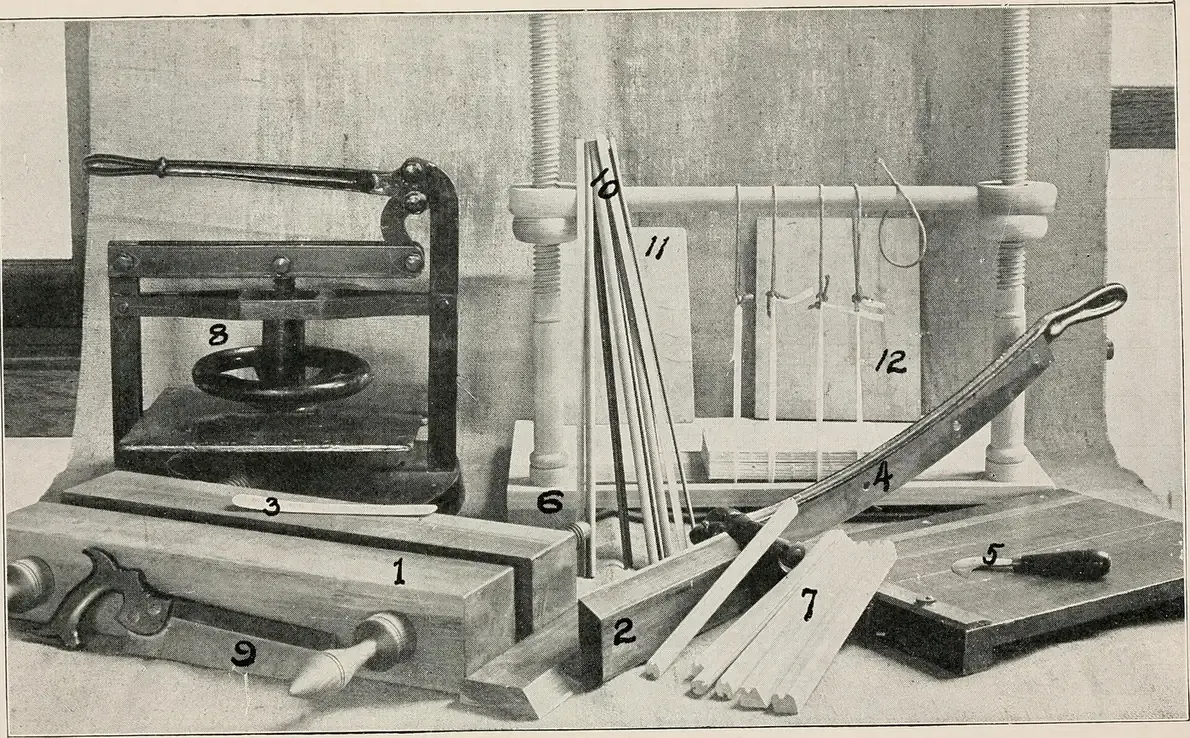
- Plate IITools from a 1914 bookbinding manual. The craft PVAc would eventually enter still relied on hide glue and hand presses when Klatte filed his patent.Wikimedia Commons
- Plate IIIA hardware-store aisle of PVA adhesives, the everyday, unglamorous form Klatte's forgotten patent eventually took.Wikimedia Commons
- Plate IVConservators examining a panel painting. PVAc's reversibility (it dissolves back out of a surface it was used to stabilize) is what earned it a place in this work.Wikimedia Commons