The Birth of Synthetic Polymers (1907-1938): The Bakelite Revolution
Cellophane
Transparent Revolution
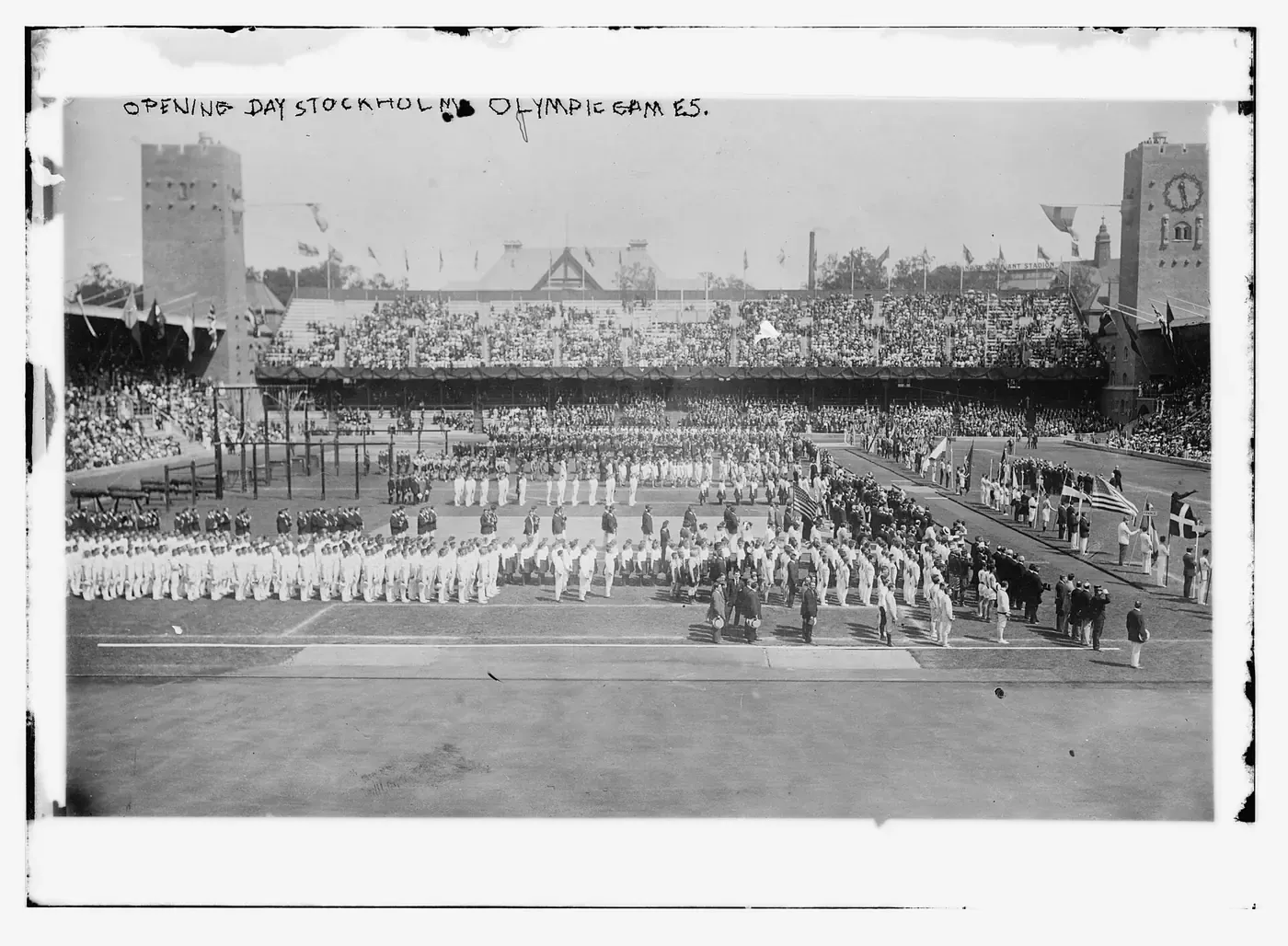
In April of 1912 the largest moving object ever built by human hands sailed out of Southampton, marketed as unsinkable by an age confident it had finally out-engineered nature. Four days later it was gone, taken down by nothing more exotic than a piece of ice. That same summer, in an Olympic stadium in Stockholm, athletes from twenty-eight nations marched in under their own flags for the fifth modern Games, in front of the largest crowds the event had yet drawn. That was a much gentler proof that the world could still be persuaded to gather around something new and orderly.
Plate I
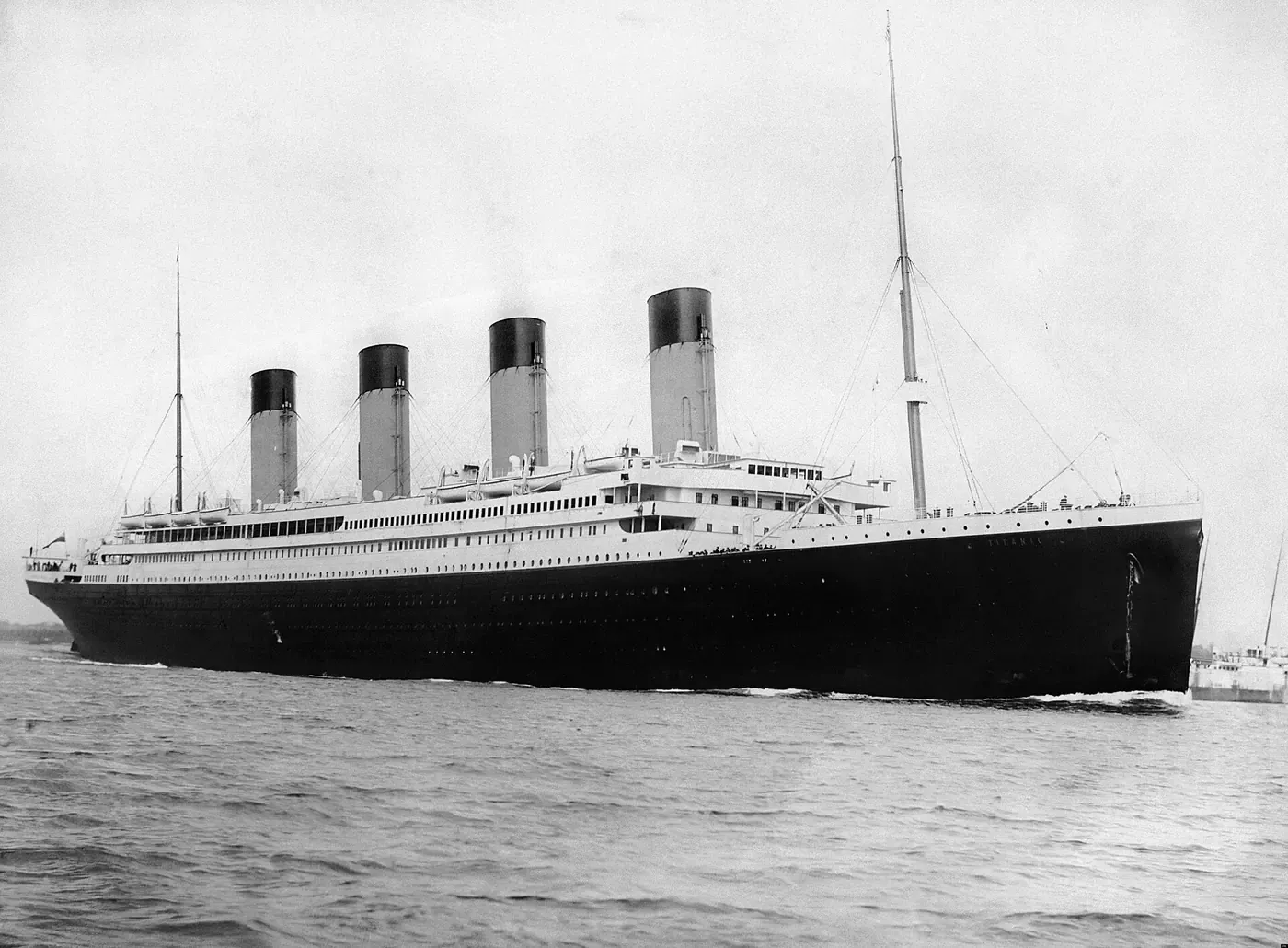

Neither event had anything to do with plastics, but 1912 sits between them as a year the world kept confusing size and spectacle with real progress. The material that would actually change how people shopped and ate was not being unveiled to cheering crowds that year. It was being perfected quietly, in a small French workshop, by a Swiss textile engineer who had spent over a decade chasing an idea that had started as nothing more than a ruined tablecloth.
Plate II

A Wine Stain and a Decade of Refinement
Around 1900, the story goes, Jacques Edwin Brandenberger was dining out when a guest spilled wine across the tablecloth. Watching the fabric soak it up and ruin the linen, he wondered whether a cloth could be made to shed a spill instead of absorbing it. He tried spraying viscose, the same cellulose solution already being spun into rayon fiber, directly onto woven fabric as a waterproof coating. It did make the cloth resist liquid, but the coating was too stiff to work as a textile finish: it peeled away from the weave in a single, flexible, transparent sheet. Brandenberger abandoned the tablecloth and started developing the peeling failure instead.
It took most of a decade to make that observation into a product. By 1908 he had built a working machine for casting viscose into continuous film rather than spraying it onto cloth. By 1912 that machine had matured into an industrial-scale slitting-and-casting line, and Brandenberger patented both the film and the process, giving the material its name from the French cellulose and diaphane, meaning “transparent.” He built his own manufacturing company in Paris to produce it. This is the year, in other words, that a laboratory curiosity became a machine capable of running continuously and a patent capable of being licensed.
The Same Chemistry, Cast Rather Than Spun
Cellophane is regenerated cellulose, made by exactly the alkali-and-carbon-disulfide xanthation process that turns wood pulp into viscose rayon fiber; the only difference is the shape of the die at the end of the line. Force the golden viscose solution through a slit instead of a spinneret and, instead of a round filament, it comes out as a flat, continuous ribbon, which an acid bath regenerates into solid cellulose film exactly as it would regenerate a fiber. What makes that film transparent rather than opaque is how tightly and evenly the cellulose chains pack together as they solidify: regular enough, at a fine enough scale, that light passes through with very little scattering, yet without ever losing the crystalline order that gives the sheet its strength. Plain cast cellulose film, though, has a serious limitation for packaging: it resists liquid water but not water vapor, so food wrapped in it can still dry out or spoil. That problem was solved fifteen years after this page’s own year, when DuPont chemist William Hale Charch developed a nitrocellulose lacquer coating, applied to the base film, that made cellophane genuinely moisture-proof. That was the innovation that actually opened up the food-packaging market cellophane is remembered for.
Plate III

What the Film Actually Does Well
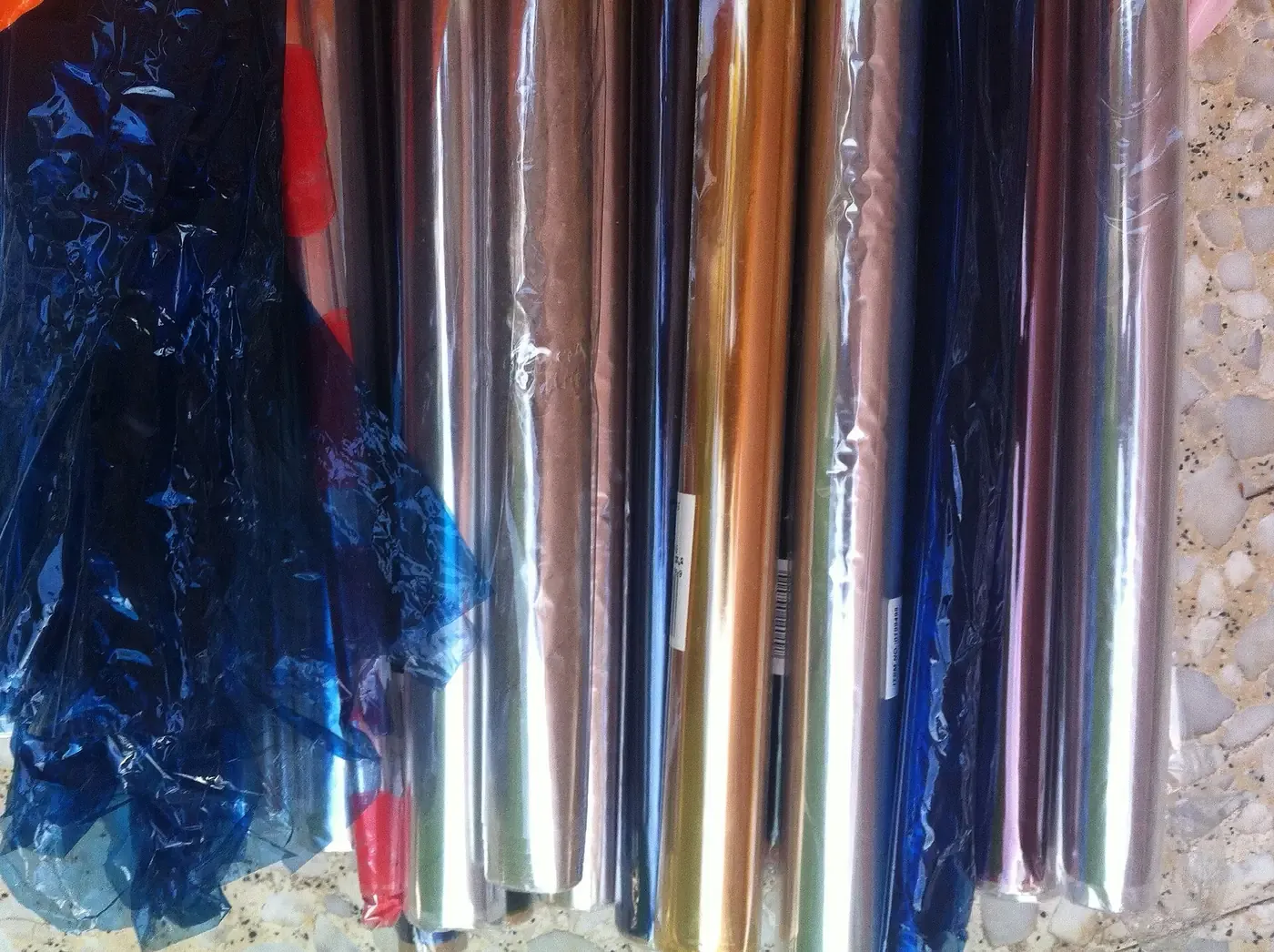
Cellophane earns its reputation on two properties working together. It is genuinely, almost unnervingly clear: a level of optical transparency that was, at the time, unmatched by any other packaging material, natural or synthetic, which is exactly why a shopper could finally see the product before buying it rather than trusting a label. It is also an excellent barrier to gas passage, holding oxygen and other atmospheric gases out well enough to keep a wrapped food noticeably fresher for longer, a direct consequence of the same tightly packed crystalline structure that makes it transparent in the first place. Being cellulose through and through, it also biodegrades the way any plant fiber does once discarded, unlike the petroleum-based films that eventually took over much of its market. Its weaknesses trace back to the same source: humidity changes how much moisture the film itself holds, which is why an uncoated sheet swells, stiffens or curls with the weather, and why Charch’s moisture-proof lacquer mattered so much to its commercial future.
From Wrapper to Household Word
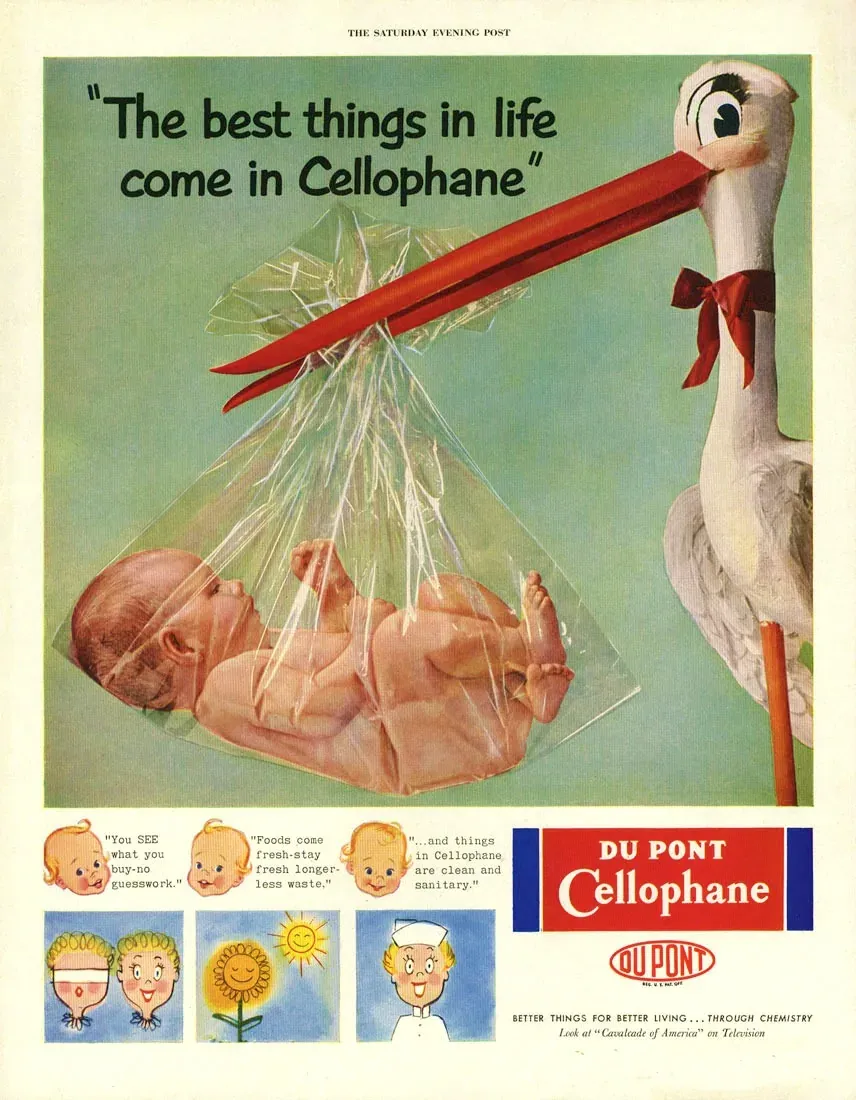
DuPont licensed Brandenberger’s French patents for North America in 1923, and once Charch’s coating made the film moisture-proof in 1927, sales roughly tripled within three years. Cellophane became so dominant in packaging through the 1930s that the name itself slipped into everyday English as a generic term for any transparent wrap, a linguistic victory DuPont’s trademark lawyers spent decades fighting and mostly lost. It even created a downstream invention of its own: cellophane-wrapped goods were notoriously hard to reseal, and in 1930 a young 3M engineer named Richard Drew answered the complaint by coating a strip of cellophane with adhesive, launching Scotch transparent tape.
Plate IV
.jpg)
Looking Back at a Century-Old Film
Petroleum-based plastic wrap eventually took over most of cellophane’s old territory, cheaper to produce and easier to run on high-speed packaging lines. But cellophane never entirely left; it survives today in specialty food wrap, in cigar bands, in twist-wrap candy, and in the dialysis membranes that quietly borrow the same fine, semi-permeable structure Brandenberger stumbled into while trying to save a tablecloth. A century after his patent, a film invented to solve a spilled glass of wine is being looked at again for a much larger reason: it comes from a tree, and it goes back to the earth.
values with [n] cite the numbered references·estimates are flagged·“not yet available” and “N/A” are honest states, not gaps
fetching the model…
Cellophane repeat unit
- Abbreviation
- —
- Type
- polymer family (hub)
- CAS number
- None (heterogeneous class or not assigned)
- Resin ID code
- none assigned
- Formula
- (C6H10O5)n[C6H7O2(OH)3]nChemically regenerated cellulose: the repeat unit is cellulose's own; what changes is the physical form, not the chemistry.
- Repeat unit (BigSMILES)
{[][>]O[C@H]1[C@H](O)[C@@H](O)[C@H]([<])O[C@@H]1CO[]}- IUPAC name
- —
- Synonyms
- —
- Also known as
- —
- Chemical family
- cellulosic
- Backbone class
- heterochain
- Polymerization mechanism
- natural-biosynthesis
- Constitutional monomer
- D-glucose (as the cellulose precursor)
- Polymer class
- thermoplastic
- Year of origin
- 1912
- Era
- The Birth of Synthetic Polymers (1907-1938): The Bakelite Revolution
- Key figures
- Jacques Edwin Brandenberger
- Polymerization type
- not yet available
- Common monomers (feedstocks)
- not yet available
- Catalysts
- carbon disulfide (xanthation agent)
Cellulose (from wood, cotton, hemp, or other organic fibers) is dissolved via the viscose process (alkali + carbon disulfide) and extruded through a slit into a dilute sulfuric acid / sodium sulfate bath, reconverting the viscose into solid cellulose film. Subsequent steps remove residual sulfur, bleach the film, and add glycerin as a softening agent to prevent brittleness. Jacques E. Brandenberger invented cellophane in 1908 and patented it in 1912; DuPont's 1927 nitrocellulose-lacquer moisture-proof coating made it commercially viable for packaging.
- Tacticity
- not yet available
- Crystal structure
- Regenerated cellulose (cellulose II allomorph, as in viscose rayon).
- Typical crystallinity
- not yet available
Molecular weight
- Number average (Mn)
- not yet available
- Mass average (Mw)
- not yet available
- Dispersity (Mw/Mn)
- not yet available
Mark-Houwink constants
not yet available
Birefringent; molecular orientation from the casting process gives distinctive optical behavior under polarized light.
- Density
- not yet available
- Melt flow index
- Not applicable
- Refractive index
- not yet availableNoted as birefringent, producing prismatic colors between polarizing filters, but no scalar index value sourced.
- Transmittance
- not yet available
- Haze
- not yet available
- Gloss
- not yet available
- Water absorption
- not yet available
- Dielectric constant
- not yet available
- Dielectric strength
- not yet available
- Electrical conductivity
- not yet available
- Glass transition (Tg)
- not yet available
- Melting temperature (Tm)
- Not applicableAs regenerated cellulose, decomposes rather than melting (see cellulose entry).
- Crystallization (Tc)
- Not applicable
- Heat deflection (HDT)
- Not applicable
- Decomposition onset
- not yet available
- Thermal conductivity
- not yet available
- Tensile modulus
- not yet available
- Yield strength
- not yet available
- Tensile strength at break
- 85 (50–120) MPa[2]cellophane film, explicitly tagged in the handbook's cellulose chapter (distinct from viscose rayon fiber, 200–400 MPa dry, and generic "regenerated cellulose," 69–170 MPa)
- Elongation at break
- not yet available
- Impact strength (Izod)
- Not applicable
- Impact strength (Charpy)
- Not applicable
- Hardness
- Not applicable
- Flexural modulus
- not yet available
- Poisson's ratio
- not yet available
- Coefficient of friction
- not yet available
- Weathering / UV
- not yet available
- Hydrolysis resistance
- not yet available
- Flammability (UL94)
- Not applicable
- Limiting oxygen index
- not yet available
- Solubility parameter (δ)
- not yet available
Gas permeability
not yet available
Polymer-solvent interaction parameter (χ)
not yet available
- Processing methods
- viscose casting into filmnitrocellulose lacquer moisture-proof coating
- Drying required
- not yet determined
- Processing temperature
- not yet available
- Shrinkage rate
- not yet available
- Packagingfood and consumer product wrap · pressure-sensitive tape base (e.g. Sellotape)
- Medicaldialysis tubing
- Industrialbattery separator components · fiberglass release agent
- Recyclable
- No
- Biodegradable
- Yes
- Degradation pathway
- As regenerated cellulose, compostable and biodegradable via the same enzymatic hydrolysis pathway as native cellulose.
Manufacturing uses carbon disulfide, described as highly toxic to workers. This is a real occupational/environmental concern distinct from the finished film's own biodegradability.
- LD50 (oral, rat)
- not yet available
- NFPA health
- not yet available
- NFPA flammability
- not yet available
- NFPA reactivity
- not yet available
- Carcinogenic classification
- not yet available
- [1]CellophaneWikipediaAccessed 2026-07-14https://en.wikipedia.org/wiki/Cellophane[wiki-cellophane]
- [2]Handbook of PolymersChemTec Publishinghttps://www.worldcat.org/isbn/9781895198928[handbook-wypych-2016]
Illustrations
- Plate IRMS Titanic departing Southampton, 10 April 1912. It was the age's confidence in engineering, days before an iceberg tested it.Wikimedia Commons
- Plate IIOpening day of the 1912 Stockholm Olympics. It was the other kind of spectacle 1912 offered, orderly where the Titanic's story was not.Wikimedia Commons
- Plate IIIModern cellophane rolls, dyed rather than left in its natural clear state. This is the same regenerated cellulose film Brandenberger patented in 1912.Wikimedia Commons
- Plate IVA Du Pont Cellophane advertisement built entirely on the material's clarity and cleanliness. These are the same qualities that first sold grocers on the wrap decades earlier.Wikimedia Commons