The Wartime Innovation Period (1939-1945)
Polyethylene Glycol (PEG)
Stealth Polymer That Revolutionized Medicine
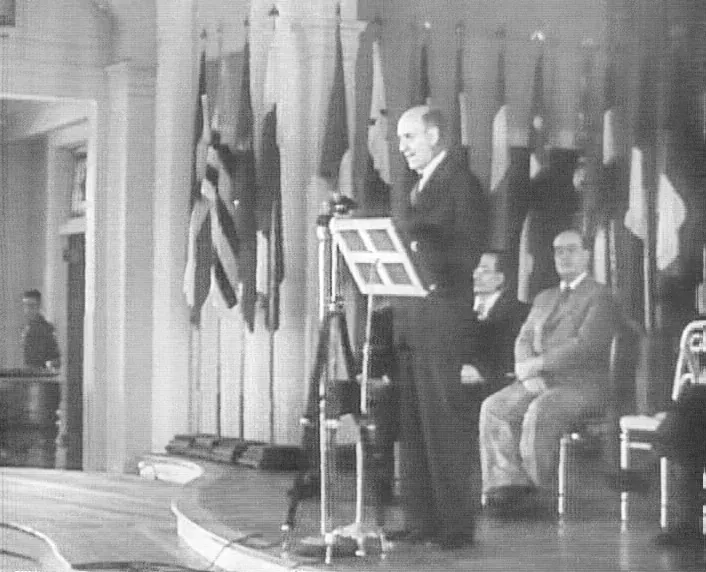
In July 1944, delegates from forty-four Allied nations gathered at a resort hotel in the White Mountains of New Hampshire to design the economic order the world would live inside for the next three decades: fixed exchange rates pegged to a gold-backed dollar, and two new institutions, the World Bank and the International Monetary Fund, built to hold the arrangement together. It was the future being drafted on paper, deliberately, by men confident their clauses would outlast them.
Plate I

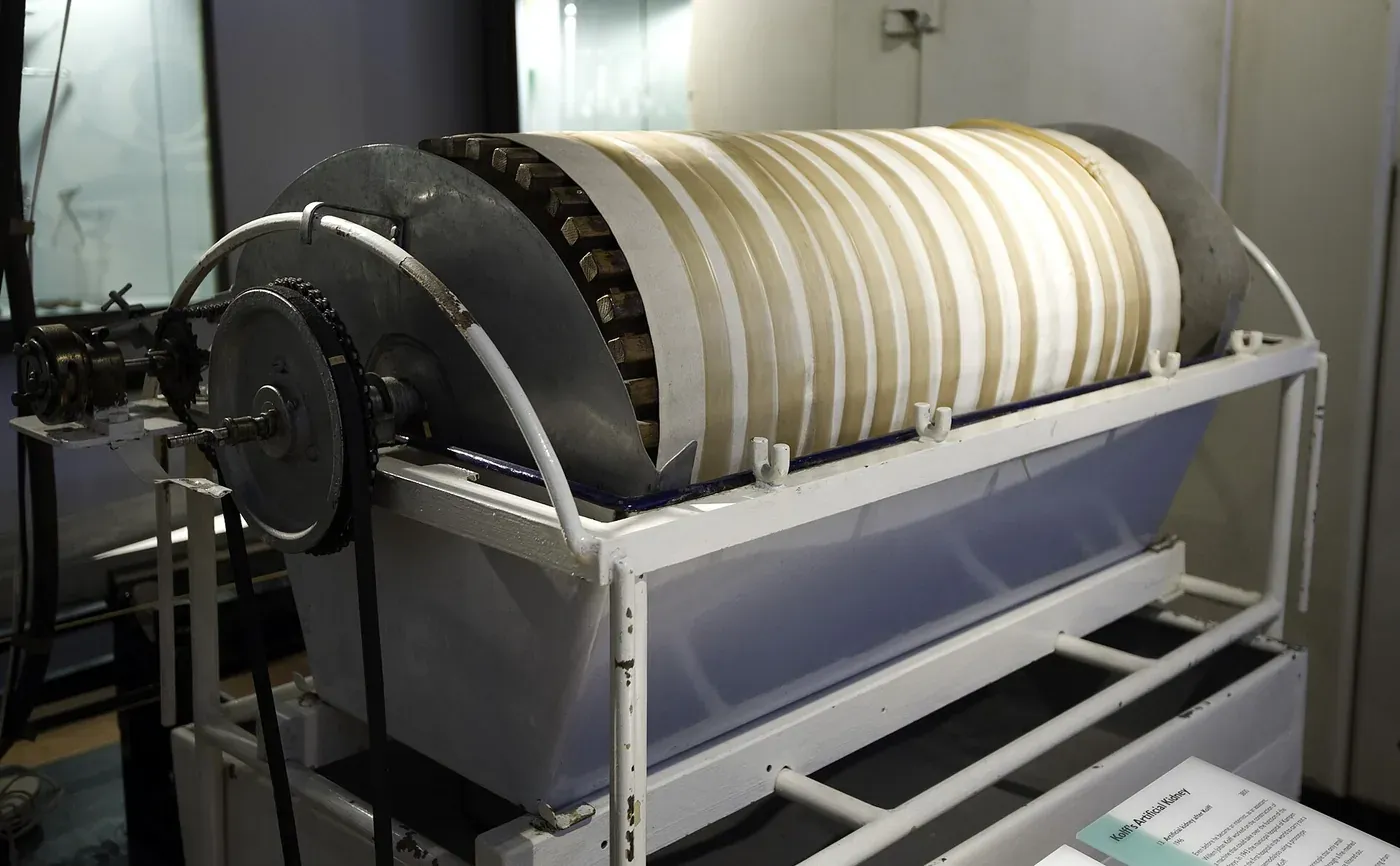
A very different kind of engineering was under way that same year on the other side of a war still being fought. In Nazi-occupied Netherlands, the physician Willem Kolff had spent the past year building a machine to do a failing kidney’s job out of whatever a wartime hospital could still lay hands on: enamel washtubs, wooden slats, and sausage casing bought from a butcher and wound in a long coil around a rotating drum. Patient after patient had gone onto it since 1943, and every one had died. Kolff kept rebuilding the machine anyway. It would not save anyone until September 1945, but by then its basic design was already, in essence, the one dialysis units still use.
Plate II

Neither event had anything to do with polyethylene glycol, and that is rather the point of setting them side by side. PEG’s own 1944 was unglamorous: a wartime industrial chemical, made in bulk by Union Carbide under the trade name Carbowax, doing duty as antifreeze, hydraulic fluid, and a cheap wax substitute in cosmetics and textile sizing. Nobody manufacturing it that year had any reason to think about kidneys. It would be three more decades before that changed, and when it did, it changed for exactly the reason this pairing suggests: a molecule that can move through a body without provoking that body’s defenses turns out to matter more to medicine than to any of the industries that first put it to work.
An Old Molecule, Put to New Work
PEG itself was nothing new in 1944. The French chemist Charles Adolphe Wurtz had isolated it back in 1859, working the same ethylene oxide chemistry that still makes it today; the Portuguese chemist A. V. Lourenço reached a related compound independently the same year. For eight decades afterward it stayed a laboratory curiosity with no real market. What changed it was the ethylene oxide industry that expanded through the 1930s and again under wartime demand for antifreeze, solvents, and explosives intermediates. That was the scale that made PEG cheap enough to be worth a trademark. Union Carbide registered Carbowax in 1940, and by the time delegates were meeting at Bretton Woods it was an established, unremarkable commodity: useful, profitable, and utterly disconnected from anything a physician would have recognized as important.
An Ether Chain with Two Loyalties
PEG’s chemistry is a chain of ethylene oxide units, each one a short two-carbon link followed by an ether oxygen, capped with a hydroxyl group at either end. That oxygen, repeated every third atom down the backbone, is doing most of the work: it hydrogen-bonds readily with water, which is why PEG dissolves in it so completely, while the carbon-hydrogen framework around each oxygen still tolerates a good number of organic solvents. Few small, uncharged, easily made molecules manage both at once, and that dual comfort (happy in water, tolerated by fats and oils alike) is the property everything else in this story depends on.
One Chemistry, Many Materials
Because a PEG chain is built one ethylene oxide unit at a time, the same reaction can be stopped almost anywhere, and the material changes character as it goes. The shortest chains are free-flowing liquids at room temperature, unable to organize into anything resembling a crystal. Lengthen the chain and the melting point climbs steadily until, by the time a producer is selling what looks like a bar of soft white wax, the material holds its shape at room temperature but softens well below the temperature of boiling water. Longer still, sold separately as polyethylene oxide, it becomes a genuine solid plastic, tough enough to be melt-processed and drawn into fiber, and it stretches considerably before it lets go rather than snapping. Across the whole range the backbone itself stays soft and mobile even in a hard freeze, which is exactly the behavior that makes low-molecular-weight PEG useful as an engine coolant additive: mixed with water, it pushes the freezing point down and the boiling point up, without the mixture ever losing its ability to flow.
Plate III

Chemically, PEG resists what a water-soluble material might not be expected to resist: aliphatic hydrocarbons and greases largely leave it alone. It is far less comfortable around alcohols, aromatic solvents, and esters, which either swell or dissolve it depending on concentration. And unlike almost everything else in this Atlas, it does not linger indefinitely in the environment: microorganisms break the ether chain down enzymatically from the ends inward, a genuine biodegradation pathway rather than a slow physical breakup into smaller plastic fragments. Combined with an oral toxicity so low it barely registers on standard scales, that is precisely the combination (soluble, degradable, and nearly inert to a living body) that made PEG worth a second look decades after Carbowax first went on sale.
The Second Career
That second look came from Frank F. Davis, working at Rutgers University in the 1970s. Davis and his graduate student Abraham Abuchowski found that chemically attaching short PEG chains to the surface of a protein changed how the body’s immune system treated it: coated proteins that would normally have been recognized as foreign and destroyed within minutes instead circulated for hours, sometimes days, largely ignored by the defenses that would have cleared them. Davis patented the technique and, with Abuchowski, founded Enzon Pharmaceuticals in 1986 to commercialize it; the first PEGylated drug, a treatment for a rare immune disorder, reached patients in 1990. The dozens of PEGylated protein therapies that followed all trace back to that one observation: a coat of this particular ether chain is close enough to invisible, to an immune system, that whatever it is wrapped around can travel further before being caught.
That same shielding effect is why PEG appears, unannounced, in every mRNA vaccine given since 2020. A strand of messenger RNA is fragile and immediately foreign to the body carrying it; wrapping it inside a lipid nanoparticle protects it physically, and a coating of PEG-linked lipid on that nanoparticle’s outer surface is what keeps the immune system from clearing the whole package before it reaches a cell. None of the underlying chemistry is new; it is the same steric shielding Davis described in the 1970s, applied to a delivery problem nobody had in 1944 or even 1977, using a polymer that had been sitting on industrial shelves the whole time.
A Ship, Preserved by the Same Chemistry
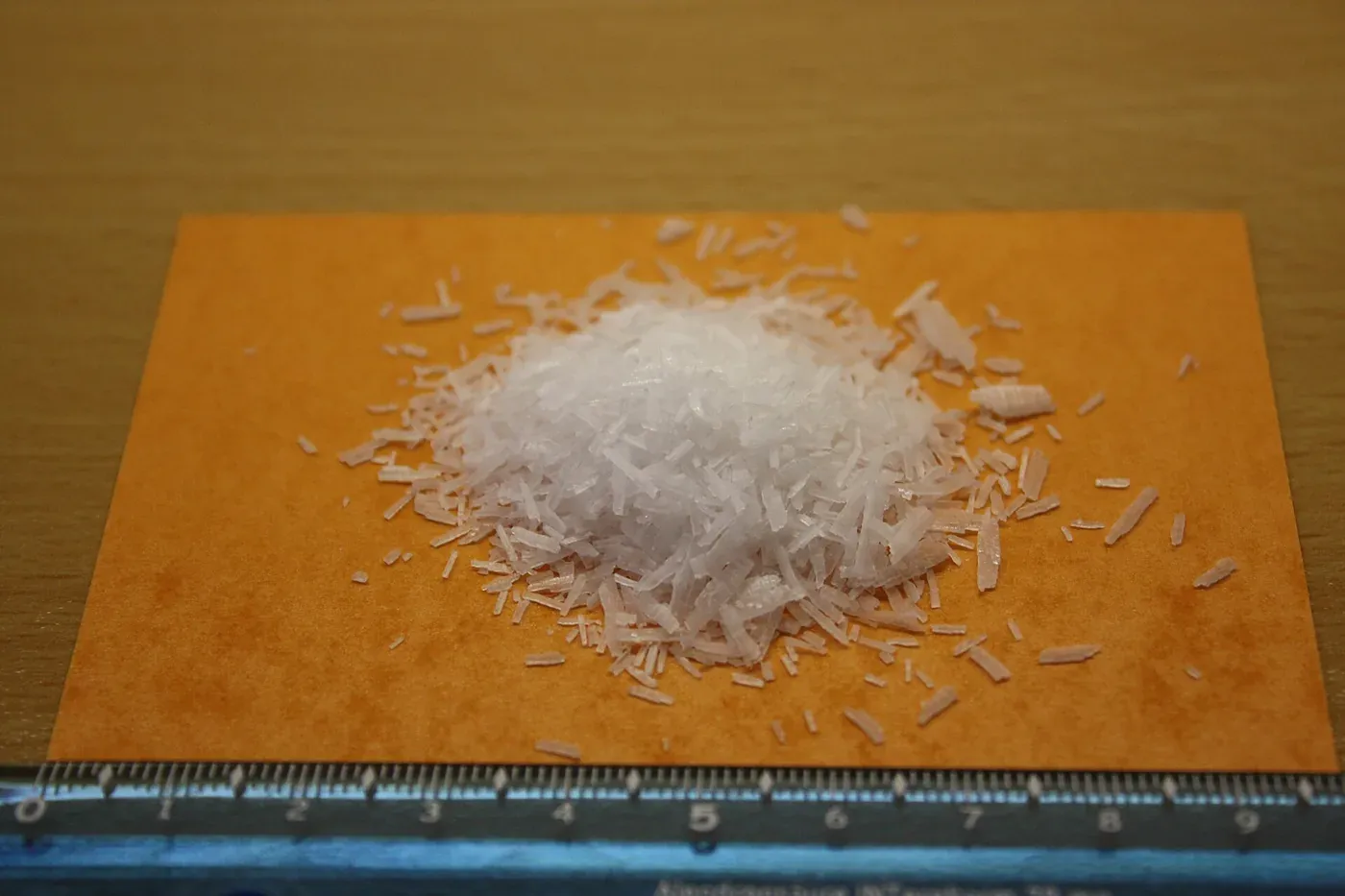
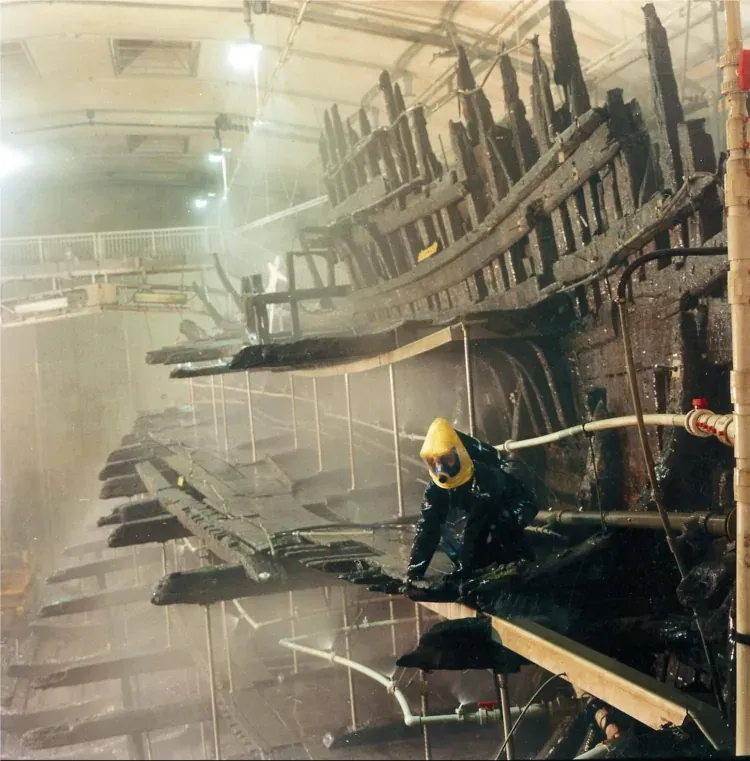
PEG’s least medical application may be its most visible. Between 1994 and 2013, conservators at Portsmouth’s Historic Dockyard sprayed the excavated hull of the Tudor warship Mary Rose continuously with polyethylene glycol solutions: first a low-molecular-weight grade to penetrate the least degraded timber, later a higher-molecular-weight grade that solidifies as it dries, to physically brace wood cells that four centuries underwater had hollowed out. The wax-like PEG that formed inside those cells is, chemically, no different from the flakes shown above; it simply replaced the water that would otherwise have left the wood to shrink, warp, and crack as it dried in open air.
Plate IV

A Family with Two Names
The industry keeps two names for the same repeat unit, purely as a matter of scale: below roughly 20,000 g/mol it is sold as polyethylene glycol, PEG; above that it is polyethylene oxide, PEO, though the underlying chain is identical. At the very high end of that molecular-weight range, PEO’s ability to dissolve a lithium salt while still holding together as a solid film has made it a starting point for solid polymer electrolytes, a route toward batteries built without the flammable liquid electrolyte conventional lithium cells depend on. It is a long way, chemically, from an antifreeze additive or a laxative capsule, and further still from Bretton Woods or a rotating drum wound in sausage casing, but it is the same chain of ethylene oxide units that connects all of it, wearing whichever of its two names fits the molecular weight in question.
values with [n] cite the numbered references·estimates are flagged·“not yet available” and “N/A” are honest states, not gaps
fetching the model…
Polyethylene Glycol repeat unit
- Abbreviation
- PEG
- Type
- polymer family (hub)
- CAS number
- 25322-68-3
- Resin ID code
- none assigned
- Formula
- (C2H4O)n[-O-CH2-CH2-]nNamed poly(ethylene glycol) below about 20,000 g/mol and poly(ethylene oxide) above it, though the repeat unit is identical.
- Repeat unit (BigSMILES)
{[][>]OCC[<][]}- IUPAC name
- —
- Synonyms
- polyethylene oxide (high-MW grades); PEO
- Also known as
- PEOpolyethylene oxide
- Chemical family
- polyester
- Backbone class
- heterochain
- Polymerization mechanism
- ring-opening-polymerization
- Constitutional monomer
- Ethylene oxide
- Polymer class
- thermoplastic
- Year of origin
- 1944
- Era
- The Wartime Innovation Period (1939-1945)
- Key figures
- Charles Adolphe Wurtz · Union Carbide · Frank F. Davis
- Events referenced
- Bretton Woods Conference (July 1944) · Willem Kolff builds the first rotating-drum artificial kidney (1943-1945)
- Polymerization type
- ring-opening polymerization
- Common monomers (feedstocks)
- ethylene oxide
- Catalysts
- NaOH, KOH, Na2CO3 (low MW); organoelement catalysts (high MW)
First documented in 1859 (A. V. Lourenco and Charles Adolphe Wurtz, independently). Manufactured by ring-opening polymerization of ethylene oxide, initiated from water, ethylene glycol, or oligomers; alkaline catalysts give lower molecular weight grades (300-~20,000 g/mol) while organoelement catalysts enable much higher molecular weight synthesis (up to ~10,000,000 g/mol).
- Tacticity
- not yet available
- Crystal structure
- not yet available
- Typical crystallinity
- 76 (70–82) %[2]applies broadly across the PEG/PEO molecular-weight range; low-MW PEGs are semi-crystalline waxy solids/liquids, high-MW PEO is also semi-crystalline but behaves very differently in bulk.
Molecular weight
- Number average (Mn)
- 120–136000 g/mol[2]spans the full commercial PEG (low MW) to PEO (high MW) range
- Mass average (Mw)
- 200–8000000 g/mol[2]spans the full commercial PEG (low MW) to PEO (high MW) range
- Dispersity (Mw/Mn)
- 1.1–1.3[2]
| Solvent | T | M range | K | a |
|---|---|---|---|---|
| acetone[3] | 298 K | 70–1,000 kg/mol | 0.032 mL/g | 0.67 |
| benzene[3] | 298 K | 80–5,200 kg/mol | 0.0307 mL/g | 0.686 |
| carbon tetrachloride[3] | 298 K | 70–1,000 kg/mol | 0.062 mL/g | 0.64 |
| chloroform[3] | 298 K | 200–1,500 kg/mol | 0.206 mL/g | 0.5 |
| methanol[3] | 298 K | — | 0.0825 mL/g | 0.57 |
| toluene[3] | 308 K | 400–4,000 kg/mol | 0.0145 mL/g | 0.7 |
| water[3] | 308 K | 30,000–7,000,000 g/mol | 0.0064 mL/g | 0.82 |
Highly flexible, hydrophilic ether backbone; readily forms hydrogen bonds with water, underlying its use for steric shielding in drug delivery (PEGylation).
- Density
- 1.125 g/cm³[1]
- Melt flow index
- not yet available
- Refractive index
- 1.4563–1.51[2]20 °C, experimental; calculated range is 1.4418–1.4468. Rises with molecular weight: Mark reports 1.4563 for low MW rising to 1.51–1.54 for high MW (handbook-mark-1999).
- Transmittance
- not yet available
- Haze
- not yet available
- Gloss
- not yet available
- Water absorption
- not yet available
- Dielectric constant
- not yet available
- Dielectric strength
- not yet available
- Electrical conductivity
- not yet available
- Glass transition (Tg)
- -70–-60 °C[2]a calculated estimate of -60 °C is also reported. Mark's DSC data on oligomers is much more scattered (conflicting data, -115 to -40 °C depending on end group and chain length, handbook-mark-1999) and is not used here.
- Melting temperature (Tm)
- -23–63 °C[2]rises steeply with molecular weight: PEG 400 approx. 4–8 °C, PEG 600 approx. 20–25 °C, PEG 1500 approx. 44–48 °C, PEG 4000 approx. 54–58 °C, PEG 6000 approx. 56–63 °C; very low-MW grades range -23 to 12 °C (DSC).
- Crystallization (Tc)
- not yet available
- Heat deflection (HDT)
- Not applicable
- Decomposition onset
- not yet available
- Thermal conductivity
- 0.858 W/(m·K)[2]melt state, experimental; calculated estimate is 0.9085 W/(m·K). No solid-state value reported.
- Tensile modulus
- 300 MPa[2]solid, high-molecular-weight PEO; low-MW PEG grades are liquids/waxes with no meaningful modulus. High-MW oriented fibers reach 500–1,000 MPa; theoretical ultimate modulus is 10,000 MPa.
- Yield strength
- not yet availableApplies in principle to solid, high-molecular-weight PEO, but no value was found in either handbook; low-MW PEG grades are liquids with no meaningful yield point.
- Tensile strength at break
- 11–60 MPa[2]solid, high-molecular-weight PEO; oriented fibers reach 100–200 MPa. Low-MW PEG grades are liquids with no meaningful tensile strength.
- Elongation at break
- 30–70 %[2]high-molecular-weight PEO fibers; not applicable to low-MW liquid PEG grades.
- Impact strength (Izod)
- not yet availableApplies in principle to solid, high-molecular-weight PEO, but no value was found in either handbook; low-MW PEG grades are liquids/waxes with no meaningful impact strength.
- Impact strength (Charpy)
- not yet availableApplies in principle to solid, high-molecular-weight PEO, but no value was found in either handbook; low-MW PEG grades are liquids/waxes with no meaningful impact strength.
- Hardness
- not yet availableApplies in principle to solid, high-molecular-weight PEO, but no value was found in either handbook; low-MW PEG grades are liquids/waxes with no meaningful hardness.
- Flexural modulus
- not yet availableApplies in principle to solid, high-molecular-weight PEO, but no value was found in either handbook; low-MW PEG grades are liquids/waxes with no meaningful flexural modulus.
- Poisson's ratio
- 0.439[2]calculated
- Coefficient of friction
- not yet available
- Solvent: water
- Highly soluble/hydrophilic[1]
- Solvent: alcohols
- poor[2]
- Solvent: aliphatic hydrocarbons
- good[2]
- Solvent: aromatic hydrocarbons
- poor[2]
- Solvent: esters
- poor[2]
- Weathering / UV
- Not applicable
- Hydrolysis resistance
- Not applicable
- Flammability (UL94)
- not yet availableNo UL94 classification found in either handbook; ignition temperature (182–287 °C) and limiting oxygen index are reported instead.
- Limiting oxygen index
- 18.5 %[2]
- Solubility parameter (δ)
- 20.2 MPa^0.5[2]matches 20.2 ± 2 MPa^0.5 (IGPC method, 25 °C) per handbook-mark-1999
Gas permeability
not yet available
Polymer-solvent interaction parameter (χ)
- benzene
- 0.18[3]323.8 K, polymer volume fraction v2=0.2 (vapor pressure method); chi is strongly concentration-dependent, falling to 0.10 at v2=0.6. At 343.5 K, chi=0.19 at v2=0.2, falling to 0.09 at v2=0.8.
- Processing methods
- ring-opening polymerization (produced as-is, generally not further melt-processed like bulk plastics)
- Drying required
- not yet determined
- Processing temperature
- Not applicable
- Shrinkage rate
- Not applicable
- Pharmaceuticalexcipient in oral/topical/parenteral products · laxative formulations · mRNA vaccine lipid-nanoparticle stabilizer · PEGylation of protein therapeutics
- Industrialwood preservation · artifact conservation · chromatography · missile propellant components
- Biological researchprotein crystallization · cell fusion · virus concentration · gene-therapy vector modification
- Recyclable
- No
- Biodegradable
- Yes
- Degradation pathway
- Enzymatic: PEO-dehydrogenase, PEO-aldehyde-dehydrogenase, and PEO-carboxylate-dehydrogenase act sequentially on the terminal units of the ether chain, producing terminal carbonyl and carboxyl groups, followed by release of two-carbon units as glyoxylic acid.
Low aquatic toxicity: LC50 (48 h) exceeds 20,000 mg/L for both fathead minnow and rainbow trout.
- LD50 (oral, rat)
- 28000–50000 mg/kg[2]rises with molecular weight: 28,000 mg/kg (MW 200), 38,100 mg/kg (MW 600), 44,200 mg/kg (MW 1,000), 50,000 mg/kg (MW 4,000)
- NFPA health
- 0[2]HMIS rating, 0–4 scale
- NFPA flammability
- 1[2]HMIS rating, 0–4 scale
- NFPA reactivity
- 0[2]HMIS rating, 0–4 scale
- Carcinogenic classification
- not listed by ACGIH, NIOSH, NTP[2]
TLV (ACGIH): 10 ppm.
- [1]Polyethylene glycolWikipediaAccessed 2026-07-14https://en.wikipedia.org/wiki/Polyethylene_glycol[wiki-peg]
- [2]Handbook of PolymersChemTec Publishinghttps://www.worldcat.org/isbn/9781895198928[handbook-wypych-2016]
- [3]Polymer Data HandbookOxford University Presshttps://search.worldcat.org/search?q=Polymer+Data+Handbook+Mark+1999[handbook-mark-1999]
Illustrations
- Plate IU.S. Treasury Secretary Henry Morgenthau Jr. opens the Bretton Woods Conference in July 1944, where delegates drew up the rules for the postwar global economy.Wikimedia Commons
- Plate IIWillem Kolff's rotating-drum artificial kidney, the machine he built and rebuilt through 1943 and 1944 before it saved its first patient.Wikimedia Commons
- Plate IIIPolyethylene glycol 4000, a mid-range molecular weight sold as flakes, solid at room temperature, but still a long way from the tough fiber-forming grades sold as polyethylene oxide.Wikimedia Commons
- Plate IVSpraying the hull of the Mary Rose with polyethylene glycol solution at Portsmouth's Historic Dockyard, a treatment that ran continuously from 1994 to 2013.Wikimedia Commons