Decoding Nature's Legacy (1833-1902)
Proteins
Life's Building Blocks
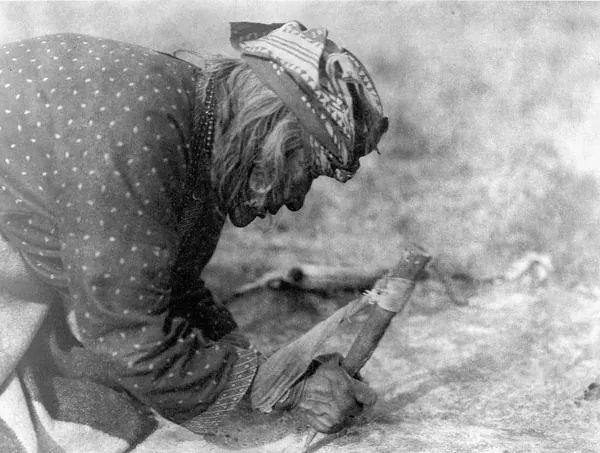
Long before anyone had a word for it, people were already working proteins by hand. Animal hides were scraped, stretched and cured into leather; spider silk and sinew were twisted into thread; egg white bound pigment to cave wall and, later, to canvas. None of it required understanding the chemistry; it required only patience, and generations of accumulated craft.
Plate I

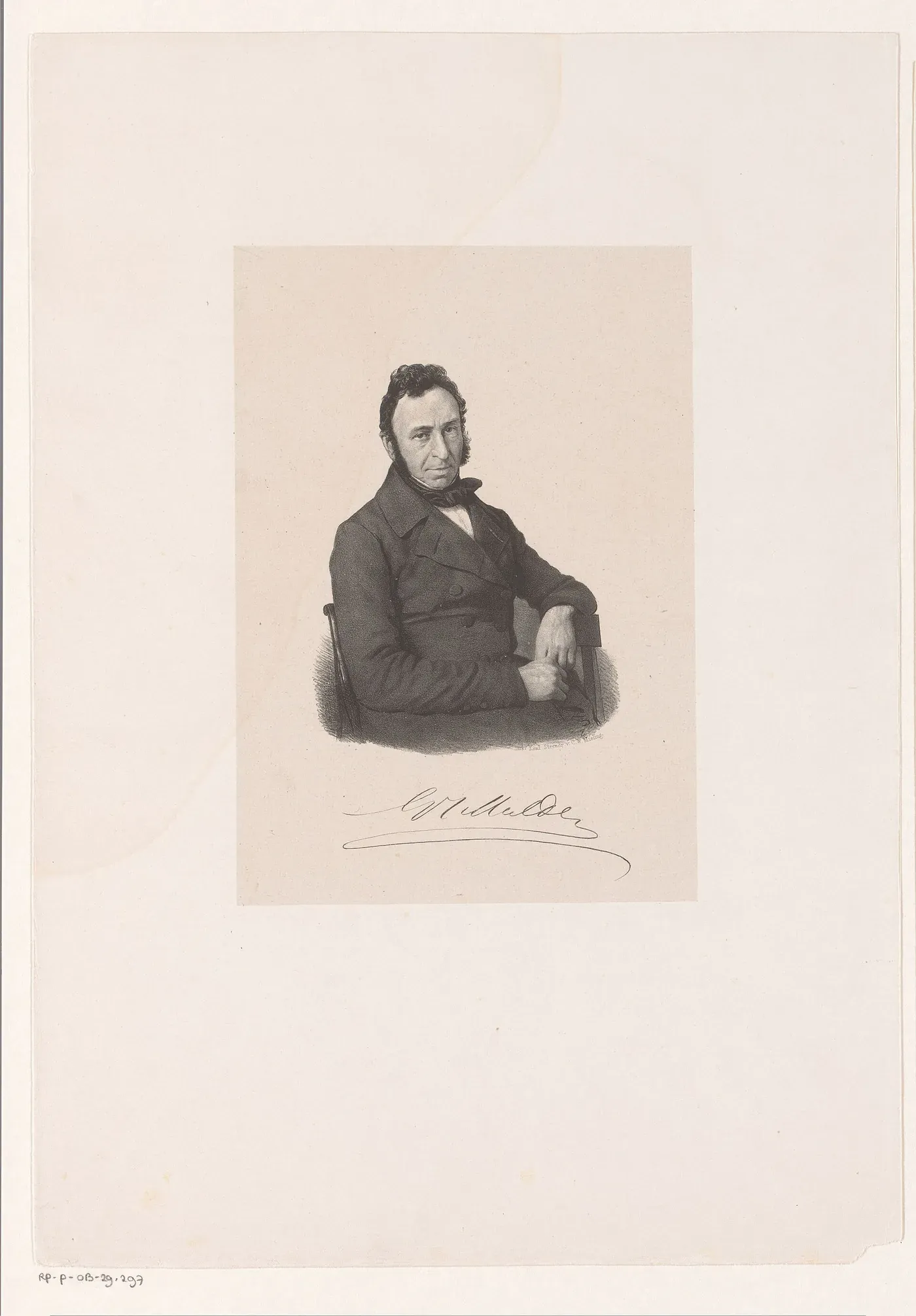
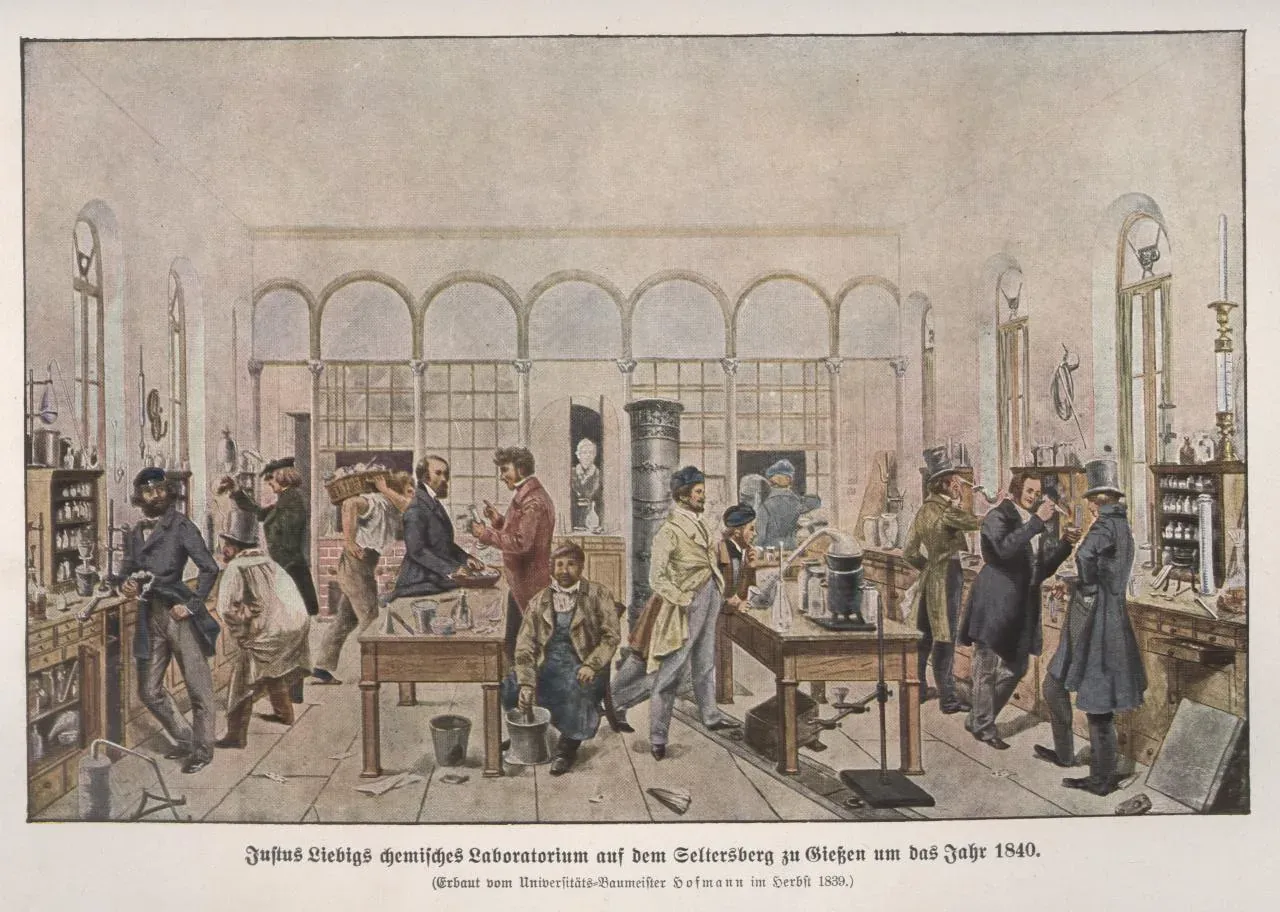
The chemistry caught up in fits and starts. In 1838 the Dutch chemist Gerardus Johannes Mulder, analyzing substances like albumin and fibrin, proposed that a whole class of animal and plant materials shared a common organic basis; that same year, in a letter to Mulder, the Swedish chemist Jöns Jacob Berzelius suggested a name for it: protein, from the Greek for “of first importance.” It was a young, contested idea, built on elemental analysis that would later prove incomplete in its details. What turned it from one chemist’s proposal into a subject the whole discipline had to reckon with was Justus von Liebig’s “Organic Chemistry in its Application to Agriculture and Physiology,” published in 1840. Liebig put Mulder’s new concept at the center of an entire theory of animal nutrition, arguing that this “protein” was the very substance of muscle and flesh, and in doing so dragged the word out of specialist journals and into the middle of European science. The theory Liebig popularized would not survive contact with more careful chemistry (he himself turned on Mulder’s specific claims within a few years), but the word did, and so did the recognition that hides, silk, egg white, and muscle were all, at bottom, the same kind of polymer.
Plates II & III


The Protein Family: Nature’s Toolkit
A protein is a chain of amino acids (twenty different kinds in nature’s standard set, each with its own chemistry) strung together by peptide bonds and then folded into a working shape. That single idea covers an enormous range of jobs. Structural proteins like collagen, keratin, and elastin build the tissues of the body, from tendon to hair to the stretchy walls of an artery. Enzymes such as catalase and carbonic anhydrase act as extraordinarily fast, specific catalysts, each shaped around an active site built for one reaction. Transport proteins like hemoglobin carry oxygen and other cargo through the bloodstream, changing shape slightly with each delivery. And motor proteins such as myosin and kinesin convert chemical energy directly into mechanical motion, the literal engines behind a muscle contraction or a cell hauling cargo along its internal scaffolding.
Among this family, collagen deserves special attention as the body’s principal structural material: by mass, the most abundant protein in the mammalian body, present in more than two dozen distinct types. Its secret is a triple helix: three long amino acid chains, each following a repeating pattern in which every third residue is glycine, wound around one another like strands in a rope. That construction gives collagen a rope-like resistance to stretching along its length while keeping the flexibility a living tissue needs, and it explains a piece of kitchen chemistry too: heat that helix past the point where it can hold its shape, and it unwinds into gelatin, which is why a simmered bone or a cut of meat left too long on the heat both change texture in the same underlying way, and why boiling shrinks a piece of rawhide.
From Chains to Structures
Protein folding runs through several layers, each more complex than the last. The primary structure is simply the sequence of amino acids: the chain’s ordering, which can run from a few dozen to several thousand units. That chain then folds into local, repeating patterns, the secondary structure, of which the two most common are the α-helix and the β-sheet, both stabilized by hydrogen bonds along the backbone; the α-helix, in particular, was worked out by Linus Pauling in 1951, more than a century after Mulder and Liebig’s tentative first sketch of what a “protein” even was. Those folded segments pack further into a tertiary structure (a globular enzyme’s active-site pocket, or a fibrous protein’s elongated shape), and some proteins go further still, assembling several folded chains into a quaternary structure, as hemoglobin does with four chains, or as collagen does with its own triple helix.
From Ancient Craft to Modern Medicine
The applications have grown enormously more sophisticated without changing their basic subject. Cooking is applied protein chemistry: beating egg whites unfolds their proteins and lets them refold around trapped air, which is why a properly beaten white holds a meringue’s shape, and searing meat firms it by denaturing and coagulating the same fibrous proteins that once powered a living muscle. Cheesemaking works because milk’s casein proteins, ordinarily held in solution as stable micelles, fall out of suspension and reassemble into a solid network once rennet or acid disturbs them.
Plate IV


Medicine and biomaterials science have taken collagen furthest of all: purified and processed collagen now appears as wound dressings, injectable fillers, and scaffolds that guide bone and tissue regeneration, in forms ranging from sponges to sheets to injectable gels. Elsewhere, spider silk proteins are being engineered into high-performance fibers, industrial enzymes now catalyze reactions from detergent formulation to biofuel production, and laboratory-designed antibodies target diseases with a precision no natural immune system could plan in advance. Scientists can now design proteins from scratch on a computer and manufacture them in bacterial or mammalian cell cultures. That is a capability Mulder, sketching his first tentative theory of “protein” in 1838, could not have imagined, even though the molecule he was trying to name is exactly the one being redesigned.
values with [n] cite the numbered references·estimates are flagged·“not yet available” and “N/A” are honest states, not gaps
- Abbreviation
- —
- Type
- polymer family (hub)
- CAS number
- None (heterogeneous class or not assigned)
- Resin ID code
- none assigned
- Formula
- Proteins are sequence-defined heteropolymers of up to 20 different L-α-amino acid monomers joined by peptide bonds; there is no single repeat unit for the class as a whole (sequence is the whole point). Individual proteins (e.g. keratin, collagen) get their own entries where relevant.
- Repeat unit (BigSMILES)
- Proteins are sequence-defined heteropolymers of up to 20 different L-α-amino acid monomers joined by peptide bonds; there is no single repeat unit for the class as a whole (sequence is the whole point). Individual proteins (e.g. keratin, collagen) get their own entries where relevant.
- IUPAC name
- —
- Synonyms
- polypeptides
- Also known as
- —
- Chemical family
- protein
- Backbone class
- heterochain
- Polymerization mechanism
- natural-biosynthesis
- Constitutional monomer
- L-α-amino acids (20 standard)
- Polymer class
- —
- Year of origin
- 1840
- Era
- Decoding Nature's Legacy (1833-1902)
- Key figures
- Gerardus Johannes Mulder · Jöns Jacob Berzelius · Justus von Liebig
- Polymerization type
- not yet available
- Common monomers (feedstocks)
- not yet available
- Catalysts
- not yet available
Biologically synthesized by ribosomes translating mRNA (up to ~20 amino acids/second in prokaryotes) via peptide bond formation between the amino and carboxyl groups of successive amino acids. Short peptides can also be made industrially by chemical peptide synthesis, but this is inefficient beyond a few hundred residues. The term 'protein' was coined by Jöns Jacob Berzelius in 1838, building on Gerardus Johannes Mulder's elemental-composition work.
- Tacticity
- not yet available
- Crystal structure
- Hierarchical structure: primary (sequence) -> secondary (α-helix/β-sheet, hydrogen-bond stabilized) -> tertiary (3-D fold, stabilized by hydrophobic core, salt bridges, disulfide bonds) -> quaternary (multi-chain assemblies).
- Typical crystallinity
- Not applicable
Molecular weight
- Number average (Mn)
- not yet available
- Mass average (Mw)
- 50000–300000 g/mol[2]Processed soy-protein-based material (Wypych 'PR' entry). Individual proteins vary enormously: raw soy protein 30,000–1,000,000, casein 19,000–25,200, albumins 10,000–15,000, globulins 150,000–450,000.
- Dispersity (Mw/Mn)
- not yet available
Mark-Houwink constants
not yet available
Folding behavior and flexibility vary enormously by sequence; no single description applies across the class.
- Density
- 1.36 g/cm³[2]Soy-protein-based industrial plastic (Wypych 'PR' entry), 20 °C; density is otherwise highly protein-specific and not meaningful for the class generally.
- Melt flow index
- Not applicable
- Refractive index
- Not applicable
- Transmittance
- not yet available
- Haze
- not yet available
- Gloss
- not yet available
- Water absorption
- not yet available
- Dielectric constant
- Not applicable
- Dielectric strength
- not yet available
- Electrical conductivity
- not yet available
- Glass transition (Tg)
- 181–252 °C[2]Specific to individual proteins, not a general class value: wheat glutenin 181 °C, collagen 192 °C, gelatin 217 °C, elastin 252 °C.
- Melting temperature (Tm)
- Not applicable
- Crystallization (Tc)
- Not applicable
- Heat deflection (HDT)
- Not applicable
- Decomposition onset
- not yet available
- Thermal conductivity
- not yet available
- Tensile modulus
- 104–1200 MPa[2]Soy-protein-based industrial material (Wypych 'PR' entry, Young's modulus). Mechanical properties are otherwise specific to individual structural proteins (e.g. keratin, collagen, silk fibroin), not meaningful for 'proteins' as a class.
- Yield strength
- Not applicable
- Tensile strength at break
- 40–50 MPa[2]Soy protein (as processed, Wypych 'PR' entry); drawn soy protein (2.5 draw ratio) reaches 99 MPa, zein 12.7 MPa (5–6 MPa cast).
- Elongation at break
- 4.6 %[2]Soy protein (Wypych 'PR' entry); zein reported much higher, 61–122%.
- Impact strength (Izod)
- Not applicable
- Impact strength (Charpy)
- Not applicable
- Hardness
- Not applicable
- Flexural modulus
- Not applicable
- Poisson's ratio
- not yet available
- Coefficient of friction
- not yet available
- Solvent: acids
- poor[2]Soy protein-based industrial material (Wypych 'PR' entry), dilute and concentrated.
- Solvent: alcohols
- good/poor[2]Soy protein-based industrial material (Wypych 'PR' entry).
- Solvent: alkalis
- poor[2]Soy protein-based industrial material (Wypych 'PR' entry).
- Solvent: aliphatic hydrocarbons
- good[2]Soy protein-based industrial material (Wypych 'PR' entry).
- Solvent: aromatic hydrocarbons
- good[2]Soy protein-based industrial material (Wypych 'PR' entry).
- Solvent: esters
- good[2]Soy protein-based industrial material (Wypych 'PR' entry).
- Weathering / UV
- Not applicable
- Hydrolysis resistance
- not yet availablePeptide bonds are hydrolyzable (this is how digestion works) but rate depends heavily on structure/sequence.
- Flammability (UL94)
- Not applicable
- Limiting oxygen index
- not yet available
- Solubility parameter (δ)
- not yet available
Gas permeability
not yet available
Polymer-solvent interaction parameter (χ)
not yet available
- Processing methods
- not yet available
- Drying required
- not yet determined
- Processing temperature
- 70–165 °C[2]Soy protein-based industrial material (Wypych 'PR' entry): 70–105 °C extrusion, 130 °C molding, 135–165 °C compression molding.
- Shrinkage rate
- Not applicable
- Food & nutritiondietary essential amino acid source
- Textiles & biomaterialswool/silk fibers (keratin, fibroin) · collagen- and elastin-based biomaterials
- Industrial enzymesbiocatalysts for ~4,000 known reaction types
- Pharmaceuticalinsulin · monoclonal antibodies · hormone-receptor therapeutics
- Recyclable
- No
- Biodegradable
- Yes
- Degradation pathway
- Enzymatic proteolysis (hydrolysis of peptide bonds) by proteases; readily biodegradable.
Soy protein-based industrial material (Wypych 'PR' entry) shows low aquatic toxicity: Daphnia magna and rainbow trout 48 h LC50 both >1,000 mg/l.
- LD50 (oral, rat)
- not yet available
- NFPA health
- not yet available
- NFPA flammability
- not yet available
- NFPA reactivity
- not yet available
- Carcinogenic classification
- not listed by ACGIH, NIOSH, NTP[2]Soy protein-based industrial material (Wypych 'PR' entry).
- [1]ProteinWikipediaAccessed 2026-07-14https://en.wikipedia.org/wiki/Protein[wiki-protein]
- [2]Handbook of PolymersChemTec Publishinghttps://www.worldcat.org/isbn/9781895198928[handbook-wypych-2016]
Illustrations
- Plate IFleshing a hide by hand, a craft built entirely on collagen chemistry, practiced for millennia before anyone had a name for the molecule involved.Wikimedia Commons
- Plate IIGerardus Johannes Mulder, whose 1838 analysis of albumin and fibrin proposed the shared substance that Berzelius would name protein.Wikimedia Commons
- Plate IIIJustus von Liebig's laboratory at Giessen, around 1840, the year his textbook made 'protein' central to the emerging science of nutrition.Wikimedia Commons
- Plate IVA sheet-web spider's silk, another structural protein whose engineering (strong, light, and self-spun) modern materials science is still trying to match.Wikimedia Commons