The Birth of Synthetic Polymers (1907-1938): The Bakelite Revolution
Polyacrylonitrile (PAN)
The Fiber That Became the Skeleton of Flight
On 18 February 1930, a 24-year-old observatory assistant named Clyde Tombaugh compared two photographic plates taken weeks apart and found a faint point of light that had shifted against the fixed stars behind it. It was Pluto, found only because Tombaugh had the patience to blink back and forth between thousands of star images looking for the one dot that did not belong. Whatever it was, it had been sitting on plates like these, and in the sky itself, for the whole of human history; nobody had simply had the right instrument, pointed the right way, to notice it.
Plates I & II
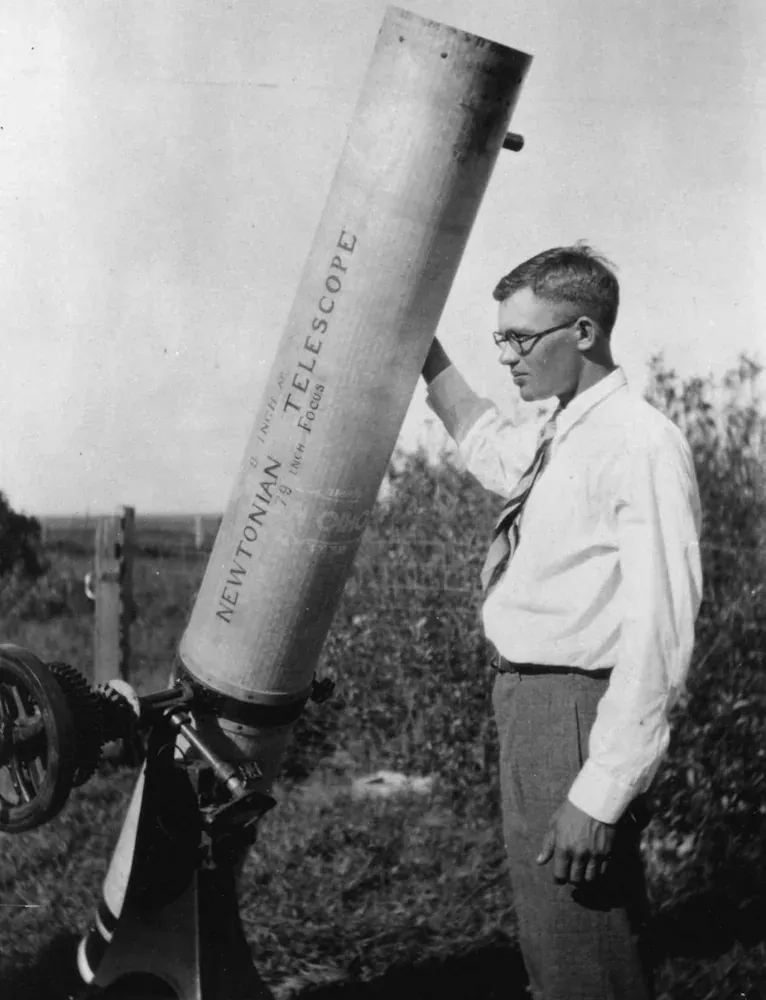

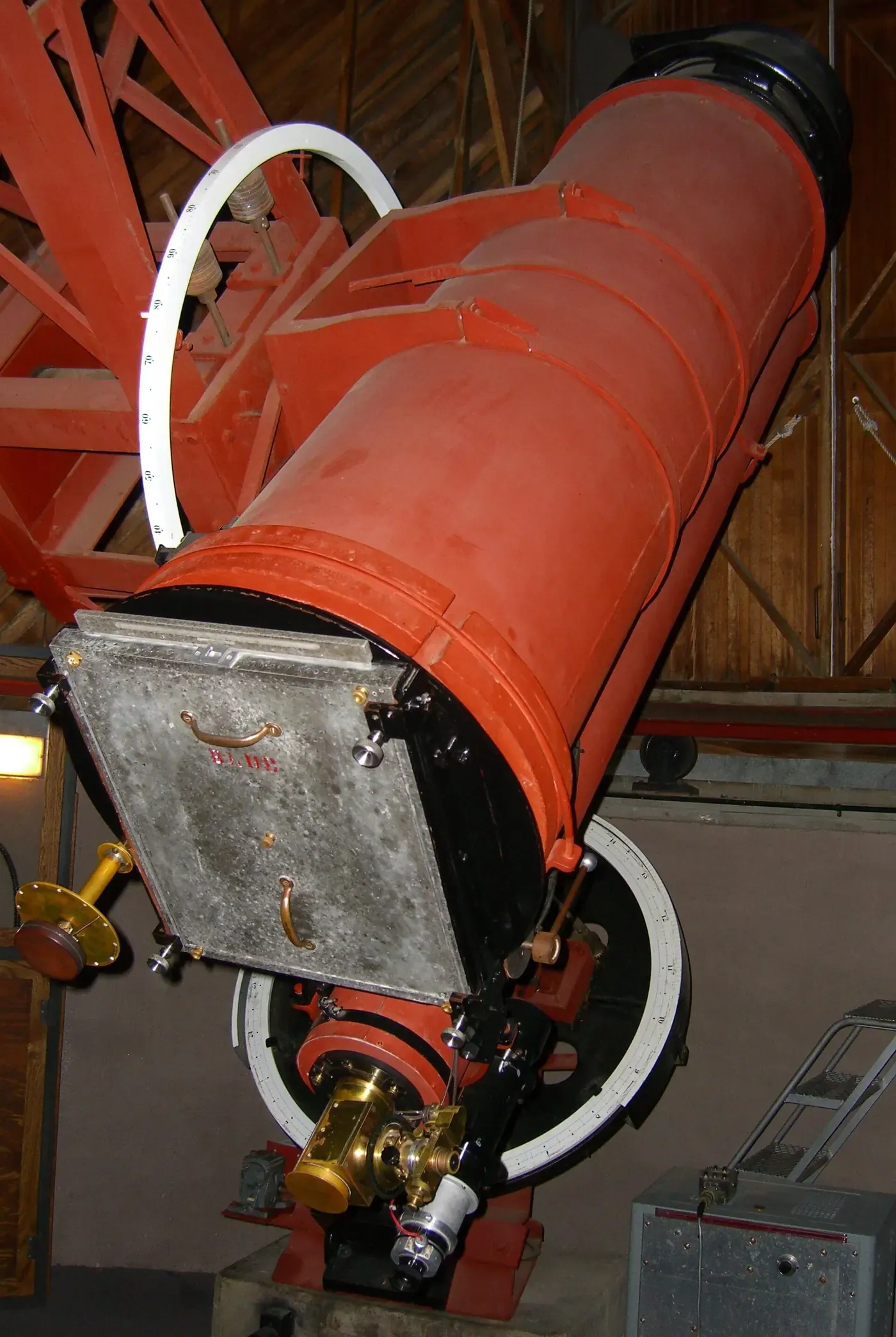

That same year, in the industrial city of Ludwigshafen, two chemists at IG Farben’s central laboratory were looking at a discovery of the opposite kind: a substance nobody could miss, sitting right there in the reaction flask, that turned out to be useless for almost exactly the reason Pluto had gone unseen for so long: the tools needed to work with it did not exist yet.
Hans Fikentscher and Claus Heuck had synthesized a new polymer they called polyacrylonitrile: a fine white powder, built on a simple carbon backbone with a small, intensely polar nitrile group hanging off every other carbon. Those nitrile groups should have made it valuable (they pull neighboring chains together so strongly that the polymer is unusually rigid and heat-resistant), but in 1930 that same strength made it impossible to do anything with. It would not melt without decomposing first, and it dissolved in none of the solvents then available to industrial chemistry. Fikentscher and Heuck had made something real and reproducible, and it went precisely nowhere. Research on it was quietly shelved.
Molecular Architecture: The Stubborn Chain
Polyacrylonitrile is built on a polyethylene-like backbone, but the nitrile group (-CN) bristling off every other carbon changes everything about how the chain behaves. Its strong dipole pulls neighboring chains together with unusual force, which is what gives the polymer its rigidity, its semicrystalline order, and its fierce resistance to solvents. This is the same intermolecular attraction that made it so maddening to its own discoverers.
PAN does not melt in the ordinary sense; heated too quickly, it degrades before it flows, and above about 180°C the nitrile groups begin to cyclize, releasing energy as they lock into ladder-like ring structures. Far from a defect, this cyclization is the key to PAN’s greatest role: it is the first step on the path from a polymer fiber to pure carbon.
Properties: Stronger Drawn Than Cast
As a bulk, unoriented solid, PAN is stiff and only moderately extensible; it will stretch a little before breaking, but nothing like a soft plastic. Draw it into a fiber, orienting the chains along the filament’s length, and the same polymer becomes markedly stronger, which is exactly why fiber, not sheet or moulding, is where it earns its living. It softens noticeably below the boiling point of water, well short of the far higher temperature at which it actually decomposes. That is a wide gap that leaves plenty of room for the oxidation and carbonization steps carbon-fiber production depends on. It shrugs off dilute acids, alcohols, and common hydrocarbon solvents, and takes in only a little water even after a long soak.
Manufacturing Journey: Learning to Tame the Untameable
The breakthrough that rescued PAN from obscurity came from solving its solubility problem. In 1931 the chemist Herbert Rein, visiting the Ludwigshafen works, obtained a sample and found that certain unusual solvents could dissolve it; by 1938 he had spun the first PAN-based fibers, and in 1942 he identified dimethylformamide as an even better solvent, opening the door to practical production. Modern PAN is almost always made as a copolymer, with small amounts of other monomers added to make it easier to dissolve and spin.
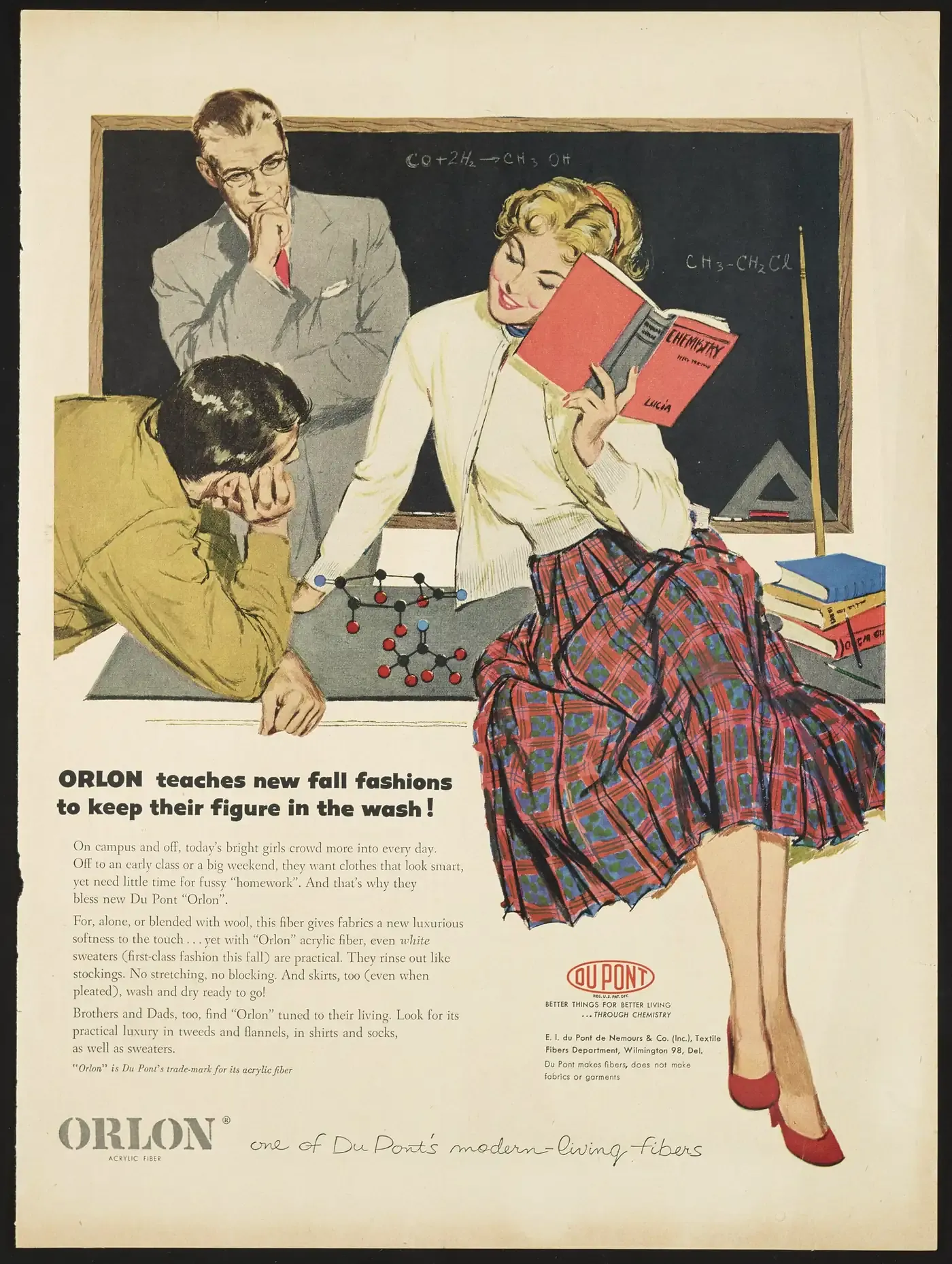
The fibers are formed by dissolving the polymer into a dope and extruding it through fine spinnerets into a coagulating bath, where the filaments solidify. For textile use, this yields the soft acrylic fibers sold under names like Orlon and Creslan.
Plate III

For the far more demanding world of carbon fiber, the PAN fiber is only the beginning, a precursor destined for the furnace.
Applications and Impact: From Sweaters to Spacecraft
In its most familiar form, PAN is the acrylic in a winter wardrobe: the warm, wool-like fiber in sweaters, blankets, and outdoor fabrics, prized for its softness, its resistance to sunlight, and its ability to hold dye. For decades this was PAN’s public face: a humble, affordable textile fiber. It also serves quietly in filtration membranes and hollow fibers for water purification.
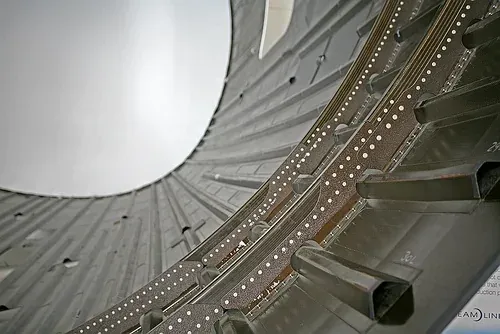
But PAN’s true significance lies in the furnace. When PAN fiber is slowly oxidized in air and then carbonized at temperatures above a thousand degrees in an inert atmosphere, its carbon atoms rearrange into the strong, light lattices of carbon fiber. Most of the world’s carbon fiber begins life as PAN. That means the skeletons of modern airliners, the bodies of Formula 1 cars, the casings of solid rocket motors, and the frames of high-end bicycles all trace their lineage back to this once-rejected powder.
Plate IV

The Precursor to the Future
As the world races to build lighter aircraft, more efficient vehicles, and larger wind turbines, demand for carbon fiber, and therefore for PAN, keeps climbing. Researchers are working to make the energy-intensive conversion from fiber to carbon cheaper and cleaner, and to develop PAN precursors that yield ever stronger, ever lighter carbon fibers. The stubborn powder of 1930 has become one of the most strategically important polymers of the twenty-first century.
The story of polyacrylonitrile is a tale of delayed recognition, in the same spirit as the point of light Tombaugh found that same year: the material was there all along, exactly as real as it would ever be, waiting only for someone with the right tools to notice what it was good for. Today, wherever strength must be married to lightness, PAN is there, no longer a footnote, but the backbone of flight.
values with [n] cite the numbered references·estimates are flagged·“not yet available” and “N/A” are honest states, not gaps
fetching the model…
Polyacrylonitrile repeat unit
- Abbreviation
- PAN
- Type
- polymer family (hub)
- CAS number
- 25014-41-9
- Resin ID code
- none assigned
- Formula
- (C3H3N)n[-CH2-CH(CN)-]nCommercial PAN typically copolymerizes acrylonitrile with 1–10% vinyl comonomers, so the pure-homopolymer repeat unit shown does not represent most commercial grades.
- Repeat unit (BigSMILES)
{[][$]CC(C#N)[$][]}- IUPAC name
- Polyacrylonitrile
- Synonyms
- acrylic fiber (textile form); Orlon (early trade name)
- Also known as
- Orlonacrylic fiber
- Chemical family
- acrylic
- Backbone class
- carbon-chain
- Polymerization mechanism
- free-radical
- Constitutional monomer
- Acrylonitrile
- Polymer class
- thermoplastic
- Year of origin
- 1930
- Era
- The Birth of Synthetic Polymers (1907-1938): The Bakelite Revolution
- Key figures
- Hans Fikentscher · Claus Heuck · Herbert Rein
- Events referenced
- Clyde Tombaugh discovers Pluto at Lowell Observatory (18 February 1930)
- Polymerization type
- free-radical chain-growth
- Common monomers (feedstocks)
- acrylonitrile, vinyl comonomers (1-10%, for solubility/dyeability)
- Catalysts
- not yet available
First synthesized in 1930 by Hans Fikentscher and Claus Heuck at IG Farben (Ludwigshafen); early research stalled because PAN did not dissolve in any industrial solvent of the time until Herbert Rein identified suitable solvents in 1938, enabling fiber production. DuPont ran the first mass production of PAN fiber in 1946 (Orlon). The carbon-fiber precursor route involves thermal oxidative stabilization at ~230°C in air, then carbonization above 1000°C in an inert atmosphere.
- Tacticity
- Statistical mix from radical polymerization: isotactic 25–29%, heterotactic 47–51%, syndiotactic 22–27%.
- Crystal structure
- Orthorhombic, pseudo-hexagonal, or hexagonal, depending on preparation.
- Typical crystallinity
- 31.75 (18.5–45) %[2]Fiber form reaches higher crystallinity (~60%).
Molecular weight
- Number average (Mn)
- 30000–40000 g/mol[2]
- Mass average (Mw)
- 30000–230000 g/mol[2]Fiber-grade material reported narrower, 80,000–100,000 g/mol.
- Dispersity (Mw/Mn)
- 1.1–3.5[2]
| Solvent | T | M range | K | a |
|---|---|---|---|---|
| butyrolactone[3] | 293 K | — | 0.0343 mL/g | 0.73 |
| butyrolactone[3] | 303 K | — | 0.0572 mL/g | 0.67 |
| butyrolactone[3] | 303 K | — | 0.0342 mL/g | 0.7 |
| butyrolactone[3] | 303 K | — | 0.04 mL/g | 0.69 |
| dimethylformamide[3] | 293 K | — | 0.0307 mL/g | 0.76 |
Strong dipole-dipole interaction between nitrile groups gives PAN unusually high intermolecular cohesion for a vinyl polymer, contributing to its high Tg and insolubility in common solvents.
- Density
- 1.184 (1.04–1.31) g/cm³[2]Experimental range 1.04–1.31 g/cm³; calculated range 1.112–1.177 g/cm³.
- Melt flow index
- Not applicable
- Refractive index
- 1.517 (1.514–1.52)[2]20 °C.
- Transmittance
- not yet available
- Haze
- not yet available
- Gloss
- not yet available
- Water absorption
- 1.25 (1–1.5) %[2]Equilibrium, immersed in water at 23 °C.
- Dielectric constant
- 2.87–4.2[2]Experimental range across frequencies/sources; typically higher at lower frequency (e.g., 6.5 at 60 Hz, 4.2 at 1 MHz).
- Dielectric strength
- not yet available
- Electrical conductivity
- 1 × 10⁻¹¹ S/m[2]Reciprocal of reported volume resistivity (1×10¹¹ Ω·m).
- Glass transition (Tg)
- 84.5 (43.8–105) °C[2]Most commonly cited range 84–85 °C; wider experimental range 43.8–105 °C reflects measurement-method/sample variation.
- Melting temperature (Tm)
- 317 (297–341) °C[2]Both handbooks report a real melting transition (Wypych DSC: 317 °C, range 297–341 °C; Mark calorimetry: 320 °C and 326 °C at different heating rates), lying close to PAN's thermal decomposition range.
- Crystallization (Tc)
- Not applicable
- Heat deflection (HDT)
- not yet available
- Decomposition onset
- 300 °C[1]
- Thermal conductivity
- not yet available
- Tensile modulus
- 3700 MPa[2]
- Yield strength
- not yet available
- Tensile strength at break
- 45.5 (19–72) MPa[2]Bulk/unoriented material; oriented fiber form reaches 133–480 MPa, film form 115–117 MPa.
- Elongation at break
- 25 (15–35) %[2]
- Impact strength (Izod)
- not yet available
- Impact strength (Charpy)
- not yet available
- Hardness
- not yet available
- Flexural modulus
- not yet available
- Poisson's ratio
- not yet available
- Coefficient of friction
- not yet available
- Solvent: common_industrial_solvents
- Historically very poor: did not dissolve in solvents available in the 1930s, delaying commercialization until dimethylformamide-type solvents were identified in 1938[1]
- Solvent: dilute acids
- good[2]
- Solvent: alcohols
- very good[2]
- Solvent: weak alkalis
- good[2]
- Solvent: aliphatic hydrocarbons
- good[2]
- Solvent: aromatic hydrocarbons
- good[2]
- Solvent: esters
- poor[2]
- Solvent: halogenated hydrocarbons
- poor[2]
- Weathering / UV
- not yet available
- Hydrolysis resistance
- not yet available
- Flammability (UL94)
- not yet available
- Limiting oxygen index
- 18.1 (18–18.2) %[2]
- Solubility parameter (δ)
- 26.335 (25.27–27.4) MPa^0.5[2]Experimental range.
Gas permeability
- O₂
- 1.5 × 10⁻¹⁷–4.1 × 10⁻¹⁶ cm³(STP)·cm/(cm²·s·Pa)[2]25 °C.
- water vapor
- 3.6 × 10⁻¹¹ (2.3 × 10⁻¹¹–4.9 × 10⁻¹¹) cm³(STP)·cm/(cm²·s·Pa)[2]25 °C.
Polymer-solvent interaction parameter (χ)
not yet available
- Processing methods
- wet/dry-jet spinning (fiber)thermal oxidative stabilization + carbonization (carbon fiber precursor)
- Drying required
- not yet determined
- Carbon fiberaircraft structural composites · missiles · sporting goodsPAN is the precursor for most high-quality carbon fiber produced today.
- Textilesacrylic fiber (>=85% acrylonitrile) · modacrylic fiber
- Recyclable
- No
- Biodegradable
- No
- Degradation pathway
- not yet available
- LD50 (oral, rat)
- 7000 (3000–11000) mg/kg[2]Two values reported (3,000 and 11,000 mg/kg) across cited studies.
- NFPA health
- 2[2]
- NFPA flammability
- 0[2]
- NFPA reactivity
- 0[2]
- Carcinogenic classification
- not listed by ACGIH, NIOSH, NTP[2]
Occupational exposure limits: TLV (ACGIH) 3 mg/m³, MAK/TRK (Germany) 3 ppm, OSHA 2 ppm. Aquatic toxicity (Daphnia magna, 48 h LC50): 1,000–185,000 mg/L.
- [1]PolyacrylonitrileWikipediaAccessed 2026-07-14https://en.wikipedia.org/wiki/Polyacrylonitrile[wiki-polyacrylonitrile]
- [2]Handbook of PolymersChemTec Publishinghttps://www.worldcat.org/isbn/9781895198928[handbook-wypych-2016]
- [3]Polymer Data HandbookOxford University Presshttps://search.worldcat.org/search?q=Polymer+Data+Handbook+Mark+1999[handbook-mark-1999]
Illustrations
- Plate IClyde Tombaugh with the homemade telescope he built before joining Lowell Observatory, where he discovered Pluto in February 1930.Wikimedia Commons
- Plate IIThe 13-inch astrograph at Lowell Observatory that recorded the photographic plates on which Tombaugh found Pluto.Wikimedia Commons
- Plate IIIA Du Pont advertisement for Orlon, the trade name under which acrylic fiber reached American closets in the 1950s, two decades after Fikentscher and Heuck's polymer had first been written off as useless.Wikimedia Commons
- Plate IVA carbon fiber section of a Boeing 787 fuselage: PAN fiber's modern destination, spun, oxidized, and carbonized into a lattice that carries an airliner's structural load.Wikimedia Commons