The Birth of Synthetic Polymers (1907-1938): The Bakelite Revolution
Bakelite
The Material of a Thousand Uses
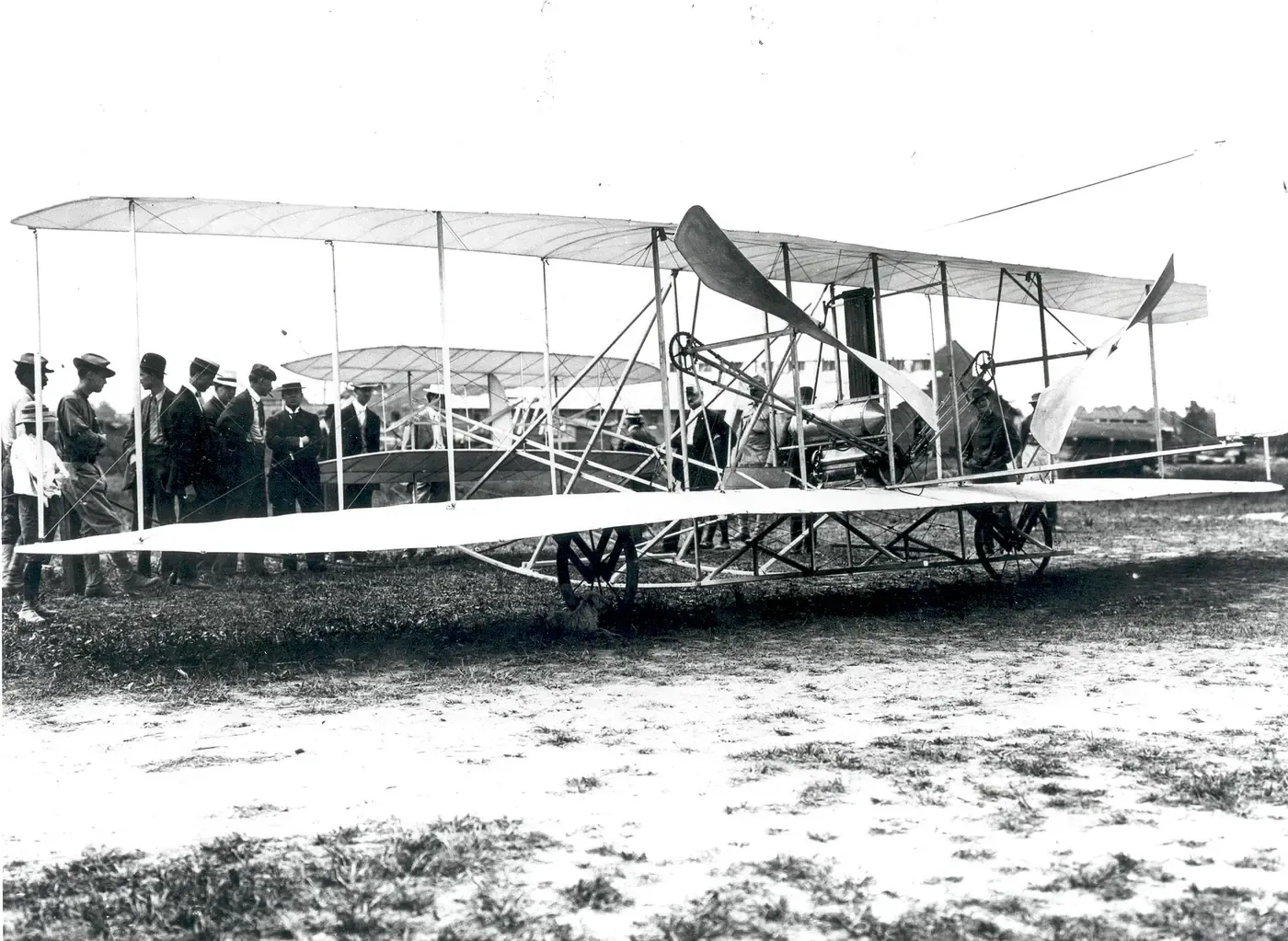
Nineteen-hundred and seven was a year of very large ambitions and very old materials. In Dayton and in Paris, the Wright brothers were trying to sell the United States Army a flying machine built of spruce, muslin and piano wire. In November, Paul Cornu lifted a man off the ground under a rotor for the first time, in a contraption of bicycle tubing. In September the Lusitania crossed the Atlantic faster than anything had crossed it before, driven by turbines and riveted steel. Every one of these machines was assembled from substances humanity had been working since antiquity: wood, cloth, metal, glass, rubber tapped from a tree.
And in October the money vanished. A failed attempt to corner the copper market brought down the Knickerbocker Trust, and the resulting panic ran through New York so quickly that J. P. Morgan had to lock the city’s bankers in his library until they agreed to save it. Fortunes that had looked permanent in the spring were gone by the autumn.
Plate I
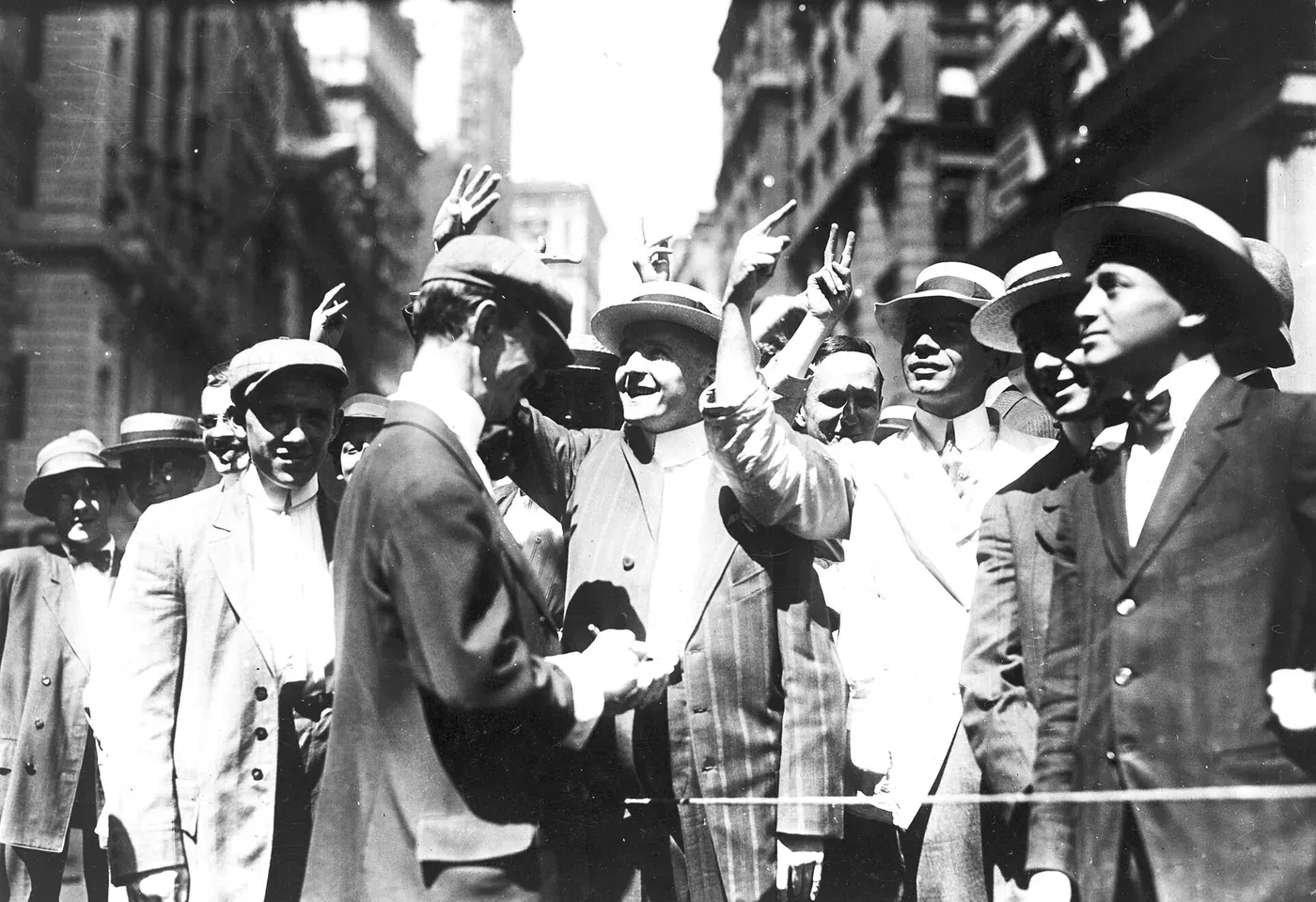

Both facts matter to this story. The first is the problem Leo Baekeland solved that year. The second is the reason he was one of the few men in America who could afford to spend a year solving it.
The Man Who Could Afford to Fail
Baekeland was Belgian, born in Ghent to a cobbler who saw no purpose in education and a maid who insisted on it. He arrived in New York in 1889 with a doctorate in chemistry, and within a decade he had invented Velox, a photographic paper that could be printed under gaslight instead of sunshine, which meant a photographer could work in the evening. In 1899 he sold the company that made it to George Eastman. He walked away with enough money to never again need a salary, and he spent it on a laboratory behind his house in Yonkers.
Plate II
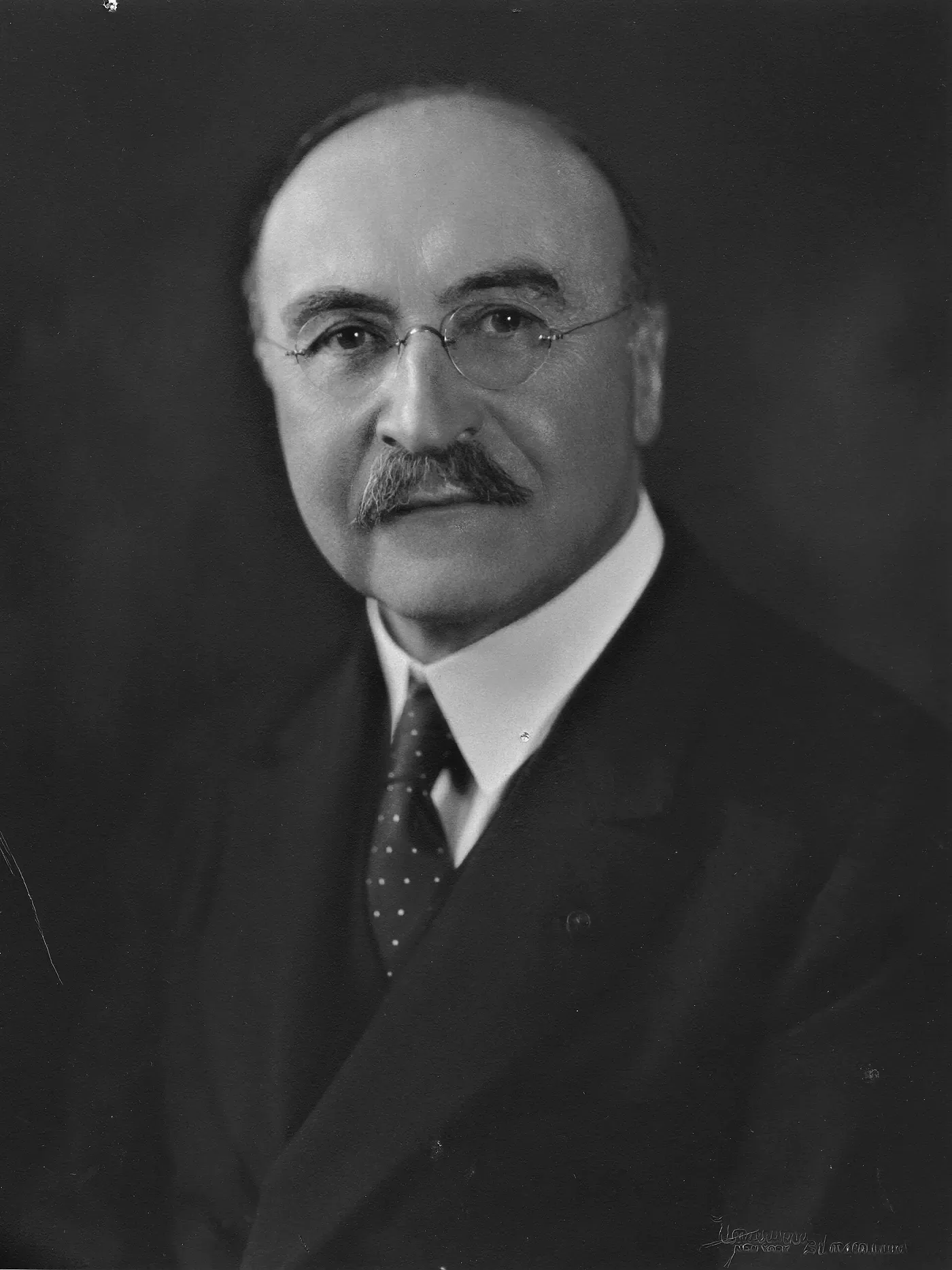

This is not a small detail. The reaction between phenol and formaldehyde was not a secret in 1907; Adolf von Baeyer had watched it produce an intractable brown sludge back in 1872, and a succession of chemists since had watched it do the same and moved on to work that would publish. Baekeland’s advantage was not insight. It was that nobody was waiting on his results, so he could treat the sludge as the answer rather than the failure.
The Problem With Beetles
What he was actually looking for was a substitute for shellac. Shellac is a resin secreted by the lac insect onto the branches of trees in India and Thailand; it is scraped off, washed, and sold. It was the only good electrical insulator the world had, and the world had just begun wiring itself for electricity: every motor winding, every switchboard, every telephone needed it. The supply was set by the reproductive rate of an insect. The demand was set by the electrification of the industrialised world. That gap was where a fortune was going to be made.
Plate III

His first result was a soluble resin he called Novolak, and it was a commercial disappointment: it was a shellac substitute, and not a very good one. The interesting material was the one he had been told to avoid: the hard, insoluble, infusible mass that formed when the reaction was allowed to run to completion. It could not be dissolved, so it could not be varnished on. It could not be melted, so it could not be poured. It also foamed violently as it cured, riddling itself with bubbles and cracking as it cooled.
Heat, Pressure, and an Egg-Shaped Vessel
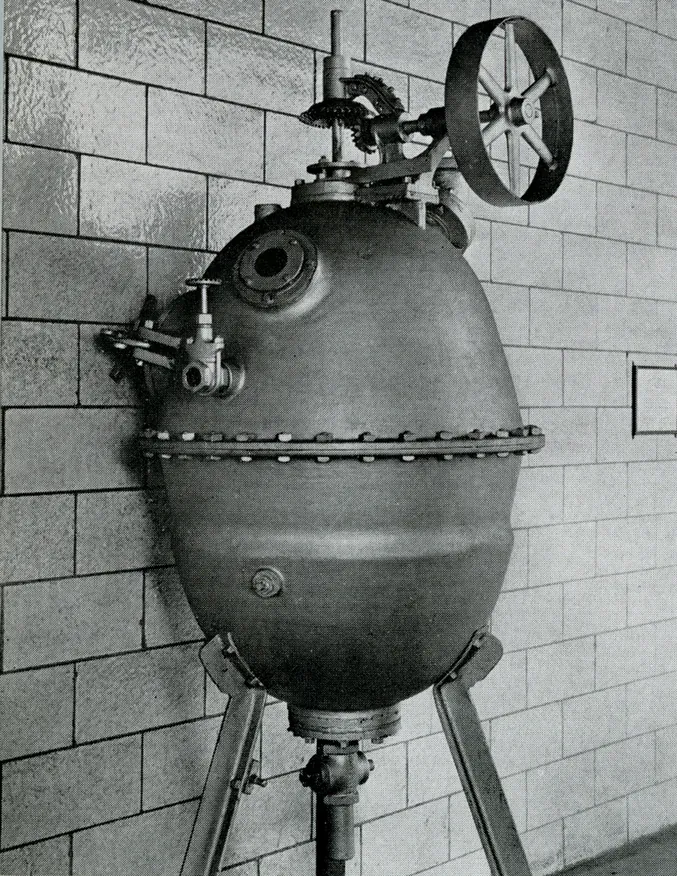
The solution was mechanical rather than chemical. If the reaction was run inside a sealed vessel, under pressure, the water it generated could not boil away and the foaming stopped. Baekeland built such a vessel (squat, riveted, shaped like an egg) and called it the Bakelizer. Inside it, at around a hundred and fifty degrees, the resin cured into a solid that would take the shape of whatever mould it had been cured in, and would then hold that shape permanently.
That was the discovery, and its significance was not the substance so much as the category. Every material humanity had used until that moment was either taken from something that had lived or dug out of the ground. This one had never existed. He filed the patent in July 1907 and, in the manner of a man who understood exactly what he had, said nothing about it in public for eighteen months. On 5 February 1909 he presented it to the American Chemical Society.
Plates IV & V

The Molecular Marvel: Understanding Phenol Formaldehyde
At its heart, phenol formaldehyde is a marriage of two simple molecules: phenol and formaldehyde. When these compounds meet under the right conditions they build a three-dimensional network of interconnected rings and bridges: each junction a phenol ring, each connection a bridge of carbon left behind by the formaldehyde. There is no chain to speak of, and no single repeat unit: a fully cured moulding is, in a real sense, one enormous molecule.
That architecture explains almost everything the material does. Because the network is covalently locked, nothing can slide. Because nothing can slide, the material cannot be softened by reheating, cannot be dissolved, and cannot be recycled by melting. These are the three properties that made it revolutionary in 1907 and awkward a century later.
Properties That Changed the Game
Cured phenolic is denser than water but far lighter than the metals it replaced, and it is genuinely hard, hard enough to hold a moulded thread or a knife-edge detail that would round off in a softer plastic. It is also stiff, with a modulus closer to a soft metal than to the flexible plastics that came after it, and it pays for that stiffness in brittleness: it will take almost no stretching at all before it fractures, which is why period Bakelite objects survive intact for decades and then shatter in one drop.
Heat is where it earns its reputation. The uncured resin softens as it is worked into a mould, but once the cure is complete there is no melting point left to reach; the network decomposes and chars long before it flows. A moulded part holds its shape well above the temperature of boiling water, conducts heat poorly enough to serve as its own handle, and resists ignition rather than feeding a flame.
Electrically it is close to inert, which was the whole point. It conducts essentially nothing, withstands a high field across a thin section without breaking down, and holds those numbers over the whole audio and radio-frequency range, which is precisely why the first half-century of radio, telephony and domestic wiring was built inside it. It absorbs very little water, so damp weather does not degrade that insulation. It shrugs off alcohols, oils, greases, aliphatic and chlorinated solvents almost completely, and handles dilute acids, alkalis, esters and ketones well. Its one visible weakness is sunlight: prolonged exposure darkens the surface, which is part of why so much surviving Bakelite is a deeper brown today than it left the factory.
The Chemical Dance: A Tale of Two Pathways
There are two routes to a phenolic network, and which one a manufacturer chooses is decided before the reaction starts, by the ratio of the two ingredients and the pH.
The resol route runs under basic conditions, usually with sodium hydroxide, and with formaldehyde in excess. The base strips a proton from phenol’s hydroxyl group, activating the ring so that formaldehyde attaches at the positions either side of it and directly opposite. The result is a resin that already carries everything it needs to finish the job: heat alone will complete the network, which is why resols are called self-curing, and why they have to be kept cold until the moment they are used.
The novolac route runs under acid, with phenol in excess. Here the acid activates the formaldehyde instead, and because formaldehyde is the limiting reagent the reaction stalls at a stable, meltable resin that will sit on a shelf indefinitely. It only becomes a thermoset when a curing agent (almost always hexamethylenetetramine) is milled in and the whole thing is heated, releasing the formaldehyde needed to finish the network on demand.
Resols go where the resin must flow into place and cure where it lands: plywood adhesives, foundry sand binders, laminates. Novolacs go where the compound must be stored, shipped and moulded to a schedule, which is most of what people actually mean by Bakelite.
Applications: The Material That Built the Modern World
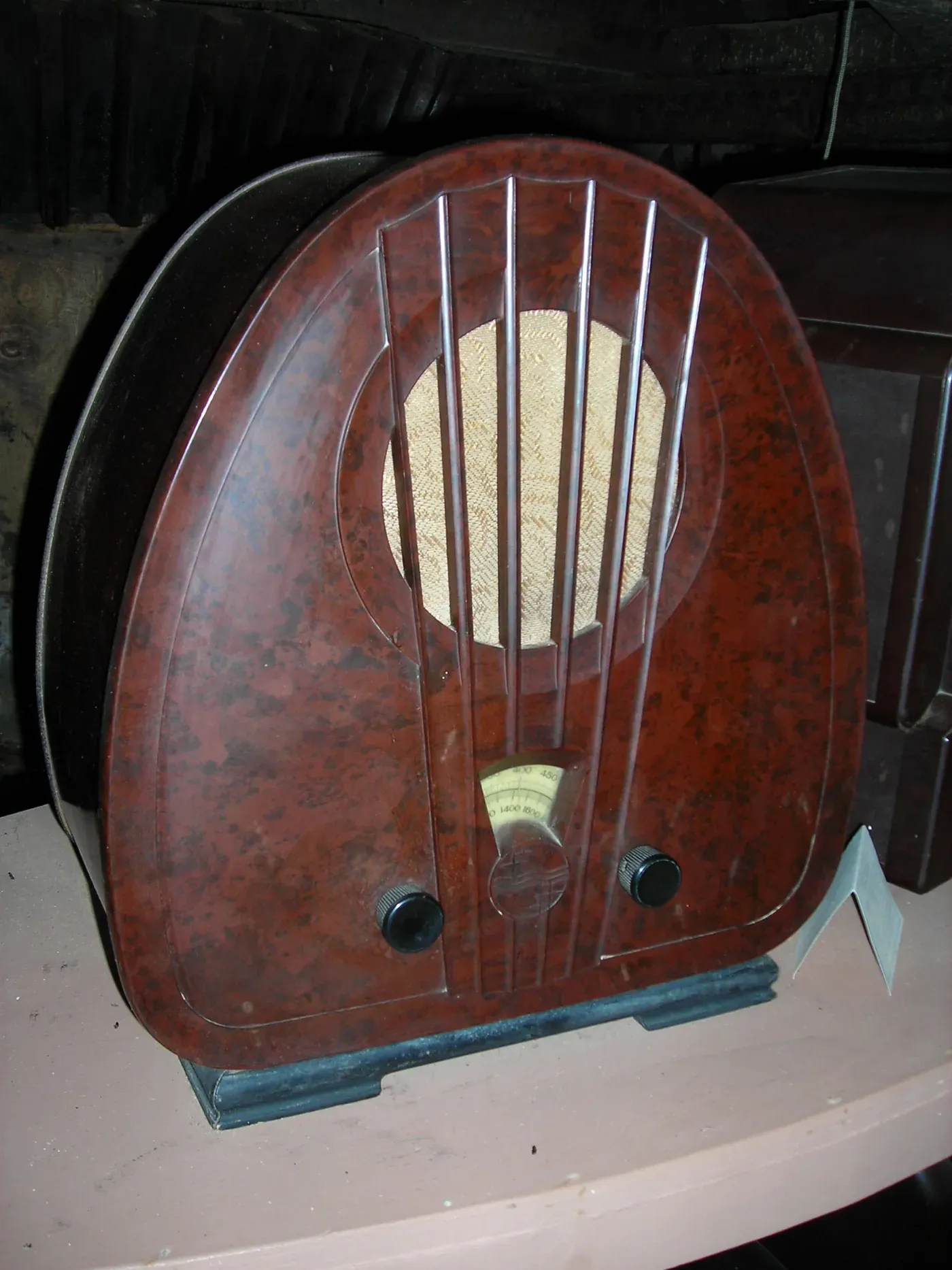
Its impact was immediate, and it was electrical first. Bakelite became the standard body for switchgear, distributor caps, plug tops, switch plates and terminal blocks, anywhere current had to be kept away from a hand. From there it moved into the objects that carried the current’s output: telephone handsets, radio cabinets, camera bodies, the black casing of almost every domestic appliance of the interwar years.
Then it escaped the electrical trade altogether. Cast into rods and sheets and cut like a semi-precious stone, it became jewellery, cutlery handles, poker chips, buttons, fountain pens and billiard balls. Because it could be moulded in quantity, it made objects that looked expensive available to people who were not. It was the first material to democratise luxury rather than imitate it.
Modern Marvels: Phenolic in Today’s World
Bakelite as a brand belongs to museums, but phenolic chemistry never left industry.
In aerospace, phenolic resins are the matrix in ablative heat shields: on re-entry they char and erode in a controlled way, carrying heat off with the material that leaves. The same refusal to melt that frustrated Baekeland’s contemporaries is what makes this work.
In cars, phenolic composites line brake pads and clutch plates, holding their structure through the temperatures generated by stopping two tonnes from motorway speed. In electronics, phenolic-modified epoxies are the substrate of the FR-4 circuit board. This is the direct descendant of the insulating property Baekeland was originally chasing. And in renewable energy, phenolic-matrix composites go into wind turbine blades and fuel-cell bipolar plates, where chemical stability and heat resistance matter more than the ability to be reshaped.
A Legacy That Shaped the Future
The lasting significance of 1907 is not the material. It is the demonstration that a material could be designed rather than found. Every synthetic polymer since (every one of the pages that follow this one) descends from a Belgian chemist in a Yonkers backyard deciding that the intractable brown mess at the bottom of the flask was not a failed experiment but a new class of matter.
values with [n] cite the numbered references·estimates are flagged·“not yet available” and “N/A” are honest states, not gaps
- Abbreviation
- —
- Type
- polymer family (hub)
- CAS number
- 9003-35-4
- Resin ID code
- none assigned
- Formula
- Crosslinked phenol-formaldehyde thermoset network; a densely crosslinked resin has no single linear repeat unit.
- Repeat unit (BigSMILES)
- Crosslinked phenol-formaldehyde thermoset network; a densely crosslinked resin has no single linear repeat unit.
- IUPAC name
- Polyoxybenzylmethyleneglycol anhydride
- Synonyms
- phenol formaldehyde resin; PF resin
- Also known as
- phenolic resinPF resin
- Chemical family
- phenolic-aminoplast
- Backbone class
- carbon-chain
- Polymerization mechanism
- step-growth-condensation
- Constitutional monomer
- PhenolFormaldehyde
- Polymer class
- thermoset
- Year of origin
- 1907
- Era
- The Birth of Synthetic Polymers (1907-1938): The Bakelite Revolution
- Key figures
- Leo Baekeland
- Polymerization type
- step-growth condensation
- Common monomers (feedstocks)
- phenol, formaldehyde
- Catalysts
- hydrochloric acid; zinc chloride; ammonia
Leo Baekeland developed the process in Yonkers, NY, patenting it December 7, 1909, as the first fully synthetic plastic. Phenol and formaldehyde undergo acid- or base-catalyzed condensation polymerization; Baekeland's innovation used high-pressure heating (~150°C) in a sealed 'Bakelizer' vessel to suppress foaming and produce a hard, insoluble thermoset.
- Tacticity
- not yet available
- Crystal structure
- not yet available
- Typical crystallinity
- 0 %estimate[1]Amorphous, densely crosslinked thermoset network.
Molecular weight
- Number average (Mn)
- not yet available
- Mass average (Mw)
- 620–6600 g/mol[2]uncured resin, resol/novolac range
- Dispersity (Mw/Mn)
- 1.41–1.72[2]uncured resin, resol/novolac range
Mark-Houwink constants
not yet available
Rigid, non-flexible network; cannot be softened by reheating once cured (thermoset).
- Density
- 1.24–1.32 g/cm³[2]unfilled resin, 20 °C; wood-flour/cotton-flock-filled molding compounds (period-typical Bakelite) 1.32–1.45, paper-base laminates 1.28–1.4, glass-fabric laminates 1.4–1.9
- Melt flow index
- Not applicableThermoset; does not melt/flow after cure.
- Refractive index
- 1.7[2]20 °C, unfilled resin
- Transmittance
- not yet available
- Haze
- not yet available
- Gloss
- not yet available
- Water absorption
- 0.1–0.4 %[2]unfilled resin, 24 h at 23 °C; wood-flour-filled molding compounds 0.3–1.0% (24 h), laminates 0.2–4.5% (Mark)
- Dielectric constant
- 3.5–5[2]unfilled resin, 100 Hz-1 MHz; wood-flour-filled molding compounds 4.0–7.0, laminates 3.6–6.0 (Mark, at 1 MHz)
- Dielectric strength
- 16 kV/mm[2]d = 0.6–0.8 mm, K20/P50 test, unfilled resin
- Electrical conductivity
- 1 × 10⁻¹⁰–1 × 10⁻⁹ S/m[2]reciprocal of reported volume resistivity, 1×10⁹-1×10¹⁰ Ω·m, unfilled resin
- Glass transition (Tg)
- not yet available
- Melting temperature (Tm)
- 90–107 °C[2]uncured (B-stage) resin softening/melting range, DSC; once cured, the crosslinked network does not melt
- Crystallization (Tc)
- Not applicable
- Heat deflection (HDT)
- 204 °C[2]1.8 MPa, unfilled resin
- Decomposition onset
- not yet available
- Thermal conductivity
- 0.2 W/(m·K)[1]
- Tensile modulus
- 7580 MPa[2]unfilled resin
- Yield strength
- 110 MPa[2]tensile stress at yield, unfilled resin; as reported, this exceeds the source's own tensile-strength-at-break figure
- Tensile strength at break
- 34.4–62 MPa[2]unfilled resin
- Elongation at break
- 1.5–2.2 %[2]unfilled resin
- Impact strength (Izod)
- 870 J/m[2]notched, 23 °C, unfilled resin; markedly higher than typical unfilled phenolic values, closer to fiber-reinforced grades
- Impact strength (Charpy)
- 1.3–1.5 kJ/m²[2]notched, 23 °C, unfilled resin; unnotched reported separately at 6–7 kJ/m²
- Hardness
- 93–128 Rockwell M[2]unfilled resin; wood-flour/cotton-flock-filled molding compounds M96-M120, laminates M70-M120 (Mark)
- Flexural modulus
- 6500–9100 MPa[2]unfilled resin
- Poisson's ratio
- 0.402[2]
- Coefficient of friction
- not yet available
- Solvent: acids (dilute/concentrated)
- good[2]unfilled resin
- Solvent: alcohols
- very good[2]unfilled resin
- Solvent: alkalis
- good[2]unfilled resin
- Solvent: aliphatic hydrocarbons
- very good[2]unfilled resin
- Solvent: aromatic hydrocarbons
- good[2]unfilled resin
- Solvent: esters
- good[2]unfilled resin
- Solvent: greases & oils
- good[2]unfilled resin
- Solvent: halogenated hydrocarbons
- very good[2]unfilled resin
- Solvent: ketones
- good[2]unfilled resin
- Weathering / UV
- general darkening[3]wood-flour-filled molding compound and laminates; laminates additionally show lower surface resistance after exposure
- Hydrolysis resistance
- not yet available
- Flammability (UL94)
- not yet available
- Limiting oxygen index
- 29–66 %[2]unfilled resin
- Solubility parameter (δ)
- not yet available
Gas permeability
not yet available
Polymer-solvent interaction parameter (χ)
not yet available
- Processing methods
- compression moldingtransfer molding
- Drying required
- not yet determined
- Processing temperature
- 143–193 °C[3]compression molding, wood-flour/cotton-flock-filled compound (period-typical Bakelite); laminating (paper- or glass-fabric-base) 135–177 °C
- Shrinkage rate
- 0.35–0.9 %[2]unfilled resin; wood-flour/cotton-flock-filled molding compound reported separately at 0.4–0.9% (Mark)
- Electricalelectrical insulators and components · radio and telephone casings
- Consumer goodsmolded consumer goods · jewelry and decorative items · billiard balls · game pieces
- Automotiveautomotive parts
- Recyclable
- No
- Biodegradable
- No
- Degradation pathway
- not yet available
As a thermoset, cannot be melt-reprocessed; historical Bakelite objects are typically kept/repaired rather than recycled.
- [1]BakeliteWikipediaAccessed 2026-07-14https://en.wikipedia.org/wiki/Bakelite[wiki-bakelite]
- [2]Handbook of PolymersChemTec Publishinghttps://www.worldcat.org/isbn/9781895198928[handbook-wypych-2016]
- [3]Polymer Data HandbookOxford University Presshttps://search.worldcat.org/search?q=Polymer+Data+Handbook+Mark+1999[handbook-mark-1999]
Illustrations
- Plate IThe New York curb market, where trading spilled into the street. In the autumn of 1907 a copper corner collapsed the Knickerbocker Trust and took much of Wall Street with it.Wikimedia Commons
- Plate IILeo Baekeland. Having sold Velox to Eastman, he could pursue a problem for years without having to justify it to anyone.Wikimedia Commons
- Plate IIIThe Wright Flyer on Army trials. Powered flight was four years old and still built from spruce and cloth; the whole technological ambition of the age was running up against the same short list of natural materials.Wikimedia Commons
- Plate IVThe first semi-commercial Bakelizer, from Baekeland's own laboratory.Wikimedia Commons
- Plate VA Philips receiver of the mid-1930s, its entire cabinet moulded in one piece.Wikimedia Commons