
United Defense M42
United Defense Supply Corporation1942–1943Second World War
Also known as Marlin, UD M42
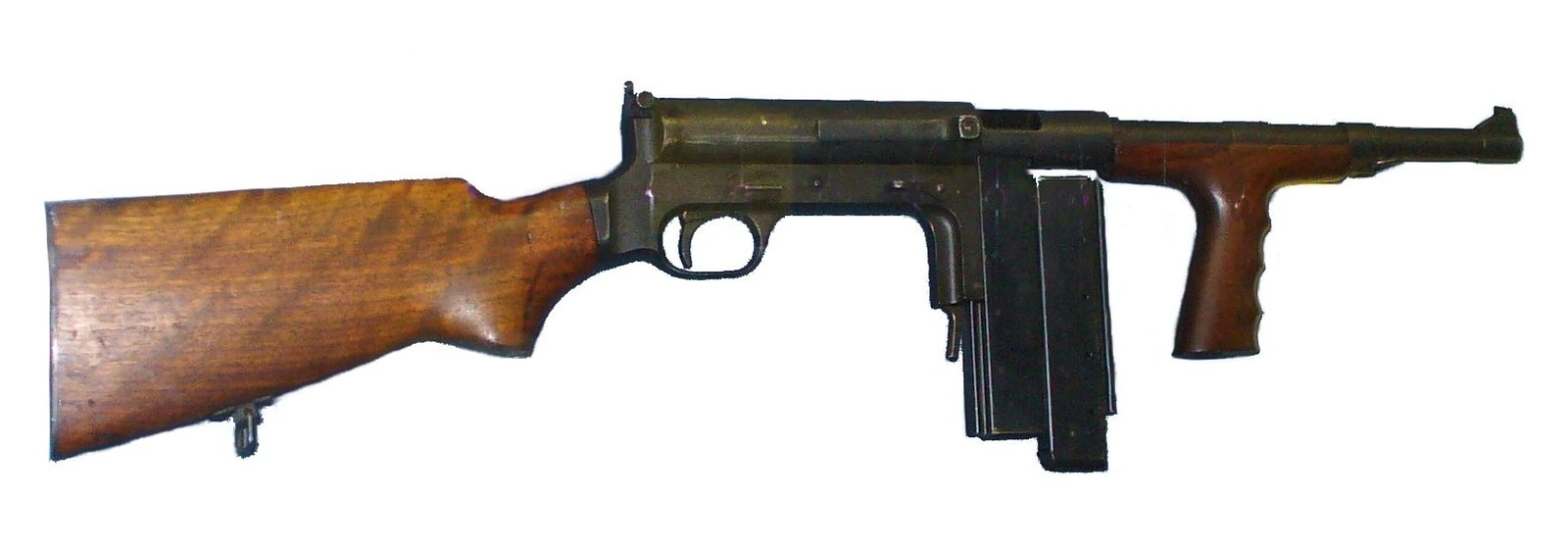
Image credit
- Title
- File:United Defence M42.jpg
- Author
- Atirador(attribution required)
- Licence
- CC BY-SA 3.0
- Source
- https://commons.wikimedia.org/wiki/File:United_Defence_M42.jpg

How Muzzle energy is calculated
E = ½ · m · v²
Inputs
- m7.452 g115.0 grverifiedsource115 gr as published, converted to grams.
- v359.7 m/s1,180 fpsverifiedMeasured with a 101.6 mm barrel, not this arm's 279 mm. Velocity outside the sourced range is not projected.
1 of 2 inputs link to their source.
How Muzzle velocity is calculated
nearest sourced barrel length, no extrapolation
Inputs
- v at 101.6 mm359.7 m/s1,180 fpsverifiedsource1180 fps as published.
Assumptions
- This figure belongs to a 101.6 mm barrel. It is shown because it is the closest measurement that exists, not because it applies here.
1 of 1 inputs link to their source.
How Loaded mass is calculated
m_loaded = m_empty + m_magazine + n · m_cartridge
Not calculated: m_magazine has no sourced figure yet. Nothing is substituted for a missing input.
Assumptions
- One magazine, filled to the stated capacity. Spare magazines, optics, slings and lights are the owner’s, not the arm’s.
No input on this calculation carries a clickable source yet.
How Free recoil is calculated
E_recoil = ½ · m_firearm · v_recoil²
Inputs
- m_firearm4.54 kg10.01 lbestimatedFrom the Wikipedia infobox, uncited there (10 lb).
- v_recoil0.5904 m/s1.937 fpsestimated
Assumptions
- Propellant gas momentum is excluded: ARMAG does not record charge weights. This is therefore a lower bound on the real free recoil, consistent between entries but smaller than a figure that includes the gas term.
- Free recoil: the arm is unrestrained. Stock design, muzzle devices, stance and shooter mass are not modelled, because none of them is a property of the arm.
No input on this calculation carries a clickable source yet.
How Capacity is calculated
as published for the primary chambering
Inputs
- capacity20estimatedFrom Wikipedia's article body, uncited there: a 20-round magazine designed by John E. Owsley; two were often welded face-to-face for a fast reload. The infobox separately states a 25-round figure, which the body text attributes instead to the unproduced .45 ACP prototype.
No input on this calculation carries a clickable source yet.
Derived figures
Computed from the sourced values above. Open ƒ on any figure for the formula, its inputs, and the assumptions it makes.
How Momentum is calculated
p = m · v
Inputs
- m7.452 g115.0 grverifiedsource115 gr as published, converted to grams.
- v359.7 m/s1,180 fpsverifiedMeasured with a 101.6 mm barrel, not this arm's 279 mm. Velocity outside the sourced range is not projected.
1 of 2 inputs link to their source.
How Sectional density is calculated
SD = mass(gr) / (7000 · diameter(in)²)
Inputs
- mass7.452 g115.0 grverifiedsource115 gr as published, converted to grams.
- diameter9.03 mm0.3555 inverifiedsourceCartridge maximum, dimension G1.
Assumptions
- Reported in the conventional lb/in² so it is directly comparable with published figures.
2 of 2 inputs link to their source.
How Power factor is calculated
PF = mass(gr) · velocity(fps) / 1000
Inputs
- mass7.452 g115.0 grverifiedsource115 gr as published, converted to grams.
- velocity359.7 m/s1,180 fpsverifiedMeasured with a 101.6 mm barrel, not this arm's 279 mm. Velocity outside the sourced range is not projected.
Assumptions
- A competition classification defined by the IPSC and USPSA rulebooks, stated in their units. It describes a scoring category, not an effect.
1 of 2 inputs link to their source.
How Magazine dump is calculated
t = (n − 1) / (rpm / 60)
Inputs
- n20estimatedFrom Wikipedia's article body, uncited there: a 20-round magazine designed by John E. Owsley; two were often welded face-to-face for a fast reload. The infobox separately states a 25-round figure, which the body text attributes instead to the unproduced .45 ACP prototype.
- rpm700 rpmestimatedWikipedia's article body states a single figure of 700 rounds/min, uncited; the same article's infobox instead gives an uncited range of 700 to 1000 rounds/min. Neither is a clickable primary source.
Assumptions
- Cyclic rate held for the whole magazine, no stoppages, trigger held down. A theoretical figure for comparing mechanisms, not a measured one.
No input on this calculation carries a clickable source yet.
How Sight error at 1 mm is calculated
θ = atan(misalignment / sight radius)
Not calculated: sight radius has no sourced figure yet. Nothing is substituted for a missing input.
Assumptions
- Shows what a stated aiming error costs. The misalignment is the reader’s figure; the site does not claim how well anyone aims.
No input on this calculation carries a clickable source yet.
Specifications
Every row here is generated from the schema, so a figure recorded on this entry cannot be missing from the table, and the same rows, read the same way, are what the comparison shows.
Identity
- Type
- Submachine gun
- Action
- Self-loading
- Fire modes
- Semi-automatic
- Fully automatic
- Operating system
- Blowback, simple
- Roles
- Designed in
- United States
- Produced in
- Introduced
- 1942
- Production
- 1942–1943
Dimensions and mass
- Mass, empty
- 4.54 kg10.01 lbestimated
From the Wikipedia infobox, uncited there (10 lb).
- Magazine, empty
- not recorded
- Length
- 820 mm32.28 inestimated
From the Wikipedia infobox, uncited there (32.3 in).
- Length, folded
- not recorded
- Width
- not recorded
- Height
- not recorded
- Barrel length
- 279 mm10.98 inestimated
From the Wikipedia infobox, uncited there (11 in).
Sights and rifling
- Sight radius
- not recorded
- Sight height over bore
- not recorded
- Rifling twist
- not recorded
- Twist direction
- not recorded
- Grooves
- not recorded
- Sight graduation
- not recorded
Operation
- Cyclic rate
- 700 rpmestimated
Wikipedia's article body states a single figure of 700 rounds/min, uncited; the same article's infobox instead gives an uncited range of 700 to 1000 rounds/min. Neither is a clickable primary source.
- Trigger pull
- not recorded
- Effective range
- not recorded
- Units produced
- not recorded
- Launch price
- not recorded
Chamberings
- 9x19mm Parabellumprimary20 rounds
Scale
A to-scale outline against family siblings. The dimensions are sourced; the shape is a representative outline for the type, and says so.
- United Defense M42820 mm32.28 inheight not recorded
Representative outline: the dimensions are sourced, the shape is not. Overall length, and barrel length where recorded, are drawn from this entry's own figures; the profile is a generic one for the firearm type and says nothing about this arm's actual contours. United Defense M42 records no height, so its outline is drawn at the type's proportion. That height is part of the shape, not a measurement.
Gallery
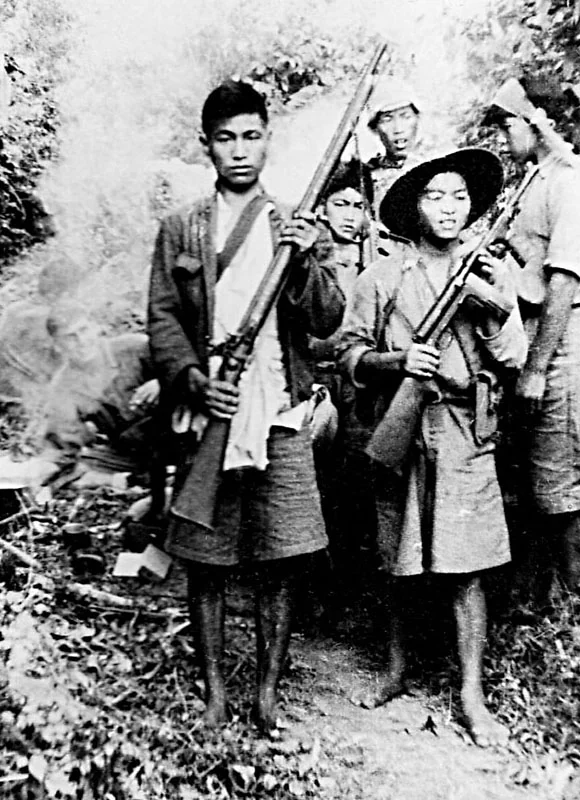
Image credit
- Title
- File:Ethnic Kachin Scouts with Black Powder Rifle and UD-42.jpg
- Author
- US Army
- Licence
- Public domain
- Source
- https://commons.wikimedia.org/wiki/File:Ethnic_Kachin_Scouts_with_Black_Powder_Rifle_and_UD-42.jpg

Image credit
- Title
- File:PeterJouvenalBBCcamerman.JPG
- Author
- ArminWenger
- Licence
- Public domain
- Source
- https://commons.wikimedia.org/wiki/File:PeterJouvenalBBCcamerman.JPG

Detail
The M42 began as a design Carl G. Swebilius drew up at the High Standard Manufacturing Company in 1940. When High Standard was assigned to building .50 calibre machine guns for Britain instead, further work on the submachine gun passed to a new company, United Defense Supply Corporation, set up by two members of the British Purchasing Commission. United Defense had no factory of its own and contracted the Marlin Firearms Company to actually build the weapon, which is why collectors and period sources often call it simply “the Marlin” rather than by its official designation.
It is a straightforward straight-blowback, selective-fire design, built with entirely machined rather than stamped parts. This was a choice that made it accurate and easy to maintain in testing but expensive and slow to produce under wartime conditions, exactly the problem it was meant to solve for the U.S. military, which considered the Thompson too costly and complicated. Only around 15,000 of the production 9×19mm version were built between 1942 and 1943, alongside six hand-made .45 ACP prototypes that used a larger 25-round magazine; the standard production gun instead used a 20-round magazine, often welded in facing pairs for a fast reload, a method later called “jungle style.”
Despite War Department interest, licensing and royalty complications limited production, and the M42 was formally classified only as a substitute standard once the cheaper, stamped-steel M3 submachine gun arrived. It found more use outside American ranks than within them: air-dropped to resistance forces across occupied Europe, including on Crete and in Italy, Belgium, the Netherlands, Denmark, Norway and France, and supplied in quantity to Dai Li’s forces in China against Japanese occupation, later passing in part to Communist Chinese units during the civil war that followed. Its 9mm chambering let European resistance fighters reload with captured German ammunition, reducing their dependence on further airdrops.
No maker specification sheet independent of Wikipedia’s own uncited figures was found for this page’s mass, length, barrel length or cyclic rate; Wikipedia’s own infobox and article body disagree on the cyclic rate, and both figures are recorded here as estimated rather than verified. No rifling twist rate or sight radius is published.
References
This entry's own bibliography. Every citation key on this page resolves into this list.
- United Defense M42 · Wikipedia · 1367483244 · read 2026-09-24 · CC BY-SA 4.0
Last verified 2026-09-24 · review status: agent-populated