
M3 submachine gun
Guide Lamp Division, General MotorsSecond World War
Also known as Grease Gun, United States Submachine Gun, Cal. .45, M3, M3A1, T20
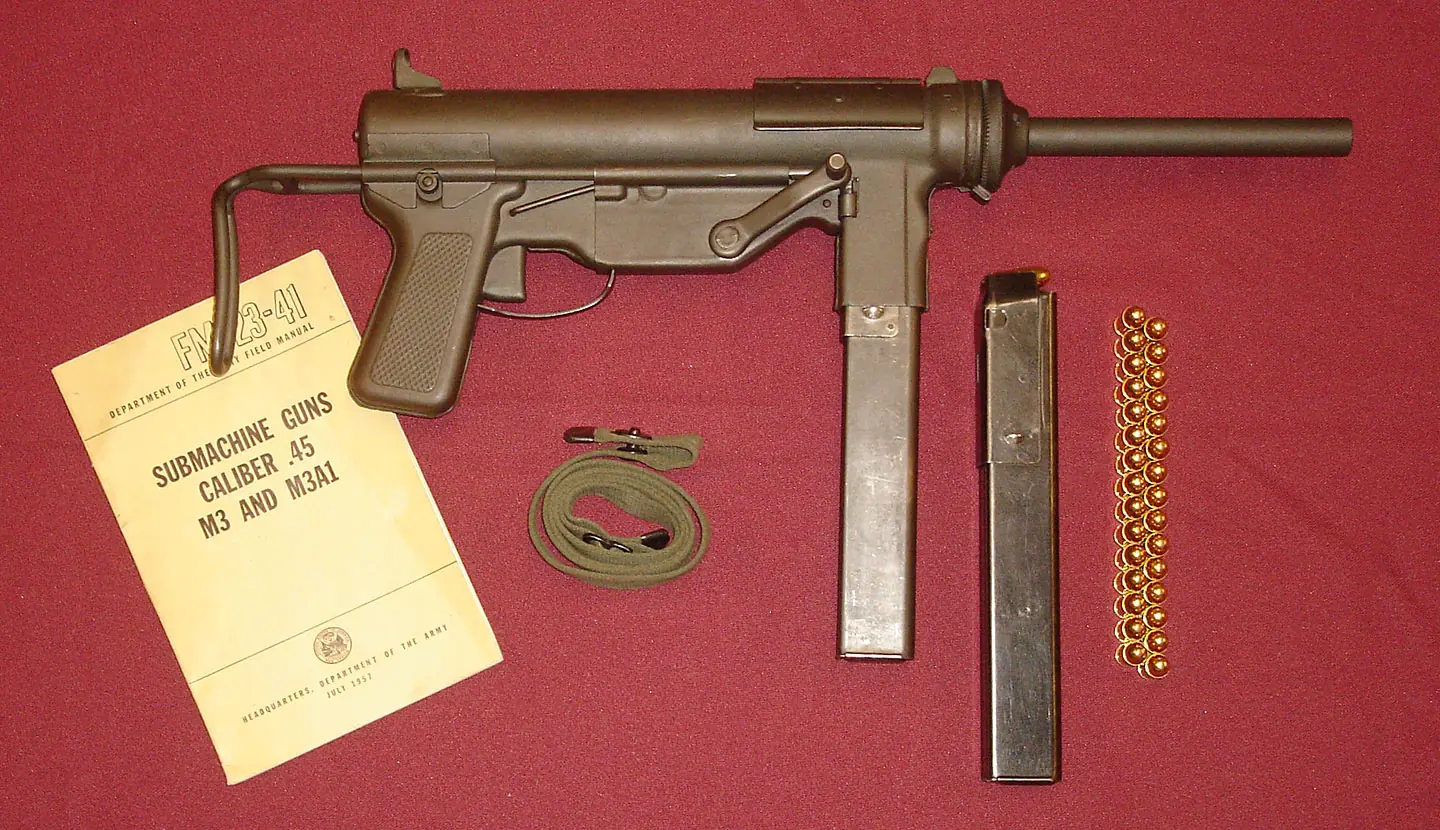
Image credit
- Title
- File:M3-SMG.jpg
- Author
- Curiosandrelics(attribution required)
- Licence
- CC BY-SA 3.0
- Source
- https://commons.wikimedia.org/wiki/File:M3-SMG.jpg

How Muzzle energy is calculated
E = ½ · m · v²
Inputs
- m14.90 g230.0 grverifiedsource230 gr as published, converted at 1 gr = 0.06479891 g.
- v271.3 m/s890.0 fpsverifiedMeasured with a 127 mm barrel, not this arm's 203.2 mm. Velocity outside the sourced range is not projected.
1 of 2 inputs link to their source.
How Muzzle velocity is calculated
nearest sourced barrel length, no extrapolation
Inputs
- v at 127 mm271.3 m/s890.0 fpsverifiedsource890 ft/s as published, converted at 1 ft/s = 0.3048 m/s.
Assumptions
- This figure belongs to a 127 mm barrel. It is shown because it is the closest measurement that exists, not because it applies here.
1 of 1 inputs link to their source.
How Loaded mass is calculated
m_loaded = m_empty + m_magazine + n · m_cartridge
Not calculated: m_magazine has no sourced figure yet. Nothing is substituted for a missing input.
Assumptions
- One magazine, filled to the stated capacity. Spare magazines, optics, slings and lights are the owner’s, not the arm’s.
2 of 4 inputs link to their source.
How Free recoil is calculated
E_recoil = ½ · m_firearm · v_recoil²
Inputs
- m_firearm3.697 kg8.150 lbverifiedsource8.15 lb, gun without magazine, from the general data table in paragraph 2c.
- v_recoil1.094 m/s3.588 fpsestimated
Assumptions
- Propellant gas momentum is excluded: ARMAG does not record charge weights. This is therefore a lower bound on the real free recoil, consistent between entries but smaller than a figure that includes the gas term.
- Free recoil: the arm is unrestrained. Stock design, muzzle devices, stance and shooter mass are not modelled, because none of them is a property of the arm.
1 of 2 inputs link to their source.
How Capacity is calculated
as published for the primary chambering
Inputs
- capacity30verifiedsourceBox magazine of 30 rounds of caliber .45 ammunition, paragraph 1a.
1 of 1 inputs link to their source.
Derived figures
Computed from the sourced values above. Open ƒ on any figure for the formula, its inputs, and the assumptions it makes.
How Momentum is calculated
p = m · v
Inputs
- m14.90 g230.0 grverifiedsource230 gr as published, converted at 1 gr = 0.06479891 g.
- v271.3 m/s890.0 fpsverifiedMeasured with a 127 mm barrel, not this arm's 203.2 mm. Velocity outside the sourced range is not projected.
1 of 2 inputs link to their source.
How Sectional density is calculated
SD = mass(gr) / (7000 · diameter(in)²)
Inputs
- mass14.90 g230.0 grverifiedsource230 gr as published, converted at 1 gr = 0.06479891 g.
- diameter11.48 mm0.4520 inverifiedsourceC.I.P. G1, maximum bullet diameter.
Assumptions
- Reported in the conventional lb/in² so it is directly comparable with published figures.
2 of 2 inputs link to their source.
How Power factor is calculated
PF = mass(gr) · velocity(fps) / 1000
Inputs
- mass14.90 g230.0 grverifiedsource230 gr as published, converted at 1 gr = 0.06479891 g.
- velocity271.3 m/s890.0 fpsverifiedMeasured with a 127 mm barrel, not this arm's 203.2 mm. Velocity outside the sourced range is not projected.
Assumptions
- A competition classification defined by the IPSC and USPSA rulebooks, stated in their units. It describes a scoring category, not an effect.
1 of 2 inputs link to their source.
How Magazine dump is calculated
t = (n − 1) / (rpm / 60)
Inputs
- n30verifiedsourceBox magazine of 30 rounds of caliber .45 ammunition, paragraph 1a.
- rpm450 rpmverifiedsource450 shots per minute in caliber .45, paragraph 3f; the manual gives the same rate for the 9 mm conversion.
Assumptions
- Cyclic rate held for the whole magazine, no stoppages, trigger held down. A theoretical figure for comparing mechanisms, not a measured one.
2 of 2 inputs link to their source.
How Sight error at 1 mm is calculated
θ = atan(misalignment / sight radius)
Inputs
- sight radius266.7 mm10.50 inverifiedsourceDistance between sights, 10.5 in, paragraph 2c.
- misalignment1 mm0.03937 inverified
Assumptions
- Shows what a stated aiming error costs. The misalignment is the reader’s figure; the site does not claim how well anyone aims.
1 of 2 inputs link to their source.
Variants
M3A1
Standardised in late 1944. The crank retracting handle that broke in service is deleted altogether: a slot is cut into the top of the bolt and the gun is cocked with a finger through a lengthened ejector port. The magazine loader becomes a bracket built into the stock, the oiler moves into the pistol grip, and the driving springs are lengthened.
- Mass, empty
7.95 lb empty from the encyclopedia infobox, which carries no citation. FM 23-41's change sheet for the M3A1 describes the alterations without republishing the data table.
| Variant | Years | Changes |
|---|---|---|
| M3A1 | — | Mass, empty |
Specifications
Every row here is generated from the schema, so a figure recorded on this entry cannot be missing from the table, and the same rows, read the same way, are what the comparison shows.
Identity
- Type
- Submachine gun
- Action
- Self-loading
- Fire modes
- Fully automatic
- Operating system
- Blowback, simple
- Roles
- Designed in
- United States
- Produced in
- Introduced
- 1942
- Production
- not recorded
Dimensions and mass
- Mass, empty
- 3.697 kg8.150 lbsource
8.15 lb, gun without magazine, from the general data table in paragraph 2c.
- Magazine, empty
- not recorded
- Length
- 756.9 mm29.80 insource
29.8 in, length over all, paragraph 2c. The wire stock telescopes; the manual publishes no collapsed length.
- Length, folded
- not recorded
- Width
- not recorded
- Height
- not recorded
- Barrel length
- 203.2 mm8.000 insource
8 in, paragraph 2a. The 9 mm conversion barrel is the same length.
Sights and rifling
Operation
- Cyclic rate
- 450 rpmsource
450 shots per minute in caliber .45, paragraph 3f; the manual gives the same rate for the 9 mm conversion.
- Trigger pull
FM 23-41 paragraph 3k gives a range of 5 to 7 lb; the midpoint of 6 lb is recorded here because a PropertyValue holds one number.
- Effective range
- 182.9 m200.0 ydsource
Maximum effective range 200 yd, paragraph 3n. The peep sight is fixed for 100 yd.
- Units produced
The encyclopedia infobox totals 606,694 M3 and 48,669 M3A1 but carries no citation for either, so the figure is recorded as an estimate rather than as a published total.
- Launch price
- USD 20 · 1943 · USestimatedabout USD 372 in 2025 money, by US consumer prices
Chamberings
- .45 ACPprimary30 rounds
- 9x19mm Parabellum32 rounds
Scale
A to-scale outline against family siblings. The dimensions are sourced; the shape is a representative outline for the type, and says so.
- M3 submachine gun756.9 mm29.80 inheight not recorded
Representative outline: the dimensions are sourced, the shape is not. Overall length, and barrel length where recorded, are drawn from this entry's own figures; the profile is a generic one for the firearm type and says nothing about this arm's actual contours. M3 submachine gun records no height, so its outline is drawn at the type's proportion. That height is part of the shape, not a measurement.
Lineage
This design
- Successor to Thompson submachine gun
Gallery
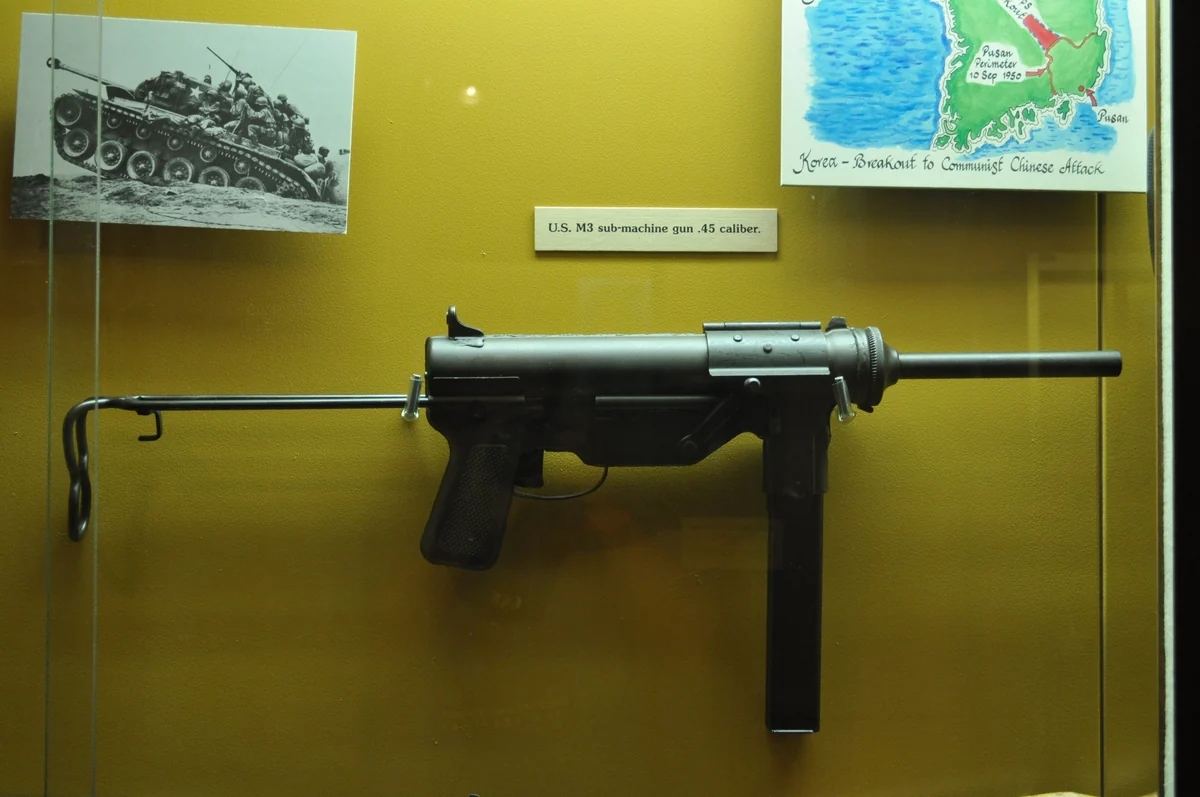
Image credit
- Title
- File:M3 submachine gun.jpg
- Author
- Joe Mabel(attribution required)
- Licence
- CC BY-SA 3.0
- Source
- https://commons.wikimedia.org/wiki/File:M3_submachine_gun.jpg

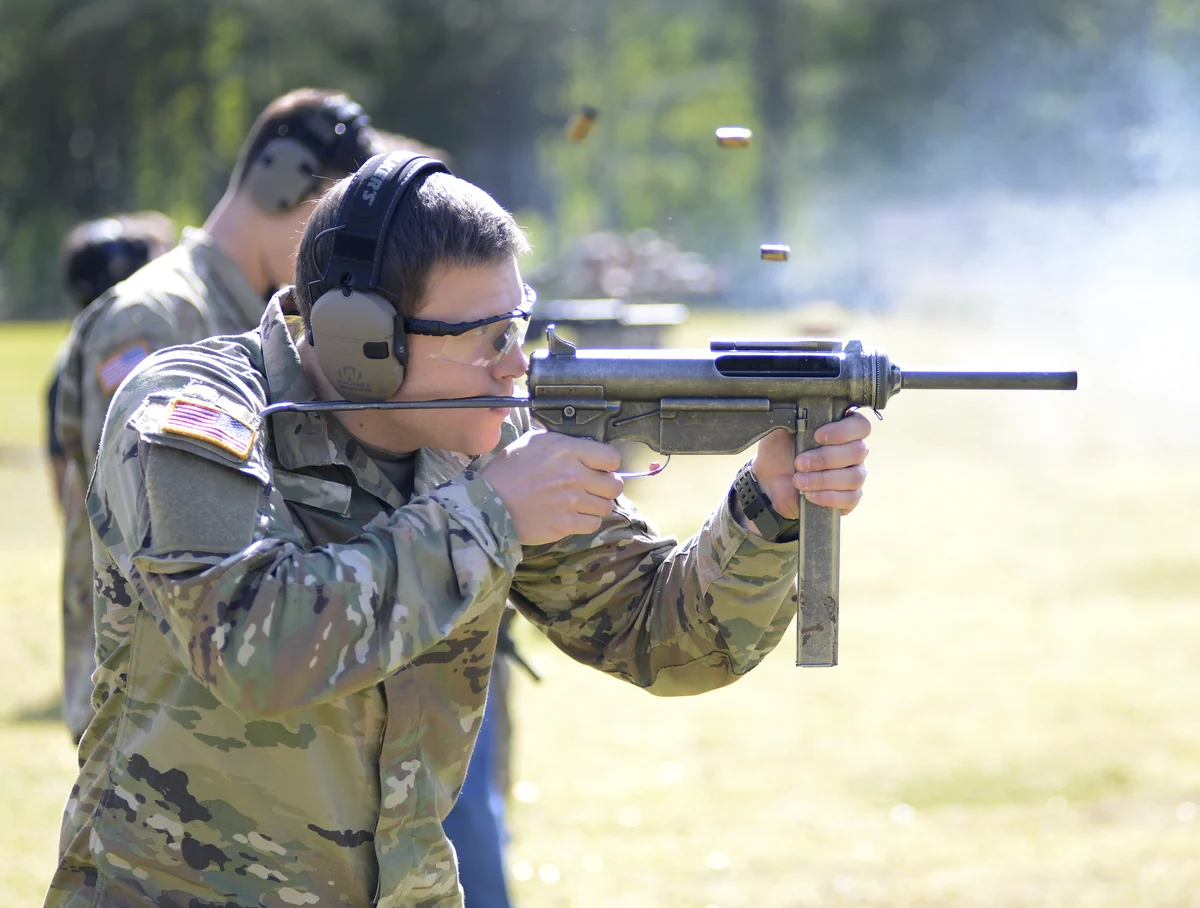
Image credit
- Title
- Special Forces Students Range Day
- Author
- K. Kassens
- Licence
- Public domain
- Source
- https://www.dvidshub.net/image/6219032/special-forces-students-range-day
- Note
- Work of the United States Government, uncopyrighted under 17 U.S.C. §105: photographed for the Army (United States Army John F. Kennedy Special Warfare Center and School), VIRIN 200511-A-OP908-020. DVIDS states no separate licence per asset.
Detail
The M3 is what happens when an ordnance board stops asking for a good submachine gun and starts asking for a cheap one. Adopted in December 1942 to replace the Thompson, it was drawn by George Hyde around sheet steel and a car-parts factory rather than around a machine shop, and its receiver is two stamped halves welded into a tube. Soldiers called it the grease gun, after the tool it resembles.
Almost everything about it follows from the cost target. There is no semi-automatic position, because a selector is parts; the bolt is instead made deliberately heavy so that the cyclic rate falls to 450 rounds a minute, slow enough that a trained hand can release the trigger after one round. It fires from an open bolt using advanced primer ignition, so the cartridge is struck while the bolt is still travelling forward and part of the bolt’s momentum has to be reversed before the case can move, which is what allows a weapon this light to be simple blowback in a cartridge this large. The bolt is drilled through longitudinally for two guide rods carrying the return springs, a layout that tolerates loose machining because the rods, not the receiver walls, hold the bolt in line.
The original M3 is cocked by a crank on the right of the ejector housing. That mechanism was the first thing to break in service, and the M3A1 of late 1944 deleted it entirely: the bolt has a finger hole cut into its top face and is pulled back by hand through the open ejector port. The same weapon accepted a factory kit of barrel, bolt and magazine adapter that rechambered it for 9x19mm Parabellum, and about a thousand were built that way for the Office of Strategic Services, so that agents could be supplied from captured German stocks. The double-column, single-feed magazine was copied from the Sten and inherited the Sten’s sensitivity to dirt along with its shape.
It was issued as a disposable item (no unit-level spares, no armourer’s tools), and it outlasted that intention by half a century, riding in American tanks until the 1990s.
Gaps on this page: Guide Lamp’s empty magazine weight is illegible in the scanned manual and is not recorded here, and no free source publishes the M3’s width or height. The overall length is the 29.8 inches printed in FM 23-41; the encyclopedia gives 29.1 inches without saying which weapon or configuration it measured, and that figure is not used. Production totals and the 1943 unit cost come from an uncited infobox and are marked as estimates. The M3A1’s weight is the only figure recorded for that variant, because the manual’s change sheet describes the alterations without repeating the data table.
References
This entry's own bibliography. Every citation key on this page resolves into this list.
- FM 23-41, Submachine Guns, Caliber .45, M3 and M3A1 · War Department / Department of the Army · FM 23-41, with Changes No. 3 · read 2026-08-31 · public domain (US Government work)
- M3 submachine gun · Wikipedia · 1371518050 · read 2026-08-31 · CC BY-SA 4.0
Last verified 2026-08-31 · review status: agent-populated