
Steyr M1912
Steyr ArmsSmokeless revolution
Also known as Steyr-Hahn, M12, Steyr M1911, Steyr Repetierpistole M1912/P16
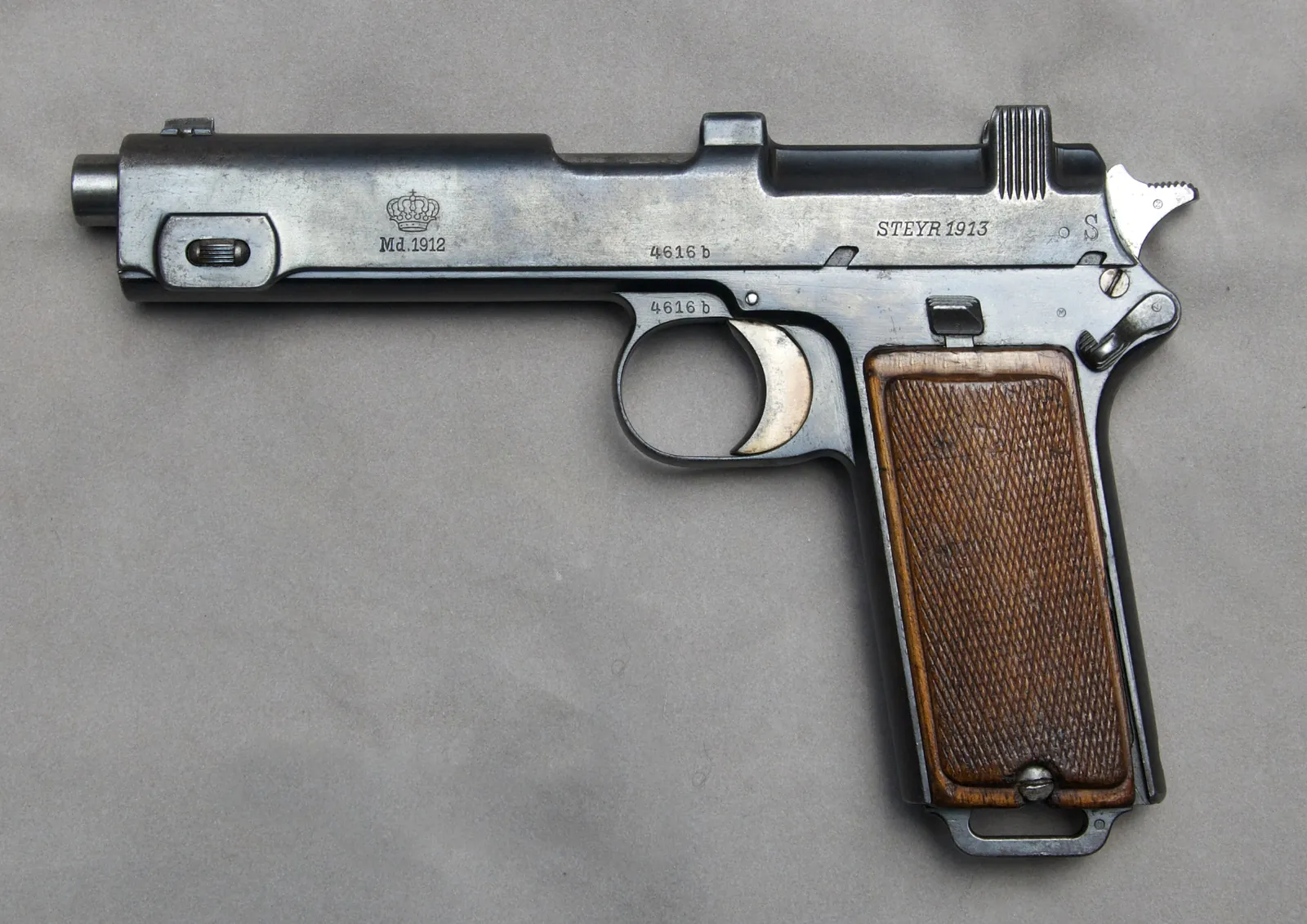
Image credit
- Title
- File:Steyr Hahn M1912 Romanian 9mm Steyr 4616b L DSC7593.jpg
- Author
- Self Loader(attribution required)
- Licence
- CC BY-SA 4.0
- Source
- https://commons.wikimedia.org/wiki/File:Steyr_Hahn_M1912_Romanian_9mm_Steyr_4616b_L_DSC7593.jpg

How Muzzle energy is calculated
E = ½ · m · v²
Inputs
- m7.452 g115.0 grverifiedsource115 gr as published in the article's ballistics table, converted to grams.
- v312.4 m/s1,025 fpsverified
1 of 2 inputs link to their source.
How Muzzle velocity is calculated
measured at this barrel length
Inputs
- v312.4 m/s1,025 fpsverifiedsource1025 ft/s as published. The table's numbered ballistics sources put Hornady against this row.
1 of 1 inputs link to their source.
How Loaded mass is calculated
m_loaded = m_empty + m_magazine + n · m_cartridge
Not calculated: m_magazine has no sourced figure yet. Nothing is substituted for a missing input.
Assumptions
- One magazine, filled to the stated capacity. Spare magazines, optics, slings and lights are the owner’s, not the arm’s.
2 of 4 inputs link to their source.
How Free recoil is calculated
E_recoil = ½ · m_firearm · v_recoil²
Inputs
- m_firearm1.2 kg2.646 lbverifiedsource1.2 kg, credited in the infobox to Jane's. The magazine is integral, so an empty-versus-loaded distinction does not arise the way it does on a pistol with a detachable one.
- v_recoil1.940 m/s6.365 fpsestimated
Assumptions
- Propellant gas momentum is excluded: ARMAG does not record charge weights. This is therefore a lower bound on the real free recoil, consistent between entries but smaller than a figure that includes the gas term.
- Free recoil: the arm is unrestrained. Stock design, muzzle devices, stance and shooter mass are not modelled, because none of them is a property of the arm.
1 of 2 inputs link to their source.
How Capacity is calculated
as published for the primary chambering
Inputs
- capacity8verifiedsourceIntegral eight-round magazine in the grip, filled from above with a stripper clip.
1 of 1 inputs link to their source.
Derived figures
Computed from the sourced values above. Open ƒ on any figure for the formula, its inputs, and the assumptions it makes.
How Momentum is calculated
p = m · v
Inputs
- m7.452 g115.0 grverifiedsource115 gr as published in the article's ballistics table, converted to grams.
- v312.4 m/s1,025 fpsverified
1 of 2 inputs link to their source.
How Sectional density is calculated
SD = mass(gr) / (7000 · diameter(in)²)
Inputs
- mass7.452 g115.0 grverifiedsource115 gr as published in the article's ballistics table, converted to grams.
- diameter9.03 mm0.3555 inverifiedsourceCartridge maximum, dimension G1. The same bullet diameter as 9x19mm Parabellum.
Assumptions
- Reported in the conventional lb/in² so it is directly comparable with published figures.
2 of 2 inputs link to their source.
How Power factor is calculated
PF = mass(gr) · velocity(fps) / 1000
Inputs
- mass7.452 g115.0 grverifiedsource115 gr as published in the article's ballistics table, converted to grams.
- velocity312.4 m/s1,025 fpsverified
Assumptions
- A competition classification defined by the IPSC and USPSA rulebooks, stated in their units. It describes a scoring category, not an effect.
1 of 2 inputs link to their source.
How Magazine dump is calculated
t = (n − 1) / (rpm / 60)
Not calculated: rpm has no sourced figure yet. Nothing is substituted for a missing input.
Assumptions
- Cyclic rate held for the whole magazine, no stoppages, trigger held down. A theoretical figure for comparing mechanisms, not a measured one.
1 of 2 inputs link to their source.
How Sight error at 1 mm is calculated
θ = atan(misalignment / sight radius)
Not calculated: sight radius has no sourced figure yet. Nothing is substituted for a missing input.
Assumptions
- Shows what a stated aiming error costs. The misalignment is the reader’s figure; the site does not claim how well anyone aims.
No input on this calculation carries a clickable source yet.
Specifications
Every row here is generated from the schema, so a figure recorded on this entry cannot be missing from the table, and the same rows, read the same way, are what the comparison shows.
Identity
- Type
- Pistol
- Action
- Self-loading
- Fire modes
- Semi-automatic
- Operating system
- Short recoil
- Roles
- Designed in
- Austria-Hungary
- Produced in
- Introduced
- 1912
- Production
- not recorded
Dimensions and mass
- Mass, empty
- 1.2 kg2.646 lbsource
1.2 kg, credited in the infobox to Jane's. The magazine is integral, so an empty-versus-loaded distinction does not arise the way it does on a pistol with a detachable one.
- Magazine, empty
- not recorded
- Length
- 216 mm8.504 insource
- Length, folded
- not recorded
- Width
- not recorded
- Height
- 142 mm5.591 insource
- Barrel length
- 128 mm5.039 insource
128 mm, which is also the test barrel length the published 9x23mm Steyr ballistics were measured in.
Sights and rifling
- Sight radius
- not recorded
- Sight height over bore
- not recorded
- Rifling twist
- not recorded
- Twist direction
- not recorded
- Grooves
- not recorded
- Sight graduation
- not recorded
Chamberings
- 9x23mm Steyrprimary8 rounds
- 9x19mm Parabellum8 rounds
Scale
A to-scale outline against family siblings. The dimensions are sourced; the shape is a representative outline for the type, and says so.
- Steyr M1912216 mm8.504 in
Representative outline: the dimensions are sourced, the shape is not. Overall length, and barrel length where recorded, are drawn from this entry's own figures; the profile is a generic one for the firearm type and says nothing about this arm's actual contours.
Gallery
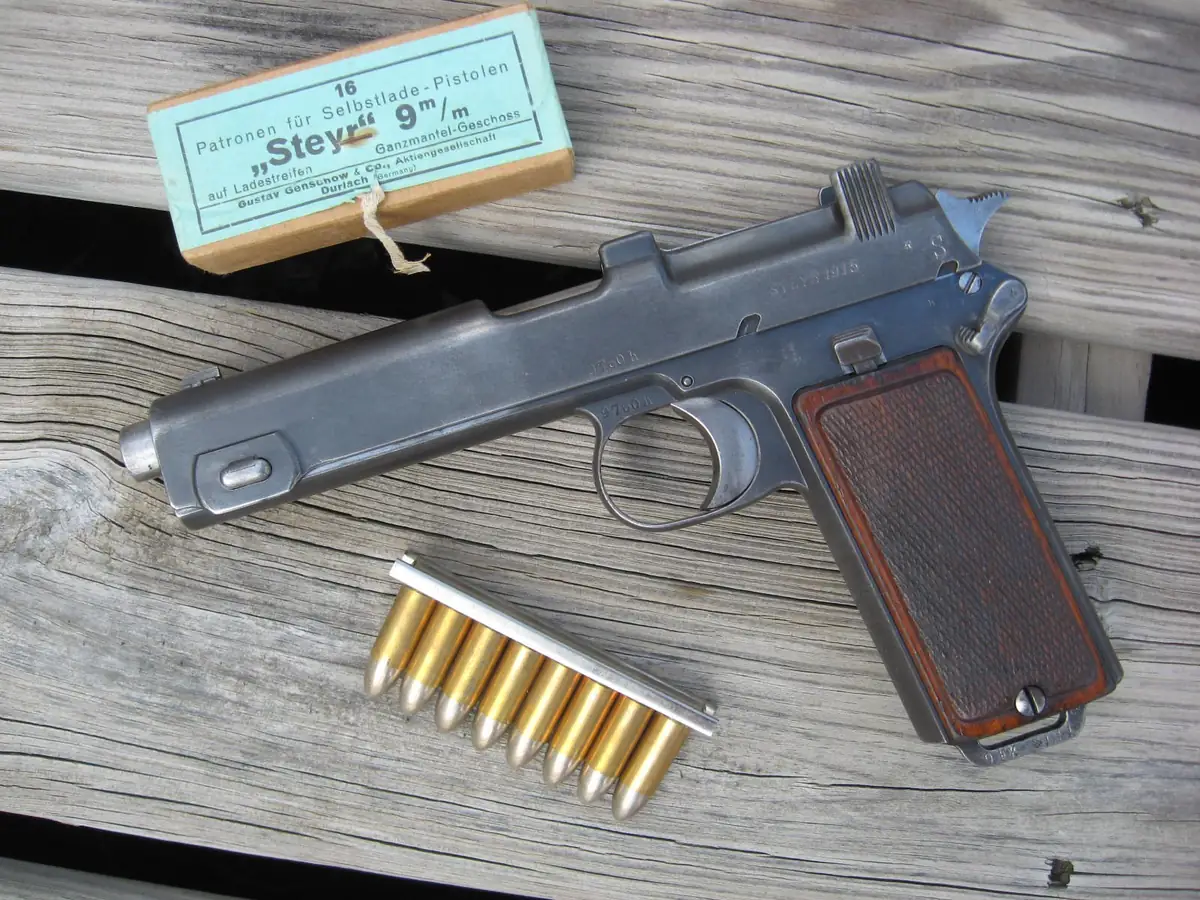
Image credit
- Title
- File:Steyr-Hahn M1912.JPG
- Author
- Drake00(attribution required)
- Licence
- CC BY-SA 3.0
- Source
- https://commons.wikimedia.org/wiki/File:Steyr-Hahn_M1912.JPG

Detail
The Steyr M1912 was Austria-Hungary’s principal military pistol of the First World War, and the thing everybody notices about it is what it does not have: a removable magazine. The eight rounds live in a box machined into the frame, and the only way to fill them is to pull the slide back, drop a charger clip into guides above the action, thumb the cartridges down and throw the strip away.
The lock is the other unusual part. It is short recoil with a rotating barrel: lugs riding in grooves turn the barrel through twenty degrees as the two parts move back together, until a lug meets a stop wedge, the barrel is held and the slide runs on alone to eject and recock. The layout that results is distinctive from across a room: the slide occupies only the rear third of a long one-piece frame, and the external hammer standing behind it is what gives the pistol its nickname, the Steyr-Hahn, and tells it apart from the hammerless Roth-Steyr M1907 that preceded it in Austro-Hungarian service.
It was designed by Karl Murgthaler, Helmut Bachner and Adolf Jungmayr at Österreichische Waffenfabriks-Gesellschaft between 1909 and 1910 and sold commercially as the Model 1911 before the army took it. Chile and Romania both ordered it; Germany ordered ten thousand; Austro-Hungarian handgun shortages during the war pushed production up, and perhaps three hundred thousand were made. A selective-fire version with a longer magazine and a fitted stock, the M1912/P16, was built in small numbers. Enough of the pistols survived the empire that the Wehrmacht reworked a proportion of them to 9x19mm Parabellum and issued them again in the Second World War.
Gaps on this page: nothing but the encyclopedia is available for the measurements, which it credits to Jane’s without a page or an edition, so every figure here rests on a single secondary source; no width, sight radius, rifling twist or trigger pull is published anywhere free. The production figure is given as “up to 300,000” (a ceiling, not a count) and is recorded as an estimate. Production is described only as running from 1912 into the 1920s, with no end year, so no production range is recorded. This entry is filed under Austria because the taxonomy has no Austria-Hungary term; the pistol was made at Steyr and adopted by the Austro-Hungarian Army.
References
This entry's own bibliography. Every citation key on this page resolves into this list.
- Steyr M1912 pistol · Wikipedia · 1367358841 · read 2026-09-01 · CC BY-SA 4.0
Last verified 2026-09-01 · review status: agent-populated