
AS Val
АС «Вал»
Tula Arms Plant1987–presentLate Cold War
Also known as Avtomat Spetsialny Val, 6P30
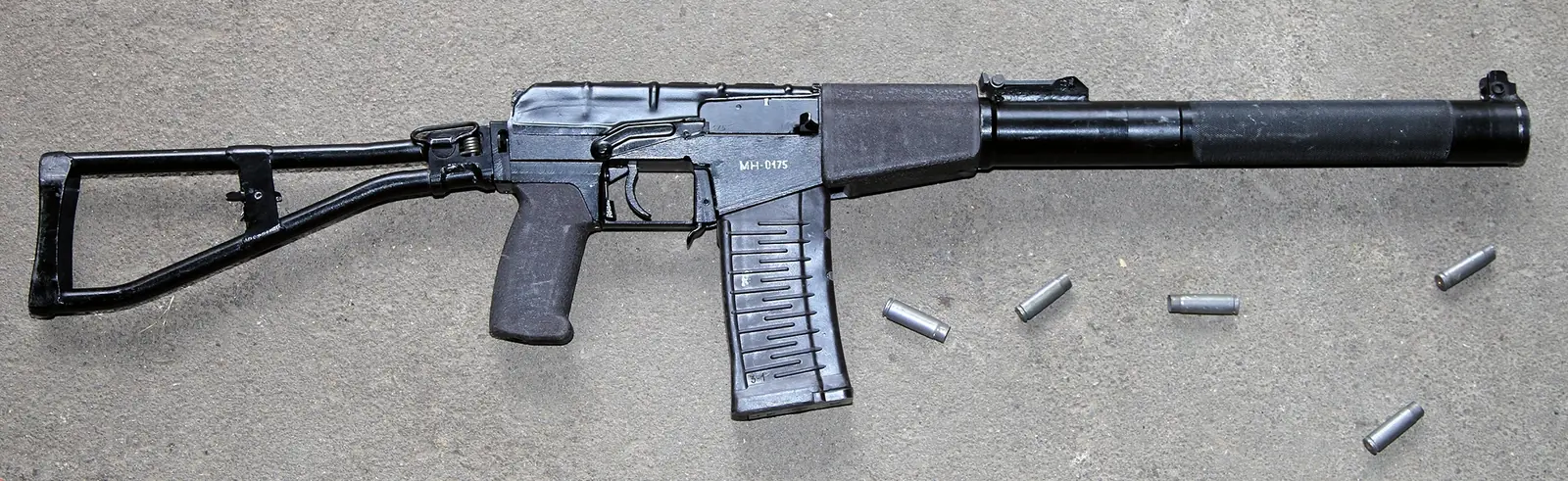
Image credit
- Title
- File:AS Val (541-03).jpg
- Author
- Vitaly V. Kuzmin(attribution required)
- Licence
- CC BY-SA 4.0
- Source
- https://commons.wikimedia.org/wiki/File:AS_Val_(541-03).jpg
.jpg)
How Muzzle energy is calculated
E = ½ · m · v²
Inputs
- m16.1 g248.5 grverifiedsource16.1 g as published in the article's ballistics table, which declares SI units.
- v290 m/s951.4 fpsverifiedMeasured with a 266.7 mm barrel, not this arm's 200 mm. Velocity outside the sourced range is not projected.
1 of 2 inputs link to their source.
How Muzzle velocity is calculated
nearest sourced barrel length, no extrapolation
Inputs
- v at 266.7 mm290 m/s951.4 fpsverifiedsource290 m/s as published, which is below the speed of sound at sea level by design.
Assumptions
- This figure belongs to a 266.7 mm barrel. It is shown because it is the closest measurement that exists, not because it applies here.
1 of 1 inputs link to their source.
How Loaded mass is calculated
m_loaded = m_empty + m_magazine + n · m_cartridge
Not calculated: m_magazine has no sourced figure yet. Nothing is substituted for a missing input.
Assumptions
- One magazine, filled to the stated capacity. Spare magazines, optics, slings and lights are the owner’s, not the arm’s.
2 of 4 inputs link to their source.
How Free recoil is calculated
E_recoil = ½ · m_firearm · v_recoil²
Inputs
- m_firearm2.5 kg5.512 lbverifiedsourceAS Val, unloaded. The same source gives 5.7 kg with the NSP-3 night sight fitted.
- v_recoil1.868 m/s6.127 fpsestimated
Assumptions
- Propellant gas momentum is excluded: ARMAG does not record charge weights. This is therefore a lower bound on the real free recoil, consistent between entries but smaller than a figure that includes the gas term.
- Free recoil: the arm is unrestrained. Stock design, muzzle devices, stance and shooter mass are not modelled, because none of them is a property of the arm.
1 of 2 inputs link to their source.
How Capacity is calculated
as published for the primary chambering
Inputs
- capacity20verifiedsourceThe AS Val is primarily used with 20-round magazines; 10-round and 30-round SR-3M magazines also fit.
1 of 1 inputs link to their source.
Derived figures
Computed from the sourced values above. Open ƒ on any figure for the formula, its inputs, and the assumptions it makes.
How Momentum is calculated
p = m · v
Inputs
- m16.1 g248.5 grverifiedsource16.1 g as published in the article's ballistics table, which declares SI units.
- v290 m/s951.4 fpsverifiedMeasured with a 266.7 mm barrel, not this arm's 200 mm. Velocity outside the sourced range is not projected.
1 of 2 inputs link to their source.
How Sectional density is calculated
SD = mass(gr) / (7000 · diameter(in)²)
Inputs
- mass16.1 g248.5 grverifiedsource16.1 g as published in the article's ballistics table, which declares SI units.
- diameter9.27 mm0.3650 inverifiedsourceCartridge maximum, dimension G1.
Assumptions
- Reported in the conventional lb/in² so it is directly comparable with published figures.
2 of 2 inputs link to their source.
How Power factor is calculated
PF = mass(gr) · velocity(fps) / 1000
Inputs
- mass16.1 g248.5 grverifiedsource16.1 g as published in the article's ballistics table, which declares SI units.
- velocity290 m/s951.4 fpsverifiedMeasured with a 266.7 mm barrel, not this arm's 200 mm. Velocity outside the sourced range is not projected.
Assumptions
- A competition classification defined by the IPSC and USPSA rulebooks, stated in their units. It describes a scoring category, not an effect.
1 of 2 inputs link to their source.
How Magazine dump is calculated
t = (n − 1) / (rpm / 60)
Inputs
- n20verifiedsourceThe AS Val is primarily used with 20-round magazines; 10-round and 30-round SR-3M magazines also fit.
- rpm850 rpmestimatedsourceThe article gives a range of 800 to 900 rounds a minute; the midpoint is recorded here because a PropertyValue holds one number.
Assumptions
- Cyclic rate held for the whole magazine, no stoppages, trigger held down. A theoretical figure for comparing mechanisms, not a measured one.
2 of 2 inputs link to their source.
How Sight error at 1 mm is calculated
θ = atan(misalignment / sight radius)
Not calculated: sight radius has no sourced figure yet. Nothing is substituted for a missing input.
Assumptions
- Shows what a stated aiming error costs. The misalignment is the reader’s figure; the site does not claim how well anyone aims.
No input on this calculation carries a clickable source yet.
Specifications
Every row here is generated from the schema, so a figure recorded on this entry cannot be missing from the table, and the same rows, read the same way, are what the comparison shows.
Identity
- Type
- Rifle
- Action
- Self-loading
- Fire modes
- Semi-automatic
- Fully automatic
- Operating system
- Gas, long-stroke piston
- Roles
- Designed in
- Soviet Union
- Produced in
- Introduced
- 1987
- Production
- 1987–present
Dimensions and mass
- Mass, empty
- 2.5 kg5.512 lbsource
AS Val, unloaded. The same source gives 5.7 kg with the NSP-3 night sight fitted.
- Magazine, empty
- not recorded
- Length
- 875 mm34.45 insource
Skeleton stock extended.
- Length, folded
- 650 mm25.59 insource
Stock folded left along the receiver.
- Width
- not recorded
- Height
- not recorded
- Barrel length
200 mm, cited in the article to Johnston and Nelson's printed small-arms reference rather than to a clickable document. The barrel is perforated along its length so that gas vents into the surrounding integral suppressor, so the figure is not the distance from breech to muzzle exit.
Sights and rifling
- Sight radius
- not recorded
- Sight height over bore
- not recorded
- Rifling twist
- not recorded
- Twist direction
- not recorded
- Grooves
- not recorded
- Sight graduation
- not recorded
Operation
- Cyclic rate
The article gives a range of 800 to 900 rounds a minute; the midpoint is recorded here because a PropertyValue holds one number.
- Trigger pull
- not recorded
- Effective range
- 400 m437.4 ydsource
Daylight figure. The same source gives 300 m at night.
- Units produced
- not recorded
- Launch price
- not recorded
Chamberings
- 9x39mmprimary20 rounds
Scale
A to-scale outline against family siblings. The dimensions are sourced; the shape is a representative outline for the type, and says so.
- AS Val875 mm34.45 inheight not recorded
Representative outline: the dimensions are sourced, the shape is not. Overall length, and barrel length where recorded, are drawn from this entry's own figures; the profile is a generic one for the firearm type and says nothing about this arm's actual contours. AS Val records no height, so its outline is drawn at the type's proportion. That height is part of the shape, not a measurement.
Lineage
What came from it
- Derivatives SR-3 Vikhr
Gallery
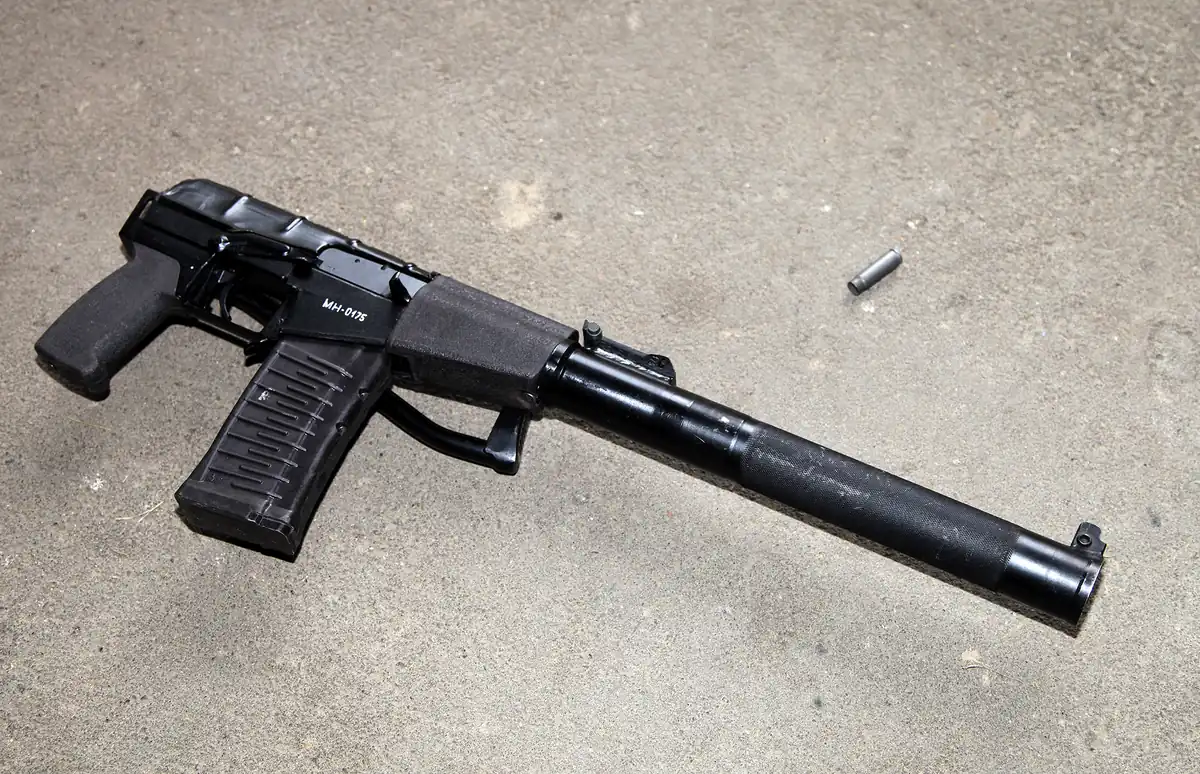
Image credit
- Title
- File:AS Val (541-14).jpg
- Author
- Vitaly V. Kuzmin(attribution required)
- Licence
- CC BY-SA 4.0
- Source
- https://commons.wikimedia.org/wiki/File:AS_Val_(541-14).jpg
.jpg)
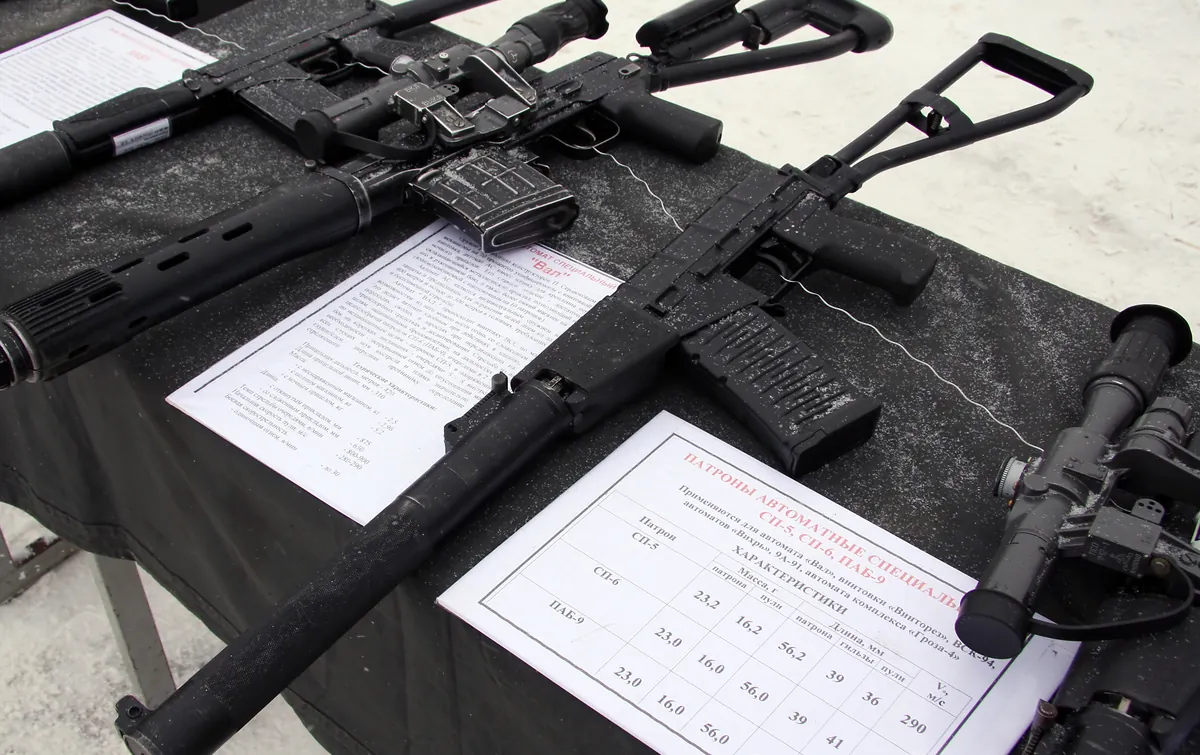
Image credit
- Title
- File:AS Val rifle.jpg
- Author
- Vitaly V. Kuzmin(attribution required)
- Licence
- CC BY-SA 4.0
- Source
- https://commons.wikimedia.org/wiki/File:AS_Val_rifle.jpg

Detail
The AS Val is a Soviet special-purpose rifle built around silence rather than around a cartridge that already existed. P. I. Serdyukov and V. F. Krasnikov at TsNIITochMash began in 1981 on a KGB and GRU requirement for a suppressed weapon for covert work, and designed the rifle and the 9x39mm round together; the sniper version, the VSS Vintorez, came first in 1983 and the Val followed in 1985.
The suppressor is not fitted to this rifle, it is most of this rifle. Everything ahead of the receiver is a two-chamber casing wider than the receiver itself, and the barrel inside it is perforated along its length: gas leaves through those holes into the first chamber, cools and loses pressure, then passes through mesh screens in the second before reaching the air. The front sight sits on the casing. Because the cartridge was designed subsonic from the start there is no crack to suppress either, so the two halves of a rifle’s report are dealt with separately and by different means. Barrel length is published as 200 mm, which is a length of rifling rather than a distance to the muzzle.
The action underneath is a modified Kalashnikov: gas-operated long stroke, rotating bolt, the familiar safety lever on the right side of the receiver, with the fire selector moved behind the trigger, which is not Kalashnikov practice. The magazines are ribbed horizontally so that a soldier can tell them from AK magazines by feel in the dark, and hold 10, 20 or 30 rounds; the Val is normally used with the 20. Folded, the skeleton stock takes the weapon from 875 mm to 650 mm, and the whole rifle with its sights and two magazines packs into an aluminium case.
Modernised as the ASM in 2018, it gained a Picatinny dust cover and a rail shrouding the suppressor.
Gaps on this page: this entry covers the AS Val only. The VSS Vintorez shares its receiver, its suppressor principle and its cartridge but is a different weapon with a different role, a fixed wooden stock and a 894 mm length, and belongs in an entry of its own; the encyclopedia treats the two in one article, which is why they cite the same source here. No free source gives the Val’s width, height, sight radius, rifling twist, trigger pull or production total, and its barrel length comes from a printed reference rather than a clickable one, so it is recorded as an estimate. The cyclic rate is published as an 800-to-900-rounds-a-minute range and is recorded as its midpoint. This entry carries no Wikidata identifier because the only item covering it is a joint one for both rifles.
References
This entry's own bibliography. Every citation key on this page resolves into this list.
- AS Val and VSS Vintorez · Wikipedia · 1368925037 · read 2026-09-01 · CC BY-SA 4.0
Last verified 2026-09-01 · review status: agent-populated