
9x39mm
N. V. Zabelin, L. S. Dvoryaninova, Y. Z. Frolov and E. S. KornilovaCIP standard
Also known as 9 x 39, SP-5, SP-6: the same cartridge under different names, all of which find this page.
Dimensions and pressure
Generated from the schema, like every specification table on this site, so a figure recorded on this entry cannot be missing from the table.
Identity
- Designed by
- N. V. Zabelin, L. S. Dvoryaninova, Y. Z. Frolov and E. S. Kornilova
- Introduced
- not recorded
- Production
- not recorded
- Standards body
- C.I.P.
- Case type
- Rimless
- Case shape
- Bottleneck
Dimensions
- Bullet diameter
- 9.27 mm0.3650 insource
Cartridge maximum, dimension G1.
- Bore diameter
- not recorded
- Case length
- 38.7 mm1.524 insource
Cartridge maximum, dimension L3. Identical to the parent 7.62x39mm.
- Overall length
- 56 mm2.205 insource
Cartridge maximum, dimension L6, and again identical to the 7.62x39mm; the round was made to occupy the same magazine length.
- Rim diameter
- 11.33 mm0.4461 insource
Dimension R1.
- Neck diameter
- 9.72 mm0.3827 insource
Dimension H2, against 8.6 mm on the parent case: this is the whole of the modification.
- Base diameter
- 11.35 mm0.4469 insource
Dimension P1.
Pressure
- Maximum pressure
- 355 MPa51,488 psisource
Pmax 3550 bar, transducer method, the same ceiling C.I.P. sets for the 7.62x39mm.
- Pressure standard
- C.I.P.
SAAMI and C.I.P. measure pressure differently and their figures are not interchangeable, which is why the body is always named beside the figure.
Loads
Velocity is recorded per barrel length as published. A gun page interpolates between these points and never projects beyond them.
SP-5 (7N8)
- Bullet mass
- 16.1 g248.5 grsource
16.1 g as published in the article's ballistics table, which declares SI units.
- Cartridge mass
- not recorded
- Bullet type
- lead-cored ball
- G1 BC
- not recorded
- G7 BC
- not recorded
| Barrel | Velocity |
|---|---|
| 266.7 mm10.50 in | 290 m/s951.4 fps |
SP-6 (7N9)
- Bullet mass
- 16.2 g250.0 grsource
16.2 g as published in the article's ballistics table.
- Cartridge mass
- not recorded
- Bullet type
- hard-cored
- G1 BC
- not recorded
- G7 BC
- not recorded
| Barrel | Velocity |
|---|---|
| 266.7 mm10.50 in | 305 m/s1,001 fps |
Wolf 278 gr FMJ
Wolf
- Bullet mass
- 18.01 g277.9 grsource
278 gr as published in the article's ballistics table, converted to grams. The one commercial load in the table.
- Cartridge mass
- not recorded
- Bullet type
- FMJ
- G1 BC
- not recorded
- G7 BC
- not recorded
| Barrel | Velocity |
|---|---|
| 266.7 mm10.50 in | 327 m/s1,073 fps |
Chambered in
Computed from every entry that lists this cartridge. Nothing here is hand-maintained.
- AK-9
Izhmash
- AS Val
Tula Arms Plant
- OTs-14 Groza
TsKIB SOO
- SR-3 Vikhr
Tula Arms Plant
Gallery
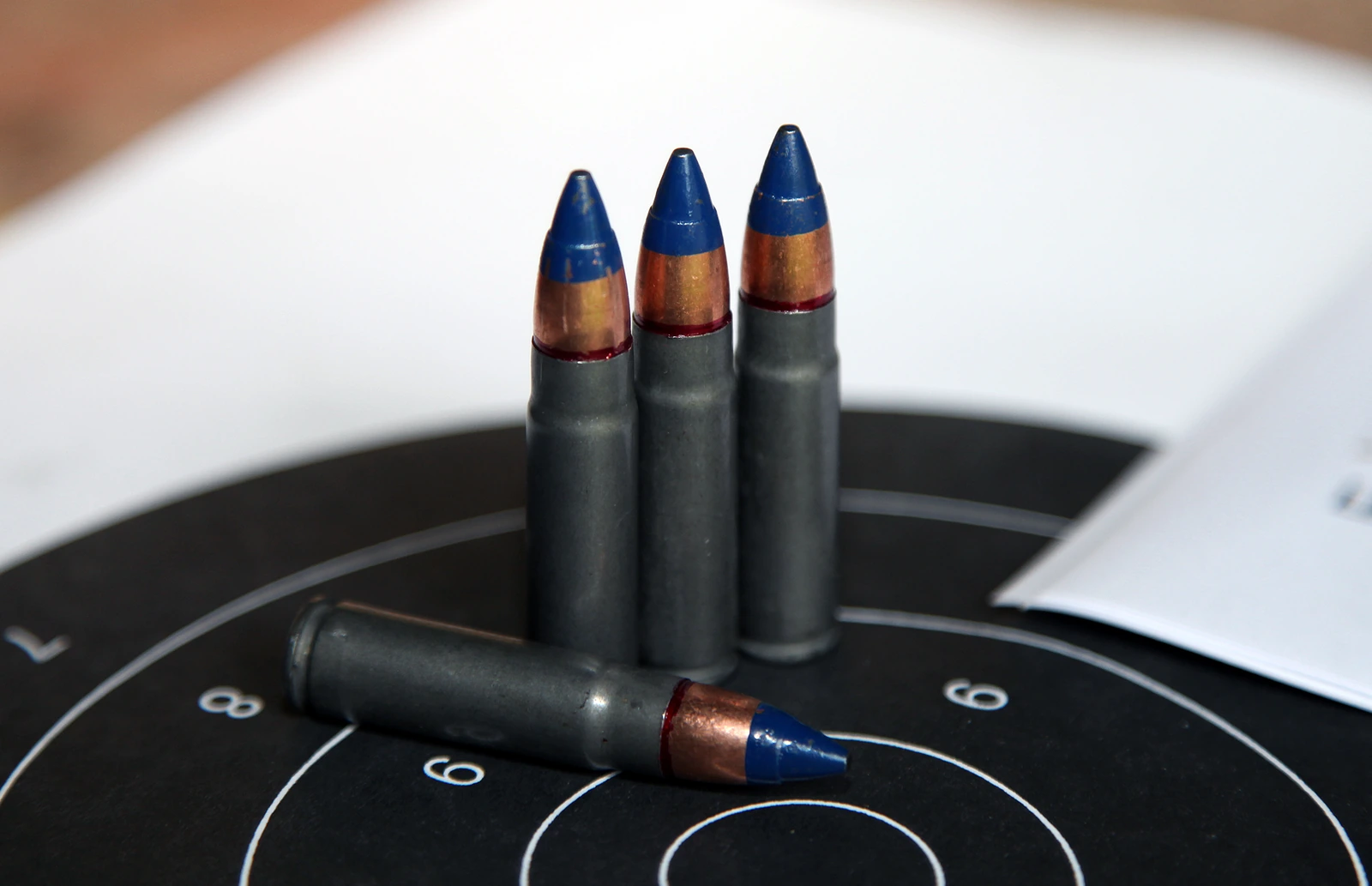
Image credit
- Title
- File:SR-3 (539-14).jpg
- Author
- Vitaly V. Kuzmin(attribution required)
- Licence
- CC BY-SA 4.0
- Source
- https://commons.wikimedia.org/wiki/File:SR-3_(539-14).jpg
.jpg)
Detail
The 9x39mm is a 7.62x39mm case necked up to take a nine-millimetre bullet, worked out in the Soviet Union in the first half of the 1980s by a team of four designers, N. V. Zabelin, L. S. Dvoryaninova, Y. Z. Frolov and E. S. Kornilova. It exists for one reason: it was designed from the start never to break the sound barrier, so that a suppressed weapon firing it makes no ballistic crack at all.
The dimensions say how narrow the brief was. Case length and overall length are 38.7 mm and 56.0 mm, the parent round’s figures to the hundredth of a millimetre, so the cartridge occupies the same magazine length and can be built on the same case-forming machinery. The head is unchanged at 11.35 mm. The neck goes from 8.6 mm to 9.72 mm and the bullet from 7.92 mm to 9.27 mm, and that is the whole of the modification.
Necking up is what makes subsonic work. A rifle case running a much wider, much heavier bullet at about 290 m/s is operating far below the pressure the case could take (C.I.P. still rates it at 3550 bar, the same as the 7.62x39mm), but it puts a 16-gram projectile into the air, roughly twice the mass a 7.62x39mm carries, which is where the energy comes back. The bullet is correspondingly short and blunt, and its aerodynamic penalty does not matter at the two to three hundred metres these weapons are sighted for. Two service loads share the case: the SP-5 with a conventional core and the hard-cored SP-6, marked with a blue tip, at almost the same mass and almost the same speed.
It has never had a civilian life to speak of. Almost every arm chambered for it is a Russian special-purpose weapon, and one commercial load appears in the record beside the two military ones.
Gaps on this page: no introduction year is recorded, because no free source gives one; the encyclopedia says only that the design was “finished in the mid 1980s”, and the arms built around it entered service in 1987. No ballistic coefficient is published for any of the three loads. All three velocities are the encyclopedia’s own table, which states a 10.5-inch test barrel for every row and cites the C.I.P. list rather than a manufacturer.
References
- C.I.P. TDCC datasheet, 9 x 39 · Tab. I, adopted 2018-05-16 · read 2026-09-01
- 9x39mm · 1372439188 · read 2026-09-01
Last verified 2026-09-01 · review status: agent-populated