
OTs-14 Groza
ОЦ-14 «Гроза»
TsKIB SOO1994–1999Post-Cold War
Also known as OTs-14-4A Groza-4, OTs-14-1A Groza-1, Thunderstorm
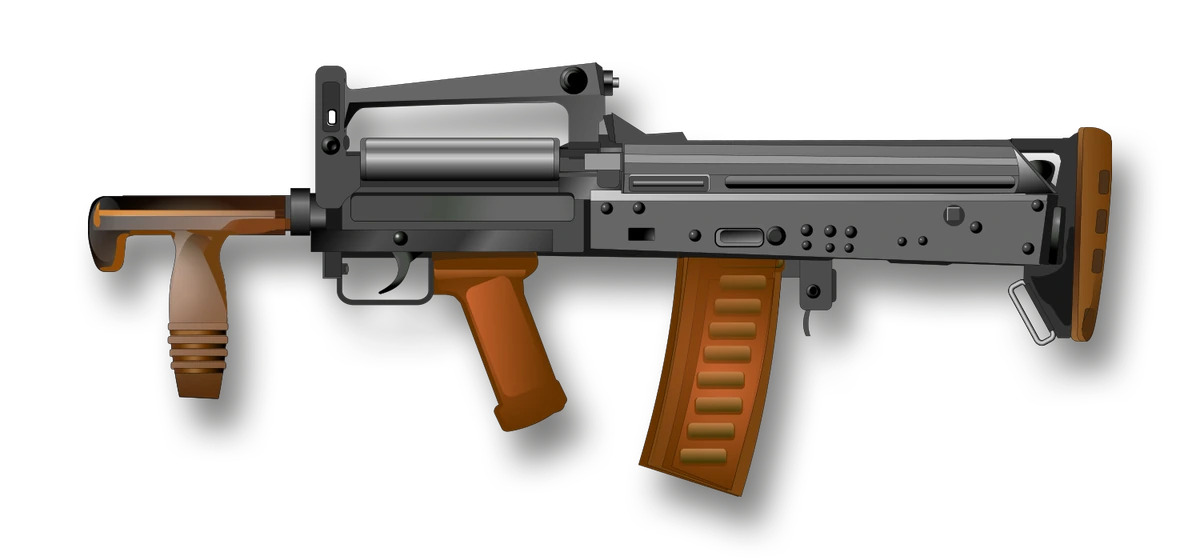
Image credit
- Title
- File:GrozaOC14 noBG.png
- Author
- Tomasz Steifer(attribution required)
- Licence
- CC BY-SA 4.0
- Source
- https://commons.wikimedia.org/wiki/File:GrozaOC14_noBG.png

How Muzzle energy is calculated
E = ½ · m · v²
Inputs
- m16.1 g248.5 grverifiedsource16.1 g as published in the article's ballistics table, which declares SI units.
- v290 m/s951.4 fpsverifiedMeasured with a 266.7 mm barrel, not this arm's 240 mm. Velocity outside the sourced range is not projected.
1 of 2 inputs link to their source.
How Muzzle velocity is calculated
nearest sourced barrel length, no extrapolation
Inputs
- v at 266.7 mm290 m/s951.4 fpsverifiedsource290 m/s as published, which is below the speed of sound at sea level by design.
Assumptions
- This figure belongs to a 266.7 mm barrel. It is shown because it is the closest measurement that exists, not because it applies here.
1 of 1 inputs link to their source.
How Loaded mass is calculated
m_loaded = m_empty + m_magazine + n · m_cartridge
Not calculated: m_magazine has no sourced figure yet. Nothing is substituted for a missing input.
Assumptions
- One magazine, filled to the stated capacity. Spare magazines, optics, slings and lights are the owner’s, not the arm’s.
2 of 4 inputs link to their source.
How Free recoil is calculated
E_recoil = ½ · m_firearm · v_recoil²
Inputs
- m_firearm2.93 kg6.460 lbverifiedsourceOTs-14-4A-01, the rifle configuration with the vertical foregrip fitted in place of the grenade launcher. With the launcher instead, the same source gives 3.97 kg.
- v_recoil1.594 m/s5.228 fpsestimated
Assumptions
- Propellant gas momentum is excluded: ARMAG does not record charge weights. This is therefore a lower bound on the real free recoil, consistent between entries but smaller than a figure that includes the gas term.
- Free recoil: the arm is unrestrained. Stock design, muzzle devices, stance and shooter mass are not modelled, because none of them is a property of the arm.
1 of 2 inputs link to their source.
How Capacity is calculated
as published for the primary chambering
Inputs
- capacity20verifiedsource20-round detachable box, shared with the OTs-12 rifle.
1 of 1 inputs link to their source.
Derived figures
Computed from the sourced values above. Open ƒ on any figure for the formula, its inputs, and the assumptions it makes.
How Momentum is calculated
p = m · v
Inputs
- m16.1 g248.5 grverifiedsource16.1 g as published in the article's ballistics table, which declares SI units.
- v290 m/s951.4 fpsverifiedMeasured with a 266.7 mm barrel, not this arm's 240 mm. Velocity outside the sourced range is not projected.
1 of 2 inputs link to their source.
How Sectional density is calculated
SD = mass(gr) / (7000 · diameter(in)²)
Inputs
- mass16.1 g248.5 grverifiedsource16.1 g as published in the article's ballistics table, which declares SI units.
- diameter9.27 mm0.3650 inverifiedsourceCartridge maximum, dimension G1.
Assumptions
- Reported in the conventional lb/in² so it is directly comparable with published figures.
2 of 2 inputs link to their source.
How Power factor is calculated
PF = mass(gr) · velocity(fps) / 1000
Inputs
- mass16.1 g248.5 grverifiedsource16.1 g as published in the article's ballistics table, which declares SI units.
- velocity290 m/s951.4 fpsverifiedMeasured with a 266.7 mm barrel, not this arm's 240 mm. Velocity outside the sourced range is not projected.
Assumptions
- A competition classification defined by the IPSC and USPSA rulebooks, stated in their units. It describes a scoring category, not an effect.
1 of 2 inputs link to their source.
How Magazine dump is calculated
t = (n − 1) / (rpm / 60)
Inputs
- n20verifiedsource20-round detachable box, shared with the OTs-12 rifle.
- rpm725 rpmestimatedsourceThe article gives a range of 700 to 750 rounds a minute; the midpoint is recorded here because a PropertyValue holds one number.
Assumptions
- Cyclic rate held for the whole magazine, no stoppages, trigger held down. A theoretical figure for comparing mechanisms, not a measured one.
2 of 2 inputs link to their source.
How Sight error at 1 mm is calculated
θ = atan(misalignment / sight radius)
Not calculated: sight radius has no sourced figure yet. Nothing is substituted for a missing input.
Assumptions
- Shows what a stated aiming error costs. The misalignment is the reader’s figure; the site does not claim how well anyone aims.
No input on this calculation carries a clickable source yet.
Specifications
Every row here is generated from the schema, so a figure recorded on this entry cannot be missing from the table, and the same rows, read the same way, are what the comparison shows.
Identity
- Type
- Rifle
- Action
- Self-loading
- Fire modes
- Semi-automatic
- Fully automatic
- Operating system
- Gas, long-stroke piston
- Designed in
- Russia
- Produced in
- Introduced
- 1994
- Production
- 1994–1999
Dimensions and mass
- Mass, empty
- 2.93 kg6.460 lbsource
OTs-14-4A-01, the rifle configuration with the vertical foregrip fitted in place of the grenade launcher. With the launcher instead, the same source gives 3.97 kg.
- Magazine, empty
- not recorded
- Length
- 565 mm22.24 insource
OTs-14-4A-01. The source gives 610 mm for the grenade-launcher configuration, 500 mm for the -02 carbine and 720 mm for the -03.
- Length, folded
- not recorded
- Width
- 60 mm2.362 insource
OTs-14-4A without a grenade launcher; 75 mm with one fitted.
- Height
- 294 mm11.57 insource
OTs-14-4A without a grenade launcher, as published.
- Barrel length
- 240 mm9.449 insource
Groza-4, the 9x39mm model. The 7.62x39mm Groza-1 has a 420 mm barrel.
Sights and rifling
- Sight radius
- not recorded
- Sight height over bore
- not recorded
- Rifling twist
- not recorded
- Twist direction
- not recorded
- Grooves
- not recorded
- Sight graduation
- 200 m218.7 ydsource
The rear aperture sight in the carrying handle is a tangent leaf graduated from 50 to 200 m.
Operation
- Cyclic rate
The article gives a range of 700 to 750 rounds a minute; the midpoint is recorded here because a PropertyValue holds one number.
- Trigger pull
- not recorded
- Effective range
- 200 m218.7 ydsource
Groza-4. The 7.62x39mm Groza-1 is given as 300 m.
- Units produced
- not recorded
- Launch price
- not recorded
Scale
A to-scale outline against family siblings. The dimensions are sourced; the shape is a representative outline for the type, and says so.
- OTs-14 Groza565 mm22.24 in
Representative outline: the dimensions are sourced, the shape is not. Overall length, and barrel length where recorded, are drawn from this entry's own figures; the profile is a generic one for the firearm type and says nothing about this arm's actual contours.
Gallery
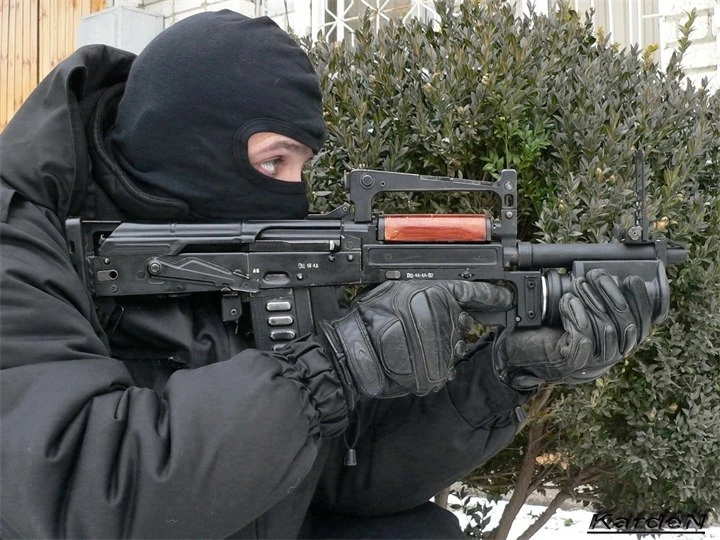
Image credit
- Title
- File:Стрельба из ОЦ-14.jpeg
- Author
- Chris-parker(attribution required)
- Licence
- CC BY-SA 4.0
- Source
- https://commons.wikimedia.org/wiki/File:%D0%A1%D1%82%D1%80%D0%B5%D0%BB%D1%8C%D0%B1%D0%B0_%D0%B8%D0%B7_%D0%9E%D0%A6-14.jpeg

Detail
The Groza is an AKS-74U turned back to front. Valery Telesh, who had designed the GP-25 under-barrel grenade launcher, and Yuri Lebedev began work at TsKIB SOO in Tula in December 1992 on a weapon that would combine a short assault rifle and a grenade launcher into one object rather than bolting the second onto the first. Prototypes were firing within a year and the rifle was in production by early 1994.
Three-quarters of its parts come straight from the AKS-74U: the gas piston, the rotating bolt, the hammer, the three-position selector on the right of the receiver. Moving the magazine behind the trigger is what the design buys with that inheritance: a 240 mm barrel inside a weapon 565 mm long, which is shorter than most submachine guns. What it costs is a Kalashnikov action working next to the firer’s cheek, and a weapon that critics found awkward to carry despite its length.
The modularity is the other half of the idea, and it is unusual. The trigger and pistol grip are a single removable unit, and the kit contains two of them: one plain, one carrying a 40 mm grenade launcher derived from the GP-25. With the launcher unit fitted, one trigger serves both barrels and a selector by the trigger guard decides which fires. Detach it and a vertical foregrip goes in its place, taking 1.23 kg off the weapon. A quick-change short barrel and a detachable suppressor are in the same aluminium case, so a single weapon can be assembled as a carbine, a foregripped assault rifle, a suppressed rifle or a rifle-and-launcher.
It was shown at MILIPOL Moscow in April 1994 and taken up by the Interior Ministry’s OMON, which wanted a 9x39mm subsonic weapon for close work in Chechnya; the Defence Ministry followed for Spetsnaz and some airborne and engineer units. A 7.62x39mm model, the Groza-1, has a 420 mm barrel and a 30-round magazine. Production stopped in 1999 and the type was phased out of military service, although Russian police units still carry it.
Gaps on this page: the figures recorded here are for the OTs-14-4A-01, the 9x39mm rifle with the vertical foregrip, because the four published configurations differ by up to 220 mm in length and 1 kg in weight and no one of them is “the” Groza; the alternatives are named in each field’s source note. No production total, sight radius, rifling twist or trigger pull is published in any free source, and the article’s own height figures (294 mm without the grenade launcher and 266 mm with it) are recorded as published without being reconciled. The illustration used as the lead image is a drawing rather than a photograph, because the only freely licensed photographs of this weapon are watermarked and low-resolution.
References
This entry's own bibliography. Every citation key on this page resolves into this list.
- OTs-14 Groza · Wikipedia · 1372065167 · read 2026-09-01 · CC BY-SA 4.0
Last verified 2026-09-01 · review status: agent-populated