
.22 Long Rifle
Introduced 1887J. Stevens Arms & Tool CompanyCIP standard
Also known as .22 LR, 22 lfB: the same cartridge under different names, all of which find this page.
Dimensions and pressure
Generated from the schema, like every specification table on this site, so a figure recorded on this entry cannot be missing from the table.
Identity
- Designed by
- J. Stevens Arms & Tool Company
- Introduced
- 1887
- Production
- not recorded
- Standards body
- C.I.P.
- Case type
- Rimmed
- Case shape
- Straight
Dimensions
- Bullet diameter
- 5.72 mm0.2252 insource
C.I.P. G1, maximum bullet diameter.
- Bore diameter
- not recorded
- Case length
- 15.57 mm0.6130 insource
C.I.P. L3, maximum case length.
- Overall length
- 25.4 mm1.000 insource
C.I.P. L6, maximum cartridge overall length.
- Rim diameter
- 7.06 mm0.2780 insource
C.I.P. R1.
- Neck diameter
- 5.72 mm0.2252 insource
C.I.P. H2.
- Base diameter
- 5.74 mm0.2260 insource
C.I.P. P1.
Pressure
- Maximum pressure
- 170 MPa24,656 psisource
C.I.P. Pmax 1700 bar; 1 bar = 0.1 MPa exactly.
- Pressure standard
- C.I.P.
SAAMI and C.I.P. measure pressure differently and their figures are not interchangeable, which is why the body is always named beside the figure.
Loads
No load data recorded yet. Without a sourced bullet mass and velocity there is nothing honest to compute, so the ballistic figures on pages that chamber this cartridge stay blank rather than being estimated into existence.
Chambered in
Computed from every entry that lists this cartridge. Nothing here is hand-maintained.
- ArmaLite AR-7
ArmaLite
- Ruger 10/22
Sturm, Ruger & Co.
- Trejo pistol
Industrias Trejo de Zacatlán
- Winchester Model 1873
Winchester Repeating Arms Company
Gallery
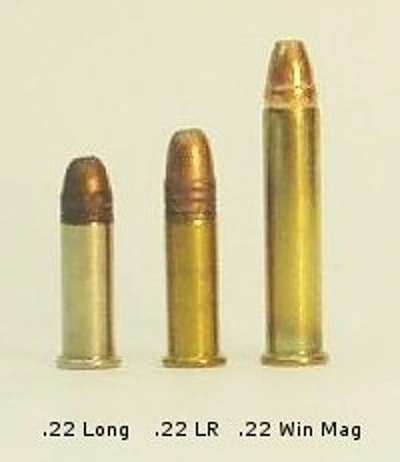
Image credit
- Title
- File:22 Long, 22 LR, 22 Winchester Magnum.JPG
- Author
- Ryan D. Larson
- Licence
- Public domain
- Source
- https://commons.wikimedia.org/wiki/File:22_Long,_22_LR,_22_Winchester_Magnum.JPG

Detail
Nothing else on this site is fired as often. The .22 Long Rifle was assembled in 1887 out of parts that already existed (the .22 Long case, the .22 Extra Long’s heavier bullet), and it has outlived every cartridge it was assembled from. Its rim is the priming: there is no primer pocket, the compound is spun into the rim during manufacture, and that is why the case cannot be reloaded and why the round costs a few cents.
The consequences run through every arm chambered for it. Rimfire priming caps chamber pressure low, so actions can be light and blowback simple. The rim itself forces a magazine to stack rounds slightly nose-down or accept a jam, which is the problem the Ruger 10/22’s rotary magazine was built to solve.
This entry carries no load rows. The article’s ballistics table gives velocities without bullet masses, and a velocity without the mass that produced it computes nothing, so the table is not transcribed.
References
- C.I.P. TDCC datasheet — 22 Long Rifle · 2024-05-14 · read 2026-08-31
- .22 Long Rifle · 1362240264 · read 2026-08-31
Last verified 2026-08-31 · review status: agent-populated