
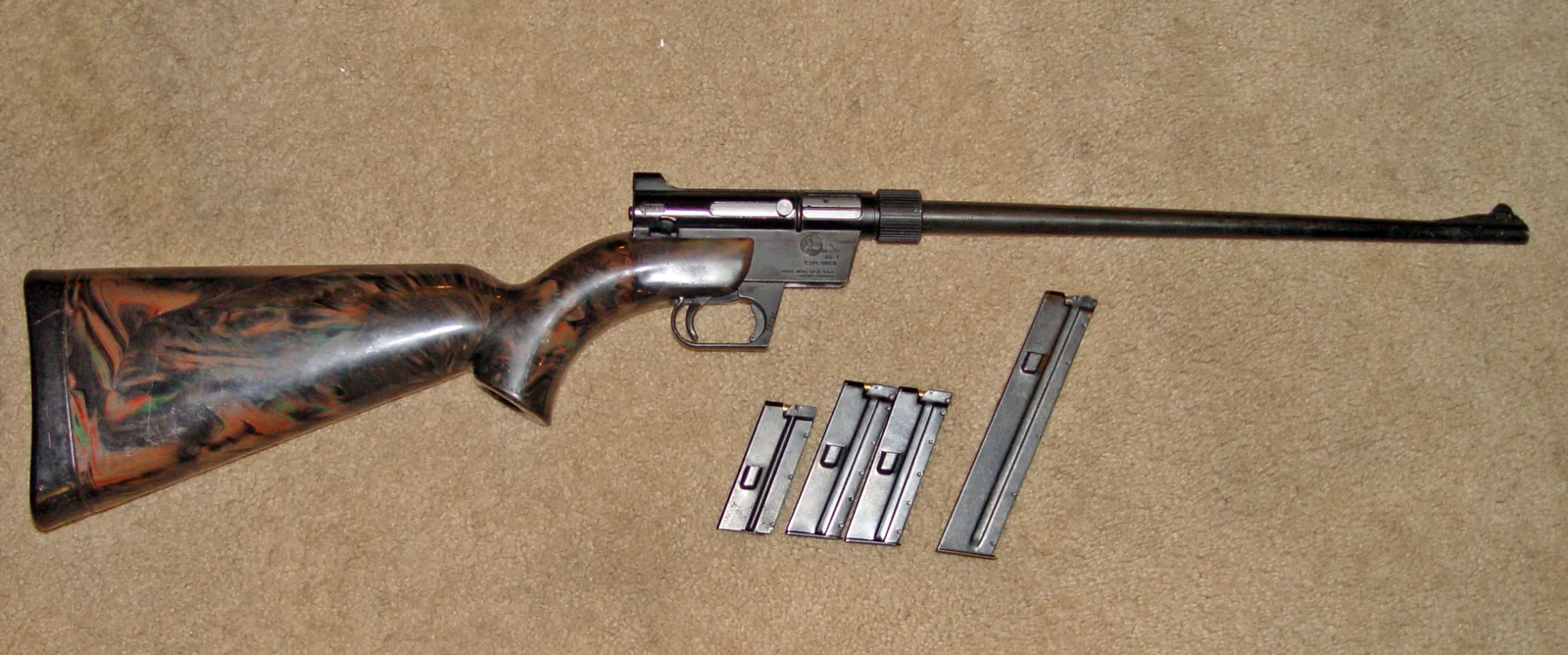
Image credit
- Title
- File:AR7rifle.jpg
- Author
- The original uploader was CynicalMe at English Wikipedia .(attribution required)
- Licence
- CC BY 2.5
- Source
- https://commons.wikimedia.org/wiki/File:AR7rifle.jpg

How Muzzle energy is calculated
E = ½ · m · v²
Not calculated: m has no sourced figure yet. Nothing is substituted for a missing input.
No input on this calculation carries a clickable source yet.
How Muzzle velocity is calculated
no sourced velocity for this pairing
Not calculated: muzzle velocity has no sourced figure yet. Nothing is substituted for a missing input.
No input on this calculation carries a clickable source yet.
How Loaded mass is calculated
m_loaded = m_empty + m_magazine + n · m_cartridge
Not calculated: m_magazine has no sourced figure yet. Nothing is substituted for a missing input.
Assumptions
- One magazine, filled to the stated capacity. Spare magazines, optics, slings and lights are the owner’s, not the arm’s.
No input on this calculation carries a clickable source yet.
How Free recoil is calculated
E_recoil = ½ · m_firearm · v_recoil²
Not calculated: v_recoil has no sourced figure yet. Nothing is substituted for a missing input.
Assumptions
- Propellant gas momentum is excluded: ARMAG does not record charge weights. This is therefore a lower bound on the real free recoil, consistent between entries but smaller than a figure that includes the gas term.
- Free recoil: the arm is unrestrained. Stock design, muzzle devices, stance and shooter mass are not modelled, because none of them is a property of the arm.
No input on this calculation carries a clickable source yet.
How Capacity is calculated
as published for the primary chambering
Inputs
- capacity8estimatedFrom the Wikipedia infobox, uncited there: the standard magazine; 5-, 10-, 15- and 25-round magazines have also been offered.
No input on this calculation carries a clickable source yet.
Derived figures
Computed from the sourced values above. Open ƒ on any figure for the formula, its inputs, and the assumptions it makes.
How Momentum is calculated
p = m · v
Not calculated: m has no sourced figure yet. Nothing is substituted for a missing input.
No input on this calculation carries a clickable source yet.
How Sectional density is calculated
SD = mass(gr) / (7000 · diameter(in)²)
Not calculated: mass has no sourced figure yet. Nothing is substituted for a missing input.
Assumptions
- Reported in the conventional lb/in² so it is directly comparable with published figures.
1 of 2 inputs link to their source.
How Power factor is calculated
PF = mass(gr) · velocity(fps) / 1000
Not calculated: mass has no sourced figure yet. Nothing is substituted for a missing input.
Assumptions
- A competition classification defined by the IPSC and USPSA rulebooks, stated in their units. It describes a scoring category, not an effect.
No input on this calculation carries a clickable source yet.
How Magazine dump is calculated
t = (n − 1) / (rpm / 60)
Not calculated: rpm has no sourced figure yet. Nothing is substituted for a missing input.
Assumptions
- Cyclic rate held for the whole magazine, no stoppages, trigger held down. A theoretical figure for comparing mechanisms, not a measured one.
No input on this calculation carries a clickable source yet.
How Sight error at 1 mm is calculated
θ = atan(misalignment / sight radius)
Not calculated: sight radius has no sourced figure yet. Nothing is substituted for a missing input.
Assumptions
- Shows what a stated aiming error costs. The misalignment is the reader’s figure; the site does not claim how well anyone aims.
No input on this calculation carries a clickable source yet.
Specifications
Every row here is generated from the schema, so a figure recorded on this entry cannot be missing from the table, and the same rows, read the same way, are what the comparison shows.
Identity
- Type
- Rifle
- Action
- Self-loading
- Fire modes
- Semi-automatic
- Operating system
- Blowback, simple
- Designed in
- United States
- Produced in
- Introduced
- 1959
- Production
- 1959–present
Dimensions and mass
- Mass, empty
- 1.134 kg2.500 lbestimated
From the Wikipedia infobox, uncited there (2.5 lb).
- Magazine, empty
- not recorded
- Length
- 889 mm35.00 inestimated
From the Wikipedia infobox, uncited there (35 in), assembled.
- Length, folded
- not recorded
- Width
- not recorded
- Height
- not recorded
- Barrel length
- 406 mm15.98 inestimated
From the Wikipedia infobox, uncited there (16 in).
Sights and rifling
- Sight radius
- not recorded
- Sight height over bore
- not recorded
- Rifling twist
- not recorded
- Twist direction
- not recorded
- Grooves
- not recorded
- Sight graduation
- not recorded
Operation
- Cyclic rate
- not recorded
- Trigger pull
- not recorded
- Effective range
- 100 m109.4 ydestimated
From the Wikipedia infobox, uncited there (109 yd).
- Units produced
- not recorded
- Launch price
- not recorded
Chamberings
- .22 Long Rifleprimary8 rounds
Scale
A to-scale outline against family siblings. The dimensions are sourced; the shape is a representative outline for the type, and says so.
- ArmaLite AR-7889 mm35.00 inheight not recorded
Representative outline: the dimensions are sourced, the shape is not. Overall length, and barrel length where recorded, are drawn from this entry's own figures; the profile is a generic one for the firearm type and says nothing about this arm's actual contours. ArmaLite AR-7 records no height, so its outline is drawn at the type's proportion. That height is part of the shape, not a measurement.
Gallery
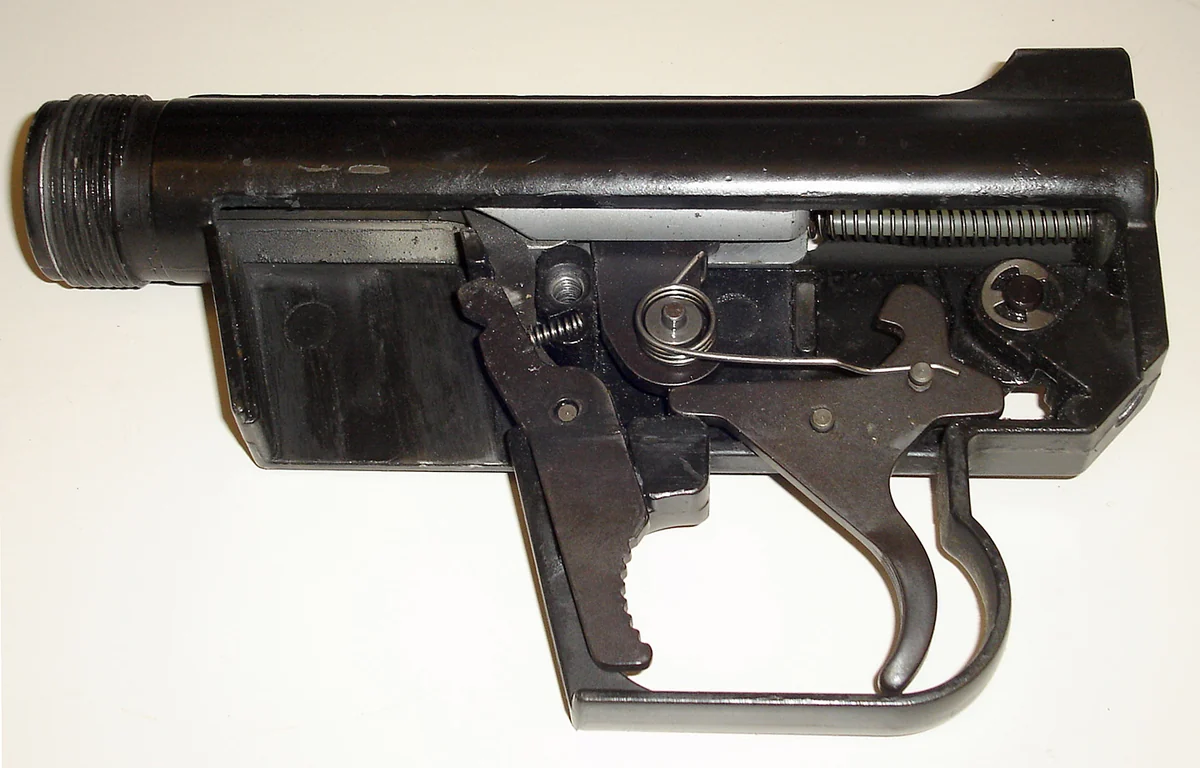
Image credit
- Title
- File:AR7 Internal Parts.jpg
- Author
- Curiosandrelics(attribution required)
- Licence
- CC BY-SA 3.0
- Source
- https://commons.wikimedia.org/wiki/File:AR7_Internal_Parts.jpg

Detail
The AR-7 is a takedown .22 Long Rifle rifle Eugene Stoner designed at ArmaLite in 1959, built from the research and tooling behind his earlier AR-5. The AR-5 was a bolt-action survival rifle in .22 Hornet that the U.S. Air Force adopted in 1956 as the MA-1, meant to replace the older M4 and M6 aircrew survival weapons; the Air Force never actually issued the MA-1, because enough M4s and M6s remained in inventory, so ArmaLite repurposed the design for the civilian market as a semi-automatic rimfire rather than a bolt-action centrefire.
It replaces the AR-5’s bolt action with a straight blowback semi-automatic mechanism, but its most distinctive feature carries over unchanged: the rifle strips into barrel, receiver and magazine, all three of which stow inside a hollow buttstock filled with plastic foam, buoyant enough to float. The receiver is aluminium, the bolt steel, and the original ArmaLite barrel used a rifled steel liner inside an aluminium shell; later production by other makers has used all-steel and composite barrels instead. ArmaLite built the rifle from 1959 until selling the design to Charter Arms in 1973, after which it passed through several further owners (Survival Arms, AR-7 Industries, and Henry Repeating Arms, which still sells a version today) and was also produced abroad, including under licence in Argentina and as an adapted pilot’s survival rifle for the Israeli Air Force. This entry covers the rifle as ArmaLite itself originally built it.
The AR-7 feeds from a detachable box magazine, standard at eight rounds with larger aftermarket magazines available, and its reliability depends more than most semi-automatic .22s on magazine condition and ammunition choice: makers have recommended round-nose, high-velocity loadings because flat-nosed bullets and low-velocity ammunition are prone to jamming on the feed ramp. It remains marketed today as a take-along utility rifle for backpackers, boaters and pilots rather than for military issue, the market its original Air Force programme never quite created.
No maker figure for the ArmaLite-production AR-7 is available independent of Wikipedia’s uncited infobox, so the mass, length, barrel length and effective range recorded here are estimated rather than verified. No source pairs a muzzle velocity with a barrel length for this rifle, so none is recorded, and no rifling twist rate is published.
References
This entry's own bibliography. Every citation key on this page resolves into this list.
- ArmaLite AR-7 · Wikipedia · 1357130734 · read 2026-09-24 · CC BY-SA 4.0
Last verified 2026-09-24 · review status: agent-populated