Levantine · Salad · Starter · Side
Tabbouleh
A parsley salad with a little bulgur in it, soaked in the juice of the tomatoes rather than in water.
Not the same asKısır (The Turkish relative, in which the proportions are reversed: a bulgur salad with herbs in it rather than a herb salad with bulgur.)Fattoush (The other Levantine chopped salad, built on fried or toasted flatbread and sumac, with no grain in it at all.)
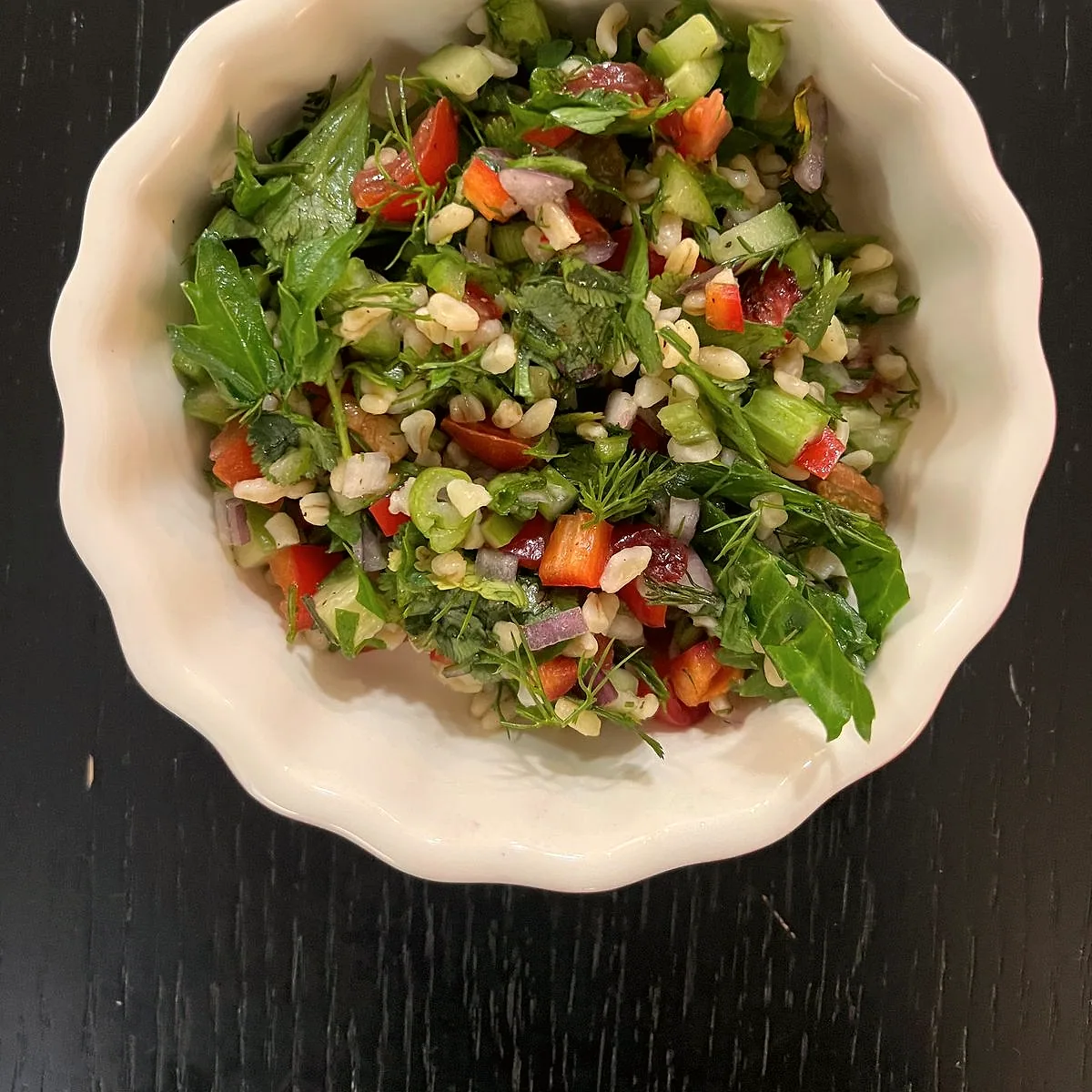

CC BY-SA 4.0. Cropped and colour-adjusted for this site.
Method
Cut the 250 g ripe tomatoes into small, even dice, working over a bowl so that none of the juice is lost. Take 8m and keep the pieces small; they should be a texture in the salad rather than an obstacle. Turn the 6 g fine sea salt through them.
Stir the 40 g fine bulgur and the 30 ml freshly squeezed lemon juice into the tomatoes and leave them for 25m. The grain swells on the juice alone and should finish tender with a distinct bite; if it is still hard, give it longer rather than adding water.
The bulgur is soaked in the tomatoes and lemon rather than in water. Fine bulgur has already been parboiled, so it needs moisture rather than cooking, and whatever it takes up is what it will taste of, which is an argument against giving it water.
Meanwhile, gather the 200 g flat-leaf parsley, dried thoroughly, into a tight bundle and cut across it with the sharpest knife in the house, then turn the pile and cut again, working for 18m until it is fine but not minced. Do the same with the 30 g fresh mint, which bruises faster and goes in last. Slice the 4 spring onions (60 g) thinly, greens and all.
The parsley has to be bone dry and the knife has to be sharp. A blunt blade bruises the leaf rather than cutting it, which turns the salad dark and gives it a flat, grassy taste no amount of lemon will lift.
Combine the herbs and spring onions with the soaked bulgur and tomatoes, pour over the 60 ml extra-virgin olive oil and the 30 ml freshly squeezed lemon juice, add the 1 g ground black pepper and turn it all over with your hands for 4m, lifting rather than stirring, so the leaves stay separate. Serve immediately.
Common pitfallDressing it in advance is the way this salad is usually ruined. Within an hour the salt has drawn the water out of the parsley and the bowl is sitting in a pool of pink liquid.
The name comes from the Arabic tābil, seasoning, and behind it an Aramaic root t-b-l; in Lebanon the connection is made directly to tatbil, to season [1][2]. The dish belongs to the mountains of what are now Lebanon and Syria, where edible wild and cultivated herbs were a substantial part of the rural diet long before this particular combination of them existed [1]. The Beqaa Valley grew a wheat variety, salamouni, reckoned in the mid-nineteenth century to make the best bulgur [1].
The one thing worth being firm about is the proportion. Tabbouleh is a herb salad, and parsley is its main ingredient rather than its garnish [2]; the grain is a minor component that gives it body. Versions made outside the region routinely invert this into a bulgur salad with herbs stirred through, which is a different dish and has its own names elsewhere: the Turkish kısır and the Armenian eetch are both properly grain-led [1].
It is not a single fixed recipe even at home. Lebanese regional versions substitute green fava beans, split lentils or eryngo for parts of the usual mixture, and some are sharpened with pomegranate or verjuice rather than lemon [2]. What travels is the idea: herbs cut fine, something sour, good oil, and just enough cracked wheat to give the fork something to hold.
Its standing in Lebanon is formal enough to have a date attached. Lebanese National Tabbouleh Day has been marked on the first Saturday of July since 2001 [1]. The dish reached wider Western notice only in the second half of the twentieth century: the word entered English in the 1950s, and Syrian Jewish versions arrived in Israel and the United States in the 1970s [1].
Sources
- Tabbouleh, WikipediaOn the Aramaic root of the name, the origin in the Lebanese and Syrian mountains, the salamouni wheat of the Beqaa, National Tabbouleh Day, and the bulgur-heavy regional relatives.
- A Tale of Tabbouleh, Lebanon TravelerOn the etymology from tatbil, on parsley as the defining ingredient, and on the regional Lebanese variants that use fava beans, lentils or eryngo in place of the usual mixture.