American · Main Course
Red Beans and Rice
Dried kidney beans simmered for hours with a smoked ham hock and andouille sausage until creamy, spooned over steamed rice.
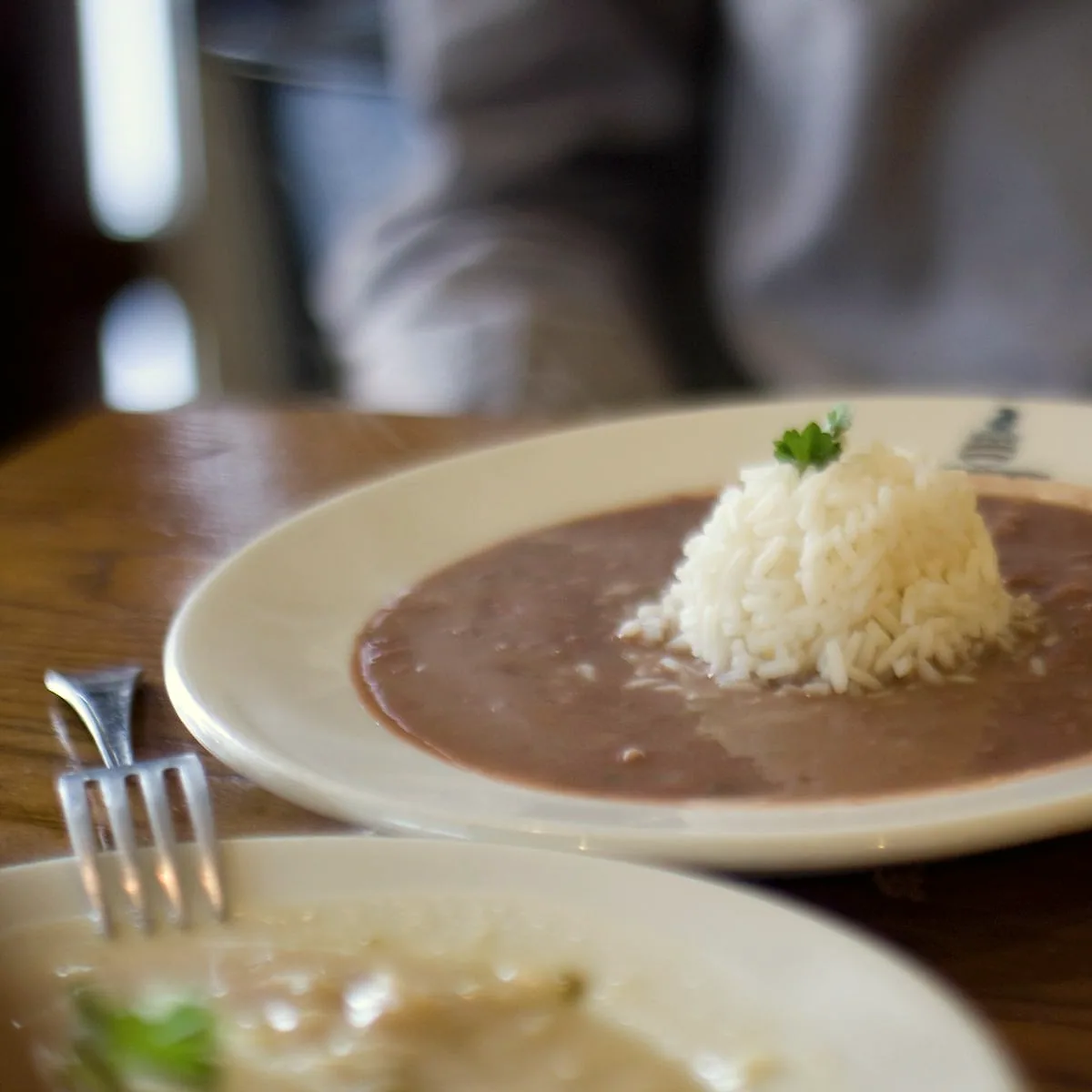

CC BY-SA 2.0. Cropped and colour-adjusted for this site.
Method
Dice the 150 g white onion, 100 g celery and 100 g green pepper, and mince the 3 garlic cloves (15 g).
Heat the 15 ml peanut oil in a large, heavy pot over a medium-high heat and brown the 300 g andouille for 8m. Lift it out and set aside.
Add the onion, celery and green pepper to the fat left in the pot and cook for 8m, stirring often, until softened. Add the garlic in the last minute.
Return the sausage to the pot along with the 450 g dried kidney beans, 300 g ham hock, 2 bay leaves (0.4 g) and 1.8 L water. Bring to the boil, then reduce to a simmer and cook, partially covered, for 2h 30m, until the beans are tender and the hock meat is falling from the bone.
Common pitfallSalting the pot too early toughens the bean skins before they have softened; the deliberate seasoning is held back until the beans are already tender in the finishing step.
While the beans simmer, combine the 300 g rice and 550 ml water in a covered saucepan, bring to the boil, then reduce to the lowest heat and cook for 20m, until the water is absorbed. Leave covered off the heat until serving.
Lift out the hock, discard the bay leaf, and pick the meat from the bone, discarding the skin and excess fat; return the meat to the pot. Mash a few spoonfuls of beans against the side of the pot to thicken the liquid, then stir in the 2 g ground cayenne pepper, 2 g ground black pepper and 5 g fine sea salt. Serve ladled over the rice.
Mashing a portion of the beans against the side of the pot releases their starch and is what turns the cooking liquid into a thick, creamy gravy rather than a thin broth.
The red kidney bean itself is not native to Louisiana. It is a variety of the common bean domesticated in Central America, and the version New Orleans cooks came to rely on most likely arrived with refugees of the Haitian Revolution, who settled the city in large numbers between 1791 and 1810 and brought with them a rice-and-bean dish of their own, diri kolé ak pwa [1].
What New Orleans did with the bean was tie it to the calendar. Monday was washday, an all-day task of scrubbing linen by hand, and it left no one free to stand over a stove. A pot of dried beans, needing only an occasional stir, could simmer for hours on its own while the household did its laundry, and it was seasoned not with a fresh cut of meat but with whatever ham bone was left from Sunday's dinner, making the dish as much a use for leftovers as a meal in its own right [1]. The trinity of onion, green pepper and celery, and the long, low simmer that turns the beans creamy, both follow from that same logic of a pot left to itself.
The Monday habit outlasted the washday it was built around, and became a citywide institution: restaurants keep it on the menu specifically for Mondays, and households that have not owned a washboard in generations still treat the day as red beans day [2]. Louis Armstrong, a New Orleans native, took the dish as a personal emblem of home and is remembered for signing letters "Red beans and ricely yours" [1].
Sources
- Red Beans and Rice, 64 ParishesLouisiana Endowment for the Humanities reference entry on the bean's Haitian arrival and the Monday tradition.
- The Red Beans and Rice Ritual, Renaissance Publishing (myneworleans.com)Describes the mechanics and social life of the Monday tradition.