American · Main Course
Philly Cheesesteak
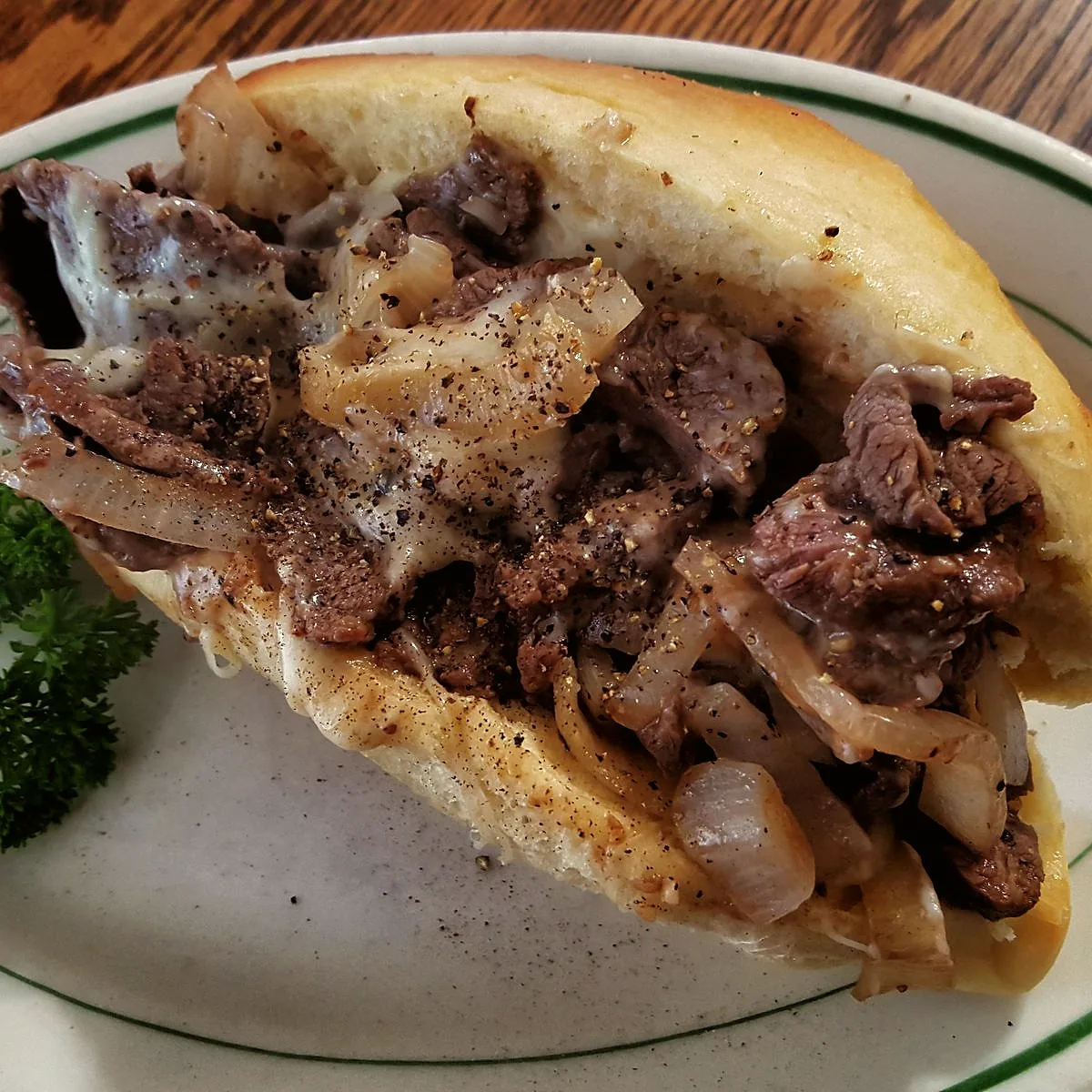
Thin-sliced ribeye chopped fine on a griddle with onion, melted under provolone in a split hoagie roll.
Not the same asItalian beef (Chicago's own thin-sliced beef sandwich, simmered in jus rather than griddled, and served without cheese as standard.)
.jpg)
CC BY 2.0. Cropped and colour-adjusted for this site.
Method
Heat half the 10 ml vegetable oil in a flat pan or griddle over a medium heat and cook the 50 g white onion for 10m, stirring occasionally, until soft and lightly browned. Push it to one side of the griddle.
Add the remaining 10 ml vegetable oil and lay the 130 g ribeye across the hot surface. Season with the 2 g fine sea salt and 1 g ground black pepper and cook for 4m, chopping and turning it with two spatulas as it browns until it is in loose, shredded pieces mixed through the onion.
Chopping the meat into the griddle as it cooks, rather than lifting whole slices, is what gives a cheesesteak its characteristic loose, shredded texture rather than the intact strips of a steak sandwich.
Common pitfallSlicing the ribeye at room temperature makes paper-thin cuts nearly impossible. Partially freezing it first firms the meat enough to slice thin and even.
Gather the meat and onion into a mound and lay the 30 g provolone over the top. Let it stand for 2m until fully melted, then fold it through.
Meanwhile split the 80 g hoagie roll and toast the cut faces on the griddle for 2m, until golden.
Pile the meat, onion and cheese into the toasted roll.
The sandwich began as a change of lunch rather than a plan. In 1930, Pat Olivieri, who ran a hot dog cart in South Philadelphia, grilled chopped beef and onion instead and put it in a roll, with no cheese at all [1]. Cheese, usually credited to provolone added at one of Olivieri's own locations around a decade later, came after the sandwich had already found its audience, which makes "cheesesteak" a somewhat late name for the dish it now describes.
Ownership of the invention itself is not settled. Olivieri's business, later known as Pat's King of Steaks, is the account most often repeated, but his own family spent decades in dispute over credit, and a rival stand, Geno's Steaks, opened directly across the intersection from Pat's in 1966 and has maintained its own competing claim to the sandwich ever since [2]. The two stands still face each other on the same corner, each selling its own version as the original.
What is not in dispute is the technique that defines it: the meat is sliced thin enough to chop and shred on the griddle as it cooks, rather than seared whole and left in strips, which is what separates a cheesesteak from the many other thin-sliced beef sandwiches served elsewhere in the country.
Sources
- The story behind the Philly cheesesteak, National GeographicOn Pat Olivieri's 1930 hot dog cart and the sandwich's beginnings without cheese.
- The Oral History of the Cheesesteak, Philadelphia MagazineOn the sandwich's spread through South Philadelphia and the rivalries that followed.