Indian · Snack
Onion Bhaji
Thinly sliced onion bound in a spiced gram-flour batter and deep-fried into a craggy, dark-golden fritter.
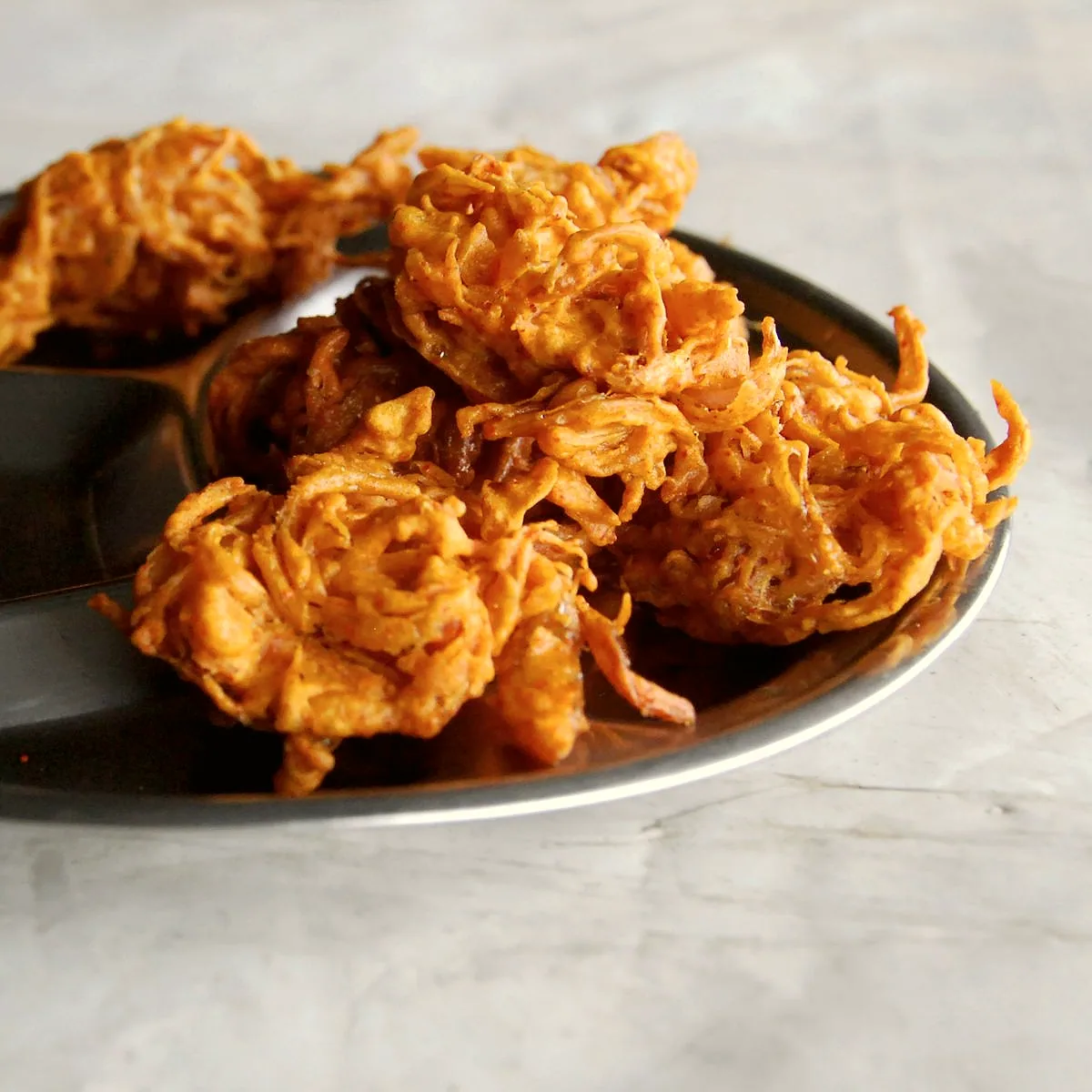

CC BY-SA 4.0. Cropped and colour-adjusted for this site.
Method
Thinly slice the 300 g yellow onion and set aside for 10m to let it release a little of its own moisture.
Whisk the 150 g gram flour, 2 g ground turmeric, 3 g ground cumin, 3 g chilli flakes and 6 g fine sea salt together, then work in the 80 ml water to a thick, barely pourable batter. Fold in the sliced onion and the 10 g fresh coriander for 8m, coating the onion in as little batter as will hold it together.
Common pitfallToo much water makes a smooth, clinging batter that fries into a heavy, greasy shell. The onion's own moisture should do most of the work; the batter should look barely enough, thick and just short of dry.
Heat the 1 L peanut oil in a deep pan to a steady, gentle bubble. Drop in loose, craggy spoonfuls of the onion mixture without crowding the pan and fry for 20m, turning occasionally, until deep golden-brown and crisp throughout. Lift out and drain.
Both names are old and both describe the technique rather than any one ingredient. Pakora comes from the Sanskrit pakvavaṭa, combining pakva, cooked, with vaṭa, a small lump: literally a cooked lump, fried in oil. Bhaji comes from a different Sanskrit word, bharjita, meaning simply fried [1]. Neither word was ever specific to onion, or to gram flour, or to any single vegetable; they named a method that could be applied to more or less anything.
Something recognisable under this method turns up early. Sanskrit and Tamil Sangam-era literature both mention fried lentil or vegetable cakes in verses over a thousand years old, though without recipes precise enough to say exactly what they tasted like [2]. Actual written recipes appear later and are considerably more specific: the Lokopakara, an eleventh-century Kannada text, describes gram flour pressed into fish-shaped moulds and fried in mustard oil, and the twelfth-century Manasollasa describes a preparation called parika, made with vegetables and gram flour, close enough to a modern pakora that the line of descent is not really in doubt [1].
What has never settled into one fixed form is the filling. Regional versions differ by what is locally abundant and by household habit rather than by any canonical recipe: besan-battered onion in Punjab, potato in Gujarat, spinach and other greens elsewhere, aubergine in Bengal under its own name, beguni [2]. The onion version this page describes, sold in Britain and much of the wider world as onion bhaji, is one branch of that same very old and very unfixed family rather than the original form of it.
Sources
- Pakora, WikipediaOn the Sanskrit etymology of both "pakora" and "bhaji", and the early recipes in the eleventh-century Lokopakara and twelfth-century Manasollasa.
- Pakoras — The Fritter That Became a Feeling, South Asia Travel JournalOn the wide regional variation in pakora across South Asia, including Punjab's onion version and other regional forms.