Caribbean · Side
Mofongo
Green plantains fried until tender then pounded in a wooden mortar with garlic, olive oil and crisp pork chicharrón, mounded and served with broth.
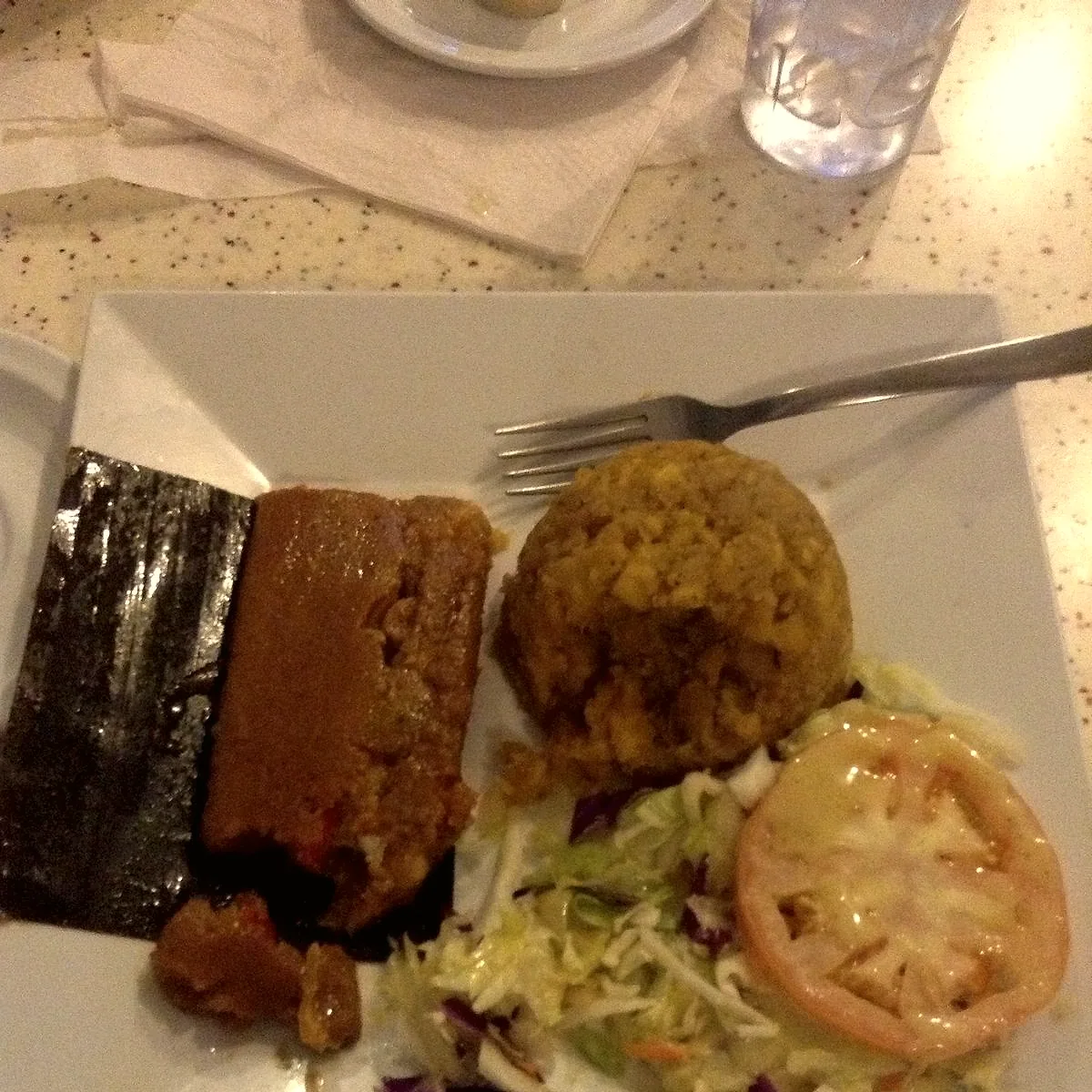

CC BY-SA 4.0. Cropped and colour-adjusted for this site.
Method
Heat the 600 ml vegetable oil in a deep, heavy pot and fry the 150 g pork belly for 20m, until deeply browned and crisp all over. Lift out with a slotted spoon and drain, leaving the oil in the pot.
Fry the 600 g green plantain in the same oil for 15m, turning occasionally, until golden outside and completely tender when pierced. Lift out and drain.
Common pitfallPlantain fried at too high a heat browns on the outside before the inside softens, which mashes into a mound with hard, undercooked lumps running through it.
While still hot, pound the fried plantain in a mortar with the 3 garlic cloves (15 g), 20 ml extra-virgin olive oil and 5 g fine sea salt, working in the crisp pork toward the end so it stays in coarse pieces rather than breaking down completely. Moisten with a little of the warm 150 ml chicken stock as needed to bring it together. This takes about 10m.
Pounding the fried plantain with the garlic and chicharrón while everything is still hot, rather than blending it smooth, is what keeps mofongo's texture coarse and studded with crisp pork rather than a uniform paste.
Press the mash into mounds, hollowing the centre of each slightly, and serve at once with the remaining stock poured around or alongside. This takes about 5m.
Mofongo is built from three histories pressed into one mortar. The pounding itself is a West African technique, brought to Puerto Rico by enslaved Africans who already made fufu (starchy vegetables boiled and pounded to a dense mass) from cassava, plantain or yam [1] [2]. The wooden mortar it is pounded in, the pilón, is Taíno rather than African, continuing a tool indigenous islanders used long before either plantains or enslaved cooks arrived. And the seasoning that finishes it (garlic and, later, sofrito) is the Spanish contribution layered on top.
Even the dish's name carries this layering in miniature. "Mofongo" is traced to the Kikongo phrase mfwenge-mfwenge, meaning roughly "a great amount of anything at all," a term that food historians have followed back to Central Africa with unusual confidence for a Caribbean dish name [1] [2].
Mofongo is also one of the few Puerto Rican dishes with an early paper trail. It appears under the name "mofongo criollo" in El Cocinero Puerto-Riqueño o Formulario, Puerto Rico's first cookbook, published in 1859 and running to some 850 recipes drawn from around the world and adapted to Puerto Rican custom [1] [3]. The dish eaten today, pounded from fried rather than boiled plantain and studded with crisp pork chicharrón, has moved some distance from that early recipe, but the core act (starch pounded soft with pork fat and garlic) has stayed constant across more than a century and a half.
Sources
- Mofongo, WikipediaStates that the earliest documented mofongo recipe appears in Puerto Rico's first cookbook, "El Cocinero Puerto-Riqueño" (1859), under the name "mofongo criollo," traces the word to the Kikongo term mfwenge-mfwenge, and describes the pilón mortar and Spanish-introduced sofrito.
- African Roots in Latin American and Caribbean Food, in 11 Dishes, Latin American Women's Aid (LAWA)Independently states that mofongo derives from the Angolan Kikongo term "mfwenge-mfwenge," meaning a large amount of anything, and traces the technique to West African fufu, brought by enslaved Africans.
- Promocionan primer libro gastronómico de Puerto Rico, El Universal (Mexico)Confirms "El Cocinero Puerto-Riqueño," published in 1859, as Puerto Rico's first cookbook, running to roughly 850 recipes across twenty-five chapters adapted to Puerto Rican custom and climate.